

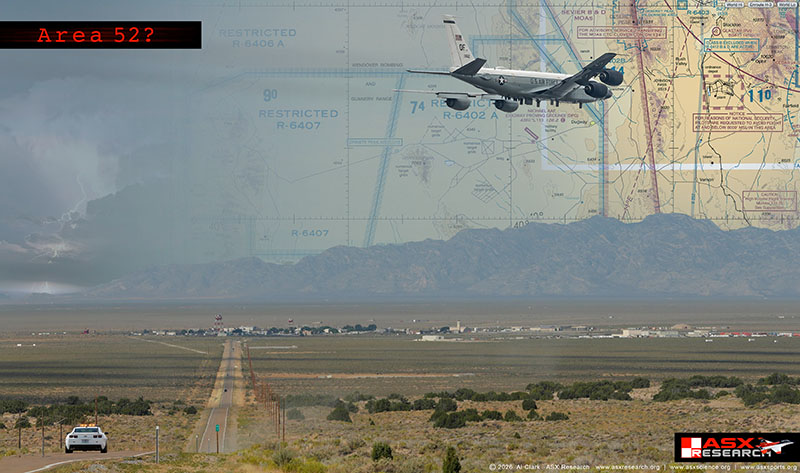
Deep in Utah’s western desert, an enormous U.S. Army installation has acquired a nickname that sounds like something from a classified aviation thriller: Area 52. For decades, rumors have suggested that Dugway Proving Ground replaced Nevada’s legendary Area 51 as a center for America’s most secret aerospace projects.
But a 58-page investigation published by ASX Research reaches a more interesting conclusion. There is no documented evidence that Dugway replaced Area 51. What exists instead is an extraordinary military and scientific complex whose actual history encompasses chemical and biological warfare, experimental aircraft, autonomous aviation, atmospheric science, and advanced defense testing.
Born in the Utah Desert
Dugway Proving Ground was established in 1942, when the United States needed an isolated location to test chemical weapons, incendiaries, protective equipment, and other wartime technologies. Western Utah offered vast distances, sparse population, dry terrain, and atmospheric conditions suitable for experiments too hazardous or extensive for conventional laboratories.
Over eight decades, the installation expanded to nearly 800,000 acres, approximately 1,300 square miles. Its landscape became part of the experimental equipment itself, allowing researchers to observe how weapons, hazardous substances, vehicles, sensors, and aircraft performed under realistic conditions.
During World War II, engineers even constructed representative German and Japanese residential buildings to study incendiary weapon effects. The purpose was not theatrical realism but measurable experimental accuracy.
The Dark History Behind the Fence
Dugway’s history includes extensive Cold War chemical and biological warfare testing. Research involved nerve agents, blister agents, biological organisms, aerosol dispersion, protective systems, and the behavior of hazardous materials in the atmosphere.
One of its most notorious episodes occurred in March 1968, when thousands of sheep in Utah’s Skull Valley became sick or died following nerve-agent testing at Dugway. The incident demonstrated that military boundaries could restrict access to land but could not guarantee containment of airborne hazards.
Following changes in American chemical and biological warfare policy, Dugway increasingly emphasized defensive research: detecting hazardous agents, evaluating protective equipment, improving decontamination, and understanding how dangerous substances disperse through real environments.
Its modern experiments have included large-scale controlled chlorine releases used to improve atmospheric-dispersion models and emergency-response planning. The scientific findings have applications extending beyond the military, including industrial accidents and toxic-material transportation emergencies.
Michael Army Airfield: The Aviation Connection
Aviation has been part of Dugway since 1942. Today, Michael Army Airfield provides an approximately 11,000-foot primary runway within an unusually extensive military test environment.
Combined with the neighboring Utah Test and Training Range, Dugway offers access to vast areas of controlled airspace. That combination makes it valuable for aircraft testing, unmanned systems, sensor integration, communications experiments, and operations that would be difficult to conduct near civilian airports.
The installation has supported unmanned aircraft including the RQ-7 Shadow and MQ-1C Gray Eagle. Its testing activities have also included ground-based sense-and-avoid technology, experimental aerial targets, cooperative operations involving manned and unmanned aircraft, and launched-effects systems.
In some programs, the aircraft themselves are only part of the experiment. Engineers are testing the relationships among aircraft, operators, sensors, data links, navigation systems, and weapons. Dugway provides the physical and electronic environment needed to evaluate those interactions under controlled conditions.
Where the Area 52 Legend Began
The claim that Dugway became an Area 51 replacement gained particular attention in 1997, when a Popular Mechanics article suggested that secret aviation activity associated with Groom Lake was moving to Utah.
The speculation involved both Michael Army Airfield and the former Green River missile complex. As Area 51 became internationally famous, the theory that the government might relocate its most sensitive testing to less conspicuous facilities appeared plausible to some observers.
But plausibility is not proof.
The ASX Research investigation distinguishes between documented military capabilities and unsupported claims of institutional replacement. Dugway’s restricted airspace, experimental aircraft, classified activities, and geographic isolation help explain the nickname. They do not establish that Groom Lake’s classified programs were transferred there.
More Than a Secret Air Base
One of Dugway’s most significant scientific contributions involves atmospheric research. Its mountains, desert basins, temperature variations, and controlled airspace have supported sophisticated investigations of turbulence, wind, atmospheric layering, and pollutant dispersion.
Researchers have used instrumented unmanned aircraft to measure atmospheric conditions at resolutions difficult to achieve with conventional weather observations. These experiments connect military flight testing with fundamental questions about aviation safety, weather prediction, and environmental science.
The installation also remains important for evaluating chemical and biological detection systems, protective clothing, filtration, and emergency-response technologies under realistic conditions.
The Reality Is More Interesting Than the Rumor
The research does not dismiss the existence of classified work at American military installations. Nor does it suggest that every activity conducted at Dugway is publicly known.
It draws a narrower, evidence-based conclusion: the documented record does not establish Dugway as the replacement for Area 51, and the unofficial designation Area 52 should not be mistaken for proof of such a transfer.
Dugway’s actual importance requires no invented identity. It is a military aviation laboratory, chemical and biological defense center, atmospheric research environment, and large-scale experimental range whose capabilities have evolved continuously since World War II.
The most compelling story behind its fences is not that Dugway became another Area 51. It is that Dugway became something substantial in its own right.
Read the complete 58-page ASX Research paper: Area 51 Replaced? Dugway Proving Ground Is Not Area 52. It’s More. — ASX Research Journal and Database, October 3, 2026.