


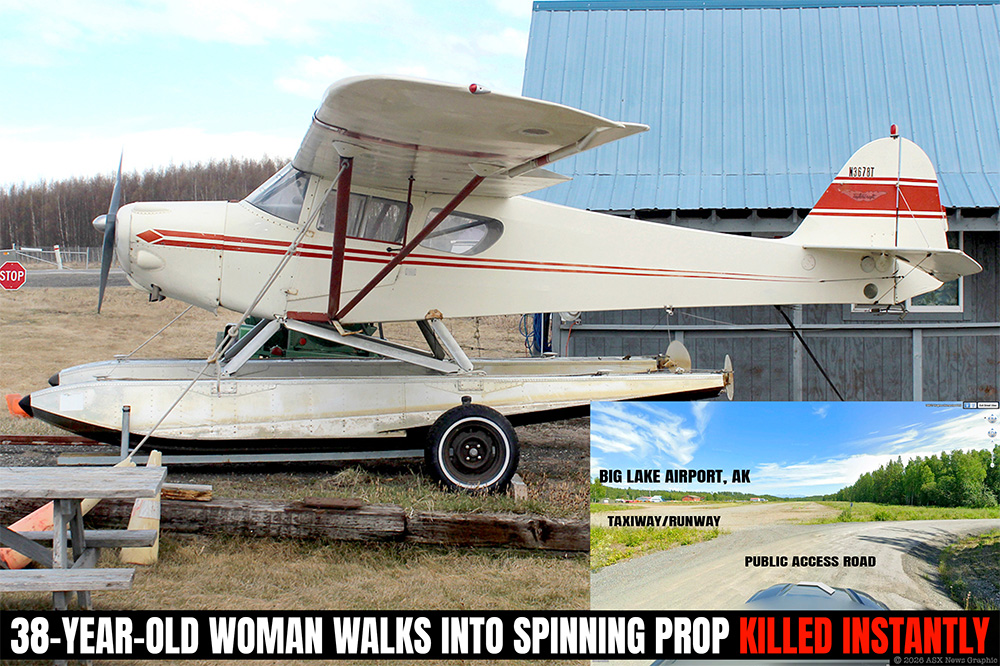
A 38-year-old Wasilla, Alaska, woman was killed on Tuesday, November 24, 2026, after walking into the rotating propeller of a privately operated Taylorcraft F-19 Sportsman at Big Lake Airport, approximately 25 miles northwest of Anchorage. The aircraft, registered N3678T, had completed its landing and was transitioning from the runway to the taxiway when its pilot encountered a motor vehicle obstructing the aircraft’s intended path. The pilot was physically uninjured, and no passengers were aboard.
The deceased was identified by Alaska State Troopers as Christina Blake, 38, of Wasilla. Preliminary information published by the Aviation Safety Network places the occurrence at approximately 16:30 Alaska Standard Time (AKST), while Alaska State Troopers documented receiving notification of the accident at approximately 16:59 AKST. The latter represents the reported notification time rather than an independently established time of impact.
Sequence of Events
According to Alaska State Troopers death investigation report AK26115853, published on November 25, Blake was operating a motor vehicle on the airport taxiway as the Taylorcraft landed and proceeded toward the taxiway. The aircraft stopped to allow the vehicle to clear its path. Rather than moving the vehicle, Blake exited and proceeded toward the stationary aircraft while its propeller was rotating.
Alaska Department of Public Safety spokesman Austin McDaniel indicated that Blake gestured toward the aircraft before continuing her approach. Subsequent reporting indicated that the pilot attempted to stop the propeller by shutting down the engine as Blake approached. The available information does not establish the precise interval between the attempted engine shutdown and the fatal contact.
Blake sustained fatal injuries after entering the rotating propeller’s arc. Alaska State Troopers, firefighters and emergency medical personnel responded to the airport. Resuscitative efforts were unsuccessful, and Blake was pronounced deceased at the scene. Her remains were transferred to the Alaska State Medical Examiner’s Office for autopsy, and notification of her next of kin was completed.
An Unexplained Encounter
One of the most unusual aspects of the accident is the apparent absence of any established relationship between Blake and the aircraft or its pilot. Alaska Department of Public Safety representatives indicated that investigators had not identified an apparent connection between Blake and the pilot, aircraft or airport. Information attributed to the National Transportation Safety Board also indicated that the pilot did not know Blake.
Authorities have expressed their preliminary belief that the fatal contact was accidental. However, the purpose of Blake’s presence on the airport taxiway, her reason for approaching the aircraft and the intended meaning of her gestures have not been publicly established. These unanswered questions are central to understanding the circumstances that preceded the fatal encounter.
The Aircraft
The aircraft involved was a 1977 Taylorcraft F-19 Sportsman, United States registration N3678T, manufacturer’s serial number F-086. Preliminary accident information identifies the aircraft as float-equipped. The Taylorcraft F-19 is a lightweight, high-wing, two-seat general aviation aircraft derived from the Taylorcraft family’s fabric-covered, tubular-steel fuselage designs.
FAA-derived aircraft registration records dated October 23, 2026, identify Shawn M. Veech and Terrence E. Kordewick as registered co-owners, with the aircraft registered in Big Lake, Alaska. Its current registration was issued on June 26, 2024, with an expiration date of June 30, 2031. The registered powerplant is a Continental O-200 series four-cylinder piston engine rated at approximately 100 horsepower. The aircraft’s original standard airworthiness certificate dates to March 8, 1977, with normal and utility category certification.
The registration information does not independently establish the identity of the pilot operating N3678T on November 24. The pilot was the aircraft’s sole occupant and sustained no reported physical injuries. The extent of any damage to the aircraft or its propeller has not been publicly established.
Big Lake Airport
Big Lake Airport, FAA identifier BGQ, is a publicly owned general aviation facility situated approximately one mile southeast of the community of Big Lake in Alaska’s Matanuska-Susitna Borough. The airport is owned and operated by the Alaska Department of Transportation and Public Facilities and supports local general aviation activities.
The airport features a single gravel runway, Runway 07/25, measuring 2,450 feet in length and 70 feet in width. Its published elevation is approximately 162 feet above mean sea level. The airport is unattended, has no air traffic control tower, and uses a Common Traffic Advisory Frequency of 122.8 MHz. Medium-intensity runway lighting is available for nighttime operations.
The operating environment at Big Lake differs considerably from that of a controlled commercial-service airport. Aircraft operating at a non-towered general aviation facility depend heavily upon pilot observation, radio communications, local operating procedures and the appropriate separation of aircraft, pedestrians and ground vehicles.
Airport Access and Ground Vehicle Safety
The presence of a civilian motor vehicle on the taxiway introduces an important airport operational safety consideration. Although some general aviation airports accommodate vehicles accessing aircraft parking areas, hangars and other aviation facilities, the interaction between ground vehicles and operating aircraft creates an identifiable collision and personnel-injury hazard.
Determining how Blake entered the aircraft operating area, whether her vehicle was authorized to be there, what warning signs or physical barriers were present, and whether existing airport procedures adequately addressed pedestrian and vehicle access would provide important context for the accident.
The fact that Big Lake Airport is open to the public does not, by itself, establish unrestricted authorization for civilian vehicles or pedestrians to occupy aircraft movement areas. Conversely, the available information does not establish that Blake violated an airport access restriction. The exact access arrangements in effect on the day of the accident have not been independently established.
The Hazard of Rotating Propellers
Rotating aircraft propellers present a potentially lethal hazard to passengers, ground personnel, maintenance technicians and members of the public. Unlike the stationary blades of a secured aircraft, a rotating propeller produces a visually indistinct disc that can be difficult to perceive, particularly under unfavorable lighting conditions or against complex backgrounds.
The visual appearance of a rotating propeller does not reliably communicate the physical boundary of its hazardous operating area. Engine noise may indicate that an aircraft is operating, but individuals unfamiliar with aviation may not correctly associate that noise with the extent of the propeller disc or the danger posed by approaching the forward portion of the aircraft.
Furthermore, engine shutdown does not necessarily produce an instantaneous cessation of propeller rotation. Depending upon engine speed, compression, propeller inertia and other mechanical characteristics, the propeller can continue rotating during the shutdown process. An aircraft that has stopped moving across the ground must therefore not be regarded as presenting a safe environment for pedestrian approach.
As a general aviation safety principle, individuals should remain clear of an aircraft with a rotating propeller and should not approach the aircraft until the engine has been secured, the propeller has stopped completely and the pilot has indicated that an approach is safe. These precautions are particularly important when individuals have little or no experience around operating aircraft.
Lighting and Environmental Considerations
The accident occurred during late afternoon in Alaska in the closing days of November, a period characterized by limited daylight. The geographic latitude of Big Lake results in considerably shorter daylight periods during the winter months than those experienced across much of the continental United States.
Ambient illumination, twilight conditions, the orientation of the aircraft relative to available light, the visual contrast of the propeller against its surroundings and the presence or absence of artificial lighting are potentially relevant human factors considerations. Nevertheless, actual visibility and illumination at the specific accident location have not been established, and there is presently no substantiated basis for identifying lighting conditions as a contributing factor.
The Pilot’s Reported Response
The preliminary sequence indicates that the pilot recognized the ground vehicle as an obstruction and brought the aircraft to a stop. Secondary reporting further indicates that the pilot attempted an engine shutdown when Blake continued approaching the aircraft. Both actions are relevant to the reconstruction of the occurrence and the evaluation of the time available to respond to the developing hazard.
Determining the aircraft’s exact orientation, the pedestrian’s approach path, the pilot’s available field of vision, the timing of the engine shutdown and the rotational state of the propeller at contact would be necessary before reaching conclusions concerning the effectiveness of the pilot’s response.
Although the pilot reportedly escaped physical injury, witnessing a fatal propeller accident at close proximity represents a potentially traumatic experience. The absence of physical injury should not be interpreted as establishing the absence of psychological consequences.
Accident Investigation
Alaska State Troopers are documenting the occurrence under death investigation case number AK26115853. The National Transportation Safety Board has been notified, and preliminary aviation accident information has been reported through federal aviation safety channels. The State Medical Examiner’s examination constitutes a separate but potentially important component of the investigation.
The fatality occurred in association with the operation of an aircraft and illustrates that serious aviation accidents are not confined to airborne flight, takeoff or landing. An aircraft can be completely stationary on the ground while its propulsion system continues to present a lethal hazard.
From an aviation safety perspective, the Big Lake occurrence warrants examination of the interaction between aircraft operations, ground vehicle access, pedestrian hazard awareness and emergency engine shutdown procedures. The circumstances demonstrate the importance of maintaining effective separation between operating aircraft and individuals who may not appreciate the hazards associated with aircraft propulsion systems.
Sources
Alaska State Troopers — Official Death Investigation Report AK26115853
Anchorage Daily News — Wasilla Woman Dies in Propeller Incident at Big Lake Airport
Alaska’s News Source — Woman Killed After Walking into Plane Propeller Blades
Alaska Public Media — Wasilla Woman Dead After Walking into Plane Propeller
FAA Civil Aircraft Registry — N3678T
FAA-Derived Aircraft Registration Records — N3678T
AirNav — Big Lake Airport, Alaska
Flight Safety Foundation — Aviation Safety Network