


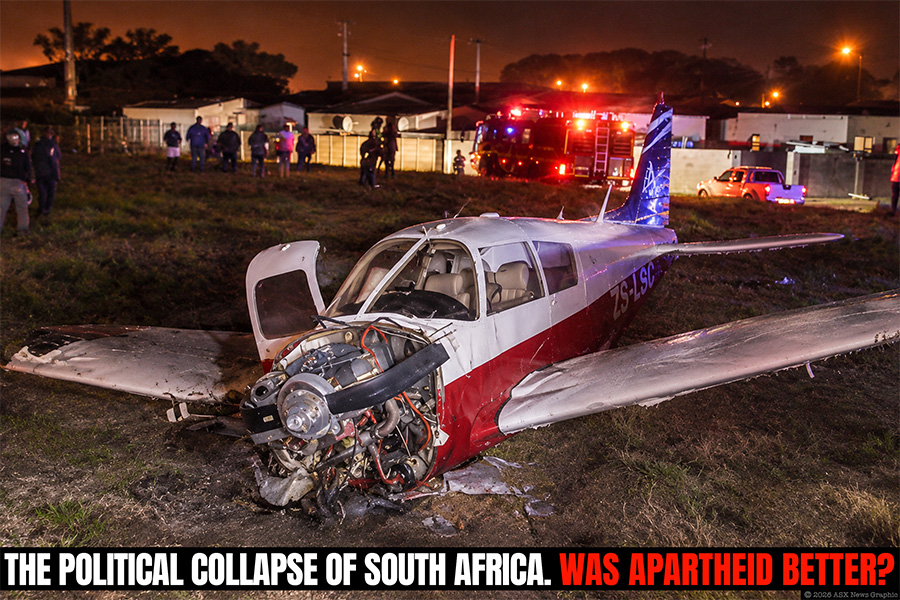
On June 28, 2022, two aviators confronted an emergency that every pilot is trained to anticipate but hopes never to experience. Their single-engine Piper Cherokee developed engine trouble while approaching Cape Town International Airport in South Africa, forcing them to abandon their intended destination and execute an emergency landing in an open field within a residential community. Both occupants survived. However, what happened immediately afterward transformed an aviation emergency into an extraordinary illustration of South Africa’s deteriorating public security environment.
Rather than simply receiving assistance from those gathering around the aircraft, the instructor and student found themselves confronted by individuals who reportedly robbed them of their personal belongings and looted the aircraft. Having successfully navigated an emergency in the air, the aviators were compelled to seek emergency assistance again, this time because of criminal activity on the ground. The incident received international attention, but the circumstances surrounding the aircraft and its occupants have remained relatively poorly documented.
More than four years later, South Africa is experiencing a political reckoning. Its electrical infrastructure has suffered years of instability, its municipal water distribution systems are deteriorating, its transportation networks are struggling, unemployment remains extraordinarily high, and millions of residents have increasingly turned to private companies to provide services traditionally associated with functioning governments. The African National Congress (ANC), the political organization once led by Nelson Mandela, has now experienced its most significant municipal electoral repudiation since the establishment of universal democratic elections in 1994.
For a country once distinguished by its industrial sophistication, engineering capabilities, financial institutions, transportation infrastructure, scientific accomplishments, and relative economic strength within continental Africa, the deterioration raises an uncomfortable historical question. After more than three decades of democratic government, has South Africa become a better or worse country in which to live? More provocatively, were certain aspects of South African society better administered under apartheid than they are today?
ZS-LSC: An Aviation Emergency Becomes a Criminal Emergency
The aircraft involved in the June 28, 2022, occurrence was ZS-LSC, a Piper PA-28 Cherokee-series aircraft identified in historical aircraft records as a PA-28-180 Cherokee C, manufacturer’s serial number 28-3527. The aircraft had previously been photographed in South Africa, and contemporary footage published following the forced landing clearly displays its registration on the port side of the rear fuselage. ASX News established the aircraft’s identity through examination of the surviving imagery and historical aircraft photographs.
The flight was reportedly an instructional operation carrying a flight instructor and student from Swellendam to Cape Town International Airport. During the latter portion of the flight, the aircraft experienced reported engine failure, necessitating an emergency landing before reaching the airport. At approximately 17:35 local time, the aircraft came down in an open area within the Luzuko community of Lower Crossroads, Cape Town, in South Africa’s Western Cape province.
Photographs and video subsequently circulated by South African media and Cape Town municipal officials show substantial damage to the aircraft, particularly around its forward fuselage and engine installation. The engine compartment was exposed, the propeller was damaged, and the aircraft was resting close to ground level. The cabin remained largely recognizable, and the two occupants survived without reported serious injuries. The available photographs do not, however, establish which individual components were damaged during the landing and which, if any, were subsequently removed by individuals at the scene.
According to contemporary statements attributed to Cape Town emergency services spokesperson Eckardt Winks, individuals gathered around the aircraft following its emergency landing and began engaging in criminal activity. The pilot reportedly contacted air traffic control again to request assistance. Cape Town Metropolitan Police responded to secure the area. South African Police Service spokesperson Joseph Swartbooi subsequently confirmed that a robbery had occurred. Among the property reportedly taken were personal belongings and aviation headsets.
Contemporary reporting is available through News24’s original coverage of the occurrence and the Cape Times report published on June 30, 2022. Historical photographs provide additional documentation of the aircraft’s identity, including images archived by JetPhotos in June 2018 and October 2018.
Although the aircraft’s registration and the general circumstances of the occurrence have been established, the identities of its occupants, the operator responsible for the instructional flight, the precise mechanical cause of the reported engine failure, the complete extent of property stolen, and the aircraft’s subsequent disposition have not been independently established by ASX News. The accompanying editorial illustration is a photographic reconstruction based on contemporary imagery of the actual aircraft and accident location.
The significance of the ZS-LSC occurrence extends beyond aviation. An emergency landing in a populated area ordinarily generates a response involving emergency services, medical assistance, traffic control, and protection of the aircraft and its occupants. In this instance, criminal activity created an additional threat to individuals who had just survived a potentially fatal emergency. It was an extraordinary example of the vulnerability experienced in communities where public security cannot always be taken for granted.
The South Africa That Once Distinguished Itself
Throughout much of the twentieth century, South Africa occupied an unusual position within the African continent. Its extensive mining industry generated demand for sophisticated engineering, heavy machinery, electrical generation, railway transportation, metallurgical research, and international financial services. Johannesburg developed into a major commercial center, while Cape Town and Durban became important maritime gateways connecting southern Africa with international markets.
South Africa established sophisticated aviation capabilities, a substantial domestic defense industry, advanced medical research institutions, nuclear technology, automobile manufacturing operations, and internationally recognized universities. In 1967, surgeon Christiaan Barnard performed the world’s first human-to-human heart transplant at Groote Schuur Hospital in Cape Town. The accomplishment demonstrated the advanced medical and institutional capabilities that existed within the country at the time.
The development of these industries distinguished South Africa from many other African economies that depended heavily upon agricultural production and the export of unprocessed natural resources. Its infrastructure permitted the extraction, processing, manufacture, transportation, and international distribution of commodities on an industrial scale. The country possessed capabilities far beyond those associated with a predominantly resource-exporting economy.
However, these accomplishments existed alongside a political and social system that systematically restricted the opportunities available to most South Africans. The country’s industrial sophistication did not mean that its prosperity, infrastructure, educational opportunities, or public services were distributed equally. The distinction between a country’s technical capabilities and the population’s access to those capabilities is essential when evaluating the apartheid period.
What Apartheid Actually Was
Apartheid, an Afrikaans term meaning separateness, became the formal governing policy of South Africa following the National Party’s electoral victory in 1948. Its foundations extended into earlier generations of colonial administration, land restrictions, racial segregation, and political exclusion. The system established legally enforced racial classifications that determined where individuals could live, work, travel, attend school, own property, and participate in political affairs.
The Population Registration Act, Group Areas Act, pass laws, and legislation governing racially segregated education created an administrative structure in which political and economic opportunities were determined substantially by racial classification. Millions of people were subjected to restrictions on residence and movement, while communities were forcibly relocated to accommodate governmental racial policies. The majority of the population was excluded from meaningful participation in the national political system.
The apparent efficiency of infrastructure serving predominantly white residential communities cannot therefore be interpreted as evidence that the apartheid government provided equally efficient services throughout the country. It concentrated substantial resources upon selected communities while leaving others inadequately served. Much of the infrastructure challenge inherited in 1994 was consequently not a question of maintaining existing systems alone, but expanding them to millions of people who had previously been excluded.
Nevertheless, recognizing apartheid’s injustice does not require denying the technical accomplishments, industrial capabilities, administrative expertise, or infrastructure that existed during that period. Electricity generation, railway engineering, water treatment, aviation, medicine, scientific research, and commercial administration are not inherently racial activities. The technical knowledge and physical infrastructure developed before 1994 represented national assets that could have been retained, expanded, and made accessible to the entire population under democratic government.
1994: An Opportunity to Build Something Better
Nelson Mandela’s election in 1994 represented an extraordinary political transformation. South Africa avoided the immediate nationwide civil conflict that many observers had feared, established a democratic constitutional framework, expanded political participation, and began addressing generations of legally imposed inequality. The new government inherited both substantial institutional capabilities and enormous social and economic obligations.
Contrary to suggestions that everything immediately deteriorated following the introduction of democracy, South Africa experienced significant economic growth and improvements in public service accessibility during the early post-apartheid period. According to the International Monetary Fund’s 2025 analysis of South Africa, the economy expanded at an average annual rate of approximately 3.6 percent between 1994 and 2007.
The World Bank’s assessment of South African poverty and inequality documented substantial expansion of basic public services. Electricity access increased from approximately 62 percent of the population in 1994 to 87 percent in 2014. Access to improved water sources increased from 83 percent in 1994 to 93 percent in 2015, while access to improved sanitation increased from 53 percent to 66 percent over approximately the same period.
These accomplishments demonstrate that democracy and effective economic development were not mutually exclusive. South Africa had already demonstrated that it could extend public services, broaden economic participation, and maintain relatively strong economic growth after apartheid. The deterioration that subsequently emerged was neither an immediate nor an unavoidable consequence of abolishing racial segregation.
The more consequential question is why the country failed to sustain that momentum. Why did a nation that successfully expanded its electricity and water networks subsequently struggle to maintain them? Why did the economic gains of the early democratic period give way to prolonged stagnation, rising unemployment, administrative instability, and widespread dissatisfaction with public institutions?
The Electricity Crisis: A Nation That Cannot Keep Its Lights On
Electricity is the foundation of a modern industrial economy. Mining operations, manufacturing facilities, hospitals, communications systems, transportation networks, water pumping stations, financial institutions, and households all depend upon reliable electrical generation and distribution. South Africa’s inability to consistently provide electricity during much of the past two decades has damaged virtually every sector of its economy.
Eskom, South Africa’s state-owned electricity utility, faced increasingly serious generation-capacity constraints during the early 2000s. Rather than maintaining sufficient reserve capacity and developing additional generating infrastructure before demand exceeded available supply, South Africa entered an extended period of electricity shortages. Beginning in 2007, scheduled power interruptions known as load shedding became an increasingly familiar component of South African life.
For businesses, load shedding meant interrupted production, damaged equipment, reduced productivity, additional operating expenses, and uncertainty over future investment. Hospitals and communications providers required independent backup generation. Businesses and households able to afford private solar installations, battery storage, and generators increasingly established their own electrical resilience rather than relying exclusively on the national grid.
This phenomenon represents something more consequential than an inconvenience. When residents and businesses must privately finance alternatives to public infrastructure for which they are already paying, the failure effectively imposes an additional economic burden upon productive activity. Those unable to purchase alternatives experience the consequences directly, creating another division between communities with financial resources and those without them.
The electrical crisis has not remained uniformly severe. Recent improvements in Eskom’s operational performance and electricity-sector reforms have reduced the frequency of power interruptions. Nevertheless, the economic damage accumulated over years of unreliable electricity, combined with the utility’s financial obligations and continuing infrastructure requirements, cannot be eliminated simply by restoring more dependable generation.
The $5.6 Billion Power Station Contracts and the Hitachi Scandal
Among the most disturbing documented episodes involving South Africa’s electrical infrastructure was the relationship between the ANC’s investment interests and the Japanese engineering conglomerate Hitachi. While South Africa was attempting to address its worsening electricity-generation crisis through the development of the Medupi and Kusile power stations, a corporate arrangement placed the country’s governing political organization in a position to financially benefit from contracts awarded by a state-owned enterprise.
In 2005, Hitachi established a subsidiary in South Africa and sold a 25 percent ownership interest to Chancellor House Holdings, an investment company associated with the African National Congress. Hitachi subsequently obtained major boiler contracts associated with the Medupi and Kusile power stations in 2007. The combined value of the contracts was approximately US$5.6 billion.
On September 28, 2015, the United States Securities and Exchange Commission (SEC) announced that it had charged Hitachi with violations of the accounting and internal-control provisions of the Foreign Corrupt Practices Act. According to the SEC, the relationship allowed Chancellor House to benefit financially from government-related contracts secured by Hitachi.
The SEC alleged that approximately US$5 million was paid in dividends associated with the contracts, with an additional US$1 million paid under a separate arrangement involving services intended to help secure the contracts. Hitachi agreed to a US$19 million settlement without admitting or denying the allegations. The original enforcement announcement is available through the United States Securities and Exchange Commission, together with the original federal court complaint.
The political implications were substantial. A state-owned utility operating under an ANC-led government awarded multibillion-dollar contracts to a company partially owned by an investment organization associated with that governing party. The SEC proceeding concerned Hitachi’s conduct and did not establish criminal liability against either the ANC or Chancellor House. Nevertheless, the documented arrangement raises fundamental questions about conflicts of interest, procurement integrity, and the separation of political organizations from public-sector commercial decisions.
South Africa’s citizens were subsequently burdened by construction delays, escalating project costs, operational difficulties, electricity shortages, and the financial consequences of maintaining a struggling national utility. The long-term economic costs extended considerably beyond the original construction contracts.
State Capture: When Government Becomes a Commercial Opportunity
South Africa’s infrastructure failures cannot be understood without examining the broader phenomenon of state capture. Particularly during the presidency of Jacob Zuma, allegations emerged that politically connected business interests had developed substantial influence over governmental appointments, procurement decisions, state-owned enterprises, and the allocation of public resources.
The Judicial Commission of Inquiry into Allegations of State Capture, commonly known as the Zondo Commission, examined these relationships extensively. Its findings, published in a series of reports in 2022, documented extensive institutional vulnerabilities and misconduct involving political officeholders, commercial organizations, government departments, and state-owned enterprises.
State capture is more destructive than an isolated instance of financial misconduct. It can fundamentally alter the objectives of public administration. Organizations established to generate electricity, transport freight, operate public infrastructure, or provide essential services may become instruments through which politically connected individuals pursue commercial advantages. Decisions concerning technical competence, maintenance schedules, capital investment, and procurement integrity become subordinate to competing political and financial interests.
Such arrangements also create consequences that may remain invisible for years. A delayed maintenance program does not necessarily cause an immediate infrastructure failure. An inadequately qualified appointment may not immediately produce an operational emergency. Deferred capital investment may temporarily improve the appearance of an organization’s financial position. When these decisions accumulate, however, the underlying system progressively loses its resilience.
South Africa’s experience illustrates how a sophisticated industrial system can deteriorate without a single catastrophic initiating event. Thousands of individual administrative, financial, political, and technical decisions can gradually consume decades of accumulated infrastructure investment until failures become increasingly frequent and expensive to reverse.
Johannesburg: An Economic Capital Without Reliable Water
South Africa’s electricity crisis has increasingly been accompanied by another fundamental infrastructure emergency: the inability of municipal authorities to consistently deliver water to residents. Johannesburg, the country’s principal financial and commercial center, has experienced repeated interruptions to water services, deterioration of distribution infrastructure, and mounting concerns over the financial and operational capabilities of its municipal water utility.
The November 2026 investigation published by the Finance Bureau highlighted a particularly extraordinary example in Douglasdale, a Johannesburg suburb where a damaged pipe reportedly discharged water for approximately three and a half years. During the municipal election campaign, Democratic Alliance mayoral candidate Helen Zille drew attention to the prolonged failure by entering the accumulated water, creating a highly visible illustration of municipal neglect.
The Finance Bureau investigation also reported that approximately one-quarter of Johannesburg’s supplied water was being lost through physical leakage, while additional quantities generated no revenue because of metering problems, unauthorized consumption, billing failures, and other causes. These categories must be distinguished: non-revenue water does not necessarily represent water physically lost through damaged infrastructure, although both create serious financial and operational consequences.
The investigation further alleged that Johannesburg’s municipal government transferred approximately R3.4 billion from Johannesburg Water’s account at the end of June 2026, subsequently contributing to financial difficulties and interruptions to infrastructure projects. It also cited extraordinarily low maintenance expenditure relative to the value of the utility’s infrastructure. The underlying municipal financial records necessary to independently substantiate those particular figures were not available to ASX News at publication, and they remain attributed to the Finance Bureau investigation.
What is particularly concerning about Johannesburg’s difficulties is that urban water shortages cannot always be attributed exclusively to rainfall, reservoir levels, or natural resource availability. Water must be purchased or extracted, treated, pumped, stored, distributed, metered, and paid for. A failure anywhere within this interconnected system can deprive households and businesses of water even when sufficient raw water exists elsewhere in the supply network.
South Africa is naturally water-constrained, and increasing population, climatic variability, and urban development place legitimate pressure upon its water resources. However, leaking pipes, inadequate maintenance, unreliable pumps, financial mismanagement, and interrupted electricity supply can amplify those pressures. The consequences are particularly serious when existing infrastructure is allowed to deteriorate faster than it can be repaired or replaced.
Transportation, Railways, Ports, and Industrial Decline
South Africa’s historical economic advantages were not limited to inexpensive electricity or abundant mineral resources. The country developed extensive railway and maritime infrastructure capable of supporting major international mining and manufacturing operations. These transportation capabilities remain fundamental to the competitiveness of its economy.
However, deteriorating railway infrastructure, theft, operational interruptions, inadequate maintenance, and declining freight reliability have created substantial difficulties for South African exporters. Mining companies depend upon the ability to transport enormous quantities of coal, iron ore, manganese, and other commodities from inland production facilities to coastal export terminals. Interruptions to these services increase costs, restrict export capacity, and reduce the economic benefits derived from the country’s natural resources.
When rail transportation becomes unreliable, freight operators increasingly depend upon trucks. This transfers additional traffic to highways, accelerates road deterioration, increases fuel consumption, places additional demands upon maintenance budgets, and can create additional transportation safety risks. The failure of one infrastructure network consequently increases pressure upon another.
The Organisation for Economic Co-operation and Development’s 2025 economic survey of South Africa identified constraints involving electricity, railways, and ports among the factors restricting investment, exports, economic activity, and improvements in living standards. The country’s industrial difficulties are therefore not simply matters of political perception; their economic consequences have been documented by major international institutions.
Political Appointments, Qualifications, and Institutional Competence
One of the most contentious questions surrounding South Africa’s administrative decline concerns the relationship between political appointments, racial transformation policies, professional qualifications, and institutional performance. These issues are frequently discussed together, although they represent different governmental practices and require separate examination.
Cadre deployment, the practice of placing individuals associated with a political organization into governmental and public-sector positions, has been extensively criticized because it can compromise the independence of public institutions. When political allegiance becomes more important than demonstrated administrative or technical competence, institutions may lose the professional standards required to perform their responsibilities effectively.
South Africa’s Broad-Based Black Economic Empowerment policies were established to address historical economic exclusion and broaden participation in ownership, employment, management, and commercial activity. Their stated objectives concern a genuine historical problem. However, the effectiveness of individual policies, their implementation, the incentives they create, and their potential susceptibility to exploitation by politically connected individuals remain legitimate subjects of economic and administrative scrutiny.
There is a fundamental distinction between expanding access to opportunity and weakening professional qualification requirements. An engineer responsible for a municipal water network, an electrical specialist responsible for a generating station, or an aviation professional responsible for flight safety must possess the necessary technical knowledge and practical competence regardless of racial identity, political affiliation, or personal background.
South Africa’s historical educational inequalities also created a genuine need for professional training and skills development. The sustainable response to that challenge was to expand access to high-quality education and professional qualifications while retaining demanding technical standards. Simply replacing personnel without adequately transferring institutional knowledge or developing equivalent professional capabilities risks compromising the systems those individuals are responsible for administering.
It would be inaccurate to attribute South Africa’s entire infrastructure crisis to racial transformation policies. Corruption, inadequate investment, poor maintenance, financial constraints, political interference, regulatory failures, skills shortages, and external economic shocks have all contributed. Nevertheless, where appointment and procurement practices demonstrably undermine competence or institutional independence, they warrant investigation regardless of the political sensitivities involved.
Public Security and the Privatization of Personal Safety
The robbery of the occupants of ZS-LSC was not an isolated example of the broader public security difficulties confronting South Africa. Armed robbery, vehicle hijacking, residential burglary, extortion, and violent crime have become significant considerations in the daily decisions of households and commercial organizations throughout the country.
According to South African Police Service crime statistics, the recorded murder rate for the July-to-September quarter of 2026 was approximately 8.8 per 100,000 inhabitants, down from 9.2 during the corresponding quarter of 2025. Attempted murder, conversely, registered an increase in its recorded population-adjusted rate over the same period.
Police-derived figures compiled for the twelve months ending September 2026 indicate that approximately 22,549 murders were recorded across South Africa, equivalent to around 62 per day. Although this represented an improvement over the previous twelve-month period, the absolute level of lethal violence remained extraordinarily high. The corresponding statistics and trends are presented in The Coastal’s compilation of South African crime data.
Crime comparisons between apartheid-era and contemporary South Africa require particular caution. Historical statistics were affected by differences in police jurisdictions, population coverage, reporting practices, political violence, and the treatment of crimes committed within different communities. There is no sound basis for assuming that every South African experienced greater personal security before 1994. Historical state violence and racially discriminatory policing also formed part of the country’s security environment.
Nevertheless, contemporary violent crime imposes a substantial economic and social burden. Private security guards, armed-response companies, surveillance systems, electrified fencing, controlled-access residential developments, and other privately financed protective measures have become prominent features of South African life.
As with private electrical generation, this development represents a partial transfer of traditional government responsibilities to private organizations. Households and businesses with sufficient financial resources can acquire additional protection, while economically disadvantaged communities are more dependent upon whatever public security services are available. The result is an increasingly unequal distribution of practical security.
The Economic Cost of Three Decades of Political Administration
South Africa’s economic trajectory provides perhaps the most persuasive statistical evidence of its long-term institutional difficulties. The International Monetary Fund’s analysis identified a substantial difference between the country’s early democratic economic performance and the period that followed. Average annual economic growth of approximately 3.6 percent between 1994 and 2007 declined to approximately 1.1 percent between 2008 and 2023.
By 2023, inflation-adjusted economic output per person had returned to approximately its 2007 level. In practical terms, more than fifteen years had passed without sustained improvements in average real economic output per inhabitant. This prolonged stagnation occurred while the population continued to increase, infrastructure accumulated additional maintenance requirements, and millions of younger South Africans entered the labor market.
According to the World Bank’s South African economic indicators, the country’s economy generated approximately US$427 billion in nominal gross domestic product during 2025, with nominal output per inhabitant of approximately US$6,598. Economic growth was approximately 1.1 percent, barely keeping pace with the country’s estimated population growth during that year.
The World Bank’s contemporary South African economic assessment reported that official unemployment increased to approximately 33.6 percent during the second quarter of 2026, while the expanded unemployment measure reached approximately 44 percent. More than eight million people were unemployed under the narrower measure alone.
These statistics have consequences far beyond employment figures. Prolonged unemployment reduces household purchasing power, restricts the growth of the domestic consumer economy, limits tax revenues, increases reliance upon government assistance, and discourages professional investment in communities where economic opportunities remain scarce. For younger generations, the inability to enter productive employment can fundamentally alter their expectations for the future.
Public debt has also increased dramatically. The OECD estimated that government debt had risen from approximately 31.5 percent of GDP in 2010 to a projected 77 percent in 2025. Growing debt-servicing obligations reduce the financial flexibility available to address infrastructure maintenance, education, healthcare, public security, and other governmental responsibilities.
Is South Africa Losing Its Distinctive Position Within Africa?
For much of its modern history, South Africa’s economic identity was associated with its ability to develop and operate a comparatively diversified industrial system. Its financial markets, manufacturing industries, transportation infrastructure, engineering institutions, and technological capabilities provided advantages that extended beyond the value of its mineral deposits.
Those advantages are increasingly being undermined by domestic constraints. Reliable infrastructure, technically competent administration, internationally competitive industries, effective law enforcement, and predictable commercial conditions are not permanent attributes of a country. They must be continuously maintained through investment, education, professional development, and effective governance.
Meanwhile, other African countries have pursued their own industrial development, infrastructure modernization, financial reforms, and technological advancement. South Africa can no longer assume that historical industrial dominance will automatically preserve its relative economic position. Countries that successfully improve their administrative and productive capabilities can progressively narrow longstanding development gaps.
Continental Africa is not a homogeneous political or economic environment. Its countries exhibit enormously different levels of institutional stability, economic development, infrastructure quality, political freedom, and administrative competence. South Africa’s declining relative advantages are therefore better understood as the consequence of its own policy and institutional failures than as an inevitable consequence of its geographic location.
The country’s historical distinction is nevertheless at risk. South Africa’s economic and technological inheritance was sufficiently substantial to provide the foundation for becoming one of the world’s more successful emerging industrial economies. Instead, prolonged stagnation and deteriorating public infrastructure have restricted the realization of that potential.
November 4, 2026: The ANC’s Political Reckoning
For decades, the African National Congress benefited from its historic association with the struggle against apartheid and the political legacy of Nelson Mandela. This association provided the organization with a degree of electoral loyalty that enabled it to maintain national political dominance despite mounting dissatisfaction with corruption, unemployment, infrastructure failures, and public administration.
The ANC’s political position changed significantly during South Africa’s 2024 national election, when the party lost its parliamentary majority for the first time since the establishment of universal democratic elections in 1994. The result compelled it to participate in a broader governmental arrangement rather than continuing to govern nationally through an outright parliamentary majority.
The municipal elections conducted on November 4, 2026, delivered an even more extraordinary demonstration of declining public confidence. According to the results announced on November 8 by the South African government’s official news service, the ANC received approximately 30.76 percent of the national municipal vote, compared with approximately 45.6 percent in 2021.
The Democratic Alliance secured approximately 24.64 percent, while former President Jacob Zuma’s uMkhonto weSizwe party received approximately 9.76 percent. Other political organizations divided much of the remaining vote, producing a substantially more fragmented political environment throughout South Africa’s municipalities.
Importantly, the collapse in ANC electoral support did not coincide with declining electoral participation. National voter turnout increased from approximately 45.9 percent in 2021 to 52 percent in 2026. Rather than simply withdrawing from the electoral process, a greater proportion of registered South African voters participated while significantly fewer supported the country’s historically dominant political organization.
The ANC remains South Africa’s largest individual political party by national municipal vote share. Nevertheless, its ability to rely upon longstanding electoral loyalty has substantially diminished. The organization must increasingly compete for political survival against alternative parties and negotiate coalition agreements in municipalities that it once controlled.
Johannesburg’s Coalition Problem
Johannesburg illustrates the difficulties associated with translating electoral dissatisfaction into effective administration. The Democratic Alliance received approximately 35 percent of the municipal vote in November 2026, compared with approximately 20 percent for the ANC and 16 percent for ActionSA. However, the Democratic Alliance did not obtain sufficient council representation to govern independently.
The city’s political instability substantially predates the latest election. In 2016, the ANC lost its outright majority in Johannesburg, allowing an opposition-led coalition to take control. The subsequent years were characterized by changing political alliances, disputes between coalition participants, and repeated changes in municipal leadership.
According to Reuters reporting published on November 19, 2026, negotiations involving the ANC, ActionSA, and other political organizations were moving toward an arrangement that could exclude the Democratic Alliance from governing Johannesburg despite its first-place electoral finish.
Coalition government is a legitimate component of parliamentary and municipal democracy. However, unstable coalitions can introduce serious administrative difficulties when political disagreements repeatedly interrupt long-term financial planning, infrastructure investment, personnel administration, and procurement programs. Johannesburg’s experience demonstrates that replacing a dominant party does not automatically establish a stable or competent alternative.
A municipal water distribution network requires maintenance and investment decisions extending across multiple years. Electricity facilities, sewage treatment plants, transportation infrastructure, and public housing projects require comparable continuity. When administrative leadership changes substantially more frequently than the infrastructure projects those administrators oversee, institutional priorities may become increasingly difficult to sustain.
Ultimately, Johannesburg’s residents do not benefit merely from a particular political party winning an election or securing a coalition agreement. They benefit when their water supply becomes dependable, infrastructure is repaired, public finances are responsibly administered, and their neighborhoods become safer.
South Africa’s Emerging Parallel Society
Perhaps the most consequential manifestation of South Africa’s institutional deterioration is the emergence of increasingly extensive privately financed alternatives to government-provided services. Private solar generation replaces unreliable electricity. Water tanks, boreholes, filtration systems, and independent pumping installations provide alternatives to municipal water networks. Private security companies assume responsibilities that many residents believe public law enforcement cannot adequately fulfill.
Private healthcare, independent schools, privately maintained residential developments, and commercial infrastructure arrangements provide additional alternatives for households and businesses capable of financing them. These arrangements demonstrate considerable individual initiative and entrepreneurial capacity, but they also illustrate the extent to which citizens may become increasingly dependent upon their own financial resources rather than collectively financed public institutions.
There is a particularly disturbing historical irony in this development. South Africa dismantled a system of legally enforced exclusion intended to separate communities and distribute opportunities unequally. Yet prolonged failures in public administration risk producing new forms of practical separation determined increasingly by wealth, geographic location, and access to privately financed services.
A household capable of purchasing solar panels, battery storage, water tanks, private security, independent education, and private medical insurance can substantially reduce its exposure to public-sector failures. A household without those resources cannot. The deterioration of common infrastructure therefore threatens to reinforce the very economic and social divisions democratic South Africa originally sought to overcome.
Was Apartheid Better?
The answer depends upon what is being measured. If the question concerns universal political rights, legal equality, freedom of movement, and the removal of institutionalized racial discrimination, democratic South Africa represents an unmistakable advancement over apartheid. The majority of South Africans gained political and legal rights that the previous system had deliberately denied them.
If the question concerns the operational condition of particular infrastructure networks, the availability of specialized engineering expertise, administrative continuity, or the efficiency of specific public institutions, the comparison becomes substantially more complicated. Some infrastructure systems and industrial capabilities established before 1994 have subsequently deteriorated, even though their services were originally distributed unequally. Their deterioration represents an administrative failure, not an argument for restoring racial segregation.
Economic history also contradicts the proposition that apartheid necessarily produced better economic outcomes. South Africa experienced substantial economic difficulties during the latter apartheid years, including international sanctions, financial isolation, political unrest, and structural inequalities. Conversely, the early democratic period generated relatively strong economic growth and substantial expansion of essential public services.
The evidence therefore does not establish that apartheid was better as a comprehensive political, social, and economic system. It does establish that important national capabilities developed before 1994 were not adequately preserved, expanded, or administered during significant portions of the subsequent democratic era.
That distinction is central to understanding South Africa’s predicament. The dismantling of apartheid did not require dismantling the country’s technical expertise, industrial capabilities, infrastructure resilience, professional standards, or administrative competence. Democratic government had the opportunity to retain those capabilities while extending their benefits to the population as a whole.
The failure to fully realize that opportunity cannot indefinitely be attributed to the political system that ended more than three decades ago. Historical inequality remains relevant, but contemporary political leaders must also be held accountable for the decisions made under their own administrations, the institutions they control, and the public resources entrusted to them.
Can South Africa Still Be Saved?
Despite its considerable problems, South Africa has not experienced complete state collapse. It retains functioning constitutional institutions, an independent judiciary, a sophisticated financial sector, internationally competitive businesses, professional organizations, substantial industrial assets, universities, and an electoral system capable of imposing meaningful political consequences upon incumbent parties.
Recent improvements in electricity reliability, ongoing structural reforms, and the substantial electoral decline of the ANC demonstrate that deterioration is not necessarily irreversible. South Africa continues to possess many of the technical, commercial, intellectual, and institutional resources required to rebuild its infrastructure and restore stronger economic growth.
However, achieving that objective requires distinguishing political transformation from institutional reconstruction. Changing the individuals occupying government offices is insufficient unless the administrative systems beneath them are capable of functioning effectively. Infrastructure management must prioritize professional competence, transparent procurement, financial accountability, long-term investment, preventive maintenance, and measurable performance.
The appointment of engineers, infrastructure managers, financial administrators, police officials, and other public-sector professionals must emphasize their capacity to fulfill the responsibilities associated with their positions. Government institutions cannot reliably provide complex technical services when their personnel decisions and financial arrangements become subordinate to short-term political objectives.
South Africa’s political leaders must also recognize that public trust is rebuilt through demonstrated results rather than historical associations, political rhetoric, or electoral promises. A functioning water distribution system is more persuasive than a campaign speech. Reliable electricity is more valuable to an industrial economy than ideological debate. Effective law enforcement provides a more tangible demonstration of governmental legitimacy than repeated assurances that conditions will eventually improve.
The June 2022 forced landing of ZS-LSC provides a particularly disturbing illustration of what is at stake. The two aviators successfully managed their aircraft emergency and survived. Yet the circumstances awaiting them on the ground reportedly created another emergency requiring police intervention. Their experience was not a statistical measure of an entire nation’s condition, but it represented a very real consequence of the public security challenges confronting South African society.
South Africa’s greatest tragedy may not be the failure to become something it never possessed the capacity to become. It may instead be the failure to preserve and develop capabilities that already existed, while extending their benefits to every citizen. The country had an extraordinary opportunity in 1994 to combine its industrial and technological achievements with democratic freedom and universal political participation. That opportunity has not disappeared, but decades of institutional deterioration have made its realization considerably more difficult.
The November 2026 elections demonstrated that a significant proportion of South Africans are no longer willing to grant their political leaders unconditional loyalty based upon historical accomplishments. Whether this represents the beginning of a national recovery or merely another chapter in a continuing political and institutional decline will depend upon what happens after the votes have been counted.
South Africa does not need to resurrect apartheid to recover the infrastructure, administrative competence, industrial sophistication, and professional standards that once distinguished it. It needs to demonstrate that a democratic government can preserve those capabilities, expand upon them, and make their benefits available to the entire population. More than three decades after the extraordinary political transformation of 1994, that remains the unfinished business of the South African nation.