


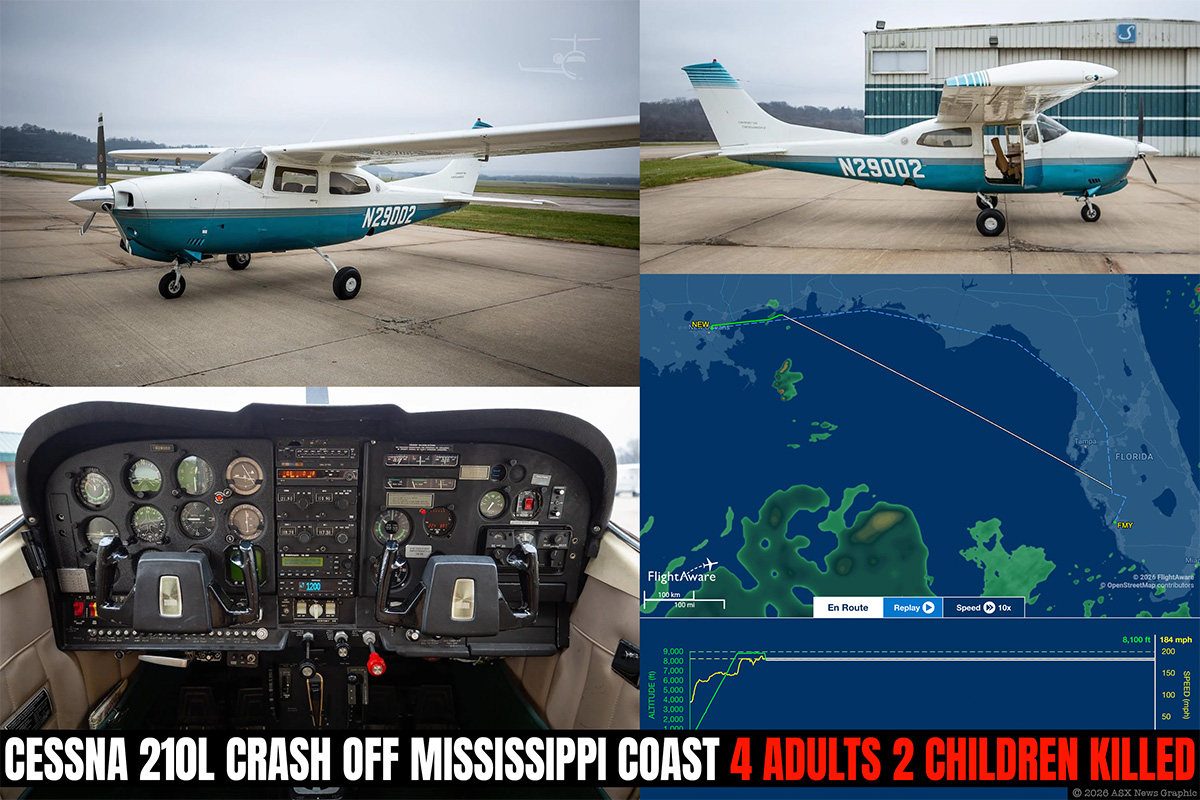
All six occupants of a privately operated Cessna 210L Centurion, including two children, were killed on Tuesday, November 24, 2026, when their aircraft entered a rapid descending turn and crashed into the waters of Mississippi Sound between Horn Island and Pascagoula, Mississippi. The aircraft was conducting a cross-country flight from New Orleans, Louisiana, to Fort Myers, Florida. Divers subsequently located all six occupants within the aircraft’s fuselage following an extensive multiagency search and rescue operation.
The accident aircraft was identified as N29002, a 1972 Cessna 210L Centurion, manufacturer’s serial number 21059777, registered to E A B Services LLC of Cape Coral, Florida. The six-place, single-engine, retractable-landing-gear aircraft had departed New Orleans Lakefront Airport (NEW/KNEW) at approximately 14:02 Central Standard Time (CST), with an intended destination of Page Field Airport (FMY/KFMY) in Fort Myers.
Flight History and Accident Sequence
According to historical flight-tracking information, N29002 had departed Page Field on November 21, 2026, for Triumph Air Strip near Buras, Louisiana. The occupants had reportedly traveled to southeastern Louisiana for a fishing trip and were returning to Florida when the accident occurred.
On November 24, the aircraft departed Triumph Air Strip at approximately 13:06 CST, arriving at New Orleans Lakefront Airport approximately 13 minutes later. Following a ground interval of approximately 43 minutes, the aircraft departed Lakefront Airport on the final leg of its return journey to Florida.
The aircraft proceeded eastbound along the northern Gulf Coast, climbing to approximately 8,800 feet. FlightAware information indicates that the aircraft had a filed altitude of 9,000 feet and a filed speed of approximately 160 knots (184 miles per hour). The published flight path indicated an intended route following portions of the northern and eastern Gulf coastline before proceeding southward toward Fort Myers.
A family member interviewed by Louisiana television station WVUE indicated that the occupants had elected to follow the coastline in an effort to avoid adverse weather over the Gulf of Mexico. This account is generally consistent with the filed route displayed by FlightAware and the areas of precipitation visible on the associated weather overlay.
Approximately 36 minutes after departure, at around 14:38 CST (20:38 UTC), the aircraft reportedly entered a sudden right-hand descending turn south of Pascagoula. Information attributed to the Federal Aviation Administration (FAA) and subsequently released by the United States Coast Guard indicated that the aircraft was descending at approximately 10,000 feet per minute when contact was lost.
Additional flight-tracking information reported by CNN, citing Flightradar24, indicated that the aircraft’s terminal descent rate may have reached approximately 18,000 feet per minute, with a recorded speed exceeding 200 miles per hour (174 knots). These figures indicate an exceptionally rapid descent and are consistent with a potentially uncontrolled flight condition immediately preceding water impact.
At a constant descent rate of 18,000 feet per minute, an aircraft would descend vertically at approximately 300 feet per second. From an altitude of 8,800 feet, such a descent rate would theoretically permit less than 30 seconds before reaching the water. This calculation illustrates the severity of the reported terminal descent and does not represent a reconstruction of the actual elapsed time between the initiation of the descending turn and impact.
The FlightAware graphical presentation reviewed by ASX News depicts the aircraft’s initial climb, a relatively brief period of flight near its cruising altitude, and the termination of recorded tracking information near the Mississippi Gulf Coast. The projected flight route beyond that point does not represent an actual continuation of the aircraft’s flight. The Flightradar24 terminal descent information has been reported separately and cannot be reconstructed in its entirety from the available FlightAware graphical presentation.
Accident Location
The aircraft impacted the waters of Mississippi Sound approximately two miles northeast of Horn Island, an undeveloped barrier island located south of the Mississippi mainland. Horn Island forms part of the Gulf Islands National Seashore and lies offshore from the coastal communities of Pascagoula, Ocean Springs, and Biloxi.
The accident location was situated within the relatively shallow coastal waters separating the barrier islands from the Mississippi mainland. Although the aircraft was operating reasonably close to land, the exceptionally rapid reported descent and subsequent water impact severely compromised the prospects for occupant survival.
Search, Rescue, and Recovery Operations
At approximately 15:45 CST, the United States Coast Guard received notification from the FAA concerning the missing aircraft. Initial FAA reporting placed the accident at approximately 15:30 CST, although publicly available flight-tracking information indicates that the aircraft’s terminal descent occurred considerably earlier, at approximately 14:38 CST. The distinction between the recorded flight termination and the subsequent notification of search and rescue authorities is significant when establishing the accident chronology.
Coast Guard Station Pascagoula deployed two small vessels, while additional resources, including a cutter and an aircraft, were dispatched through Coast Guard units in the Mobile area. The Mississippi Department of Marine Resources and the Pascagoula Police Department also deployed marine resources to assist in locating the aircraft and its occupants.
During the initial search, responders located aircraft wreckage, three life jackets, and a life raft in the vicinity of the accident site. The aircraft’s cabin section was also located. No survivors were observed in the surrounding waters.
Following several hours of search operations, divers from the Mississippi Department of Marine Resources located the remains of all six occupants within the aircraft’s fuselage. The Coast Guard subsequently concluded its search for survivors.
Authorities reported that the occupants included four adults and two children, the latter identified in preliminary reporting as boys aged eight and ten. A family member provided a slightly different description of the age distribution, identifying three adults, a teenager, and two younger children aboard the aircraft. The names of the occupants and the identity of the pilot had not been independently established by ASX News at publication.
The recovery of life-saving equipment outside the aircraft does not establish that the occupants had attempted to evacuate or intentionally deploy that equipment before impact. Its discovery may alternatively reflect structural damage and the release of equipment from the aircraft during or following the impact sequence.
The Accident Aircraft
N29002 was manufactured by the Cessna Aircraft Company in 1972 as a Cessna 210L Centurion. The aircraft was assigned manufacturer’s serial number 21059777 and was approximately 54 years old at the time of the accident.
The Cessna 210L is a high-wing, single-engine, unpressurized, retractable-landing-gear aircraft equipped with a six-cylinder, horizontally opposed, fuel-injected Continental IO-520-series engine. The aircraft was designed to provide substantially greater cross-country performance, payload capability, and range than smaller fixed-landing-gear aircraft within the Cessna single-engine product line.
Historical sales documentation for the actual accident aircraft, retained by Aircraft.com, identifies N29002 as having been equipped with a Continental IO-520 engine, a three-bladed Hartzell propeller, GAMI fuel injectors, an electronic engine-monitoring system, and an Appareo ADS-B transponder installation.
The historical aircraft listing reported approximately 4,375 hours of total airframe time, 875 hours since new on the engine, and 530 hours since new on the propeller. The listing also documented an annual inspection completed in September 2018 and instrument-flight certification completed in July 2018.
Historically installed avionics included dual King KX170B navigation and communication radios, a Trimble TNL 1000 GPS, a Century IIB autopilot, a King KN64 distance-measuring equipment installation, an automatic direction finder, and a four-place intercommunication system.
These specifications establish a documented historical configuration of N29002. They do not establish the aircraft’s maintenance status, accumulated flight hours, avionics configuration, or mechanical condition on November 24, 2026. The aircraft could have undergone subsequent modifications, equipment replacements, maintenance, or engine overhaul during the intervening years.
Historical photographs and equipment documentation for the actual accident aircraft are available through the Aircraft.com archive for N29002.
Meteorological Conditions
Meteorological observations recorded at Trent Lott International Airport (PQL/KPQL) near Pascagoula bracket the approximate time of the accident. The following METAR observations were recorded at 19:53 UTC and 20:53 UTC, corresponding to 13:53 CST and 14:53 CST, respectively.
METAR KPQL 241953Z 36007KT 10SM FEW019 BKN024 OVC044 17/12 A3008 RMK AO2 SLP186 T01720117
METAR KPQL 242053Z 35007KT 10SM OVC023 17/12 A3007 RMK AO2 SLP184 T01670117 56014
The observation preceding the accident indicated surface winds from 360 degrees at seven knots, visibility of ten statute miles, few clouds at 1,900 feet above ground level, a broken cloud layer at 2,400 feet, and an overcast layer at 4,400 feet. The reported temperature was 17 degrees Celsius, with a dew point of 12 degrees Celsius and an altimeter setting of 30.08 inches of mercury.
The subsequent observation indicated surface winds from 350 degrees at seven knots, visibility of ten statute miles, and an overcast ceiling at 2,300 feet above ground level. The temperature and dew point remained nominally unchanged, while the altimeter setting decreased to 30.07 inches of mercury.
Although surface visibility remained favorable at the reporting airport, the observations establish the presence of extensive cloud cover within the region. The reported flight altitude of approximately 8,800 feet was substantially above the lowest reported cloud ceilings. Surface meteorological observations cannot establish the cloud tops, atmospheric conditions, visibility, turbulence, or icing potential encountered by the aircraft at its operating altitude.
The FlightAware meteorological overlay also depicts scattered precipitation near portions of the aircraft’s initial route and substantially larger areas of precipitation farther offshore. The available graphical presentation does not establish that N29002 entered a thunderstorm or encountered hazardous convective activity immediately before its terminal descent.
Preliminary Flight Dynamics Assessment
One of the most significant characteristics of this accident is the apparent transition from relatively stable cross-country cruising flight into an exceptionally rapid descending turn. The reported descent rates of between 10,000 and 18,000 feet per minute substantially exceed those normally associated with routine descents or conventional emergency gliding flight following a loss of engine power.
An engine failure in a single-engine aircraft does not ordinarily produce such a descent rate if the aircraft remains under positive aerodynamic control. A properly managed forced descent would generally involve the establishment of an appropriate gliding attitude and airspeed, followed by selection of a suitable landing or ditching location.
The reported combination of a sudden descending turn, rapidly decreasing altitude, and increasing or substantial forward speed raises the possibility of a loss-of-control-in-flight (LOC-I) occurrence. A steep spiral descent, an upset associated with an instrument meteorological conditions encounter, an incapacitation event, a flight-control malfunction, or a structural failure could each produce certain characteristics consistent with the limited publicly reported terminal flight data.
A steep descending spiral is particularly significant because an aircraft can rapidly accelerate while losing altitude as increasing bank angle reduces the vertical component of aerodynamic lift. An inappropriate attempt to arrest the descent without first correcting excessive bank can further increase aerodynamic loading. Such a condition can potentially result in excessive airspeed, structural overstress, or insufficient altitude for recovery.
These scenarios represent preliminary investigative considerations rather than established findings concerning N29002. The aircraft’s actual attitude, indicated airspeed, engine power, control inputs, autopilot engagement status, structural integrity, and cockpit circumstances immediately preceding impact have not been established through the publicly available information.
The reported tracking speed must also be distinguished from indicated airspeed. Public flight-tracking services ordinarily derive aircraft movement from transmitted position and velocity information, and the resulting groundspeed cannot be directly compared with aircraft-specific indicated airspeed limitations without additional atmospheric and flight data.
The discovery of the aircraft’s cabin and other debris within Mississippi Sound establishes substantial aircraft damage but does not independently demonstrate that an in-flight structural breakup occurred. Wreckage distribution, fracture surfaces, deformation characteristics, and evidence of pre-impact versus impact-related structural separation will be particularly important in determining the sequence of events.
Aircraft Loading and Occupant Survival
With six occupants aboard, the accident aircraft was operating at its nominal seating capacity. The Cessna 210L’s ability to accommodate six occupants does not necessarily mean that it can carry six occupants, their baggage, and maximum usable fuel simultaneously while remaining within approved weight and center-of-gravity limitations.
Determining the aircraft’s actual takeoff weight and center-of-gravity position will require its individual empty-weight and balance documentation, occupant weights, fuel quantity, baggage weights, and the distribution of equipment carried aboard. The reported fishing trip may also be relevant when establishing the type and quantity of baggage or recreational equipment carried aboard the aircraft.
No evidence currently available to ASX News establishes that N29002 was overloaded or operating outside its approved center-of-gravity envelope. Aircraft loading is nevertheless an appropriate component of the technical investigation, particularly given the reported loss of control and the number of occupants aboard.
The presence of life jackets and a life raft indicates that flotation equipment was available aboard the aircraft. However, the survivability of a water impact depends substantially upon impact velocity, aircraft attitude, structural deformation, restraint performance, occupant injury, and the ability to evacuate the aircraft following impact. A controlled ditching and a high-energy uncontrolled water impact represent fundamentally different survivability environments.
Investigation
The National Transportation Safety Board (NTSB) has been identified as the lead investigative agency, with assistance from the Federal Aviation Administration. The investigation will need to establish the circumstances surrounding the aircraft’s departure from cruise flight and the sequence of events that resulted in its rapid descent into Mississippi Sound.
Important evidentiary sources are expected to include air traffic control recordings, radar information, ADS-B transmissions, aircraft maintenance records, pilot certification and instrument proficiency records, meteorological information, aircraft loading documentation, engine examination, flight-control continuity, and examination of recovered aircraft components.
The aircraft’s historically documented electronic engine-monitoring equipment may also represent a potentially significant source of information if it remained installed, incorporated data-recording capabilities, and can be recovered in a condition permitting the extraction of stored information.
The aircraft’s autopilot configuration and operational condition may warrant examination, particularly in establishing whether the terminal descending turn followed an inadvertent disengagement, an aircraft-control anomaly, pilot intervention, or a condition unrelated to the autopilot system.
No cockpit communications establishing the nature of an emergency, identifying a mechanical malfunction, or documenting the pilot’s actions immediately before the terminal descent have been made publicly available in the material reviewed by ASX News.
All six occupants were fatally injured, and N29002 was destroyed. Preliminary flight-tracking information identifies an abrupt departure from cruising flight and an exceptionally high-energy descent as the defining characteristics of the accident. Establishing the initiating event responsible for that departure from controlled flight will be central to the technical investigation.
Source Documentation
CNN Newsource / KVIA — Accident coverage and Flightradar24 terminal descent information.
WVUE FOX 8 — Occupant recovery, family interview, and flight history.
Associated Press — Confirmation of six fatalities following the Mississippi aircraft accident.
WLOX / WAFB — Coast Guard notification and multiagency search operations.
Aircraft.com — Historical aircraft specifications and photographs of N29002.
FlightAware — N29002 historical flight-tracking information.