

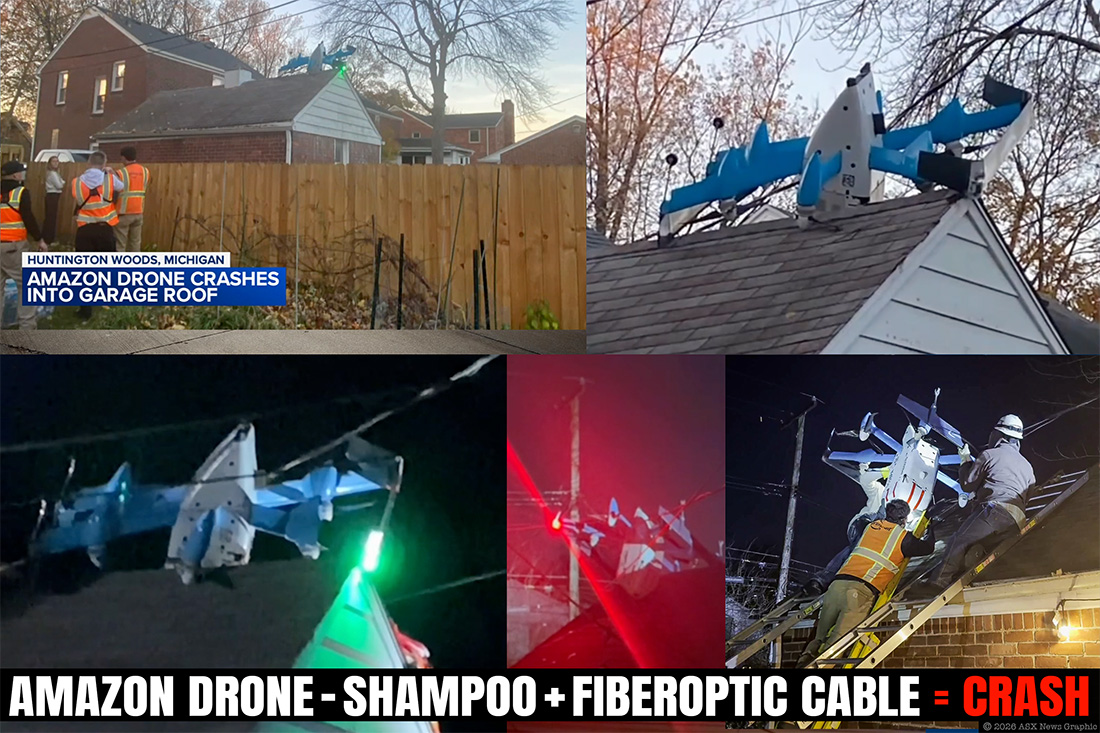
An Amazon Prime Air MK30 autonomous delivery drone crashed onto a residential garage in Huntington Woods, Michigan, on Friday, November 20, 2026, shortly after completing the delivery of a bottle of shampoo. The aircraft reportedly struck an overhead fiber-optic cable, lost a propeller, experienced uncontrolled flight, and subsequently became entangled in an electrical service line before coming to rest on the roof of a neighboring garage.
The incident occurred at approximately 16:30 Eastern Standard Time in the suburban community north of Detroit. No injuries were reported, although the garage sustained damage and the aircraft required a coordinated recovery operation involving Amazon personnel and local utility workers. The Federal Aviation Administration (FAA) has confirmed that it is investigating the occurrence.
The aircraft is identified in the Aviation Safety Network database as N538PA, an Amazon MK30 bearing manufacturer’s serial number 1786501051 and registered to Amazon.com Services LLC. The aircraft had departed Amazon’s Prime Air distribution facility in nearby Hazel Park, Michigan, and was beginning its return flight following the successful delivery of its commercial payload.
From a Routine Delivery to Uncontrolled Flight
Huntington Woods resident Jim Brennan told Detroit television station WXYZ that his wife had ordered shampoo through Amazon and that the couple subsequently received notification that the merchandise would arrive by drone within seven minutes. It was their first experience receiving a package through Amazon’s autonomous aerial delivery service.
The MK30 approached the residence in forward flight before transitioning to its vertical-flight configuration and descending into the backyard. The aircraft successfully deposited the package before beginning its climb away from the delivery location.
According to Brennan, the ascending aircraft encountered a suspended fiber-optic communications cable. The resulting collision reportedly separated one of the aircraft’s propellers, after which the drone exhibited substantial instability and erratic movement.
Video recorded by another witness, Claire Brennan, documented the aircraft’s apparent difficulty maintaining controlled flight. The drone subsequently reached the neighboring property of Logan Coomes, where it became lodged between an overhead electrical cable and the roof of his garage.
The reported sequence is particularly significant because the aircraft had already successfully completed the delivery. The hazardous encounter occurred during the departure phase, when the aircraft was transitioning away from its designated delivery location and navigating the surrounding residential obstacles.
Aircraft Recovery and Property Damage
Amazon personnel reportedly arrived at the accident location within approximately ten minutes. Recovery of the aircraft, however, required the assistance of DTE Energy personnel because of its proximity to the electrical service line.
Local public safety personnel also responded. Electrical service to the affected property was temporarily interrupted to facilitate the safe removal of the aircraft.
The drone was recovered at approximately 19:30 local time, roughly three hours after the initial occurrence. Photographs and video documented the aircraft resting on the roof during daylight and subsequently being removed by personnel working from ladders after dark.
Coomes reported damage to the garage roofing materials, including displaced shingles and an area near the roof ridge potentially susceptible to water intrusion. Amazon agreed to assist with the property damage and provided the household with a $100 Amazon gift card.
Brennan subsequently indicated that his residence had been placed on a list of locations temporarily excluded from drone deliveries as a precautionary measure.
The Amazon MK30
The MK30 represents Amazon’s latest generation of commercially deployed autonomous delivery aircraft. The electrically powered aircraft employs six propellers arranged within a configuration designed to accommodate both vertical takeoff and landing and efficient forward flight.
Weighing approximately 83 pounds (37.6 kilograms), the aircraft is designed to transport packages weighing up to five pounds (2.27 kilograms). Its autonomous flight systems incorporate environmental sensing, obstacle avoidance, automated navigation, and flight-control capabilities intended to enable operations without a pilot physically aboard the aircraft.
The MK30 was developed to facilitate expanded commercial delivery operations in populated environments, where aircraft must repeatedly transition between forward flight and vertical flight while operating near buildings, vegetation, utility infrastructure, vehicles, and people.
Unlike an aircraft operating predominantly within established airport environments, an autonomous residential delivery aircraft must contend with potentially different obstacle configurations at virtually every delivery location. This creates an enormously complex operational environment in which successful navigation cannot depend exclusively upon conventional geographic mapping or predetermined flight paths.
The Problem with Suspended Cables
Overhead utility lines have represented a persistent hazard to low-altitude aviation for decades. Helicopters, agricultural aircraft, and other aircraft conducting operations near the surface have historically been vulnerable to wire strikes, particularly when cables are difficult to distinguish from surrounding terrain, vegetation, or structures.
Autonomous delivery aircraft introduce an additional dimension to this longstanding aviation safety problem. Rather than depending upon a human pilot’s visual recognition of an obstacle, the aircraft must rely upon combinations of sensors, environmental data, navigation algorithms, and automated decision-making systems.
Thin cables present a particularly demanding detection problem. Their relatively small physical dimensions, changing illumination, background clutter, orientation, and potentially irregular positioning can complicate automated obstacle recognition. Detecting the utility poles or buildings supporting a cable does not necessarily establish that the aircraft has successfully identified the cable itself.
Safe autonomous delivery consequently requires more than the identification of an unobstructed package delivery location. The aircraft must also establish that its approach, descent, subsequent ascent, and departure trajectories remain clear of obstacles.
The Huntington Woods occurrence illustrates the importance of examining the entire delivery sequence. A successful package release does not constitute a successful flight if the aircraft cannot subsequently depart the delivery area safely.
Propulsion Redundancy and Post-Collision Controllability
Another technically significant aspect of the occurrence is the reported loss of a propeller following the initial cable strike.
Although multirotor aircraft can incorporate propulsion redundancy, the presence of multiple motors does not automatically guarantee continued controlled flight following the failure of an individual propulsion unit. The location of the affected propeller, available thrust margins, aircraft configuration, flight-control architecture, and any accompanying structural damage influence the aircraft’s ability to recover.
A collision with a suspended cable may also produce substantially different consequences from an isolated motor failure. In addition to propeller damage, the aircraft may experience abrupt external forces, structural deformation, entanglement, vibration, and disruptions to its normal aerodynamic behavior.
Determining whether the MK30 detected the cable, attempted an avoidance maneuver, recognized the propulsion impairment, or initiated an appropriate emergency response will be important to understanding the occurrence. The available public evidence does not establish which internal aircraft systems were functioning at the time of the collision.
The Risk to People on the Ground
The absence of an onboard pilot or passengers does not eliminate the potential for aviation-related injuries or fatalities. An aircraft weighing approximately 83 pounds presents a materially different public safety consideration from a small recreational drone, particularly when operating directly above residential properties.
Potential hazards include blunt-force trauma from aircraft impact, injuries from rotating propellers, damage to structures and vehicles, electrical infrastructure damage, and hazards associated with damaged lithium-based propulsion batteries.
The occupants of the affected Michigan properties were fortunate that nobody was beneath the aircraft when it descended onto the garage. Had the same occurrence taken place over a gathering of people in a residential backyard, the consequences could have been considerably different.
Commercial drone delivery safety must therefore be evaluated not merely through the protection of the aircraft and its payload but also through the protection of individuals who have no involvement in the delivery operation.
An Expanding Commercial Aviation Operation
Amazon has reported that its Prime Air operation is conducting approximately 6,000 daily deliveries and has completed hundreds of thousands of deliveries during 2026. The company is pursuing a substantial expansion of its autonomous delivery network throughout the United States.
The Huntington Woods accident is not the first publicly reported occurrence involving the MK30. Previous occurrences involving Amazon delivery aircraft in Arizona and Texas have also attracted public and regulatory scrutiny.
As the number of commercial drone operations increases, the statistical exposure to operational hazards increases correspondingly. Even a low occurrence rate can produce a meaningful absolute number of accidents when multiplied across millions of annual flight operations.
For perspective, an operation conducting 6,000 flights daily would exceed two million annual flights if that operating frequency were maintained throughout an entire year. This is an illustrative calculation rather than a confirmed annual operating total.
Meaningful evaluation of commercial drone safety will require reliable operational exposure data, consistent accident and incident classification, documentation of technical failures, and transparent reporting of corrective actions. Isolated accident counts, without corresponding fleet utilization and flight activity data, cannot independently establish the overall safety performance of a commercial drone operator.
Federal Aviation Administration Investigation
The FAA has confirmed its investigation into the Huntington Woods occurrence. The National Transportation Safety Board (NTSB) has also indicated that it is gathering information to determine whether a separate investigation is warranted.
Important technical areas include obstacle-detection performance, flight-path selection, characterization of the delivery environment, propulsion-system damage, automated emergency-response functionality, and the aircraft’s ability to maintain controlled flight following an obstacle collision.
Amazon stated that safety remains its principal operational priority and characterized such occurrences as uncommon. The company also indicated that it examines deliveries that do not proceed as intended.
The Automation of the Gig Economy
Earlier today, ASX News published an examination of the growing displacement of conventional human labor through artificial intelligence, autonomous transportation, and commercial drone delivery. Amazon’s expanding Prime Air operation was among the technologies discussed in that report.
The Huntington Woods occurrence provides a practical illustration of another dimension of that technological transition. Replacing a human delivery driver with an autonomous aircraft does not eliminate operational risk. It changes the nature, distribution, and potential consequences of that risk.
Delivering a bottle of shampoo by air may represent an impressive technological accomplishment. The commercial viability of such operations, however, must be accompanied by demonstrable levels of safety, reliability, and protection of the public.
Related ASX News article: The End of the Gig Economy. It’s Probably Time to Go Back to School.
ASX News Establishes Amazon Drone Accidents Category
In recognition of the rapid expansion of Amazon’s commercial autonomous aerial delivery operations and the need for independent documentation of their associated aviation safety occurrences, ASX News has established a new dedicated reporting category entitled Amazon Drone Accidents.
The category will provide a centralized repository of accident and incident reports involving Amazon Prime Air aircraft worldwide, documenting aircraft identification, operational circumstances, technical failures, obstacle encounters, property damage, injuries, regulatory investigations, and subsequent safety developments.
The objective is to establish a longitudinal historical record through which recurring failure modes, operational hazards, technological developments, and regulatory responses can be examined over time.
The establishment of this category is not predicated upon a determination that Amazon’s drone delivery operations are inherently unsafe. Rather, it recognizes that the emergence of large-scale autonomous commercial aviation warrants independent, systematic, and sustained safety surveillance.
The November 20, 2026, Huntington Woods occurrence serves as the inaugural report within this new ASX News reporting category.
Sources and Additional Information
Detroit Free Press: Amazon drone crashes in Huntington Woods; NTSB weighs probe.
CNN: Amazon drone crashes into garage after delivering shampoo.
United Press International: Amazon delivery drone crashes into Michigan garage.
Ars Technica: Amazon drone crashes on garage after delivering shampoo, draws FAA probe.
FAA Aircraft Registry: N538PA.