


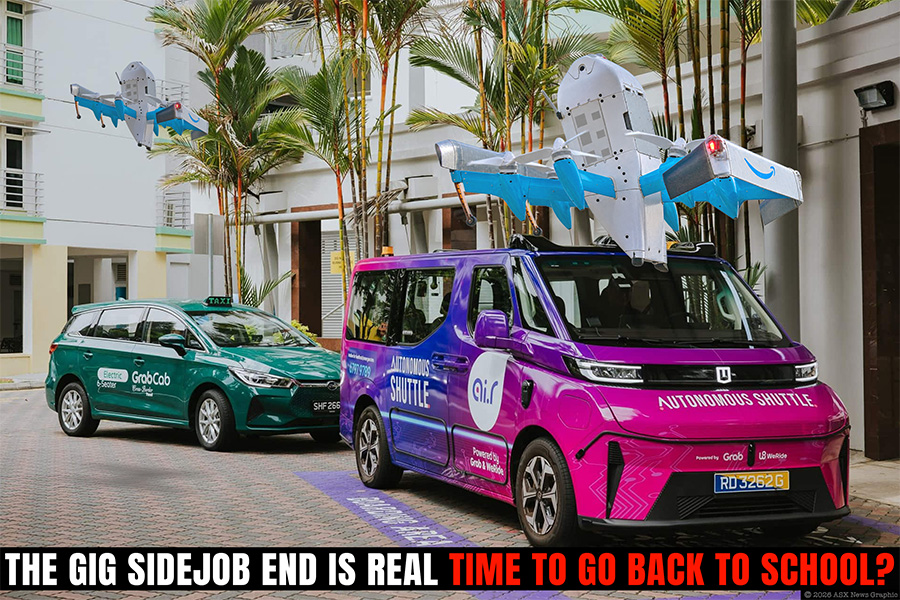
For years, the gig economy presented itself as the great economic escape route. If you lost your job, you could drive for a ride-hailing service, deliver food, transport packages, become a virtual assistant, design graphics, write advertising copy, or sell your professional services through an international freelancing platform. You could establish an income without necessarily having a university degree, an employer, or even a traditional workplace. Technology had liberated millions of people from the constraints of conventional employment. Ironically, that same technology is now threatening the economic foundation upon which their newfound independence was built.
Something fundamentally different is happening in late 2026. Artificial intelligence and autonomous transportation are no longer isolated technological developments confined to research laboratories and speculative investment presentations. They are increasingly becoming commercially viable alternatives to human labor. Three companies operating in distinctly different economic sectors—Upwork, Grab, and Amazon—provide particularly revealing examples of this transformation.
The Collapse of the Economic Safety Net
The gig economy emerged partly as a response to the limitations of traditional employment. Workers who could not find suitable full-time positions, individuals seeking supplementary income, parents requiring flexible schedules, and professionals displaced by corporate restructuring found opportunities through digital platforms. For many, gig work became more than a temporary financial arrangement. It became a career.
After the COVID-19 pandemic accelerated remote employment and digital commerce, millions of people became increasingly comfortable with the idea that a conventional employer was no longer necessary. A laptop, smartphone, internet connection, motorcycle, or automobile could become the foundation of an independent business. International platforms allowed individuals in developing economies to compete for employment opportunities previously inaccessible to them.
However, the structural weakness of this economic model was always present. The independent contractor typically owns neither the platform nor the technology that distributes the work. The worker remains dependent upon an intermediary whose commercial objectives may eventually diverge from the financial interests of the people performing the services. When that intermediary discovers a less expensive way to deliver the same product or service, the relationship can change dramatically.
Upwork: When the Employment Platform Eliminates Its Own Jobs
On November 12, 2026, Upwork Inc. disclosed an expansion of its corporate restructuring program through an amended Form 8-K filed with the United States Securities and Exchange Commission. The company had initially announced plans in May to eliminate approximately 24 percent of its workforce. Following additional restructuring authorized by its board of directors on November 10, the expected cumulative reduction has increased to approximately 37 percent.
The restructuring is now expected to be substantially completed during the first quarter of 2027. The company estimates that associated costs will range between $27 million and $37 million, primarily related to employee severance and other termination expenses.
The reduction concerns Upwork’s own workforce and does not mean that 37 percent of its registered freelancers are being removed from the platform. Nevertheless, the company’s financial disclosures reveal a considerably broader problem affecting the freelance marketplace itself.
In its quarterly report for the period ending September 30, 2026, Upwork acknowledged declining gross services volume and active client numbers. Among the contributing factors identified by the company was the changing influence of artificial intelligence on particular categories of freelance services. Difficulties attracting and retaining customers, changes affecting search engine visibility, and wider economic uncertainty were also identified as contributing factors.
This distinction is important. The problem is not merely that an employment platform is reducing its internal operating expenses. The marketplace through which independent workers obtain employment is itself experiencing technological disruption. Businesses that previously hired freelance writers, translators, graphic designers, administrative assistants, programmers, and researchers are increasingly capable of completing portions of those assignments using artificial intelligence.
That does not necessarily eliminate the need for skilled professionals. It does, however, change the amount of human labor required to accomplish a particular task. A company that previously contracted five individuals may find that two experienced professionals equipped with AI systems can produce comparable output. Even when the quality of automated work requires human supervision, the total demand for human labor can decline.
For freelancers, the consequences may become apparent through fewer available assignments, increased competition, declining compensation, and rising expectations regarding productivity. Unlike traditional corporate layoffs, this displacement may occur without a formal announcement, termination notice, severance payment, or any official acknowledgment that a job has disappeared.
Grab: The Driver May No Longer Be Necessary
While artificial intelligence is transforming the digital services marketplace, autonomous transportation is introducing a comparable threat to occupations that were once considered relatively resistant to computer-based automation.
On September 15, 2026, Southeast Asian technology company Grab announced plans to increase its Singapore autonomous vehicle fleet from 10 to 50 vehicles over approximately six months. The expansion represents a fivefold increase and forms part of a broader corporate objective to introduce thousands of autonomous vehicles throughout Southeast Asia by 2030.
Working with Singapore’s transportation authorities, Grab intends to expand its autonomous operations within Punggol and pursue additional deployment opportunities elsewhere in Singapore, subject to regulatory authorization. Its autonomous transportation initiatives, including its collaboration with autonomous driving technology company WeRide, demonstrate that driverless mobility is becoming an operational component of the company’s commercial strategy.
Grab currently describes its approach as a hybrid mobility model incorporating both autonomous vehicles and human drivers. There is no announced regional deadline for the elimination of human drivers. Nevertheless, the long-term economic implications of autonomous transportation cannot be ignored.
The human driver represents a recurring operating expense for conventional transportation services. Autonomous vehicles introduce substantial alternative expenses involving acquisition, financing, maintenance, insurance, software, remote supervision, and regulatory compliance. If those expenses eventually become lower than the cumulative cost of conventional driver-operated transportation, the commercial incentive to expand autonomous fleets becomes increasingly compelling.
Unlike a human driver, an autonomous transportation system does not require rest for physiological reasons, does not experience fatigue in the conventional sense, and does not depend upon an individual remaining available throughout an operating shift. Vehicles must still undergo maintenance, charging, cleaning, and operational inspections, but their potential utilization rates could significantly alter the economics of commercial transportation.
For millions of individuals who entered ride-hailing because they believed driving represented an accessible and dependable source of income, the emergence of commercially deployed autonomous transportation represents a development worthy of serious attention.
Amazon: Automation Takes to the Sky
The transportation revolution is not confined to the ground. Amazon’s Prime Air initiative illustrates how autonomous aviation could eventually transform another significant component of the gig economy: last-mile delivery.
On August 19, 2026, Amazon announced plans to expand its American drone delivery service to nearly 500 cities and towns by the end of the year. At the time of the announcement, the company reported 11 operational delivery locations serving communities across seven states. Amazon also reported completing hundreds of thousands of drone deliveries during 2026 and conducting thousands of deliveries daily across its network.
The expansion is particularly significant because it transforms drone delivery from a geographically limited commercial experiment into a potentially substantial distribution system. Amazon customers can receive eligible lightweight products in approximately 30 minutes under suitable operating conditions. The company’s electric-powered MK30 aircraft incorporates automated navigation and obstacle-detection capabilities designed to support commercial operations within regulated airspace.
Amazon Prime Air operates under Federal Aviation Administration Part 135 certification. Its expansion requires aviation safety assessments, suitable infrastructure, operational personnel, regulatory compliance, and consideration of environmental and community concerns. In November 2026, Amazon also announced that its British operation had achieved a significant aviation safety authorization from the United Kingdom Civil Aviation Authority, expanding potential delivery opportunities around Darlington.
The Federal Aviation Administration has published environmental assessments for extensive proposed Amazon drone operations throughout the United States. Some proposed delivery facilities contemplate operating as many as 1,000 flights per day from an individual location. Although proposed operational capacity should not be confused with actual daily delivery numbers, the scale of these plans provides insight into the potential future of automated commercial distribution.
There are substantial limitations. Drones cannot transport every product, serve every address, or operate reliably under all weather conditions. Traditional delivery vehicles remain indispensable for heavier merchandise, consolidated shipments, and numerous other distribution requirements. Prime Air continues to operate alongside Amazon’s existing logistics network rather than replacing it entirely.
However, widespread technological displacement does not require the complete elimination of an occupation. If automated aircraft eventually account for a substantial percentage of lightweight local deliveries, the number of conventional delivery assignments available to human workers could decline. The same competitive and economic pressures could eventually influence food delivery, pharmaceutical distribution, grocery delivery, and other commercial transportation services.
Why the Philippines Should Be Paying Attention
Few countries have as much reason to monitor these developments as the Philippines. The country’s English-speaking workforce, established outsourcing industry, growing digital infrastructure, and widespread adoption of online employment have made international freelance work an attractive economic opportunity for Filipino households.
Virtual assistants, customer service representatives, transcriptionists, content writers, social media managers, graphic designers, and administrative support personnel provide services to businesses throughout the world. Meanwhile, ride-hailing and delivery platforms provide opportunities for individuals seeking income outside conventional employment arrangements.
The International Labour Organization published a research brief on February 5, 2026, examining Philippine occupational exposure to generative artificial intelligence. The organization estimated that approximately 12.7 million Filipino workers, representing more than one-quarter of the country’s employment, work in occupations exposed to generative AI. Among Southeast Asian countries with comparable recent data, the Philippines recorded the highest exposure rate.
Exposure does not represent a prediction that 12.7 million jobs will disappear. It indicates that AI has the potential to substantially influence the tasks performed within those occupations. Some workers may become considerably more productive, while others could experience declining employment opportunities or fundamental changes to their responsibilities.
Research published by the University of the Philippines School of Economics in 2026, using nationally representative data from the 2025 Jobs and Skills Survey, also identified significant vulnerabilities among platform workers. Drivers and delivery workers frequently entered platform employment because alternative opportunities were limited. Workers in these categories also experienced comparatively restricted access to conventional employer-provided benefits, including health insurance, pensions, and separation benefits.
This creates a potentially dangerous economic combination. Individuals who entered independent employment because conventional opportunities were unavailable may eventually confront technological displacement without the financial protections ordinarily associated with traditional employment.
The Philippines is not Singapore. Differences in road infrastructure, congestion, traffic behavior, regulatory systems, geography, and operating economics could significantly delay the widespread introduction of autonomous vehicles. An autonomous shuttle successfully operating within a controlled Singapore transportation environment cannot simply be assumed to function equally well on the streets of Manila, Cebu, or the provincial communities of the Philippine archipelago.
Nevertheless, the economic threat to Filipino online freelancers does not require autonomous technology to reach Philippine streets. A business in California, London, Melbourne, or Toronto can reduce its dependence on overseas administrative or creative services through artificial intelligence installed thousands of kilometers away. Technological displacement can cross national borders without the technology itself ever entering the affected country.
The Disappearing Entry-Level Professional
One of the most concerning aspects of this transformation involves the traditional relationship between entry-level employment and professional development. Historically, individuals entered an occupation performing relatively uncomplicated assignments. Through experience, supervision, additional training, and exposure to increasingly complex responsibilities, they gradually developed professional competence.
Artificial intelligence is particularly effective at automating many of the routine activities that once provided this occupational training ground. Preliminary research, basic computer programming, document preparation, transcription, routine correspondence, and administrative processing can increasingly be completed with limited human involvement.
This presents an important question for businesses and educational institutions. If the entry-level work through which inexperienced professionals traditionally developed expertise progressively disappears, where will the next generation of experienced professionals acquire that expertise?
Organizations may discover that eliminating junior positions creates immediate financial benefits while simultaneously weakening the long-term development of their professional workforce. An enterprise that depends entirely upon experienced individuals supervising automated systems must eventually confront the problem of replacing those experienced individuals when they retire or leave the organization.
The educational system may consequently assume an increasingly important responsibility for providing practical experience that employers are no longer willing to finance through conventional entry-level employment.
Artificial Intelligence Is Also Creating Employment
It would be economically shortsighted to suggest that technological advancement only destroys employment. Autonomous transportation, commercial drone aviation, robotics, cybersecurity, data infrastructure, and artificial intelligence are creating opportunities that did not exist within the conventional gig economy.
Autonomous aircraft require maintenance technicians, aerospace engineers, flight operations specialists, aviation safety professionals, regulatory compliance personnel, and individuals responsible for monitoring operational performance. Automated ground transportation requires comparable expertise involving vehicle maintenance, sensor systems, electronics, software, infrastructure, and transportation management.
Artificial intelligence introduces opportunities in cybersecurity, systems integration, data governance, software development, quality assurance, risk management, and specialized applications across medicine, engineering, education, finance, and numerous other professional disciplines.
The problem is that these emerging occupations frequently require technical competence substantially beyond the qualifications necessary to enter conventional delivery, ride-hailing, or routine freelance employment. A displaced delivery driver cannot automatically become an autonomous aircraft maintenance technician, just as a virtual assistant cannot automatically become a cybersecurity engineer.
The existence of new jobs therefore does not guarantee that those jobs will be accessible to the people whose existing occupations are being disrupted. The transition requires education, training, investment, and time.
It’s Probably Time to Go Back to School
Education has traditionally been associated with the acquisition of a credential required to obtain employment. In the emerging technological economy, however, the value of education may increasingly reside in its ability to develop intellectual adaptability, analytical reasoning, technical understanding, and the capacity to acquire entirely new professional competencies.
Returning to school does not necessarily mean enrolling in a four-year university program. Technical colleges, vocational institutions, professional certification programs, apprenticeships, graduate education, and carefully selected specialized training courses can provide meaningful opportunities for occupational advancement.
Individuals working in transportation might investigate qualifications in vehicle electronics, electric propulsion, automation maintenance, logistics management, or unmanned aircraft operations. Administrative professionals could pursue specialized education in information security, healthcare administration, accounting, regulatory compliance, or advanced business systems. Creative professionals might develop expertise in intellectual property management, sophisticated production techniques, technical illustration, or specialized design applications.
These decisions should be based on demonstrated employment requirements rather than fashionable technological terminology. An expensive educational program that produces a credential for which employers have little demand may create additional financial hardship. The objective is to acquire a combination of specialized knowledge, practical experience, and recognized qualifications that provides genuine economic mobility.
Importantly, learning how to use artificial intelligence is not necessarily sufficient. Familiarity with AI software will increasingly become a basic occupational expectation rather than an exceptional professional qualification. The more durable advantage may belong to individuals who possess substantive expertise within a particular discipline and know how to apply artificial intelligence responsibly within that discipline.
An experienced aviation professional using artificial intelligence is fundamentally different from someone using artificial intelligence to imitate an experienced aviation professional. The same principle applies to medicine, engineering, law, accounting, cybersecurity, and other occupations where knowledge, judgment, professional responsibility, and the consequences of error remain critically important.
The Responsibility of Governments and Educational Institutions
Governments must recognize that technological unemployment and conventional unemployment are not necessarily equivalent. Providing temporary financial assistance to workers displaced by an economic recession may help them survive until employment opportunities return. However, when an occupation is permanently transformed by technology, waiting for the previous employment market to recover may accomplish very little.
Educational institutions must correspondingly reassess whether their curricula reflect the occupational requirements emerging from technological development. Programs designed around repetitive administrative activities, outdated software applications, and narrowly defined professional responsibilities may no longer provide graduates with the economic protection they once offered.
For countries such as the Philippines, developing affordable retraining opportunities through universities, vocational institutions, and organizations such as the Technical Education and Skills Development Authority could become increasingly important. Educational accessibility must extend beyond young people entering the labor market to include experienced workers seeking to protect their livelihoods during periods of technological restructuring.
Businesses also have a responsibility to consider the social and economic consequences of replacing human labor. Corporate profitability and operational efficiency are legitimate commercial objectives, but widespread erosion of household purchasing power could ultimately weaken the consumer markets upon which those businesses depend.
The Beginning of the End?
The gig economy will not disappear overnight. Human drivers, delivery personnel, online freelancers, and independent contractors will continue providing valuable services for the foreseeable future. New forms of independent employment will emerge, and some existing occupations may become more profitable through the intelligent application of automation.
However, the economic conditions that allowed comparatively accessible independent work to flourish are being fundamentally altered. Artificial intelligence is reducing dependence on routine digital labor. Autonomous vehicles are challenging conventional transportation economics. Commercial drone delivery is introducing a new alternative to human-operated distribution.
Upwork, Grab, and Amazon are not three unrelated corporate stories. Together, they illustrate a broader transformation occurring across the digital, terrestrial, and aerial dimensions of the modern economy. The same technological infrastructure that helped create the gig economy is increasingly capable of performing the services for which that economy was established.
For individuals currently dependent upon these occupations, the most valuable commodity may be time. Time to acquire additional qualifications, develop new professional competencies, diversify income, and prepare for an employment environment that could look substantially different by the beginning of the next decade.
The appropriate moment to pursue additional education is not necessarily after the job disappears. It may be while the income from that job still provides the opportunity to prepare for something better.
Technology gave millions of people an alternative to traditional employment. Education may now provide them with an alternative to technological unemployment.
Sources and Further Reading
United States Securities and Exchange Commission — Upwork Inc., Amended Form 8-K, November 12, 2026.
Grab — Autonomous Fleet Expansion and Southeast Asian Mobility Strategy, September 15, 2026.
Amazon — Prime Air Drone Delivery Expansion, August 19, 2026.
Amazon Prime Air — Commercial Drone Delivery Operations.
Federal Aviation Administration — Environmental Review and Commercial Drone Operations.
Amazon UK — Prime Air SAIL 4 Authorization, November 10, 2026.