


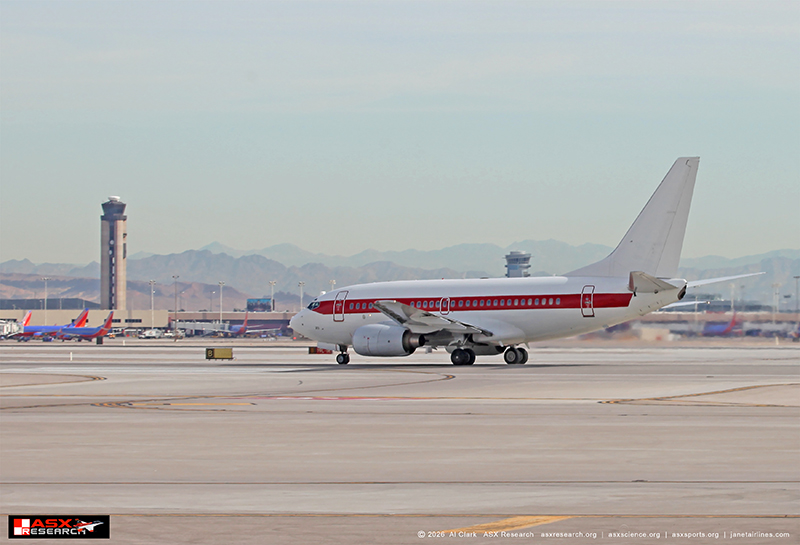
Every day, ordinary-looking passenger jets depart Las Vegas for some of the most closely guarded aerospace facilities in the United States. Their white fuselages and narrow red stripes are familiar to aviation enthusiasts, but there is no public ticket counter, reservation system, or published passenger schedule.
They belong to the operation commonly known as JANET, a government employee-airlift network connecting Las Vegas with restricted installations including Area 51 and Tonopah Test Range.
In a 30-page ASX Research investigation, aviation researcher Albert N. Clark reconstructs JANET’s history, aircraft, operations, infrastructure, and role in America’s classified aerospace enterprise. The study reveals something more compelling than the mythology: an essential transportation system whose aircraft are visible even when the work of their passengers remains secret.
The Airline You Can See but Cannot Book
JANET aircraft operate from a dedicated facility at Harry Reid International Airport in Las Vegas. They share runways and controlled airspace with commercial airlines, communicate with air traffic controllers, and operate recognizable passenger aircraft bearing United States registrations.
What makes the operation unusual is its purpose. JANET transports authorized government, military, and contractor personnel rather than paying members of the traveling public.
Its aircraft can be photographed, identified, and sometimes observed through public aviation-surveillance systems. Yet those observations reveal remarkably little about the classified programs supported by the people aboard.
From the U-2 to Area 51
The story begins in 1955, when the Central Intelligence Agency selected Groom Lake, Nevada, as an isolated test location for Lockheed’s revolutionary U-2 reconnaissance aircraft.
The remote desert site offered security and restricted airspace, but its isolation created a logistical problem. Engineers, pilots, technicians, mechanics, and other personnel still needed to reach the facility.
Early aircraft shuttles connected Groom Lake with the outside world, including Lockheed’s facilities in Burbank, California. The CIA has acknowledged the importance of these flights to the original U-2 program.
The hazards of this early transportation network became tragically apparent on November 17, 1955, when a Douglas C-54 carrying personnel toward Groom Lake struck Mount Charleston near Las Vegas. All 14 people aboard were killed.
As Groom Lake expanded into programs involving the CIA’s Mach 3 A-12 OXCART aircraft and other classified aerospace projects, the requirement for dependable personnel transportation only increased.
How JANET Became JANET
The recognizable JANET operation emerged during the early 1970s, initially using Douglas DC-6 aircraft. The defense contractor EG&G played an important role in the transportation system and the wider Nevada testing enterprise.
The name JANET has inspired popular interpretations, including “Just Another Non-Existent Terminal.” However, the research finds no authoritative public documentation establishing such phrases as official acronyms.
A historical account instead attributes the name to Richard A. Sampson, a former Groom Lake commander who reportedly named the commuter operation after his wife, Janet.
Around 1980, Boeing 737-200 aircraft began replacing the piston-powered DC-6 fleet. Their simple white-and-red appearance established the distinctive visual identity that survives today.
Six Boeing 737s and a Secretive Mission
Between 2008 and 2009, six Boeing 737-600 aircraft entered the operation, replacing the aging 737-200s.
The research identifies the aircraft by their publicly documented registrations: N319BD, N869HH, N859WP, N273RH, N365SR, and N288DP. Registration information associates the fleet with the United States Department of the Air Force.
The 737-600 is an unusual but logical choice. Its passenger capacity, established commercial-airliner systems, and maintainability suit frequent transportation between Las Vegas and remote military installations.
Smaller Beechcraft aircraft have also supported the network, providing flexibility for routes and passenger loads that do not require a full-sized Boeing jet.
The aircraft themselves are not particularly exotic. Their destinations and the work performed by their passengers are what make the operation extraordinary.
More Than the Area 51 Shuttle
Although JANET is commonly associated with Area 51, its operational geography extends beyond Groom Lake.
Tonopah Test Range, approximately 160 miles northwest of Las Vegas, developed its own significant national-security history. The facility supported weapons testing and became closely associated with secret operations involving the F-117 stealth fighter.
Other aerospace facilities in Nevada and California have also been associated with portions of the employee-airlift network, although the research cautions that publicly reported routes must be evaluated according to the strength of their supporting evidence.
JANET is therefore better understood as a transportation network linking geographically isolated defense organizations than as a single shuttle serving one mysterious destination.
A Surprisingly Busy Operation
The operation’s scale challenges the popular image of an occasional secret flight.
In 2023, aviation-industry reporting described an Air Force requirement for continuing contractor support of the Boeing 737-600 fleet. The contemplated workload included capacity for approximately 190 flights per week.
That figure represents a reported contracting requirement, not proof that exactly 190 flights occur every week. Nevertheless, it illustrates the scale of the government’s recurring transportation needs.
Unlike commercial airlines, JANET does not exist to generate ticket revenue. Its economic purpose is to deliver specialized personnel efficiently to facilities where their work supports expensive and technically demanding programs.
In practical terms, the aircraft turn remote national-security installations into workplaces accessible through a daily commute.
Secrecy Does Not Eliminate Aviation Risk
JANET’s unusual mission does not exempt it from conventional aviation hazards.
On March 16, 2004, a Beechcraft 1900C registered N27RA crashed while approaching Tonopah Test Range, killing its pilot and four passengers.
An unclassified Air Force investigation concluded that the pilot suffered sudden cardiac incapacitation while maneuvering for landing. Investigators also identified undisclosed medical conditions and medication-related issues.
The accident demonstrated that aviation safety remains fundamental even when aircraft support classified programs. Medical fitness, operational procedures, weather, maintenance, and human performance remain consequential regardless of the passengers’ security clearances.
It also demonstrated that meaningful accident investigations can enter the public record without exposing unrelated classified missions.
The Limits of Watching a Secret Airline
JANET illustrates an important distinction between observing an aircraft and understanding the activity it supports.
Aircraft registrations, radio communications, flight movements, and photographs can establish portions of the transportation system’s existence and history. They cannot independently reveal the identities, assignments, or classified projects of its passengers.
Modern surveillance technology, including publicly accessible ADS-B receiver networks, has made some aviation activity easier to observe. But increased visibility does not eliminate the difference between documented evidence and speculation.
The research emphasizes that responsible investigation must distinguish government records, accident reports, and documented aircraft histories from enthusiast observations, rumors, and unsupported claims.
Why the Red-Striped Aircraft Matter
For more than seven decades, personnel transportation has helped sustain America’s restricted Nevada aerospace enterprise. Aircraft types, contractors, and technologies have changed, but the underlying requirement has remained consistent.
Secret aircraft programs depend on more than revolutionary machines. They require engineers, technicians, maintainers, security specialists, flight crews, administrators, and the infrastructure needed to bring those people to work.
JANET makes that infrastructure visible.
The central finding of the ASX Research investigation is that JANET succeeds not by making its aircraft disappear, but by separating observable transportation from protected mission information.
Everyone can see the airplane. Almost nobody outside the classified programs knows what its passengers accomplished after landing.
Read the complete 30-page ASX Research paper: JANET Airlines: The Airline That Hides in Plain Sight — ASX Research Journal and Database, September 29, 2026.