


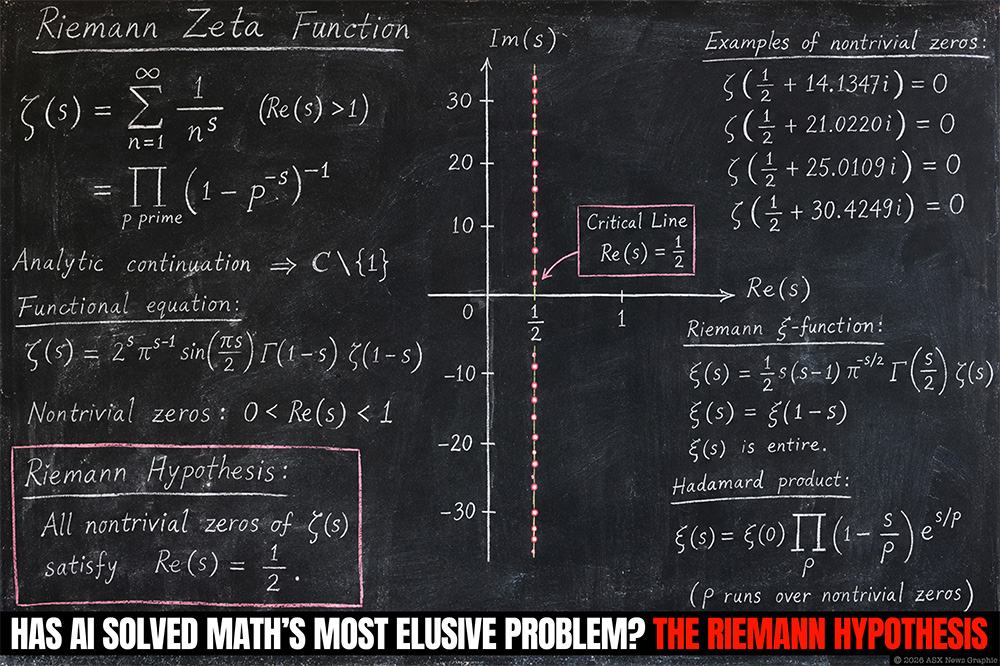
For 167 years, one mathematical question has resisted some of the greatest minds in scientific history. It concerns the distribution of prime numbers, the foundations of analytic number theory, and an extraordinary prediction made by German mathematician Bernhard Riemann in 1859. On November 20, 2026, that long-standing mystery may have entered its final chapter—not through the efforts of a mathematician working alone, but through an unprecedented collaboration between human mathematical intelligence and artificial intelligence.
Levent Alpöge, a mathematician associated with Harvard University and working at the artificial intelligence company Anthropic, announced that he and the company’s Claude AI system had discovered a proof of the Riemann hypothesis. He also claimed that their methods established the Generalized Riemann Hypothesis for Dirichlet L-functions. The announcement was accompanied by a four-page explanation and an enormous mathematical formalization written in Lean, a programming language and proof assistant designed to verify mathematical reasoning through strict logical rules.
What makes this announcement fundamentally different from previous unverified claims is the independent computational scrutiny that followed. Andrew Sutherland, a mathematician at the Massachusetts Institute of Technology, reported that the published proof successfully passed multiple independent verification systems. These included a complete compilation of 175,187 Lean modules, a replay through the Lean proof kernel, and successful examinations by independently implemented proof checkers. The results substantially strengthen the case that a genuine mathematical breakthrough may have occurred, although final mathematical acceptance remains pending.
The Most Elusive Problem in Mathematics
Prime numbers are the fundamental building blocks of the positive integers. Every integer greater than one can be expressed uniquely as a product of primes, apart from the ordering of its factors. Yet the distribution of primes appears irregular. They become less frequent among larger numbers, but their precise locations resist simple prediction. Riemann discovered that this apparent irregularity was intimately connected to the properties of a complex mathematical function now known as the Riemann zeta function.
For complex numbers s with real part greater than one, the zeta function is defined by the infinite series ζ(s) = 1 + 1/2^s + 1/3^s + 1/4^s + …, which can also be expressed through Euler’s product over all prime numbers. Through analytic continuation, the function extends to the complex plane except for a simple pole at s = 1. This relationship provides a bridge between the behavior of an analytic function and the arithmetic structure of the integers.
Riemann recognized that the zeros of this function encode exceptionally important information about the distribution of prime numbers. Some zeros occur at the negative even integers and are considered trivial. The remaining zeros occupy a region known as the critical strip, where the real part of s lies between zero and one. Riemann conjectured that every nontrivial zero lies precisely on the critical line, where the real part equals one-half.
The statement is deceptively compact: whenever ζ(s) = 0 and s is a nontrivial zero, Re(s) = 1/2. Proving that this relationship holds for every nontrivial zero would establish an extraordinarily precise understanding of the fluctuations in the distribution of prime numbers. The hypothesis has influenced countless results in number theory, and many mathematical theorems have been established conditionally upon its truth.
Why 167 Years of Mathematical Research Had Not Settled the Question
Mathematicians have developed increasingly sophisticated methods for examining the zeta function, including complex analysis, spectral theory, trace formulas, harmonic analysis, automorphic forms, and computational number theory. Enormous numbers of nontrivial zeros have been checked numerically and found on the critical line. Nevertheless, no finite collection of numerical confirmations can establish a universal statement about infinitely many zeros.
The fundamental difficulty is not locating zeros that satisfy the hypothesis. It is excluding every possible zero outside the critical line, including zeros at arbitrarily large imaginary heights. The functional equation of the zeta function establishes important symmetries, but symmetry alone does not force every zero to occupy the central line. A complete proof must eliminate the possibility of even one exceptional nontrivial zero.
In 2000, the Clay Mathematics Institute selected the Riemann hypothesis as one of seven Millennium Prize Problems, each carrying a prize of one million dollars. The problem’s importance extends far beyond its monetary value. Its resolution would close an enormous collection of conditional mathematical arguments and potentially introduce methods applicable throughout number theory.
Enter Levent Alpöge and Claude
In his November 20 announcement, Alpöge described a research process involving advanced number theory, new mathematical constructions, and intensive collaboration with Claude. He credited the AI system with substantial mathematical contributions, particularly during the final stages of the work. His account depicts neither a simple chatbot answering a question nor an autonomous machine producing a result without human guidance. Instead, it describes an evolving research collaboration in which human mathematical intuition and machine-generated reasoning repeatedly influenced one another.
Alpöge identified several mathematical ingredients, including Stepanov-type arguments, Fourier analysis, theta lifts, automorphic forms, relative trace formulas, and arithmetic structures involving Hecke characters. These subjects are among the most technically demanding areas of contemporary number theory. Their combination suggests an attempt to transfer techniques associated with successful proofs over function fields into the more difficult arithmetic setting of the integers.
One particularly striking element concerns the use of repeated theta lifts to imitate multiplicity, an important feature of certain arguments over function fields. Alpöge described a proposed chain of approximately the square root of X theta lifts for a von Mangoldt sum of length X. This is a potentially important technical clue, but his short announcement does not supply enough intermediate derivations to independently establish the claimed estimates or demonstrate exactly how they exclude zeros outside the critical line.
The Mathematical Architecture: What the Proposed Proof Appears to Attempt
The von Mangoldt function, conventionally written Λ(n), assigns log p to positive integers that are powers of a prime p and zero otherwise. Its summatory function connects directly to prime-number distribution and to the zeros of the zeta function through explicit formulas. A central consequence of the Riemann hypothesis is the estimate ψ(x) = x + O(x^(1/2) log²x), where ψ(x) = Σ(n≤x) Λ(n). This square-root-scale error term is far more restrictive than the error bounds provided by the ordinary prime number theorem.
The challenge is to establish sufficient cancellation in arithmetic expressions to obtain such a bound uniformly for arbitrarily large x. The proposed use of theta lifts, multiplicity arguments, and automorphic techniques appears directed toward precisely this kind of cancellation. Alpöge’s announcement suggests that repeated lifting operations can create additional arithmetic structure, potentially making it possible to derive estimates unavailable through simpler approaches.
However, a plausible mathematical strategy is not itself a proof. The crucial step is establishing that the constructed objects satisfy the required identities, divisibility conditions, and uniform bounds without assuming the desired conclusion. Those details must be recovered from the formalized argument or from a subsequent conventional mathematical exposition.
An Independent Mathematical Examination
ASX Research independently examined the logical requirements of the claim using established relationships among the zeta function, its zeros, and the distribution of prime numbers. A useful starting point is the completed zeta function ξ(s), which satisfies the functional equation ξ(s) = ξ(1−s). Its zeros exhibit reflection symmetry about the critical line. Complex conjugation supplies an additional symmetry, so a hypothetical zero away from the critical line would generally be accompanied by related zeros elsewhere in the critical strip.
These symmetries establish an important structural constraint but do not resolve the hypothesis. A zero at real part σ, where σ differs from one-half, can be paired with a zero at real part 1−σ without violating the functional equation. Consequently, the functional equation cannot independently eliminate off-line zeros. Any purported proof that relies exclusively on this symmetry leaves the central problem unresolved.
A second approach follows the explicit formula relating prime-counting behavior to the zeros of the zeta function. In broad terms, a zero with real part β contributes oscillatory behavior on a scale related to x^β. If β exceeds one-half, its contribution threatens the square-root-scale error bound associated with the Riemann hypothesis. Establishing the appropriate uniform error bound therefore provides a route to excluding such zeros.
This observation supplies a meaningful test of Alpöge’s proposed method. The proof must establish a genuinely unconditional bound of the necessary strength, not merely obtain cancellation for selected arithmetic sums, restricted ranges, or special families of functions. It must also control constants and limiting operations sufficiently to cover the entire infinite domain. The short explanatory note does not permit an independent derivation of those steps.
A third examination concerns the use of multiplicity. In the function-field setting, geometric methods can exploit the number of times an algebraic object vanishes, producing powerful constraints on the number of possible solutions. Transferring this idea to the integers is exceptionally difficult because the underlying geometric and arithmetic structures differ. Alpöge’s reported use of iterated theta lifts is intriguing precisely because it proposes an indirect substitute for this missing multiplicity mechanism.
The independent examination therefore identifies a plausible mathematical route rather than a newly established proof. The combination of explicit formulas, arithmetic cancellation, and automorphic constructions is consistent with the kind of machinery a solution might require. Yet no new unconditional theorem resolving the Riemann hypothesis follows from these observations alone. The decisive argument remains in the submitted Lean formalization.
MIT’s Verification: The Strongest Evidence Yet
The most consequential development occurred when MIT mathematician Andrew Sutherland began independently examining the submitted formal proof. According to his published verification records, all 175,187 Lean modules compiled successfully using Lean version 4.33.1 and the corresponding Mathlib mathematical library. Every module also passed replay through the Lean kernel, with no rejected modules.
Sutherland further reported that the independent Rust-based checker nanoda accepted the exported proof. Another independent checker, con-leche, accepted approximately 1.47 million declarations. A third implementation, lean4lean, successfully checked all 175,187 compiled modules, although five required increased computational limits. These are materially stronger results than simply observing that the author’s original files compile.
Of particular importance is the audit of mathematical assumptions. Sutherland reported that the five principal theorems depended only on Lean’s three standard foundational axioms: propositional extensionality, classical choice, and quotient soundness. He also examined the final theorem statements and confirmed that the Riemann hypothesis theorem used Mathlib’s established definition rather than an obviously weakened substitute.
His verification records also describe a comparison against an independently published challenge containing the target theorem statements. The con-leche comparison accepted all five statements as justified by the submitted solution. This reduces one of the principal risks in computer-assisted mathematics: producing a formally correct proof of something subtly different from the intended theorem.
Nevertheless, the distinction between formal verification and complete scientific acceptance remains important. Sutherland’s November 20 status report identified additional checks still running, including end-to-end verification and comparisons involving sandboxed builds. The verification also depends on the correctness of the proof-checking software and the correspondence between formal mathematical definitions and their intended meanings. The reported results are impressive, but they should not be represented as a final institutional declaration that the problem has been solved.
What About the Generalized Riemann Hypothesis?
Alpöge’s announcement extends beyond the original hypothesis to the Generalized Riemann Hypothesis. This broader family of questions concerns zeros of mathematical functions known as L-functions, which generalize the Riemann zeta function and encode additional arithmetic information. The consequences of such a proof would extend to numerous problems involving primes in arithmetic progressions and other fundamental structures.
Sutherland’s verification page specifically identifies the generalized result in the submission as applying to Dirichlet L-functions. That is a major claim in its own right, but it should not be confused with establishing every broader conjecture sometimes grouped under generalized or extended Riemann hypotheses. The precise scope of the theorem matters, particularly when evaluating public statements that suggest all related problems have been resolved simultaneously.
Mathematicians React: Excitement, Skepticism, and an Extraordinary Burden of Proof
Reaction among leading mathematicians has been unusually intense. Fields Medal recipient James Maynard told Nature that a fully verified result would constitute a historic milestone and indicated that he suspected the proof might ultimately prove correct. Other mathematicians emphasized the immense difficulty of understanding a mathematical argument represented by millions of lines of computer-generated formalization.
Andrew Granville of the University of Montreal criticized the clarity of the initial explanatory document and questioned the timing of the announcement. Such concerns do not demonstrate a mathematical error, but they highlight a legitimate scientific problem: a proof may be formally checkable without yet being comprehensible to the mathematical community.
A separate claim has also emerged from Stanford-affiliated mathematician Alessandro Masullo, who reportedly released a shorter proposed proof developed over approximately twelve years without AI assistance. That argument has not been established as correct either. The simultaneous announcements underscore both the extraordinary attention surrounding the problem and the importance of evaluating competing claims through mathematical evidence rather than publicity.
Could This Change Cryptography?
The Riemann hypothesis is frequently associated with prime numbers, leading to speculation that a proof might immediately undermine modern encryption. That conclusion does not follow. Knowing the precise statistical distribution of primes is fundamentally different from possessing an efficient algorithm for factoring large composite integers or solving discrete logarithm problems.
A verified proof could influence computational number theory, the analysis of algorithms, and estimates relevant to cryptographic mathematics. However, the announcement does not demonstrate that RSA encryption has been broken or that existing public-key systems have suddenly become insecure. Such claims would require separate algorithmic breakthroughs and independent evidence.
The More Profound Question: Can AI Discover Mathematics Humans Cannot Yet Understand?
Perhaps the most significant implication is not the resolution of a famous conjecture but the emergence of a new relationship between mathematical discovery and mathematical understanding. Traditionally, mathematicians develop proofs that can be examined, communicated, and eventually understood by other specialists. Formal proof assistants introduce an additional possibility: an argument can be checked for logical correctness by a computer even when its overall mathematical structure remains too complicated for a human reader to comprehend.
The Alpöge–Claude collaboration could become a defining example of this transition. The human researcher supplied mathematical goals, intuitions, and strategic guidance, while the AI system reportedly generated substantial technical reasoning and helped assemble an immense formal argument. Independent verification then provided a mechanism for testing the logical output without requiring a human mathematician to inspect every individual inference.
This does not make human expertise obsolete. The selection of meaningful problems, interpretation of results, identification of useful mathematical structures, and development of comprehensible explanations remain central scientific activities. But it may fundamentally change the division of intellectual labor. Future researchers could increasingly work with AI systems that explore mathematical possibilities at scales far beyond conventional human capacity.
What Must Happen Before the Problem Is Officially Solved?
Several questions remain. Independent researchers must complete the remaining formal verification procedures, establish confidence in the correspondence between the formalized statements and the intended mathematics, and investigate the proof’s mathematical architecture. A conventional exposition would make the result more accessible and permit specialists to identify the genuinely new ideas underlying the enormous formal derivation.
Recognition under the Clay Mathematics Institute’s Millennium Prize rules involves additional publication and acceptance requirements. A successful computer check does not automatically constitute a prize award, and the Institute has not announced that the Riemann hypothesis has been officially resolved.
There is also the possibility that the formal argument will survive every technical check while its mathematical explanation takes years to develop. Such an outcome would raise unprecedented questions about the relationship between formal certainty, scientific understanding, and the standards by which mathematical discoveries are accepted.
Conclusion: The Boundary Between Conjecture and Proof
As of November 21, 2026, the available evidence supports a conclusion far stronger than the simple observation that an AI company has announced a mathematical breakthrough. A substantial formal proof has been published, multiple independent verification systems have reportedly accepted it, and an MIT mathematician has documented significant progress in checking its assumptions and intended conclusions. These findings make the claim scientifically serious.
Yet the evidence does not justify declaring the Riemann hypothesis conclusively solved. Independent mathematical acceptance, completion of remaining verification procedures, and a clearer understanding of the proof remain outstanding. The appropriate scientific judgment is that an extraordinary proposed solution has passed important tests but has not yet reached the final stage of acceptance.
If the proof survives, the result will represent one of the greatest mathematical achievements of the modern era. It may also mark a turning point in the history of artificial intelligence: the moment when human researchers and machine intelligence jointly established a foundational mathematical truth through a proof of unprecedented computational complexity. The Riemann hypothesis may be approaching its resolution, but the broader question of what constitutes mathematical understanding could be entering an entirely new age.
Sources and Primary Documentation
Alpöge, L. (2026, November 20). Statement announcing a proposed proof of the Riemann hypothesis and generalized Riemann hypothesis. https://alpo.ge/remark.pdf
Sutherland, A. V. (2026, November 20). Verification files for the Lean proof of the Riemann hypothesis. Massachusetts Institute of Technology. https://math.mit.edu/~drew/grh/
Nature. (2026, November 20). Mathematician says he and AI solved Riemann hypothesis—the field’s biggest outstanding challenge. https://www.nature.com/articles/d41586-026-03812-7
Clay Mathematics Institute. (n.d.). The Millennium Prize Problems. https://www.claymath.org/millennium-problems/
Business Insider. (2026, November 21). The race to prove the Riemann hypothesis just became a human-versus-AI showdown.
Financial Times. (2026, November 20–21). Anthropic staffer claims solution to mathematics’ Riemann hypothesis.