


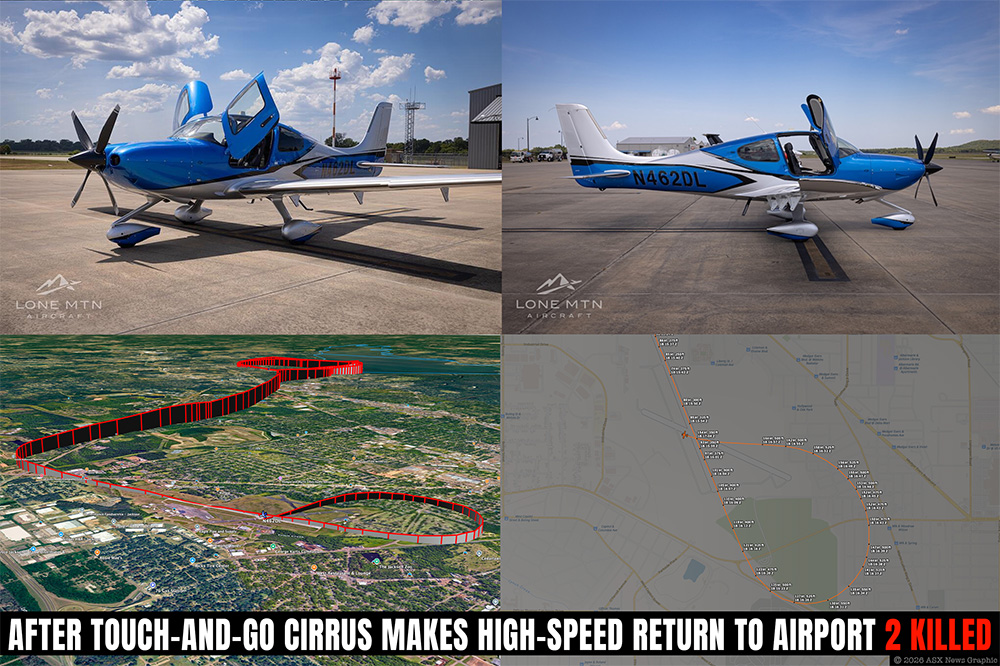
Two people were killed on Saturday, November 21, 2026, when a Cirrus SR22T G7+ Turbo crashed at Hawkins Field Airport (KHKS) in Jackson, Mississippi. The accident occurred at approximately 12:17 p.m. Central Standard Time and was followed by a substantial post-impact fire. Preliminary ADS-B flight-tracking data reveal an unusual sequence of low-altitude maneuvering and sustained acceleration following what appears to have been a touch-and-go landing.
Hinds County Coroner Jeramiah Howard confirmed that neither occupant survived. The aircraft was destroyed. The National Transportation Safety Board (NTSB) has confirmed its involvement in the investigation and identified the aircraft as a Cirrus SR22.
Accident Aircraft
The Aviation Safety Network identifies the aircraft as N462DL, a 2025 Cirrus SR22T G7+ Turbo, manufacturer’s serial number 10961. Previously published aircraft registration records identify its registered owner as Danmar Leasing LLC of Little Rock, Arkansas. The aircraft received its airworthiness certificate on September 26, 2025, making it approximately 14 months old at the time of the accident.
The aircraft was powered by a 315-horsepower Continental TSIO-550-K turbocharged reciprocating engine driving a four-bladed MT propeller. A previous sales listing published by Lone Mountain Aircraft advertised N462DL for $1,399,000 and recorded approximately 130 flight hours on the airframe, engine and propeller at the time the listing was prepared.
The aircraft represented one of the most technologically advanced generations of single-engine piston aircraft manufactured by Cirrus. Its equipment included the Garmin-based Cirrus Perspective Touch+ avionics suite, a GFC 700 three-axis autopilot with yaw damper, Electronic Stability and Protection (ESP), enhanced terrain awareness, the Cirrus Airframe Parachute System (CAPS), and the Safe Return Emergency Autoland system.
Departure and Flight History
The Jackson Municipal Airport Authority reported that the aircraft was believed to have originated from Bruce Campbell Field (KMBO) in Madison, Mississippi, a short distance northeast of Jackson. The intended final destination has not been officially established.
Local reporting by Darkhorse Press indicated that the aircraft had conducted two takeoff-and-landing sequences during approximately the half-hour preceding the fatal flight. Representatives of the Madison airport told WAPT that the aircraft was not associated with its airport organization and that none of its flight school’s student pilots were involved.
The available flight history suggests that the aircraft may have been engaged in proficiency flying, familiarization, flight training or another operation involving repeated runway approaches. The precise purpose of the flight and the qualifications and roles of the two occupants have not been established.
An Unusual Final Flight Profile
Preliminary ADS-B data examined by ASX News depict the aircraft proceeding southeast along the alignment of Runway 16 at Hawkins Field shortly before the accident. Between 18:15:34 and 18:15:43 UTC, the aircraft’s recorded groundspeed decreased from 92 knots to 74 knots, consistent with a landing maneuver.
At 18:15:50 UTC, the aircraft was accelerating through 80 knots. Its groundspeed subsequently increased to 85 knots at 18:15:54, 93 knots at 18:15:59 and 101 knots at 18:16:04. This sequence is consistent with an apparent touch-and-go landing followed by a renewed departure along Runway 16.
Rather than continuing into a conventional rectangular traffic pattern, the aircraft entered a continuous left-turning maneuver southeast of the airport. At 18:16:20 UTC, its recorded groundspeed had increased to 123 knots. Six seconds later, it was travelling at 127 knots as it continued turning eastward.
The aircraft subsequently turned northward while continuing to accelerate. At 18:16:37 UTC, its recorded groundspeed was 141 knots. By 18:16:43, it had reached 152 knots. The aircraft then continued turning toward the northwest and toward the alignment of the airport’s intersecting Runway 29.
At 18:16:52 UTC, the aircraft was travelling at 158 knots. Five seconds later, its recorded groundspeed reached 164 knots. The terminal ADS-B position, recorded at 18:17:04 UTC near the intersection of the airport’s runways, indicated a groundspeed of 154 knots and a reported altitude of 350 feet.
Hawkins Field has a published airport elevation of approximately 341 feet above mean sea level. The ADS-B altitude values must be interpreted in the context of their altitude reference, atmospheric pressure corrections and local terrain elevation. Nevertheless, the recorded sequence clearly depicts an aircraft maneuvering at exceptionally low altitude relative to the airport throughout the final departure and return.
Acceleration Rather Than Deceleration
Perhaps the most distinctive characteristic of the final flight sequence is the sustained increase in groundspeed. From its recorded minimum of 74 knots during the apparent landing maneuver, the aircraft accelerated to 164 knots over approximately 74 seconds, an increase of 90 knots.
Although the aircraft decelerated slightly during its final seven seconds of recorded flight, its terminal groundspeed remained substantially greater than would normally be expected during a stabilized landing approach in this aircraft type.
The aircraft’s reported altitude decreased from 500 feet to 350 feet during those final seven seconds, corresponding to an average indicated descent rate of approximately 1,286 feet per minute. This descent occurred while the aircraft was still travelling at more than 150 knots over the ground.
The combination of low-altitude maneuvering, sustained acceleration and a terminal descent toward the intersecting runway distinguishes this accident from the conventional profile of an aircraft experiencing a straightforward loss of engine power immediately following takeoff.
ADS-B groundspeed is not indicated airspeed, and the available tracking information does not establish engine power, aircraft attitude, flap configuration, control inputs or wind-relative performance. However, the sequence raises substantive questions concerning the intended maneuver and the circumstances under which it was conducted.
Potential Human and Aircraft-System Factors
Several investigative avenues emerge from the unusual terminal flight profile. These include an improperly executed low-altitude maneuver, spatial disorientation, distraction, control-system abnormalities, automation-related events, an unsuccessful runway transition, and sudden medical incapacitation of a person operating the aircraft.
The possibility of deliberate aircraft control inputs must also remain within the broader scope of investigative inquiry. Flight-tracking data alone, however, cannot establish whether a maneuver was intentional, inadvertent, medically influenced or the consequence of an aircraft-system malfunction. No evidence establishing suicidal intent or deliberate self-harm has been identified in the publicly available information.
The presence of two occupants adds another dimension to the accident. Investigators will need to establish whether both individuals were qualified pilots, which occupant was operating the aircraft, whether instruction or aircraft familiarization was taking place, and whether any emergency developed within the cockpit during the final maneuver.
Air traffic control communications will be particularly valuable in determining whether the aircraft was conducting a planned runway change, requested an unusual maneuver, experienced a reported emergency or ceased communicating with controllers before impact.
Safe Return Emergency Autoland and CAPS
Of particular significance is the aircraft’s documented installation of the Safe Return Emergency Autoland system. This technology is designed to enable an aircraft to navigate to a suitable airport and execute an automated landing when activated under appropriate emergency conditions, including pilot incapacitation.
Unlike earlier Cirrus SR22 generations equipped primarily with CAPS and conventional autopilot capabilities, the G7+ incorporates an additional mechanism intended to address emergencies in which the pilot is unable to continue operating the aircraft.
The presence of this system does not establish that it was activated, that the circumstances met its operational requirements or that sufficient time and altitude were available for its intervention. Examination of recoverable avionics information may establish the status of the autopilot, emergency autoland functions and electronic flight-envelope protection during the final flight sequence.
The aircraft was also equipped with the Cirrus Airframe Parachute System. Whether an attempted deployment occurred, or whether the aircraft’s altitude and flight conditions permitted an effective deployment, has not been established.
Impact and Emergency Response
The aircraft crashed within the portion of Hawkins Field occupied by the Mississippi Army National Guard. A significant fire developed following the impact.
Two National Guard maintenance personnel were present at the installation in connection with military helicopter operations and responded with portable fire extinguishers. Their efforts were unsuccessful in rescuing the aircraft’s occupants.
The emergency response also involved Jackson Municipal Airport Authority operations personnel and police, the Jackson Fire Department, American Medical Response and the Hinds County coroner’s office.
The airport authority subsequently announced that Hawkins Field would remain closed until Monday, November 23, while accident-related activities continued.
Hawkins Field Airport
Located northwest of downtown Jackson, Hawkins Field is a public-use airport with two intersecting runways. Runway 16/34 measures 5,387 feet in length and 150 feet in width. Runway 11/29 measures 3,431 feet in length and 150 feet in width.
The geometry of the intersecting runways is particularly relevant to the terminal ADS-B flight path. Following its apparent departure from Runway 16, the aircraft conducted a sweeping left turn that brought it back toward the airport from the southeast, broadly aligned with the direction of Runway 29.
The available tracking data place the aircraft near the runway intersection at its final recorded position. Establishing the precise impact location relative to the runway surfaces, together with the aircraft’s heading, pitch and bank angle at impact, will be important in reconstructing the terminal maneuver.
Investigative Significance
The accident presents an unusual combination of circumstances: a relatively new aircraft equipped with advanced emergency systems, an apparent series of preceding landing maneuvers, sustained acceleration during a low-altitude turn, and a terminal descent toward an operational airport.
Recoverable avionics data could provide investigators with aircraft parameters unavailable through public ADS-B tracking, including indicated airspeed, engine performance, pitch attitude, bank angle, automation status and potentially recorded system alerts. Medical and toxicological findings, air traffic control recordings, surveillance imagery and witness observations may further clarify the events preceding impact.
The central investigative question is not merely why N462DL descended into the airport environment, but why an aircraft apparently completing a routine landing maneuver subsequently entered a sustained, accelerating, low-altitude flight path that terminated near an intersecting runway.
Primary reporting and technical sources: WLBT; Darkhorse Press; WAPT; Aviation Safety Network; ADS-B Exchange; Lone Mountain Aircraft listing for N462DL; FAA airport information via AirNav.