


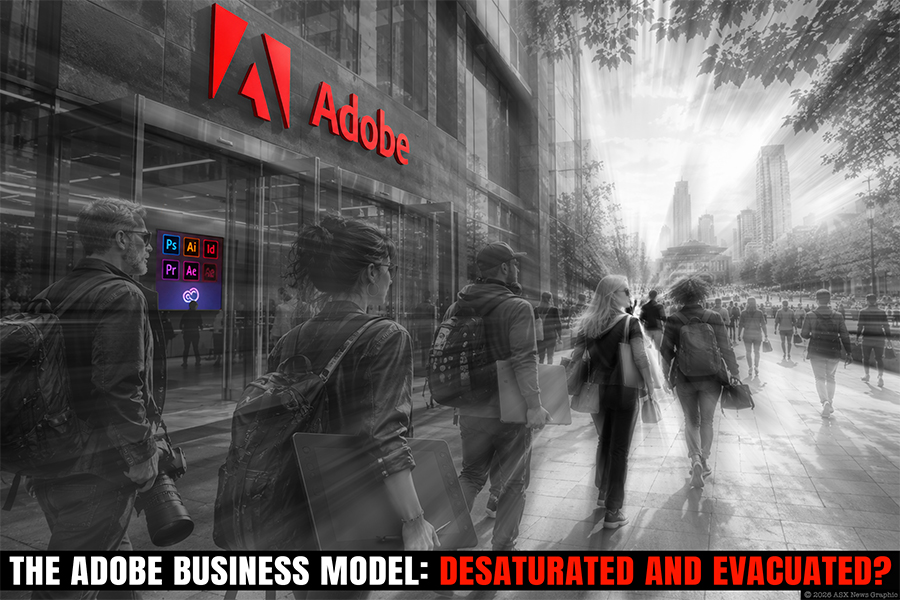
For decades, Adobe represented the undisputed establishment of professional digital creativity. Photographers, graphic designers, illustrators, filmmakers, publishers, and advertising agencies built entire careers around its software. Photoshop became part of the English language, Illustrator helped define digital graphic design, and the Portable Document Format (PDF) transformed the worldwide exchange of electronic documents. Adobe did not merely participate in the digital creative revolution; it helped create it. But in 2026, the company finds itself confronting an extraordinary economic paradox: record financial performance accompanied by growing uncertainty about the sustainability of the very business model responsible for its success.
From Software Ownership to Permanent Tenancy
Founded in 1982 by John Warnock and Charles Geschke, Adobe originally established its relationship with customers through conventional software licensing. Creative professionals purchased applications and retained the ability to use those versions indefinitely, subject to technological compatibility. When Adobe introduced an upgrade, customers could independently determine whether its improvements justified another expenditure. The commercial relationship required Adobe to repeatedly demonstrate the value of its innovations.
That relationship fundamentally changed in 2013 when Adobe transitioned its flagship creative applications toward the Creative Cloud subscription model. Customers increasingly found themselves paying for continued access rather than purchasing perpetual software licenses. Discontinuing payment meant surrendering access to applications that had become essential components of their professional lives.
From Adobe’s perspective, the transformation was financially brilliant. Recurring subscription payments provided predictable revenue, reduced dependence on traditional upgrade cycles, and facilitated continuous software development. From the customer’s perspective, however, the transformation introduced permanent financial obligations for tools that previously could be purchased outright.
Adobe had effectively transformed itself from a software merchant into a digital landlord. The designer’s studio, the photographer’s darkroom, and the filmmaker’s editing suite had become rented properties.
The Financial Paradox
Adobe’s financial statements reveal a company that remains exceptionally profitable. According to its fiscal 2025 annual report, Adobe generated approximately $23.77 billion in revenue, an 11 percent increase over the preceding fiscal year. Subscription revenue accounted for approximately $22.9 billion, or 96 percent of total revenue. Annual net income reached $7.13 billion, while operating cash flow exceeded $10 billion.
The momentum continued into 2026. On September 10, Adobe announced third-quarter revenue of $6.76 billion, representing year-over-year growth of 13 percent. Its revised full-year revenue forecast reached approximately $26.58 billion to $26.63 billion. By conventional financial measures, Adobe appears remarkably healthy.
Yet investors have demonstrated increasing concern about its future competitive position. Reuters reported that Adobe shares declined in extended trading following its September earnings announcement despite better-than-expected quarterly revenue and adjusted earnings. Earlier leadership announcements and concerns about artificial intelligence competition had also placed substantial pressure on its share price.
The apparent contradiction becomes more understandable when one recognizes that financial markets value companies not simply according to their current earnings, but according to expectations of their future earnings. Adobe’s existing subscribers continue to generate extraordinary revenue. The emerging question is whether future generations of creative professionals will demonstrate the same willingness to pay.
The $150 Million Cost of Making Departure Difficult
On June 17, 2024, the United States Department of Justice filed a federal complaint against Adobe and two company executives concerning subscription disclosures and cancellation practices. The government alleged violations of the Restore Online Shoppers’ Confidence Act, particularly involving the disclosure of early termination fees and obstacles encountered by customers attempting to cancel subscriptions.
On March 13, 2026, the Justice Department announced a settlement agreement requiring Adobe to pay $75 million in civil penalties and provide another $75 million in services to qualifying customers. A federal court entered the stipulated final judgment and permanent injunction on April 10, 2026.
Adobe disputed the government’s allegations and denied wrongdoing. The company maintained that subscriptions delivered continuous innovation, improved accessibility, and flexibility for customers. Nevertheless, the settlement imposed enforceable requirements concerning subscription disclosures and cancellation procedures.
The significance of the litigation extends beyond its monetary value. For a company generating tens of billions of dollars annually, the financial consequences are manageable. The more substantial issue is the relationship between Adobe and the creative professionals upon whom its financial success depends.
A subscription model based upon customers voluntarily renewing a valuable service is fundamentally different from one in which customers perceive departure as financially or professionally difficult. The former encourages loyalty. The latter creates an incentive to search for alternatives.
The Economics of Renting Creativity
Adobe’s published United States pricing places its Creative Cloud Pro individual subscription at a regular price of $69.99 per month under an annual contract billed monthly. Customers seeking a month-to-month arrangement without an annual commitment face a published price of $104.99 per month. A lower-priced Creative Cloud Standard option is also available.
At $69.99 per month, a creative professional pays $839.88 annually, or $8,398.80 over ten years, assuming no subsequent price increases. The more flexible monthly arrangement would cost $12,598.80 over the same period at its published rate. Neither arrangement provides a perpetual license to the subscribed desktop applications.
For a successful commercial design agency, those expenditures may represent an acceptable operating cost. For independent photographers, freelance designers, students, small publishers, and emerging creative professionals, they can represent a substantial financial burden, particularly in countries where average incomes are significantly lower than those of the United States.
The financial barrier becomes increasingly difficult to justify when capable competing applications are available at little or no cost. Adobe’s challenge is no longer simply demonstrating that its applications are excellent. It must demonstrate that their additional value is sufficient to justify a continuing financial commitment.
The Competitor Adobe Could Not Buy
In September 2022, Adobe announced its intention to acquire Figma for approximately $20 billion. Figma had established itself as a formidable competitor in collaborative digital design, particularly through browser-based workflows that challenged traditional desktop software conventions.
Competition authorities in Europe and the United Kingdom examined the proposed acquisition, raising concerns about its potential effects on competition. In December 2023, Adobe and Figma abandoned the transaction after concluding that the necessary regulatory approvals were unlikely to materialize.
Adobe subsequently paid Figma a $1 billion termination fee, as documented in its financial filings. The expenditure produced no acquisition, and Figma remained an independent competitor.
The episode represented an important strategic setback. An emerging competitor that Adobe had sought to incorporate into its own ecosystem was instead left free to develop its technology, expand its customer base, and challenge Adobe’s established market position.
Canva Opens the Exit Door
Perhaps an even more consequential development occurred on October 29, 2025, when Canva announced that its redesigned Affinity professional design application would be available free of charge. Combining photo editing, vector illustration, and page layout within a unified application, Affinity directly addresses three major areas historically associated with Photoshop, Illustrator, and InDesign.
Canva’s announcement fundamentally altered the economic comparison facing creative professionals. The question was no longer whether an alternative application could justify its purchase price. The core Affinity application eliminated that purchase price altogether.
Canva’s commercial strategy does not require abandoning profitability. Its broader ecosystem provides opportunities to monetize premium services, artificial intelligence capabilities, collaboration, and enterprise products. Giving away capable professional software can serve as a mechanism for attracting users into that ecosystem.
For Adobe, however, the arrival of free professional-grade creative software presents a structural challenge. Even if Photoshop, Illustrator, and InDesign retain advantages in certain workflows, the financial justification for subscribing to them becomes increasingly dependent upon the specific requirements of individual users.
The landlord now faces competition from another building offering substantially similar workspace without charging conventional rent.
Artificial Intelligence Changes the Definition of Creative Software
Artificial intelligence presents Adobe with a challenge potentially more significant than competition from conventional software developers. Traditional creative applications provide sophisticated instruments with which users manually construct, modify, and refine visual compositions. Generative artificial intelligence introduces an alternative workflow in which users can describe a desired composition and receive a preliminary or finished visual product within seconds or minutes.
The distinction is economically important. Artificial intelligence does not need to reproduce every function of Photoshop to diminish demand for Photoshop. It only needs to eliminate enough of the tasks for which individual customers previously required the application.
A small publisher requiring an editorial illustration may no longer need to assemble a composition from multiple stock photographs, manually remove backgrounds, construct lighting effects, and spend several hours adjusting individual graphical elements. An artificial intelligence system may produce an acceptable starting point almost immediately.
Similarly, merchandise designers can rapidly experiment with visual concepts, photographers can automate selected restoration tasks, and marketing departments can produce numerous variations of promotional material without reproducing every stage of the traditional production process.
Professional creative software will remain essential for many precision-dependent workflows, but the number of customers requiring its full range of capabilities may change. Adobe consequently faces competition not only from alternative applications, but also from technologies that reduce the necessity of using conventional applications at all.
Adobe’s Artificial Intelligence Counteroffensive
Adobe has not remained passive in the face of technological disruption. Its Firefly artificial intelligence platform and the integration of generative capabilities throughout Creative Cloud represent substantial investments in preserving the company’s relevance.
In its September 2026 earnings presentation, Adobe reported that annualized recurring revenue from its AI-first offerings had surpassed $650 million, representing year-over-year growth exceeding 150 percent. The company also reported reaching more than one billion monthly active users across its creativity and productivity products.
These developments demonstrate that Adobe possesses significant opportunities within the emerging artificial intelligence economy. Its established customer relationships, extensive software ecosystem, technical expertise, and corporate resources provide considerable advantages over smaller competitors.
But the transition carries an unavoidable strategic tension. Adobe must develop technologies capable of automating tasks upon which demand for its traditional products has historically depended. Its challenge is to capture sufficient revenue from those new technologies to compensate for potential changes in conventional software demand.
Adobe must increasingly compete in an environment where creative capabilities are becoming more accessible, alternative tools are becoming less expensive, and artificial intelligence models developed by competing companies can deliver overlapping functionality.
A New Chief Executive and a Different Commercial Direction
On December 1, 2026, Anil Chakravarthy is scheduled to succeed Shantanu Narayen as Adobe’s president and chief executive officer. Narayen, who became chief executive in 2007 and oversaw the transition toward subscription-based software, will move into the position of executive chair.
Chakravarthy’s professional background includes leadership of Adobe’s Customer Experience Orchestration business and previous service as chief executive of enterprise data management company Informatica. His appointment provides an indication of how Adobe may position itself within an increasingly AI-driven commercial environment.
Enterprise marketing, automated content production, customer experience management, and intelligent software agents offer potentially lucrative opportunities beyond conventional individual creative subscriptions. Large corporations may continue to pay substantial fees for integrated platforms that provide organizational security, scalability, collaboration, and workflow management.
Meanwhile, independent creative professionals may increasingly assemble their own production ecosystems using free applications, specialized paid services, and artificial intelligence tools selected according to their individual requirements.
The future Adobe may therefore become increasingly differentiated from the company that generations of photographers, illustrators, and graphic designers originally encountered.
The Industrialization of Creative Independence
The emerging transformation extends well beyond Adobe. Artificial intelligence and increasingly accessible professional software are lowering barriers to creative production across numerous industries. Independent publications, small businesses, individual entrepreneurs, and artists can now accomplish projects that previously required substantial software investments, specialized personnel, or expensive external services.
Creative professionals are not necessarily abandoning craftsmanship. Rather, they are gaining greater freedom to determine which elements of their work require traditional manual expertise and which can be accelerated through automation.
The economic significance lies in the restoration of choice. A photographer may retain Photoshop for demanding commercial assignments while using free software for routine editing. A publisher may combine Affinity with generative artificial intelligence. A filmmaker may use alternative editing platforms without participating in Adobe’s broader subscription ecosystem.
Each decision reduces the assumption that an entire professional career must exist within a single company’s commercial infrastructure.
The Landlord’s Dilemma
Adobe is not financially collapsing. Its revenue, profitability, technological capabilities, and established professional ecosystem remain formidable. Declaring the company obsolete would ignore both its financial performance and its substantial capacity for innovation.
What is changing is the distribution of bargaining power between Adobe and its customers. For years, professional dependency provided extraordinary protection against competitive disruption. Proprietary workflows, accumulated expertise, established industry standards, and software compatibility made migration difficult.
Today, that dependency is being challenged simultaneously by regulatory intervention, independent competitors, free professional software, and artificial intelligence. None of these developments individually guarantees Adobe’s decline. Together, however, they create a commercial environment fundamentally different from the one in which Creative Cloud achieved its dominance.
The challenge facing Adobe is not merely retaining subscribers. It is persuading increasingly independent creative professionals that remaining subscribers represents their best available choice.
Adobe helped establish an era in which creative professionals rented access to the instruments of their own productivity. It now faces an emerging era in which those same professionals possess unprecedented opportunities to work independently of any single software provider.
For the first time in more than a decade, the landlord must seriously confront the possibility that many of its tenants no longer need the building.
Sources
Adobe Inc. — Fiscal Year 2025 Annual Report and Form 10-K.
U.S. Securities and Exchange Commission — Adobe Reports Record Q3 Results, September 10, 2026.
U.S. Department of Justice — Adobe Agrees to $150 Million Settlement and Injunction, March 13, 2026.
Adobe — Statement Regarding the Department of Justice Settlement, March 13, 2026.
Adobe — Creative Cloud Individual Subscription Plans and Pricing.
Adobe and Figma — Termination of Merger Agreement, December 18, 2023.
Adobe Inc. — Fiscal Year 2023 Annual Report and Form 10-K.
Canva — Introducing the All-New Affinity, October 29, 2025.
Reuters — Adobe Beats Third-Quarter Revenue Estimates on AI Product Demand, September 10, 2026.
Adobe — Third-Quarter Fiscal 2026 Earnings Presentation.