

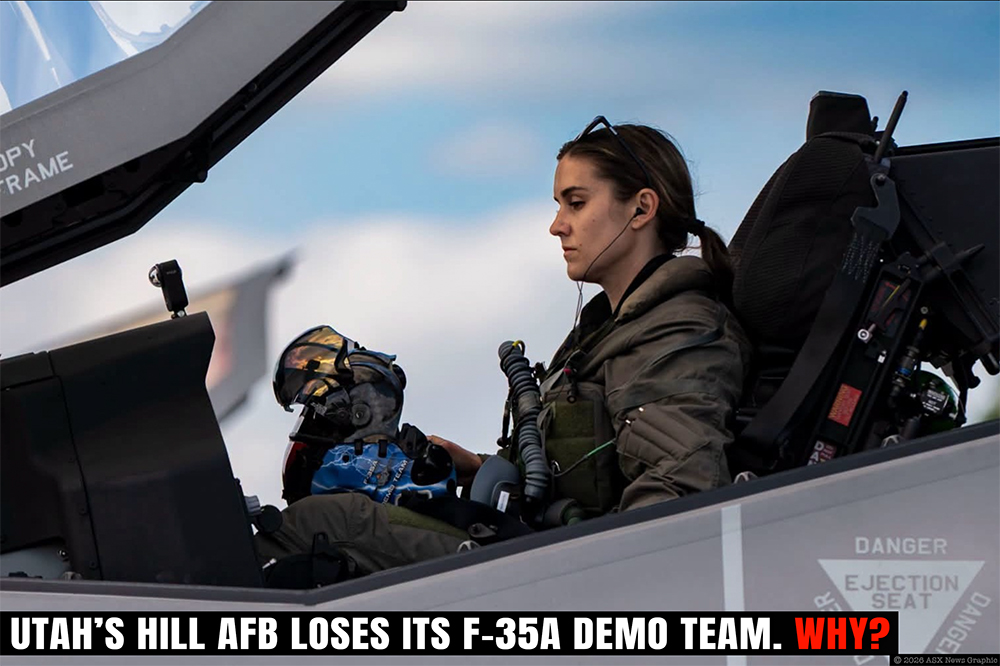
On November 20, 2026, the United States Air Force announced that its F-35A Lightning II Demonstration Team would return to Luke Air Force Base, Arizona, after seven years operating from Hill Air Force Base, Utah. Air Combat Command described the relocation as the product of an assessment involving operational tempo, aircraft availability, and the concentration of experienced F-35 pilots at Luke. The announcement ended one chapter in the team’s history while leaving several questions unanswered, particularly concerning an abrupt suspension of demonstration activities during the summer of 2026.
The decision also invites a broader examination of an organization that has served as both a public demonstration of American military aviation technology and a recruiting and outreach instrument for the Air Force. Since its origins in the F-35A Heritage Flight program, the organization has experienced changes in command structure, operational assignment, demonstration capabilities, and leadership. Its history includes two consecutive female demonstration commanders, a return to male leadership in 2026, and two major relocations under different presidential administrations.
An examination of official Air Force announcements, military biographies, demonstration manuals, and contemporary reporting establishes a substantial documented history. It also permits a careful evaluation of whether political priorities, gender-based selection practices, or operational considerations can be identified as factors in the team’s leadership appointments and relocation decisions.
Origins: The F-35A Heritage Flight Program at Luke Air Force Base
The team’s history begins at Luke Air Force Base, Arizona, where the 56th Fighter Wing became a major center for training pilots to operate the Lockheed Martin F-35A Lightning II. As the aircraft entered operational service, the Air Force developed a public demonstration capability intended to introduce the fifth-generation fighter to military audiences, civilian spectators, and prospective recruits.
Air Combat Command identifies the team’s institutional origins at Luke in late 2015. The early organization operated as the F-35A Heritage Flight Team, participating in formations that paired modern fighters with aircraft representing earlier generations of American military aviation. The purpose was both educational and ceremonial, connecting contemporary airpower with the historical development of the Air Force.
The Air Force’s official history of Luke records that an F-35A participated in a Heritage Flight with a P-38 Lightning during the Heritage Flight Conference at Davis-Monthan Air Force Base on March 4, 2016. The F-35A also appeared in Heritage Flight demonstrations at Luke’s April 2–3, 2016, airshow, where Maj. William Andreotta was identified as the participating pilot from the 61st Fighter Squadron. These events establish that the program’s earliest public flying activities preceded the later creation of the full single-ship demonstration routine.
The initial mission was not to reproduce the precision formation aerobatics of the Thunderbirds or the Blue Angels. Instead, the program concentrated on demonstrating the F-35A’s presence and capabilities while honoring historical military aircraft. That distinction remains important because the F-35A Demonstration Team is a specialized single-aircraft demonstration organization rather than an operational fighter squadron or a multi-aircraft formation aerobatic team.
Andrew “Dojo” Olson and the Transition to a Full Demonstration Team
One of the most consequential figures in the organization’s early development was Capt. Andrew “Dojo” Olson. His official Air Force biography records that he became commander and pilot of the F-35A Heritage Flight Team in December 2017, before assuming command of the F-35A Demonstration Team in October 2018.
Olson brought extensive operational experience to the position. A graduate of Virginia Tech with a degree in aerospace engineering, he commissioned through the Reserve Officer Training Corps in 2010. His assignments included flying the F-15E Strike Eagle and serving as an F-35A instructor and evaluator pilot. By February 2019, his official biography credited him with more than 2,000 flight hours, including more than 480 combat hours.
During 2018, the Air Force began expanding the F-35A’s public flying profile. On December 4, 2018, the 56th Fighter Wing announced that the Heritage Flight Team would transition to a full F-35A Demonstration Team for the 2019 airshow season. The change introduced a more demanding solo performance designed to demonstrate the aircraft’s maneuverability, acceleration, high-angle-of-attack characteristics, and high-G capabilities.
Olson worked with the organization to develop and practice the new demonstration profile. Air Force reporting described a routine incorporating aggressive maneuvering, high-speed passes, slow-speed flight, and steep vertical maneuvers. The team also developed a coordinated ground performance involving its maintenance personnel, making aircraft preparation and launch part of the public presentation.
The 2019 demonstration program represented the transformation of the F-35A from a comparatively new aircraft displayed alongside historical fighters into the centerpiece of an independent aerial performance. It also established a demanding professional role: the demonstration pilot was simultaneously an experienced tactical aviator, public representative, flight leader, and commander of a traveling military organization.
The First Relocation: From Luke to Hill in 2019
On September 4, 2019, the Air Force announced that the F-35A Demonstration Team would move from Luke Air Force Base to Hill Air Force Base for the 2020 airshow season. The transfer placed the organization under the 388th Fighter Wing and Air Combat Command rather than its previous assignment within Air Education and Training Command.
The operational significance was considerable. Luke’s principal F-35 mission centered on training, while Hill was home to the Air Force’s first operational combat-coded active-duty F-35A wing. The relocation therefore aligned the demonstration organization with a combat wing responsible for employing the aircraft operationally.
The Air Force’s September 2019 announcement explicitly stated that a new pilot and team were being selected from the 388th Fighter Wing. The decision to relocate the organization was therefore publicly announced before the subsequent appointment of Capt. Kristin Wolfe as demonstration commander.
This chronology is relevant to questions about gender and politics. The move to Hill occurred during President Donald Trump’s first administration, and the official explanation emphasized the transfer from a training organization to an operational combat wing. The available records do not establish that the relocation was undertaken to facilitate a particular demographic appointment.
Kristin “BEO” Wolfe: The First Female F-35A Demonstration Commander
Capt. Kristin “BEO” Wolfe assumed command of the F-35A Demonstration Team on February 29, 2020, following certification by Air Combat Command commander Gen. Mike Holmes at the Heritage Flight Training Course at Davis-Monthan Air Force Base. The Air Force publicly announced the appointment on March 2, 2020.
Wolfe was the first woman to serve as the team’s demonstration pilot and commander. Before her selection, she had flown the F-22A Raptor as an instructor pilot and transitioned to the F-35A in 2017. The Air Force credited her with approximately 800 fighter flight hours in the two fifth-generation aircraft at the time of her appointment.
The official announcement attributed Wolfe’s selection to her flight experience and leadership abilities. Col. Steven Behmer, commander of the 388th Fighter Wing, publicly endorsed her qualifications. Her predecessor, Olson, also emphasized her experience flying and instructing in fifth-generation fighters.
The appointment took place under President Donald Trump, not President Joe Biden. That fact is important because Wolfe’s selection cannot accurately be characterized as an appointment made during the Biden administration. The decision was made within the Air Force’s command structure during the final year of Trump’s first term.
Wolfe’s appointment also carried an identifiable public-relations dimension. As the first female F-35A demonstration commander, she attracted attention beyond the aviation community and became a visible representative of women serving in advanced military aviation. The Air Force’s public statements emphasized her role as an ambassador for the service. However, public attention to the historic nature of an appointment does not, by itself, establish that gender determined the selection.
Wolfe led the team through the disruption of the COVID-19 pandemic and remained in the demonstration position through the 2023 season. Her tenure provided substantial continuity during a period when the Air Force was expanding public familiarity with the F-35A and demonstrating the aircraft internationally.
Melanie “MACH” Kluesner: A Second Consecutive Female Commander
On March 1, 2024, Capt. Melanie “MACH” Kluesner became the new certified pilot and commander of the F-35A Demonstration Team after completing the Air Combat Command Heritage Flight Training Course at Davis-Monthan Air Force Base. She succeeded Wolfe following months of preparation and training.
Kluesner was assigned to the 421st Fighter Squadron and had commissioned into the Air Force in 2014 after graduating from the University of Southern California. At the time of her appointment, the Air Force described her as a veteran combat fighter pilot with more than 1,000 flight hours. Her flying background included the T-6A, T-38, F-16, F-35B, and F-35A.
Her family history became a prominent element of the Air Force’s announcement. Kluesner explained that her father had flown F-16 demonstrations for Pacific Air Forces during the 1980s. Her mother belonged to the first graduating class of women at the United States Air Force Academy and had completed pilot training with fighter qualifications at a time when women were prohibited from flying fighters.
Kluesner’s appointment occurred during President Joe Biden’s administration. Unlike Wolfe’s selection in 2020, the 2024 appointment took place during a period when the Department of Defense maintained explicit diversity, equity, and inclusion initiatives. That broader policy environment is relevant to an investigation of military personnel practices, but it does not independently establish that Kluesner was selected because of her gender.
In its official announcement, the Air Force highlighted both Kluesner’s qualifications and her potential to inspire future aviators. Kluesner emphasized discipline, teamwork, service, and the importance of encouraging people who might not fit traditional expectations of what a fighter pilot looks like. These statements establish that public representation and recruiting were part of the team’s mission. They do not establish that operational qualifications were waived or that another candidate was passed over because of sex.
Were the Female Commanders Selected for Political Reasons?
The appointment of two consecutive female demonstration commanders raises a legitimate question about the relationship between military personnel selection, public representation, and government policy. The answer requires distinguishing three separate issues: whether the pilots possessed documented professional qualifications, whether the Air Force valued their public visibility, and whether their gender was a determining factor in the selection decisions.
On the first question, official records document substantial fighter aviation experience for both Wolfe and Kluesner. Both completed the demonstration qualification and certification process. Wolfe’s prior F-22 instructor experience and Kluesner’s operational flying background are relevant professional credentials, not merely ceremonial qualifications.
On the second question, the answer is affirmative. The Air Force explicitly uses demonstration teams for recruiting, public outreach, and the promotion of military aviation. Its public statements identify both commanders as representatives of the service and emphasize the inspirational potential of their appointments. The gender-related historical significance of their leadership was also publicly discussed.
The third question is more difficult. ASX News found no publicly documented selection directive, candidate-ranking record, command correspondence, or credible firsthand testimony establishing that Wolfe or Kluesner was chosen because she was a woman, or that a more qualified male candidate was rejected to achieve a demographic objective. Neither appointment can therefore be factually classified as a gender-preference selection on the available evidence.
The distinction is not a defense of any particular personnel policy. It is an evidentiary boundary. An investigation of discriminatory selection practices would require documentation identifying the applicant pool, comparative qualifications, selection criteria, decision-making authorities, and any instructions concerning demographic representation.
What Air Force Regulations Actually Require
Air Force Manual 11-246, Volume 1, dated March 18, 2022, establishes procedures governing fighter demonstration teams, including the F-35A. Chapter 2 assigns demonstration-pilot selection responsibility to wing commanders and states that pilots are normally selected in August before beginning training for the following airshow season. Demonstration duty is normally a two-year assignment.
The manual does not establish a requirement to appoint women or prescribe a gender-based allocation of demonstration-pilot positions. It addresses organizational responsibilities, personnel selection, training, qualification, operational limitations, and certification. It also requires extensive preparation, documented flight proficiency, and oversight by the appropriate military command authorities.
New demonstration pilots must receive training from qualified predecessors, demonstrate proficiency in approved flight profiles, and complete specified evaluation and certification procedures. The regulations require attention to low-altitude maneuvering, emergency procedures, abort criteria, aircraft performance limitations, and the safe conduct of demonstrations before public audiences.
These requirements establish the formal framework under which the appointments occurred. They do not disclose how the wing commanders compared individual applicants or whether considerations outside the published manual entered their deliberations. Certification establishes that a pilot completed the required process; it does not independently reconstruct every factor involved in the initial selection.
Military Diversity Policy and the 2025 Political Reversal
Federal policy concerning diversity and personnel management changed substantially during the period covered by the team’s history. The Biden administration supported diversity, equity, and inclusion programs within federal institutions, including the Department of Defense. In January 2025, the returning Trump administration issued executive directives restricting such initiatives and prohibiting preferences or disadvantages within the armed forces based on sex, race, or ethnicity.
The Department of Defense subsequently directed the elimination of DEI offices and related programs. A January 2026 Department of Defense Inspector General report documented these policy changes and the associated restructuring of diversity-management reporting.
The relevance to the F-35A Demonstration Team is chronological and institutional. Wolfe was appointed before the Biden administration, Kluesner during it, and the next commander, Maj. Sean Loughlin, was appointed during Trump’s second administration. However, the available records contain no directive linking any of these individual appointments to a presidential diversity policy or to its subsequent reversal.
Nor does the appointment of a male commander in 2026 establish that the Air Force was correcting an earlier gender-based selection practice. That interpretation would require evidence of intent or policy implementation that has not been identified in the public record.
Sean “RAMBO” Loughlin Takes Command in 2026
On February 27, 2026, Air Combat Command commander Gen. Adrian Spain certified Maj. Sean “RAMBO” Loughlin as the new commander and demonstration pilot of the F-35A Lightning II Demonstration Team during the Heritage Flight Training Course at Davis-Monthan Air Force Base.
Loughlin was assigned to the 421st Fighter Squadron at Hill Air Force Base. His official biography identifies previous operational assignments flying the F-15E Strike Eagle at RAF Lakenheath in the United Kingdom, the A-10C Thunderbolt II at Osan Air Base in South Korea, and the F-35A at Hill. He had accumulated more than 1,200 flight hours and previously served as chief of wing safety for the 388th Fighter Wing.
His appointment brought the team back under male command after approximately six years of leadership by Wolfe and Kluesner. The Air Force identified his operational experience and safety background as professional qualifications for the role.
Loughlin’s tenure was also significant because it preceded an unexpected interruption to the team’s 2026 public demonstration schedule. Although the team performed earlier in the season, its remaining planned appearances were subsequently canceled.
The Unexplained August 2026 Operational Pause
According to aviation reporting published November 20, 2026, the F-35A Demonstration Team entered an apparent operational pause in late August 2026. The remaining demonstrations scheduled for that airshow season were canceled, but neither the team nor the Air Force publicly provided a detailed explanation of the interruption.
The timing is noteworthy. The pause occurred only months after Loughlin’s certification and before the Air Force announced the team’s return to Luke. The organization had already operated successfully at numerous locations over the preceding years, making the sudden interruption an important development in its operational history.
Nevertheless, the publicly available evidence does not establish why the demonstrations stopped. There is no verified finding that the pause resulted from pilot performance, an aircraft safety incident, maintenance deficiencies, disciplinary action, personnel selection disputes, or political intervention.
The absence of a detailed explanation leaves a legitimate unanswered question about the team’s operational availability. It does not justify assigning a cause without documentary evidence. Aviation safety analysis requires distinguishing a reported interruption from the factors responsible for it.
November 20, 2026: The Return to Luke Air Force Base
Air Combat Command formally announced on November 20 that the F-35A Demonstration Team had been reassigned to the 56th Fighter Wing at Luke Air Force Base in preparation for the 2027 airshow season. The decision reverses the 2019 transfer that placed the organization under the 388th Fighter Wing at Hill.
The official announcement identifies three considerations: operational tempo, aircraft availability, and Luke’s substantial concentration of experienced F-35 pilots. Those factors are consistent with the challenges of supporting a traveling demonstration organization while maintaining the operational requirements of combat-assigned fighter units.
Luke’s extensive F-35 training infrastructure provides access to pilots, maintenance capabilities, and aircraft resources associated with one of the Air Force’s principal fifth-generation fighter training organizations. Hill, by contrast, remains responsible for operational combat missions and the demands associated with maintaining and deploying combat-ready F-35 units.
The Air Force reported that leadership at the 56th Fighter Wing was already selecting a new demonstration pilot and supporting team. Gen. Adrian Spain was scheduled to certify the incoming pilot during the February 2027 Heritage Flight Training Course at Davis-Monthan Air Force Base.
As of the November 20 announcement, the Air Force had not specified the precise date on which the relocation would be completed. The reassignment had been announced and preparations were underway, but the public record did not establish that the physical transfer had already been completed.
Seven Years at Hill: The Operational Record
During its approximately seven-year assignment at Hill, the demonstration team performed at 145 airshows in 37 states and 13 countries, according to Air Force figures reported at the time of the relocation announcement. Its activities brought the F-35A before domestic and international audiences and demonstrated the aircraft’s performance alongside historic military aircraft.
The organization operated with a small traveling contingent rather than the personnel strength of a conventional fighter squadron. Air Force documentation describes approximately 15 personnel, including the demonstration pilot and commander, safety officers, maintainers, crew chiefs, aircrew flight-equipment specialists, and public affairs representatives.
These personnel are essential to the mission. The pilot’s visible performance depends on aircraft preparation, maintenance, inspections, flight planning, operational risk management, ground safety observation, and logistical coordination. The team’s professional responsibilities therefore extend well beyond the individual aviator featured in public demonstrations.
Its role also extends beyond entertainment. Air Force documentation describes the demonstration mission as showcasing the capabilities of the F-35A, honoring military aviation heritage, and supporting public engagement and recruiting. Those institutional objectives explain why demonstration pilots are expected to possess both operational flying competence and the ability to represent the service before large audiences.
Was the Relocation Politically Motivated?
The two principal relocations occurred during different periods of American political leadership. The move from Luke to Hill was announced in September 2019 under President Donald Trump. The return from Hill to Luke was announced in November 2026, also under President Trump, during his second administration.
The documented rationale for the 2019 move was the transfer of the team from a training command environment to an operational combat wing. The documented rationale for the 2026 return was operational tempo, aircraft availability, and the availability of experienced F-35 pilots at Luke.
Both decisions involved military organizational priorities, and both occurred within presidential administrations that exercised authority over the Department of Defense. That establishes the governmental context, but not direct presidential involvement in either decision.
ASX News found no official memorandum, public statement, credible testimony, or documented order establishing that the 2026 move was intended to reverse diversity policies, remove a particular commander, alter the demographic composition of the team, or make a partisan political statement.
The fact that the organization returned to its original base after an unexplained operational pause warrants further scrutiny. However, a temporal relationship between the pause and relocation is not proof of causation. The Air Force has not publicly established whether the two developments were directly connected.
The Outstanding Questions
Several important questions remain unanswered in the available public record. The Air Force has not published the complete selection-board documentation for the appointments of Wolfe, Kluesner, or Loughlin. Consequently, the identities and qualifications of all competing applicants, the precise selection criteria applied in each case, and the internal deliberations of the responsible commanders cannot be independently reconstructed.
The Air Force also has not provided a detailed public explanation for the late-August 2026 operational pause. Its November relocation announcement does not disclose the underlying operational assessment, specific aircraft-availability data, or the comparative resource analysis used to determine that Luke would better support the demonstration mission.
These missing records are consequential. They are the evidence needed to determine whether personnel decisions were influenced by demographic considerations, whether operational readiness problems affected the team’s schedule, and whether the 2026 reassignment reflected a change in organizational priorities beyond those publicly identified.
Conclusion: A Documented History and Unresolved Questions
The F-35A Demonstration Team’s history is a decade-long progression from an early fifth-generation Heritage Flight program at Luke Air Force Base to a full single-ship demonstration organization, a seven-year assignment to an operational fighter wing at Hill, and a planned return to its original base for the 2027 airshow season.
Its successive commanders—Andrew Olson, Kristin Wolfe, Melanie Kluesner, and Sean Loughlin—represent different periods of the team’s development. Official Air Force records document their aviation experience, professional assignments, and demonstration qualifications. Two consecutive commanders were women, and their appointments attracted attention for their historical significance. The evidence reviewed does not establish that either appointment resulted from a gender preference or political directive.
The strongest unresolved operational issue concerns the August 2026 pause and its possible relationship to the November reassignment. The Air Force’s explanation identifies legitimate operational considerations, but the supporting assessment and detailed reasons for the earlier interruption have not been made public.
The record therefore supports a clear distinction between established facts and unanswered questions. The team is returning to Luke, its history includes substantial organizational and leadership changes, and its mission has always combined aviation performance with public representation. Whether undisclosed political considerations affected particular decisions remains unproven. Determining that would require additional primary documentation, not assumptions drawn from the sex of individual pilots or the political affiliation of the president serving when they were appointed.
References and Source Documentation
Air Combat Command. (2026, November 20). F-35A Lightning II Demonstration Team reassigned to the 56th Fighter Wing. U.S. Air Force. https://www.acc.af.mil/
Air Combat Command. (2024). F-35 Demo Team announces new pilot and commander. U.S. Air Force. https://www.acc.af.mil/News/Article-Display/Article/3698257/f-35-demo-team-announces-new-pilot-and-commander/
Department of the Air Force. (2022, March 18). Air Force Manual 11-246, Volume 1: Air Force fighter type aircraft demonstrations (A-10, F-16, F-22, F-35). https://static.e-publishing.af.mil/production/1/af_a3/publication/afman11-246v1/afman11-246.pdf
Department of Defense Office of Inspector General. (2026, January 12). Annual report to Congress as required by Section 554 of the FY 2021 National Defense Authorization Act (DODIG-2026-041). https://media.defense.gov/2026/Jan/12/2003855390/-1/-1/1/DODIG-2026-041%20SECURE.PDF
388th Fighter Wing Public Affairs. (2019, September 4). F-35A Lightning II Demonstration Team moves to Hill AFB for 2020 airshow season. U.S. Air Force. https://www.388fw.acc.af.mil/News/Article-Display/Article/1951313/f-35a-lightning-ii-demonstration-team-moves-to-hill-afb-for-2020-airshow-season/
388th Fighter Wing Public Affairs. (2020, March 2). 388 FW pilot to lead F-35A Demonstration Team. U.S. Air Force. https://www.388fw.acc.af.mil/News/Article-Display/Article/2099301/388-fw-pilot-to-lead-f-35a-demonstration-team/
388th Fighter Wing Public Affairs. (2026, February 27). New pilot announced to lead F-35A Lightning II Demonstration Team. U.S. Air Force. https://www.388fw.acc.af.mil/News/Article-Display/Article/4418039/new-pilot-announced-to-lead-f-35a-lightning-ii-demonstration-team/
56th Fighter Wing Public Affairs. (2018, December 4). F-35 HFT prepares for new demonstration profile. U.S. Air Force. https://www.acc.af.mil/News/Article/1706334/f-35-hft-prepares-for-new-demonstration-profile/
Luke Air Force Base. (2019). Captain Andrew “Dojo” Olson: Official biography. U.S. Air Force. https://www.luke.af.mil/Facts/Biographies/Display/Article/1465509/captain-andrew-dojo-olson/
Luke Air Force Base. (2020). Luke Air Force Base heritage pamphlet, 1941–2020. U.S. Air Force. https://www.luke.af.mil/Portals/58/Luke%20Heritage%20Pamphlet%201941-2020%20Expanded%2020200814.pdf
388th Fighter Wing. (2026). Major Sean J. Loughlin: Official biography. U.S. Air Force. https://www.388fw.acc.af.mil/About-Us/Biographies/Display/Article/4418431/sean-j-loughlin/
D’Urso, S. (2026, November 20). F-35A Demo Team moves back to Luke AFB. The Aviationist. https://theaviationist.com/2026/11/20/f-35a-demo-team-moves-back-to-luke-afb/
Wirthlin, J. R., Jr. (2026, November 20). F-35A Lightning II Demonstration Team to leave Hill Air Force Base by 2027. KSL. https://www.ksl.com/article/51647153/f-35a-lightning-ii-demonstration-team-to-leave-hill-air-force-base-by-2027