

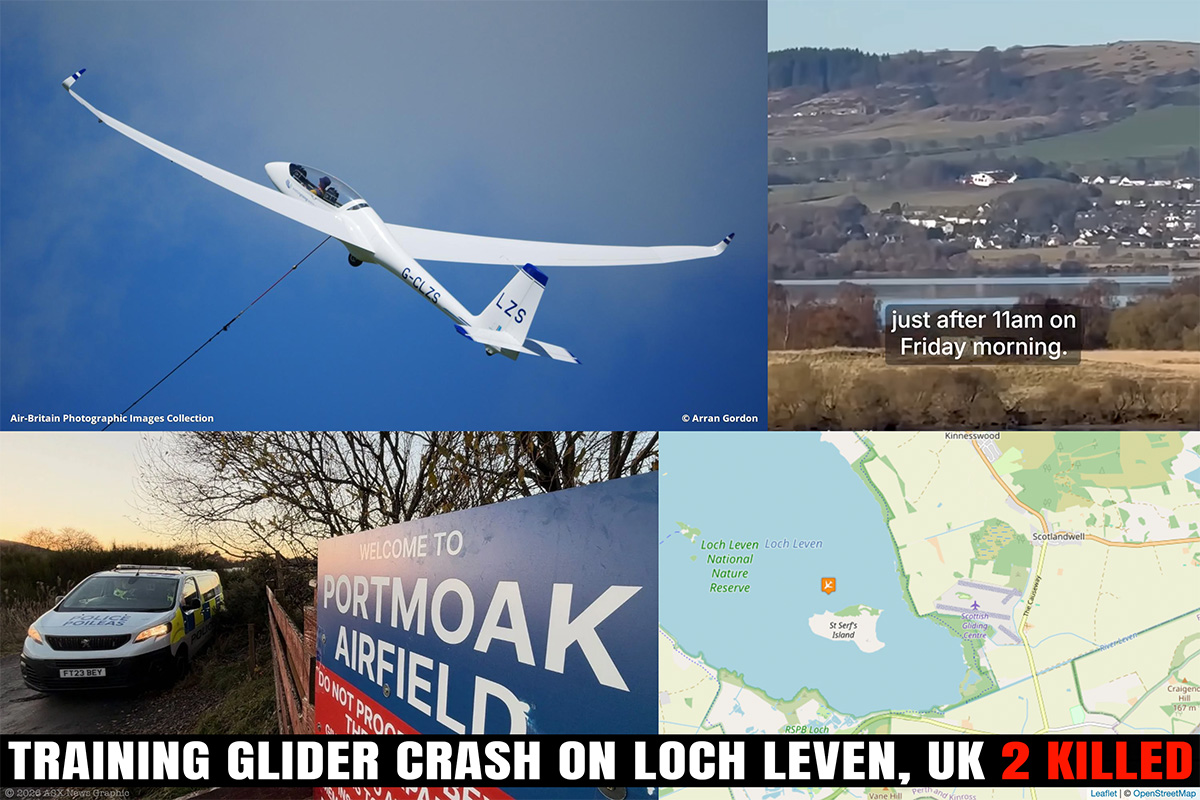
KINROSS, SCOTLAND — Two men were killed on Friday, November 20, 2026, when a two-seat SZD-54-2 Perkoz glider crashed into Loch Leven near Kinross, Scotland, during a local training flight originating from Portmoak Airfield. Emergency services launched a major response involving police, ambulance personnel, specialist rescue teams, firefighters, and Coastguard helicopters. Both occupants were subsequently recovered from the water and pronounced dead.
Police Scotland confirmed that the men’s next of kin had been informed and that their deaths were not being treated as suspicious. The United Kingdom’s Air Accidents Investigation Branch (AAIB) launched a formal aviation safety investigation, deploying specialists in aircraft operations, engineering, and recorded data to establish the circumstances surrounding the fatal accident.
Accident Overview
The accident occurred at approximately 11:00 a.m. local time on Friday, November 20, 2026, in the vicinity of Loch Leven, a freshwater loch in Perth and Kinross, Scotland. The aircraft was identified as a Polish-designed SZD-54-2 Perkoz, a two-seat sailplane used for glider training and other soaring operations.
The glider had departed Portmoak Airfield, home of the Scottish Gliding Centre, for a local training flight. The airfield lies east of Loch Leven, placing the surrounding loch and countryside within the local operating environment of the gliding club.
According to the Aviation Safety Network’s preliminary accident record, the aircraft was operated by Scottish Gliding Union Ltd. The database lists registration G-CLZS and manufacturer’s serial number 542.A.21.026, although it explicitly identifies the registration as unconfirmed. These identifiers should therefore be treated as provisional pending verification through the aircraft’s registration records or the AAIB investigation.
The flight involved two occupants, both of whom sustained fatal injuries. No additional fatalities were reported. The aircraft was recorded as destroyed in the preliminary Aviation Safety Network entry.
Emergency Timeline and Rescue Operations
The emergency response began shortly after 11:00 a.m. The Scottish Fire and Rescue Service reported receiving notification at 11:01 a.m., followed by a call to the Scottish Ambulance Service at 11:02 a.m. Police Scotland recorded receiving a report of a glider having crashed into Loch Leven at approximately 11:05 a.m.
The Scottish Ambulance Service dispatched two Special Operations Response Teams, an air ambulance carrying a critical care team, and a conventional ambulance. HM Coastguard also participated in the response, deploying two search-and-rescue helicopters to the area.
Firefighters mobilized an appliance and specialist resources to assist the emergency services. The response required coordination among multiple agencies operating around a large inland body of water, where access to an accident site can present challenges different from those encountered following a conventional land-based aircraft crash.
The Coastguard reported that its helicopters joined the emergency response following notification of the incident at approximately 11:20 a.m. The precise sequence of aircraft location, recovery operations, and the retrieval of the occupants has not been publicly established.
Police Scotland subsequently confirmed that the bodies of both men had been recovered from Loch Leven. Their next of kin were notified. Authorities had not publicly released the occupants’ identities in the initial reports reviewed for this article.
Local airspace restrictions were introduced following the accident, while emergency personnel and investigators conducted operations in the area.
The Aircraft: SZD-54-2 Perkoz
The SZD-54-2 Perkoz is a Polish-designed, two-seat sailplane developed for training and soaring operations. Its tandem-seat configuration allows an instructor and student to occupy the aircraft during instructional flights, making it suitable for advanced training as well as other gliding activities.
Like other unpowered sailplanes, the Perkoz relies on aerodynamic lift and the management of its available energy to remain airborne. Once released from a launch aircraft or other launch system, a conventional glider must maintain an appropriate relationship between altitude, airspeed, distance, and available landing areas.
Gliders can extend their flights by exploiting rising air associated with thermal activity, ridge lift, or other atmospheric conditions. However, the availability and strength of these sources of lift vary with weather, terrain, and local conditions.
The presence of two occupants on this flight is consistent with the reported training activity, but the identities and operational roles of the occupants have not been independently established. It would therefore be premature to identify either man as the instructor or student.
Likewise, the precise launch method, release altitude, flight duration, and aircraft configuration at the time of the accident have not been confirmed. These are matters that may be clarified through the AAIB investigation.
Portmoak Airfield and the Loch Leven Operating Environment
Portmoak Airfield is an established Scottish gliding location near Scotlandwell, east of Loch Leven. The airfield supports gliding activity in an area characterized by open countryside, nearby hills, and the substantial expanse of water formed by the loch.
The location provides access to a variety of soaring environments. However, the presence of a large body of water introduces an additional consideration for flight planning and emergency landing decisions. Unlike a prepared landing field, a water surface offers no conventional ground landing area for a sailplane.
In a glider, an unplanned water landing may involve significant impact forces, structural damage, rapid water entry, and difficulties escaping from the cockpit. These hazards are particularly important when considering occupant restraint systems, canopy operation, and the potential consequences of aircraft submersion.
These considerations are relevant to the general safety environment but do not establish that the aircraft was attempting an emergency landing, that it experienced an energy-management problem, or that water immersion contributed to either fatality. No such accident-specific findings had been publicly released.
Investigation by the Air Accidents Investigation Branch
The AAIB confirmed that it had initiated an investigation and deployed a multidisciplinary team to gather evidence. The team included inspectors specializing in aircraft operations, engineering, and recorded data.
The investigation is expected to examine the aircraft’s flight history, operational circumstances, technical condition, and available evidence concerning its final moments. Depending on the evidence recovered, investigators may be able to reconstruct portions of the flight and identify the circumstances that preceded the impact.
Potential sources of evidence include aircraft wreckage, onboard instruments or electronic devices, flight-tracking information, maintenance documentation, operational records, and witness accounts. The availability and evidentiary value of these materials have not yet been established.
The investigation may also examine meteorological conditions, including wind, visibility, cloud conditions, and the atmospheric environment in which the glider was operating. Weather observations from the relevant period would need to be correlated with the aircraft’s location and flight profile before any conclusions could be drawn.
For a two-seat training aircraft, investigators may additionally examine the purpose of the flight, the experience and qualifications of the occupants, the intended instructional activities, and the procedures applicable to the operation.
The aircraft’s position relative to Portmoak Airfield, its altitude and airspeed before impact, and the sequence of events leading to contact with the water will be particularly important to any eventual reconstruction.
As of the initial reporting, no verified information had established whether the accident involved a loss of control, structural or mechanical failure, an attempted emergency landing, a training maneuver, or another sequence of events.
Scottish Gliding Centre Responds
The Scottish Gliding Centre confirmed that a Perkoz glider had crashed during a local training flight on November 20. The organization stated that it was cooperating with the AAIB, Police Scotland, and the British Gliding Association.
The club also emphasized that the circumstances leading to the accident had not been determined. Its statement provided confirmation of the aircraft type and the training nature of the flight while avoiding speculation concerning the sequence of events.
The British Gliding Association serves as the national governing body for gliding in the United Kingdom and has an established role in supporting gliding safety, operational standards, and the exchange of safety information within the sport.
Safety Considerations for Glider Training
Training flights in sailplanes involve a combination of aircraft handling, situational awareness, weather interpretation, energy management, and decision-making. Unlike powered aircraft, conventional gliders cannot rely on engine thrust to recover lost altitude or extend their range when atmospheric lift is unavailable.
Maintaining appropriate landing options is therefore a fundamental component of glider operations. The suitability of those options depends on the aircraft’s altitude, position, performance, environmental conditions, and the pilot’s ability to assess the available margins.
Water presents a particularly unforgiving environment for an aircraft not designed for routine water operations. The consequences of an impact can extend beyond the initial collision to include cockpit flooding, difficulty releasing restraints, disorientation, and delayed rescue access.
Training operations also require clear communication and coordination between occupants, particularly when instructional exercises involve unusual attitudes, simulated emergencies, or transitions of aircraft control. Whether any such activity was taking place during this flight is unknown.
These general safety principles provide context for understanding the operating environment. They should not be interpreted as evidence of pilot error, inadequate training, or deficiencies in the aircraft or gliding club.
Two Lives Lost in Scotland’s Gliding Community
The deaths of both occupants represent a significant loss for the Scottish gliding community. The accident occurred during an activity intended to develop and maintain flying skills, underscoring the potential consequences of an aviation emergency even within an established training environment.
The emergency response brought together multiple Scottish and United Kingdom agencies, whose personnel worked to locate and recover the occupants and secure the area for subsequent investigative work.
The AAIB’s investigation will provide the principal means of establishing the technical and operational circumstances of the accident and identifying any safety lessons supported by the evidence.
For now, the confirmed record is that a two-seat Perkoz glider departed Portmoak Airfield on a local training flight, crashed into Loch Leven at approximately 11:00 a.m. on November 20, 2026, and both men aboard lost their lives.
Sources
Police Scotland — Bodies of two men recovered after glider crash at Loch Leven, November 20, 2026.
STV News — Two men dead after glider crashes into Loch Leven during training flight, November 20, 2026.
The Guardian — Two men killed after glider crashes into Loch Leven in Scotland, November 20, 2026.
The Independent — Two men dead after glider crash at UK beauty spot, November 20, 2026.
ITV News — Two men killed as glider crashes into loch, November 20, 2026.
Aviation Safety Network — Preliminary accident record, SZD-54-2 Perkoz, Loch Leven, November 20, 2026.
Scottish Gliding Centre — Public statements concerning the November 20, 2026, Perkoz accident, as reported by Scottish news organizations.