


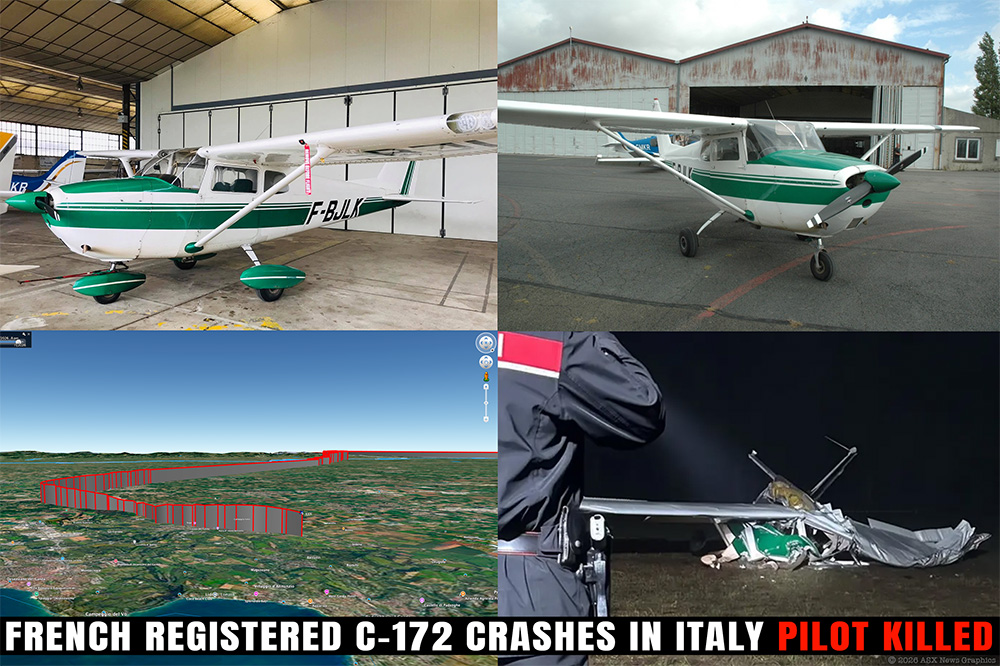
LONATO DEL GARDA, ITALY — November 19, 2026 (ASX News) — A French-registered Cessna 172B Skyhawk crashed in open countryside near Barcuzzi, Lonato del Garda, in northern Italy on Wednesday, November 18, killing its sole pilot and triggering a formal aviation safety investigation by Italy’s National Agency for Flight Safety (ANSV).
The aircraft, identified as Cessna C172 registration F-BJLK, was destroyed in the accident, which occurred in the province of Brescia, Lombardy, near the southern shores of Lake Garda.
Italian emergency services mounted an extensive search involving rescue helicopters, firefighters, law enforcement personnel and medical responders before locating the wreckage in countryside between Lonato del Garda, Bedizzole and Padenghe sul Garda.
The cause of the crash remains undetermined. ANSV confirmed on November 18 that it had opened a safety investigation and dispatched an investigator to the accident site.
Aircraft and Accident Information
- Date: Wednesday, November 18, 2026
- Approximate time: Early afternoon, approximately 13:40–15:00 local time across preliminary reports
- Aircraft: Cessna 172B Skyhawk
- Registration: F-BJLK (France)
- Manufacturer serial number: 17248217
- Operator: Private
- Location: Near Barcuzzi, Lonato del Garda, Brescia, Lombardy, Italy
- Flight phase: En route, according to the Aviation Safety Network record
- Occupants: 1
- Fatalities: 1
- Survivors: 0
- Aircraft damage: Destroyed
- Investigating authority: Agenzia Nazionale per la Sicurezza del Volo (ANSV)
- Investigation status: Open; cause undetermined
The Flight: Preliminary Reports of a Journey From Spain
According to preliminary Italian media reports, the Cessna had departed from Spain and was traveling toward northern Italy when the accident occurred. GardaPost reported that the aircraft was believed to have departed from Andorra, in the Pyrenees region between Spain and France, with Verona-Boscomantico Airport identified as its intended destination.
Other early accounts suggested the aircraft may have been expected at an airfield near Bedizzole, closer to the eventual accident location.
These differing reports have not been reconciled by investigators. Neither the precise departure aerodrome nor the intended destination was identified in ANSV’s initial public announcement.
The aircraft’s French registration establishes its national registration but does not, by itself, identify the nationality of its pilot, the ownership arrangements, or the operational purpose of the flight.
Preliminary reports also stated that the aircraft disappeared from radar before the wreckage was located. However, the precise circumstances of any loss of surveillance contact, including whether it resulted from low altitude, terrain obstruction, receiver coverage or the accident itself, have not been established.
Crash Near Barcuzzi: Emergency Search Begins
The first reports of an aircraft accident emerged during the afternoon of November 18 in the countryside surrounding Barcuzzi, a locality within the municipality of Lonato del Garda.
Initial emergency notifications did not establish an exact impact position. Consequently, rescue authorities organized a broader aerial search covering rural areas between Lonato, Bedizzole and Padenghe sul Garda.
The regional emergency medical organization, AREU, mobilized emergency personnel and an air ambulance helicopter from Bergamo. The Italian fire service also deployed a Drago rescue helicopter from Malpensa.
Additional responders included the Carabinieri, firefighters, the Valsabbia mountain rescue service, ambulance crews and emergency medical personnel.
Following aerial reconnaissance, responders located the wreckage in open countryside. The aircraft had sustained extensive impact damage and was described by multiple news organizations as destroyed.
The pilot was found deceased. Medical responders were unable to provide lifesaving assistance.
Initial rescue operations also included checks to establish whether additional occupants or other persons might have been involved. ANSV subsequently stated that, based on the information available, the pilot appeared to have been the aircraft’s only occupant.
Identification of the Pilot
At the time of the initial reporting, Italian authorities had not publicly established the pilot’s identity.
Fanpage reported that the condition of the remains complicated identification and that no identification documents had been found with the deceased.
Other reports suggested that the pilot may have been of foreign origin, although no official identification or nationality confirmation was available in the reviewed sources.
ASX News is withholding any speculation concerning the pilot’s identity pending confirmation by the competent authorities.
The Aircraft: Cessna 172B Skyhawk
The aircraft involved was identified by ANSV as a Cessna C172 bearing French registration F-BJLK. The Aviation Safety Network identifies the aircraft more specifically as a Cessna 172B Skyhawk, manufacturer serial number 17248217.
The Cessna 172 family is among the most widely produced light aircraft in aviation history. Introduced in 1956, the high-wing, single-engine design has been extensively employed for private flying, flight training, recreational aviation and general transportation.
The 172B belongs to an early generation of the Skyhawk series. It is a conventional fixed-wing airplane equipped with a piston engine, fixed tricycle landing gear and seating typically accommodating up to four occupants, depending on configuration.
Although several early news reports described the aircraft as an ultralight, the official identification supplied by ANSV establishes that the aircraft was a Cessna C172. The term ultralight should therefore not be treated as a confirmed technical classification in this accident.
The aircraft’s age, maintenance history, airworthiness status, recent inspections and installed equipment have not been established from the initial investigation announcement.
Flight-Tracking Evidence and Its Limitations
Publicly accessible ADS-B Exchange flight-tracking records associated with aircraft hexadecimal identifier 38256A provide a potential source of information concerning the aircraft’s movements on November 18.
Such records may assist investigators and independent researchers in examining the aircraft’s recorded ground track, altitude reports, groundspeed and the timing of its final transmissions.
However, publicly received surveillance data must be interpreted with considerable care, particularly during the final moments of a flight.
ADS-B coverage depends on several factors, including aircraft equipment, receiver distribution, terrain, altitude and the availability of valid transmissions. A loss of recorded positions does not necessarily establish the precise moment or location of an accident.
Similarly, pressure-altitude information requires appropriate correction and interpretation before it can be compared reliably with terrain elevation. Pressure altitude is not necessarily equivalent to the aircraft’s true altitude above mean sea level or its height above the ground.
No verified numerical reconstruction of F-BJLK’s final descent, airspeed, vertical speed or impact trajectory has yet been established in this report.
Accordingly, ASX News is not attributing the accident to an aerodynamic stall, loss of control, engine failure, controlled flight into terrain or any other specific mechanism based solely on the available flight-tracking information.
Weather, Terrain and Operational Considerations
The accident occurred in the Lake Garda region of Lombardy, an area characterized by agricultural land, populated communities, hills and nearby elevated terrain.
Investigators will need to establish the meteorological conditions prevailing along the flight route and in the accident area, including visibility, cloud base, wind, precipitation and any localized atmospheric effects.
Weather conditions at the time of the crash have not been established in the reviewed official information.
Consequently, there is no verified basis at this stage for concluding that adverse weather, reduced visibility or turbulence contributed to the accident.
The aircraft’s route and intended destination may also be relevant to determining whether it was operating in visual meteorological conditions, approaching an airfield, maneuvering at low altitude or encountering a developing operational difficulty.
These remain investigative questions rather than established circumstances.
ANSV Opens Formal Safety Investigation
On November 18, Italy’s National Agency for Flight Safety formally announced the opening of a safety investigation into the accident involving Cessna C172 F-BJLK near Lonato del Garda.
The agency also confirmed that it had arranged for an investigator to travel to the crash site.
As Italy’s independent civil aviation accident investigation authority, ANSV is responsible for examining aviation occurrences with the objective of identifying safety issues and preventing future accidents.
The investigation may examine physical wreckage evidence, aircraft maintenance documentation, operational records, available flight-tracking information, meteorological data and witness accounts.
Particular attention may be given to the condition of the aircraft’s engine, propeller, flight controls, fuel system and structural components, as well as the distribution of wreckage and physical evidence at the impact site.
Investigators may also seek to reconstruct the pilot’s recent flight activity, planning, communications and decision-making, where reliable evidence is available.
These are potential investigative avenues, not findings announced by ANSV.
The agency’s initial statement did not identify a probable cause, contributing factor, mechanical malfunction or specific sequence of events immediately preceding the crash.
Key Questions Remaining Unanswered
Several important aspects of the accident remain unresolved:
- What were the aircraft’s confirmed departure point, intended destination and planned route?
- What was the exact sequence of events during the final minutes of flight?
- Were any emergency communications transmitted before the accident?
- What were the aircraft’s verified altitude, airspeed and flight path before impact?
- Were the engine and flight controls functioning normally?
- What weather conditions existed at the aircraft’s location and altitude?
- Did the pilot attempt an emergency landing or other recovery maneuver?
- What do the wreckage distribution and impact signatures reveal about the aircraft’s attitude and energy at impact?
- Were any mechanical, operational, environmental or human factors involved?
Answers to these questions will require a comprehensive examination of the evidence rather than assumptions drawn from preliminary media reports.
Accident Investigation Versus Speculation
In the immediate aftermath of a fatal general aviation accident, early reports frequently contain incomplete or conflicting information about the aircraft, its occupants, the route and the circumstances of impact.
The F-BJLK accident illustrates this difficulty. Initial news reports differed concerning the aircraft’s classification, intended destination and approximate accident time.
The official ANSV announcement provides the strongest available confirmation of the aircraft’s identity, the pilot fatality and the opening of a formal investigation.
Until additional evidence becomes available, the circumstances that caused the aircraft to descend into the countryside near Lonato del Garda remain unknown.
ASX News Assessment
The November 18, 2026 accident involving Cessna 172B F-BJLK resulted in the loss of one life and the destruction of a privately operated aircraft during a reported cross-country flight in northern Italy.
The available evidence establishes the accident location, aircraft registration, fatal outcome and initiation of an official safety investigation. Preliminary reports also describe an extensive emergency search and the recovery of the wreckage from countryside near Barcuzzi.
However, the aircraft’s final flight profile, the circumstances of its loss of altitude and the initiating event remain unverified.
ANSV’s investigation will be central to establishing whether mechanical, operational, meteorological or other factors played a role.
ASX News will continue monitoring official investigation developments and update this report as verified information becomes available.
Sources and References
- ANSV — Official Announcement: Cessna Accident in Brescia Province, November 18, 2026
- Fanpage — Aircraft Crash at Lonato del Garda
- Giornale di Brescia — Aircraft Wreckage Found Near Lake Garda
- Sky TG24 — Fatal Aircraft Accident in Brescia Province
- BresciaToday — Initial Accident Coverage
- GardaPost — Preliminary Flight Route and Rescue Operations
- ADS-B Exchange — F-BJLK Historical Flight Tracking, November 18, 2026
Editorial note: This report reflects information available on November 19, 2026. The accident remains under investigation. Preliminary media reports and unverified flight-tracking interpretations should not be construed as official investigative findings.