

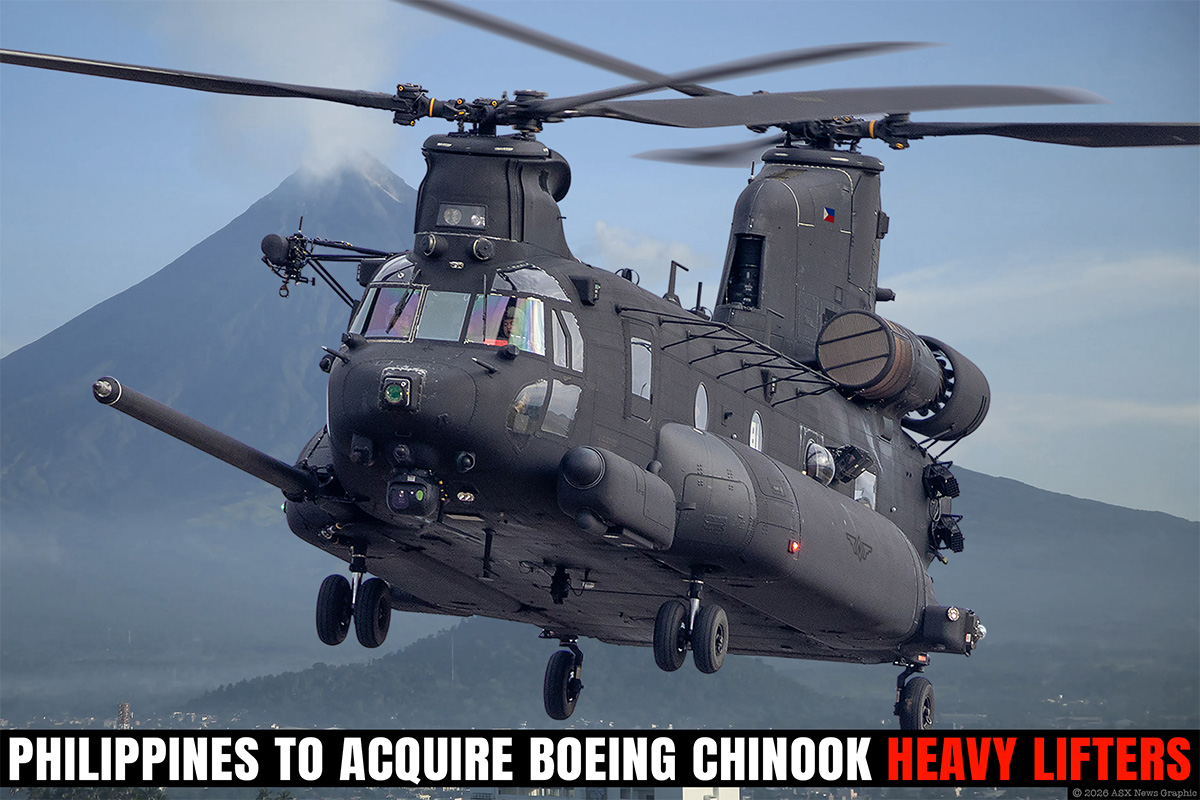
The Philippines could be preparing to introduce one of the world’s most capable heavy-lift military helicopters into its expanding military aviation inventory. Reports emerging on November 24, 2026, indicate that the Philippine government intends to acquire Boeing CH-47 Chinook helicopters through a recently announced multibillion-dollar defense financing arrangement with the United States, with aircraft deliveries reportedly anticipated in 2029.
The development follows the historic November 18 meeting between Philippine President Ferdinand Marcos Jr. and U.S. President Donald Trump in Manila, during which the two governments announced plans to pursue a Foreign Military Financing (FMF) loan package exceeding $2 billion. The agreement represents a significant expansion of American support for Philippine military modernization and reflects Washington’s growing strategic commitment to its treaty ally in the Indo-Pacific.
Philippine defense publication Modern Arms Philippines attributed the Chinook acquisition announcement to Defense Secretary Gilberto Teodoro Jr. Additional reports attributed the information to an interview conducted by TV5’s Ted Failon and DJ Chacha. Neither the number of helicopters nor the specific Chinook variant has been publicly established. ASX News has independently verified the broader financing announcement, although the original interview and a formal Chinook procurement agreement have not yet been independently verified.
The $2 Billion American Defense Package
In an official fact sheet released on November 18, the White House announced that Washington and Manila would pursue a defense loan package exceeding $2 billion to facilitate Philippine purchases of American military equipment. The initiative is expected to support more than 7,000 American jobs while substantially expanding Philippine military capabilities.
Washington also identified $400 million in Foreign Military Financing intended to improve Philippine military operational capabilities in the South China Sea. The assistance encompasses infrastructure, unmanned systems, command-and-control capabilities and long-range defense systems.
Speaking to reporters at Camp Aguinaldo on November 24, Teodoro distinguished the $2 billion financing arrangement from the $400 million grant. The distinction is financially important because the larger financing package should not be interpreted as an outright donation of American military equipment.
The defense secretary indicated that Manila had identified sophisticated American defense capabilities that are difficult to obtain internationally. However, he declined to identify the individual systems during the media briefing. The publicly released American financing documents likewise do not specifically identify the CH-47 Chinook.
Closing a Longstanding Gap in Philippine Military Aviation
The Philippines has been seeking an enhanced heavy-lift helicopter capability for several years. Under the administration of former President Rodrigo Duterte, Manila negotiated a PHP12.7 billion agreement with Russia for 16 Mil Mi-17 transport helicopters. The contract was signed in November 2021, before Russia launched its full-scale invasion of Ukraine in February 2022.
The acquisition subsequently encountered significant geopolitical complications. Former Defense Secretary Delfin Lorenzana acknowledged that concerns surrounding potential American sanctions influenced the Philippine government’s decision to abandon the Russian helicopter purchase.
In August 2022, the Philippine Department of National Defense formally announced that it was proceeding with the termination of the Russian contract. Although the cancellation removed a politically complicated procurement arrangement, it did not eliminate the military requirement that had originally justified the acquisition.
The proposed Chinook acquisition could finally address that capability gap while bringing the Philippines into closer operational alignment with American and allied military aviation organizations.
The World’s Largest S-70i Black Hawk Fleet
The Philippine Air Force has already undergone a substantial transformation of its rotary-wing capabilities through the acquisition of Sikorsky S-70i Black Hawk helicopters manufactured by PZL Mielec in Poland, a subsidiary of Lockheed Martin.
The Philippines originally ordered 16 Black Hawks in 2019 and subsequently signed a PHP32 billion contract for an additional 32 aircraft in February 2022. The final seven helicopters from the second contract were formally accepted on August 26, 2026, completing the delivery program.
Although 48 aircraft were delivered under the two contracts, the loss of one helicopter in 2021 reduced the fleet to 47 aircraft. The completed acquisition made the Philippines the world’s largest operator of the S-70i Black Hawk variant.
The Chinook would complement rather than replace the Black Hawk. While the Black Hawk provides an exceptionally versatile medium-lift utility platform, the Chinook occupies a substantially different operational category, allowing the transportation of larger and heavier loads.
Together, the two aircraft types could provide the Philippine Air Force with a more comprehensive rotary-wing transportation capability than it has possessed at any previous point in its history.
The Boeing CH-47 Chinook
Originally developed by Vertol and subsequently manufactured by Boeing, the CH-47 Chinook first flew in September 1961. More than six decades later, the aircraft remains in production, demonstrating the remarkable adaptability and continued military relevance of its fundamental design.
The Chinook’s distinctive tandem-rotor configuration employs two large counter-rotating main rotors positioned above the forward and rear sections of the fuselage. Unlike conventional single-main-rotor helicopters, the Chinook does not require a tail rotor to counteract engine-induced torque.
This configuration allows the aircraft to devote its main rotor system to vertical lift while providing considerable stability and flexibility when transporting heavy internal and external cargo. A large rear loading ramp facilitates the movement of personnel, equipment, vehicles and supplies.
The latest CH-47F Block II incorporates structural improvements, an upgraded drivetrain, redesigned fuel tanks and modern digital avionics. Boeing identifies a maximum gross weight of 54,000 pounds (24,494 kilograms), representing a 4,000-pound increase over the preceding CH-47F configuration.
CH-47F Block II Technical Specifications
Manufacturer: Boeing Defense, Space & Security
Aircraft classification: Twin-engine tandem-rotor heavy-lift helicopter
Powerplants: Two Honeywell T55-GA-714A turboshaft engines
Engine power: 4,777 shaft horsepower per engine
Overall length with rotors operating: 98 feet, 10.7 inches (30.1 meters)
Fuselage length: 51 feet, 2 inches (15.6 meters)
Overall height: 18 feet, 7.8 inches (5.7 meters)
Rotor diameter: 60 feet (18.3 meters) each
Maximum gross weight: 54,000 pounds (24,494 kilograms)
Useful load: 27,700 pounds (12,565 kilograms)
Cruise speed: 157 knots (291 kilometers per hour)
Service ceiling: 20,000 feet (6,096 meters)
Fuel capacity: 1,080 U.S. gallons (4,088 liters)
These specifications describe Boeing’s current CH-47F Block II configuration and should not be interpreted as confirmation that the Philippines has selected this particular variant. Operational payload capacity will vary according to fuel requirements, atmospheric conditions, aircraft configuration and mission limitations.
What Could a Philippine Chinook Fleet Cost?
The financial scale of a potential Philippine acquisition can be partially illustrated through recent American military procurement contracts. On April 15, 2026, Boeing announced a $324 million U.S. Army contract for six CH-47F Block II Chinooks, representing an average contract value of approximately $54 million per aircraft.
Applying that figure exclusively as an illustrative benchmark, four helicopters would represent approximately $216 million, while six would represent approximately $324 million. Neither figure constitutes an actual Philippine procurement estimate.
International military acquisition agreements frequently incorporate additional expenditures associated with spare engines, replacement components, specialized equipment, technical support, training, infrastructure and initial logistics packages. Consequently, the complete financial commitment associated with establishing a Philippine Chinook fleet could substantially exceed the basic aircraft procurement cost.
A dedicated heavy-lift helicopter program would also impose continuing operational expenditures throughout the aircraft’s service life, including maintenance, fuel, personnel, inspections and component overhaul requirements.
An Aircraft Particularly Suited to the Philippine Archipelago
The Philippines is geographically unlike many of the countries operating the Chinook. With 7,641 islands scattered across an extensive maritime territory, the nation faces transportation challenges that cannot be adequately addressed through conventional road and railway infrastructure alone.
Numerous Philippine communities depend upon maritime transportation for commercial goods, construction materials, medical supplies and emergency services. During severe weather events, these transportation networks can become temporarily inaccessible or completely disrupted.
The ability to transport substantial quantities of equipment directly between islands without requiring conventional airport infrastructure could make heavy-lift helicopters particularly valuable to the Philippine government.
Unlike fixed-wing transport aircraft, helicopters can deliver personnel and equipment into suitable areas lacking operational runways. The Chinook’s rear-loading ramp and external cargo capability would further expand the range of equipment that Philippine authorities could transport into isolated communities.
Transforming Philippine Disaster Response
The Philippines is among the world’s most disaster-prone countries, regularly experiencing typhoons, flooding, earthquakes, volcanic activity and landslides. These events frequently destroy infrastructure precisely when transportation and emergency logistics are most urgently required.
The catastrophic impact of Super Typhoon Yolanda, internationally known as Haiyan, in November 2013 demonstrated the importance of large-scale military aviation support during national emergencies. International assistance included substantial American military airlift operations delivering emergency supplies and evacuating affected populations.
During subsequent disasters, Philippine military helicopters have repeatedly demonstrated their importance in delivering humanitarian assistance to isolated communities. Nevertheless, the size and weight limitations of medium-lift helicopters restrict the types of emergency equipment that can be transported.
Chinooks could potentially deliver portable generators, water purification equipment, communications systems, engineering machinery, medical facilities and larger quantities of food and drinking water. They could also support medical evacuation and the transportation of emergency personnel when conventional access routes become unavailable.
For affected regions such as the Visayas, where numerous island communities are vulnerable to both severe weather and infrastructure disruption, an indigenous heavy-lift helicopter capability could significantly improve national emergency response capacity.
The West Philippine Sea and Regional Defense
The proposed Chinook acquisition must also be examined within the broader geopolitical environment surrounding the West Philippine Sea and the South China Sea, where competing territorial and maritime claims have generated persistent diplomatic and security tensions between Manila and Beijing.
The Philippine government’s military modernization initiatives increasingly emphasize territorial defense and maritime security alongside traditional domestic security responsibilities. This transition requires not only surveillance aircraft, naval vessels and defensive systems, but also the logistical infrastructure necessary to sustain military operations.
Military effectiveness depends heavily upon the ability to transport personnel, equipment and supplies. Sophisticated defensive systems are of limited utility if an armed force lacks the transportation and maintenance infrastructure required to sustain them.
A Philippine Chinook fleet could strengthen the government’s ability to support remote installations, transport engineering equipment, maintain communications infrastructure and respond to emergencies throughout its extensive maritime territory.
Although heavy-lift helicopters are not substitutes for fighter aircraft, naval combatants or maritime surveillance systems, they provide an essential supporting capability that can improve the effectiveness of a broader national defense architecture.
The Strategic Importance of Northern Luzon
Washington and Manila also announced plans to modernize Basco Airport in Batanes and develop a $40 million fuel storage facility at Subic Bay. These infrastructure initiatives illustrate the increasing importance of transportation, logistical support and operational accessibility within the expanding U.S.-Philippine defense relationship.
The northern Philippine islands occupy a strategically significant position near the Luzon Strait, which separates Taiwan from the Philippines. The surrounding maritime environment is increasingly important to international security, commercial shipping and regional military planning.
Enhanced Philippine transportation capabilities could improve the country’s ability to maintain government services, emergency response operations and military infrastructure throughout these geographically isolated regions.
The combination of transportation aircraft, modernized airports, improved fuel infrastructure and expanded communications capabilities suggests that Philippine military modernization is increasingly being approached as an interconnected national capability rather than simply an accumulation of individual aircraft and weapons systems.
Interoperability With the United States and Regional Allies
The Chinook already operates with numerous American allies and regional military partners, including Australia, Japan, Singapore, South Korea, India, Taiwan and Thailand.
Introducing the aircraft into Philippine service could provide additional opportunities for joint training, cooperative maintenance arrangements, multinational humanitarian assistance and greater operational compatibility with allied military aviation organizations.
The extensive international Chinook operator community also provides a mature foundation of technical experience, maintenance knowledge and aircraft support infrastructure that could assist the Philippines in establishing its own heavy-lift aviation program.
Interoperability is particularly important during multinational humanitarian emergencies, when aircraft from several countries may be required to coordinate transportation, maintenance support and logistical operations under difficult circumstances.
The Infrastructure and Aviation Safety Challenge
Acquiring the helicopters would represent only the beginning of a successful Philippine heavy-lift aviation program. Establishing a safe, reliable and sustainable Chinook fleet would require significant investment in specialized training, maintenance facilities, ground support equipment and operational infrastructure.
The aircraft’s considerable dimensions and weight would require assessments of hangar capacity, parking aprons, pavement strength, landing areas and ground maneuvering clearances. Existing facilities designed primarily for smaller helicopters may require substantial modification.
Chinook operations would also introduce specialized training requirements associated with tandem-rotor aircraft systems, heavy external loads, cargo restraint, weight and balance, crew coordination and emergency procedures.
Philippine operating conditions present additional considerations, including tropical temperatures, high humidity, substantial precipitation and saltwater exposure. Effective corrosion prevention, component inspections, maintenance planning and meteorological risk management would be particularly important.
The considerable rotor downwash generated by heavy-lift helicopters must also be carefully managed during operations near buildings, emergency personnel, displaced populations and unsecured debris. These considerations become especially significant during humanitarian operations in disaster-damaged communities.
Developing comprehensive safety management processes, qualified instructor personnel, standardized operational procedures and sustainable maintenance programs would be essential to ensuring that the aircraft’s introduction produces a genuine improvement in Philippine aviation capability.
From Acquisition to Operational Readiness
Reports identifying 2029 as the anticipated delivery year provide a possible indication of the government’s intended procurement timeline. However, aircraft delivery should not be confused with the establishment of a fully operational heavy-lift helicopter capability.
The Philippines would need to complete procurement negotiations, establish contractual arrangements, secure aircraft production allocations and develop the necessary training and logistical support programs. The timing of these processes would influence the eventual introduction of the aircraft into operational service.
As of November 24, 2026, the publicly available documentation reviewed by ASX News does not establish a final aircraft quantity, configuration, contract value, delivery sequence or signed Chinook procurement agreement.
Nevertheless, the American financing announcement, the Philippines’ longstanding heavy-lift transportation requirement and the completion of its major Black Hawk acquisition program provide a compelling strategic foundation for the reported Chinook initiative.
A New Era for Philippine Military Aviation
Should the acquisition proceed, the introduction of the Boeing CH-47 Chinook could represent one of the most consequential developments in Philippine rotary-wing aviation history. Its significance would extend far beyond conventional military transportation, encompassing national resilience, disaster preparedness, humanitarian assistance, territorial security and infrastructure development.
For a nation whose geography presents extraordinary transportation challenges and whose population is regularly exposed to destructive natural hazards, the ability to rapidly transport heavy equipment and emergency supplies across the archipelago would constitute a valuable national resource.
The proposed acquisition also reflects the continuing evolution of the relationship between the Philippines and the United States, with military modernization increasingly supported by financing arrangements, infrastructure investments, technological cooperation and shared security objectives.
The Philippines has already established the world’s largest S-70i Black Hawk fleet. Adding the Chinook could provide the country with the next major component of a modern, diversified military helicopter force capable of addressing the extraordinary demands of defending and serving an archipelagic nation.
Sources
The White House — November 18, 2026: U.S. economic and defense agreements in Asia
ABS-CBN News — Philippine defense acquisitions under the $2 billion financing package
Philippine News Agency — PH eyes multi-domain defense platforms
Boeing — H-47 Chinook technical specifications and operational capabilities
Boeing — U.S. Army orders six CH-47F Block II Chinooks, April 15, 2026
United States Army — CH-47 Chinook helicopter
PZL Mielec — Completion of Philippine Black Hawk deliveries, August 26, 2026
Philippine News Agency — Termination of Russian helicopter acquisition agreement
Janes — Philippines scraps Mi-17 order with Russia