


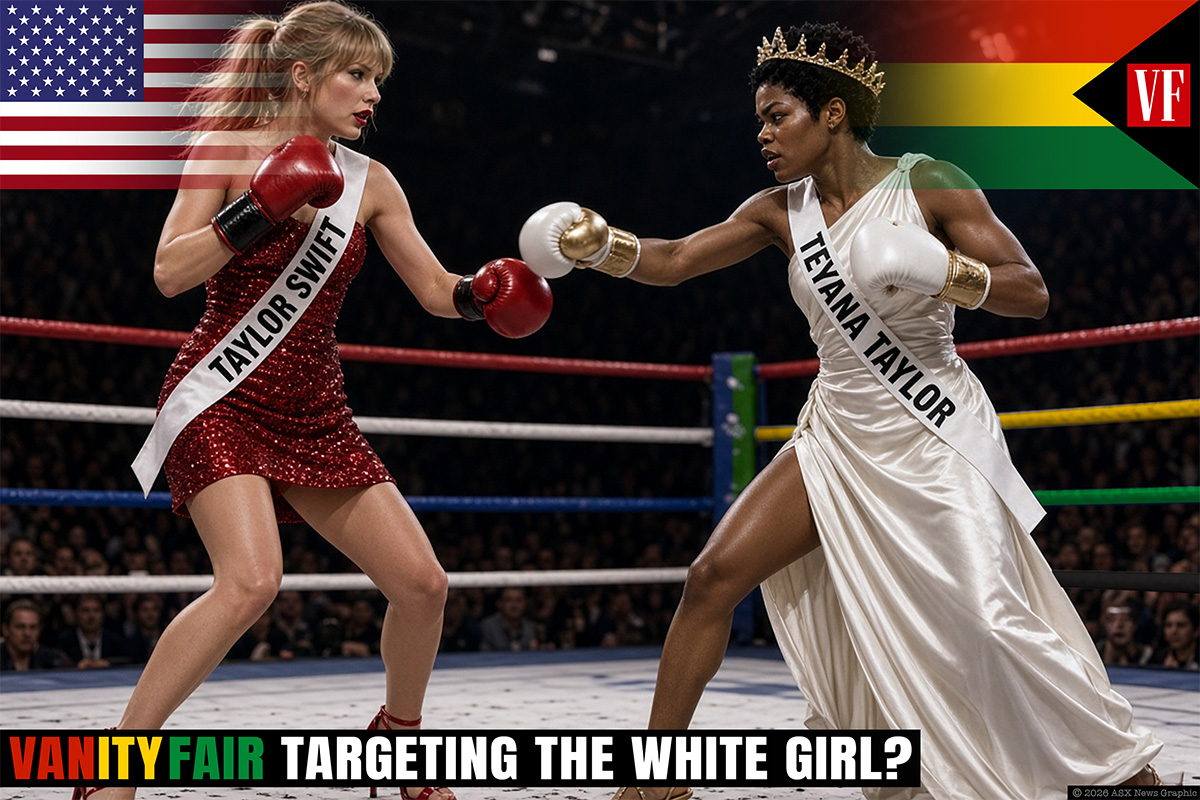
Vanity Fair has thrown the first punch. On November 23, 2026, the internationally recognized magazine published an extraordinarily contentious article targeting one of America’s most commercially successful and culturally influential entertainers, Taylor Swift. Written by May Jeong and commonly referred to as “The Mastermind,” the article has generated a backlash that now threatens to place the publication itself under greater scrutiny than the woman it sought to expose.
Swift did not initiate this confrontation. Vanity Fair made a calculated editorial decision to investigate her personal history, childhood, financial background, friendships, professional relationships and public image. What the magazine apparently intended as an examination of celebrity power has instead raised fundamental questions about the integrity, political orientation and cultural biases of contemporary entertainment journalism.
The Anatomy of a Hit Piece
Perhaps the most peculiar element of the Vanity Fair article is its refusal to identify Taylor Swift by name. Despite leaving readers with little uncertainty about the identity of its subject, the publication relies on pseudonyms and literary devices that make the investigation resemble an elaborate exercise in celebrity gossip.
Jeong reportedly interviewed more than 100 individuals. Yet the number of people interviewed does not independently establish the credibility of the resulting narrative. An investigation involving hundreds of interviews can still produce a distorted representation if its evidence is selectively assembled to support a predetermined conclusion.
The distinction between investigating an individual and investigating an allegation is fundamental. Legitimate investigative journalism ordinarily begins with a question or a substantive allegation requiring examination. Beginning with a person and searching for damaging information about that individual presents an entirely different set of ethical considerations.
Among the revelations attracting widespread ridicule were recollections concerning Swift’s childhood popularity and the number of pairs of Ugg boots she reportedly owned. That such material could find its way into a major magazine’s purported examination of one of the world’s most successful entertainers raises serious questions about the editorial threshold for evidence.
America’s Sweetheart Under Attack
Taylor Swift represents an extraordinary American commercial success story. Her career has evolved from country music performances into an international entertainment enterprise encompassing songwriting, recording, production, touring and sophisticated intellectual property management.
She is also a white American woman whose public identity has become deeply embedded within contemporary American popular culture. Her demographic identity should neither insulate her from legitimate criticism nor make her a more acceptable target for hostility. That principle should apply universally, regardless of race, ethnicity, gender or economic status.
Nevertheless, the manner in which Vanity Fair treats Swift’s upbringing and financial success invites examination of whether contemporary cultural attitudes toward privilege have influenced the publication’s editorial judgment. Financial advantages may legitimately form part of a biographical investigation, but they do not negate talent, professional discipline, creativity or individual accomplishment.
Having parents who possess the financial resources to support their child’s ambitions is not evidence of wrongdoing. Nor does achieving extraordinary financial success constitute an ethical transgression. If specific instances of misconduct exist, they should be established through independently verifiable evidence rather than insinuation.
Vanity Fair’s Cultural and Editorial Identity
Vanity Fair has a substantial history of celebrating African culture, Black entertainers and prominent individuals of African descent. Its July 2007 Africa issue, guest-edited by Bono, featured 20 alternative covers and represented a particularly ambitious editorial undertaking centered on the African continent.
More recently, the magazine’s Winter 2026 cover presented American entertainer Teyana Taylor in imagery inspired by the Statue of Liberty, accompanied by messaging commemorating America’s 250th anniversary. The composition placed the entertainer within one of the most recognizable symbols of American national identity.
There is nothing inherently objectionable about either editorial undertaking. The celebration of African heritage and Black American achievement is entirely compatible with responsible journalism. However, a publication that prominently embraces particular cultural narratives cannot reasonably expect its broader editorial philosophy to remain exempt from examination when controversy arises over its treatment of other individuals.
The contrast between Vanity Fair’s celebratory treatment of Teyana Taylor and its hostile examination of Taylor Swift is visually and editorially striking. Although the two women are not engaged in a personal confrontation, the contrasting coverage provides an opportunity to examine the values and priorities of the institution responsible for publishing both.
Is Racial Bias a Legitimate Question?
Racial bias is frequently examined within American journalism, entertainment, education, employment and institutional decision-making. There is no intellectually defensible reason why such an examination should become unacceptable when the individual potentially disadvantaged by editorial bias happens to be white.
If journalists are prepared to investigate whether racial identity influences the treatment of Black celebrities, they must also be prepared to investigate whether racial identity influences the treatment of white celebrities. Applying different standards to the legitimacy of those inquiries would itself represent an intellectual inconsistency.
Does Vanity Fair’s editorial leadership regard Swift’s identity, wealth and cultural prominence as representing a form of privilege requiring public deconstruction? Would an entertainer of comparable professional stature but a different racial background receive the same treatment under equivalent circumstances? Would the magazine devote similar investigative resources to childhood grievances, personal friendships and adolescent consumer purchases?
These questions warrant examination. The contrasting coverage does not independently establish racial animus, and Vanity Fair’s support for Black entertainers is not evidence of hostility toward white entertainers. Establishing discriminatory editorial treatment would require a systematic comparison of the magazine’s coverage of similarly situated individuals. Nevertheless, racial motivation should neither be presumed nor automatically excluded from legitimate inquiry.
The burden of maintaining consistent editorial standards belongs to Vanity Fair. Its readers are entitled to question whether the magazine applies those standards uniformly.
The Weaponization of Privilege
One of the more troubling characteristics of contemporary cultural commentary is the tendency to transform the concept of privilege from a descriptive socioeconomic condition into an implied indictment of the individual possessing it.
Swift’s commercial success makes her an obvious subject for examination within that framework. Yet the existence of financial advantages during childhood cannot explain away an entertainment career spanning decades, the creation of an extensive musical catalog, the development of an international audience or the ability to sustain extraordinary commercial relevance.
Similarly, Swift’s dispute over the ownership of her original master recordings represented a substantial commercial and intellectual property controversy. Her decision to rerecord her music demonstrated considerable business ingenuity. Whether one sympathizes with her position or that of the executives involved, the dispute deserves examination on its contractual and commercial merits rather than through the simplified characterization of an ambitious woman pursuing a personal vendetta.
When professional ambition becomes evidence of manipulation, financial success becomes evidence of greed, and the maintenance of personal boundaries becomes evidence of vindictiveness, almost any accomplished individual can be transformed into a villain through sufficiently hostile editorial framing.
Anonymous Accusations and Journalistic Accountability
Anonymous sources perform an important function in investigative journalism, particularly when disclosure could expose individuals to retaliation or substantial professional consequences. Their use, however, places an additional responsibility on the journalist and publication to establish credibility, corroboration and relevance.
The anonymity surrounding significant portions of Vanity Fair’s criticism makes it difficult for readers to independently evaluate the relationships, experiences and potential motivations of the individuals supplying damaging characterizations of Swift.
Former acquaintances, business associates and classmates may possess valuable information. They may also possess longstanding grievances, financial interests, personal resentments or memories affected by the passage of time. Responsible journalism requires the examination of these possibilities before presenting their accounts as the foundation of a sweeping assessment of another person’s character.
Swift declined to participate in Vanity Fair’s reporting. That decision does not establish the accuracy of the accusations directed against her. Individuals are under no obligation to participate in an investigation of their personal lives, and declining an interview cannot reasonably be treated as an admission of misconduct.
The Journalism Industry Pushes Back
Criticism of Vanity Fair has extended beyond Swift’s considerable fan base. Chris Willman, Variety’s senior music writer and chief music critic, published a column questioning whether the magazine’s article met the standards of journalism. The criticism is particularly significant because it originates within the professional entertainment media industry itself.
Other entertainment publications have similarly questioned the relevance of the childhood anecdotes, the dependence on unidentified sources and the unusual literary construction of the article. The resulting controversy has shifted attention toward the credibility of the publication responsible for the investigation.
Readers can examine the original Vanity Fair article and the subsequent criticism published by Variety to independently evaluate the competing perspectives.
Vanity Fair Picked This Fight
Taylor Swift’s celebrity status does not place her beyond criticism. Her financial empire, commercial decisions and considerable cultural influence are legitimate subjects of public-interest journalism. But the legitimacy of the subject does not automatically establish the legitimacy of every investigation undertaken against her.
Vanity Fair voluntarily entered this confrontation. It selected the subject, assigned the journalist, assembled the allegations, determined the editorial tone and authorized publication. Every one of those institutional decisions is now deserving of public scrutiny.
Whether the article represents ideological hostility toward wealth, resentment of extraordinary commercial success, racial bias, misogyny or simply an aggressive attempt to generate readership remains an open question. What is considerably less ambiguous is that the publication chose to construct and disseminate an intensely unfavorable examination of one of America’s most recognizable entertainers.
Journalistic accountability cannot function as a one-way street. A magazine willing to investigate the character, motivations, historical behavior and cultural influence of Taylor Swift must be willing to submit its own institutional character, motivations, historical behavior and cultural influence to an equally rigorous examination.
Vanity Fair threw the first punch. It should not be surprised that the public is punching back.