


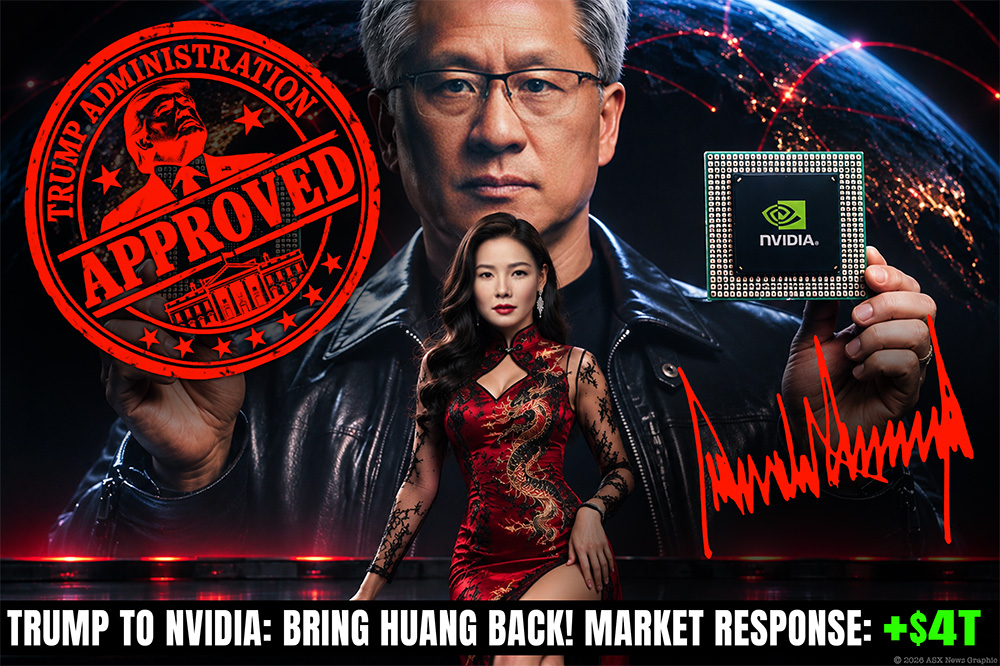
Eleven days after resigning from the company he co-founded in 1993, Jensen Huang is once again at the helm of NVIDIA. Following direct intervention by President Donald Trump and Vice President JD Vance, NVIDIA’s board of directors unanimously approved Huang’s reinstatement, sending the semiconductor giant’s market capitalization soaring from approximately $3 trillion to nearly $4 trillion.
The November 23, 2026, announcement triggered an extraordinary recovery on Wall Street. NVIDIA shares gained approximately 31.5 percent during Monday’s trading session, restoring an estimated $950 billion in market capitalization and reversing a substantial portion of the financial damage that followed Huang’s departure.
The episode represents a remarkable convergence of presidential authority, corporate governance, international espionage allegations, national security, artificial intelligence and global financial markets.
Trump Sends in the Vice President
President Trump’s involvement in Huang’s reinstatement was considerably more extensive than a public expression of support. According to Reuters and the Associated Press, Trump and Vice President JD Vance personally intervened in the leadership crisis, with Vance and senior administration officials helping persuade NVIDIA’s directors to restore Huang to his position.
The administration reportedly considered Huang’s leadership strategically important to maintaining American competitiveness in artificial intelligence, particularly in the development of open-weight AI models capable of competing against emerging Chinese technologies.
Trump also expressed concern that Huang’s departure could ultimately benefit China, particularly if the executive’s technological expertise and industry relationships became available to America’s principal competitor in artificial intelligence.
The intervention followed considerable pressure from technology industry executives and investors. A public campaign supporting Huang’s reinstatement attracted more than 180,000 signatures, including that of SpaceX chief executive Elon Musk.
The Official Reinstatement
According to NVIDIA’s Form 8-K filing with the United States Securities and Exchange Commission, the corporation’s board reinstated Huang on November 22 as president, chief executive officer and a member of its board of directors. The decision was publicly announced the following day.
Colette Kress, who had served as interim chief executive following Huang’s resignation, returned to her continuing responsibilities as executive vice president and chief financial officer. Harvey C. Jones retained his position as chairman of the board.
NVIDIA acknowledged that its directors had received information from senior officials within the United States government during their deliberations. The board concluded that Huang’s reinstatement did not present a national security risk.
The decision represented a substantial reversal of the board’s previously stated position against bringing Huang back to lead the corporation.
From $3 Trillion to $4 Trillion
Wall Street’s response was immediate and extraordinary. According to The Wall Street Journal, NVIDIA recovered approximately $950 billion in market capitalization during Monday’s trading session, with its shares increasing by approximately 31 percent.
The company’s valuation climbed from roughly $3 trillion at Friday’s close to approximately $4 trillion, illustrating the extraordinary degree to which investor confidence in NVIDIA remains associated with its founder.
For perspective, the market value recovered by NVIDIA during a single trading session exceeded the entire market capitalization of many of the world’s largest publicly traded corporations.
The recovery extended throughout the American financial markets. The Nasdaq Composite gained approximately 6.5 percent, while the S&P 500 advanced approximately 4.7 percent as investors returned to technology and artificial intelligence-related equities.
Huang personally benefited from the recovery as well. Forbes estimated that the increase in NVIDIA’s share price added approximately $34 billion to his personal fortune during Monday’s session.
Although NVIDIA had not fully recovered its valuation from immediately before Huang’s resignation, the magnitude of Monday’s rebound demonstrated how rapidly investor sentiment could change following the resolution of the company’s immediate leadership crisis.
The Woman at the Center of the Controversy
Huang’s November 12 resignation followed revelations concerning extramarital relationships, including an affair with Chinese businesswoman Alice Huang, who is not related to the NVIDIA executive.
The relationship attracted national security attention because American intelligence officials reportedly suspected Alice Huang of connections to Chinese intelligence. Beijing has denied allegations that she was a Chinese spy.
Alice Huang previously headed Megaspeed, a company with commercial connections to NVIDIA that has attracted scrutiny over possible violations of American semiconductor export controls.
The possibility that a foreign intelligence organization could have established access to the chief executive of one of America’s most strategically important technology corporations transformed what might otherwise have remained a personal and corporate governance scandal into a matter of national security.
The concerns extend beyond the potential disclosure of proprietary semiconductor technology. NVIDIA’s commercial relationships, international distribution networks, advanced computing infrastructure and future product development represent information of considerable strategic and economic value.
The Presidential Seal of Approval
Trump publicly supported NVIDIA’s decision to reinstate Huang, stating that the United States government had no reason to believe his return presented a national security risk.
According to Reuters, Trump also stated that Attorney General Todd Blanche had confirmed that the federal government possessed no evidence that Jensen Huang had engaged in unlawful conduct.
Trump nevertheless called for NVIDIA to continue examining its compliance with American export-control requirements. The president’s position therefore distinguished between Huang’s suitability to return as chief executive and the broader investigations involving the corporation’s international commercial activities.
The administration’s intervention demonstrated the degree to which NVIDIA’s leadership has become a matter of concern extending beyond its shareholders and board of directors.
The Investigations Continue
NVIDIA’s announcement confirmed that its independent investigation into reports of possible foreign intelligence targeting of Huang would continue despite his reinstatement.
The corporation established an investigative committee composed entirely of independent directors and retained outside legal counsel to assist with its inquiry. Huang has expressed support for the investigation and committed to cooperating with it.
NVIDIA has also established a separate National Security and Export Control Committee responsible for overseeing international trade compliance and addressing national security risks.
The corporation is additionally recruiting a chief compliance officer who will report to the board’s Nominating and Corporate Governance Committee.
Congressional scrutiny remains active. According to the Associated Press and Reuters, Huang is scheduled to testify before the Senate Banking Committee on December 3, where lawmakers are expected to examine national security concerns and matters relating to NVIDIA’s international operations.
Why NVIDIA Matters to America
NVIDIA’s transformation from a manufacturer of graphics processors for personal computers into a dominant supplier of artificial intelligence computing infrastructure has placed the corporation at the center of one of the most consequential technological transformations in modern history.
Its processors power advanced artificial intelligence systems, scientific research, robotics, autonomous vehicles, industrial simulation and high-performance computing. Its software ecosystem supports an international community of developers, researchers and technology companies.
The corporation’s influence extends across numerous industries and national borders, making its products increasingly important to economic development, scientific advancement and national competitiveness.
For Washington, maintaining American leadership in advanced semiconductor technology is closely associated with preserving the country’s competitive position in artificial intelligence. For Beijing, developing comparable technological capabilities and reducing dependence on American-designed hardware remain important strategic objectives.
NVIDIA consequently occupies a particularly sensitive position between commercial opportunities in international markets and the national security objectives of the United States.
Corporate Independence and Presidential Influence
The administration’s participation in Huang’s reinstatement raises fundamental questions about the relationship between private corporate governance and government intervention in industries considered strategically important.
Supporters of Huang’s return emphasize his technical knowledge, entrepreneurial leadership, international relationships and the extraordinary financial consequences associated with his departure.
Critics have questioned whether political pressure influenced an independent corporate board before investigations into possible national security and corporate compliance concerns had reached their conclusions.
The decision also illustrates the increasing difficulty of separating the interests of multinational technology corporations from the strategic objectives of the governments within whose jurisdictions they operate.
The Trillion-Dollar Executive
Rarely has the departure and subsequent reinstatement of a corporate executive produced such extraordinary financial consequences in less than two weeks.
Jensen Huang’s return to NVIDIA was accompanied by a nearly $1 trillion recovery in the corporation’s market capitalization, substantial gains across American financial markets and an extraordinary demonstration of presidential influence over the leadership of a private technology corporation.
What began as a scandal involving the personal conduct of a prominent corporate executive has become an international story involving intelligence allegations, semiconductor export restrictions, corporate accountability, presidential intervention and the future of artificial intelligence.
Jensen Huang is back. NVIDIA is approaching a $4 trillion valuation once again. And the Trump administration has placed its support behind the man whose leadership Wall Street has effectively valued at nearly a trillion dollars.
Sources
NVIDIA — Official announcement of Jensen Huang’s reinstatement
United States Securities and Exchange Commission — NVIDIA Form 8-K
Reuters — Huang returns as Nvidia CEO after Trump intervention in abrupt board reversal
The Wall Street Journal — Nvidia Stock Surges as Investors Cheer Jensen Huang’s Return as CEO
Fortune — Wall Street puts a trillion-dollar valuation on Jensen Huang’s return
Forbes — Jensen Huang Ends Monday $34 Billion Richer After Being Reinstated As Nvidia CEO
TIME — Six questions surrounding Jensen Huang’s return
Al Jazeera — Implications of Jensen Huang’s return for Washington and Wall Street