


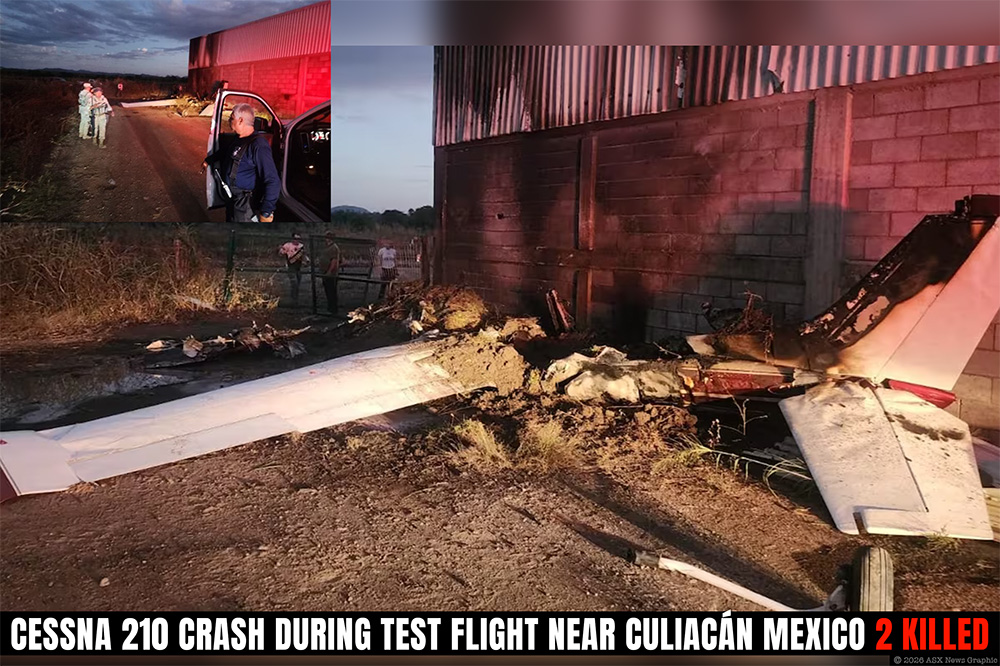
Two people were killed on Saturday, November 21, 2026, when a light aircraft identified by multiple Mexican news organizations as a Cessna 210 Centurion crashed and caught fire in a rural area east of Culiacán, the capital of the Mexican state of Sinaloa. Preliminary reports indicate that the aircraft may have been conducting a test flight when the accident occurred.
The aircraft crashed within the grounds of Campestre Santa Rosa, between the communities of Carboneras and Ejido Plan de Oriente, in the administrative district of Sanalona. The accident site is located approximately nine kilometers east of Culiacán.
Accident Sequence
According to Vanguardia, the accident occurred shortly before 5:00 p.m. local time (0000 UTC on November 22). Mexico’s 911 emergency service received notification of the accident at approximately 5:40 p.m. local time.
Preliminary eyewitness accounts indicate that the aircraft may have experienced a mechanical problem while conducting a test flight. Some reports suggest that the pilot attempted an emergency landing before the aircraft struck the ground and a masonry wall on the premises of a private property.
Other regional reporting describes an abrupt lateral departure shortly after the aircraft became airborne. The aircraft subsequently descended into the terrain, where a substantial post-impact fire developed. Neither occupant survived.
The available accounts raise the possibility that the accident occurred during the initial climb or an attempted return following takeoff, rather than during the en route phase of flight. The departure airfield, intended destination, duration of the flight and precise sequence of events have not been established.
Accident Aircraft
Multiple Mexican news organizations, including Línea Directa and N+ television news, have identified the aircraft as a Cessna 210 Centurion. The precise model variant, nationality and registration markings, manufacturer’s serial number, year of manufacture and registered owner have not been independently established by ASX News.
The Cessna 210 Centurion is a family of high-wing, single-engine aircraft equipped with retractable landing gear. Produced in numerous configurations between 1957 and 1986, the aircraft was available in normally aspirated, turbocharged and pressurized variants and was widely utilized for private transportation and commercial general aviation operations.
Photographs of the accident site examined by ASX News depict extensive fire damage to the central fuselage and cabin area. Portions of the empennage and wing structure survived the fire, revealing elements of the aircraft’s red-and-white exterior paint scheme.
No legible aircraft registration markings have been detected in the available wreckage photographs. The observed structural characteristics are consistent with the reported Cessna 210 identification, although positive identification of the individual aircraft remains outstanding.
Identification of the Occupants
Subsequent reporting by El Debate and Café Negro Portal identified the two deceased occupants as Baudelio N., believed to have been the pilot, and Rafael Humberto N., a resident of the Bachigualato district of Culiacán.
Mexican news organizations have published conflicting information concerning Rafael Humberto’s age. The full surnames, professional backgrounds, aviation qualifications and respective responsibilities of the two occupants aboard the aircraft have not been publicly established.
Significance of the Reported Test Flight
One of the most significant elements of the preliminary reporting is the suggestion that the aircraft was conducting a test flight. El Financiero and N+ have both reported that the accident occurred in association with apparent flight-testing activities.
Establishing the purpose of the reported test flight will be particularly important in reconstructing the circumstances preceding the accident. Test flights involving privately operated general aviation aircraft may be conducted following maintenance, engine replacement or overhaul, avionics installations, flight-control adjustments, restoration work or the investigation of previously reported operational deficiencies.
No information has emerged identifying any specific maintenance activity or technical deficiency associated with the accident aircraft. Consequently, the reported test-flight status cannot presently be associated with a particular mechanical failure or maintenance procedure.
Nevertheless, the aircraft’s recent maintenance history, the reason for conducting the flight, and any discrepancies identified during preceding ground or flight operations represent important avenues of investigative inquiry.
Possible Loss of Control During Initial Climb
The preliminary eyewitness description of the aircraft abruptly departing laterally shortly after becoming airborne warrants particular attention. Such a flight profile could be consistent with an aerodynamic stall accompanied by a wing drop, potentially during an attempted response to an abnormal aircraft or engine condition.
During initial climb, an unexpected reduction in engine performance can leave a pilot with limited altitude, time and maneuvering options. An attempt to maintain altitude or execute an immediate turn without establishing an appropriate airspeed may significantly increase the risk of an aerodynamic stall.
However, no recorded flight-path information, aircraft performance data, engine examination findings or sufficiently detailed eyewitness testimony has been made available to establish whether such a sequence occurred in this accident. The reported mechanical malfunction and possible lateral departure represent preliminary investigative leads rather than established causal findings.
Emergency Response
The accident prompted a response involving the Culiacán Fire Department, Civil Protection personnel, Mexican Red Cross paramedics, municipal and state police, and members of the Mexican Army.
Firefighters extinguished the flames consuming the aircraft wreckage, while medical personnel confirmed that both occupants had died. No injuries to individuals on the ground were reported.
Military and law enforcement personnel secured the accident site to facilitate the collection of evidence and recovery of the deceased. Forensic personnel from the Fiscalía General del Estado de Sinaloa conducted examinations at the scene before the bodies were transferred to the Servicio Médico Forense (SEMEFO) for the corresponding legal and medical procedures.
Aircraft Identification and Investigative Priorities
Positive identification of the accident aircraft through its registration markings or manufacturer’s serial number will be fundamental to establishing its documented operational and maintenance history. This information could also establish the precise aircraft configuration, applicable airworthiness directives, registered ownership and any recorded history of previous accidents or significant repairs.
The reported test-flight operation, possible mechanical malfunction and apparent loss of control shortly after departure constitute the principal investigative leads emerging from the available information. Establishing the aircraft’s identity and the specific purpose of the flight may provide the most direct means of determining the technical and operational circumstances preceding the fatal accident.
Sources
Vanguardia — November 21, 2026.
El Financiero — November 21, 2026.
Línea Directa — November 21, 2026.
El Debate — November 21, 2026.
Café Negro Portal — November 21, 2026.
N+ FORO TV — November 21, 2026.
Los Noticieristas — November 21, 2026.
Spanish-language television news report — November 21, 2026.