

A military-configured Cessna 208B Grand Caravan crashed in heavily wooded terrain near Kalonge, in the Minembwe region of South Kivu, Democratic Republic of the Congo, on Sunday morning, November 22, 2026. Two of the four occupants were killed, while two others survived. The aircraft was reportedly supporting military operations involving the Armed Forces of the Democratic Republic of the Congo (FARDC) and allied Burundian forces.
The crash occurred at approximately 6:00 a.m. local time amid ongoing fighting in the mountainous eastern Congo. The Front for the Refoundation of the Nation (FRN), an armed movement opposing the Congolese government, claimed its forces shot down the aircraft. The group alleged that the airplane was preparing to conduct an attack against civilians near Minembwe.
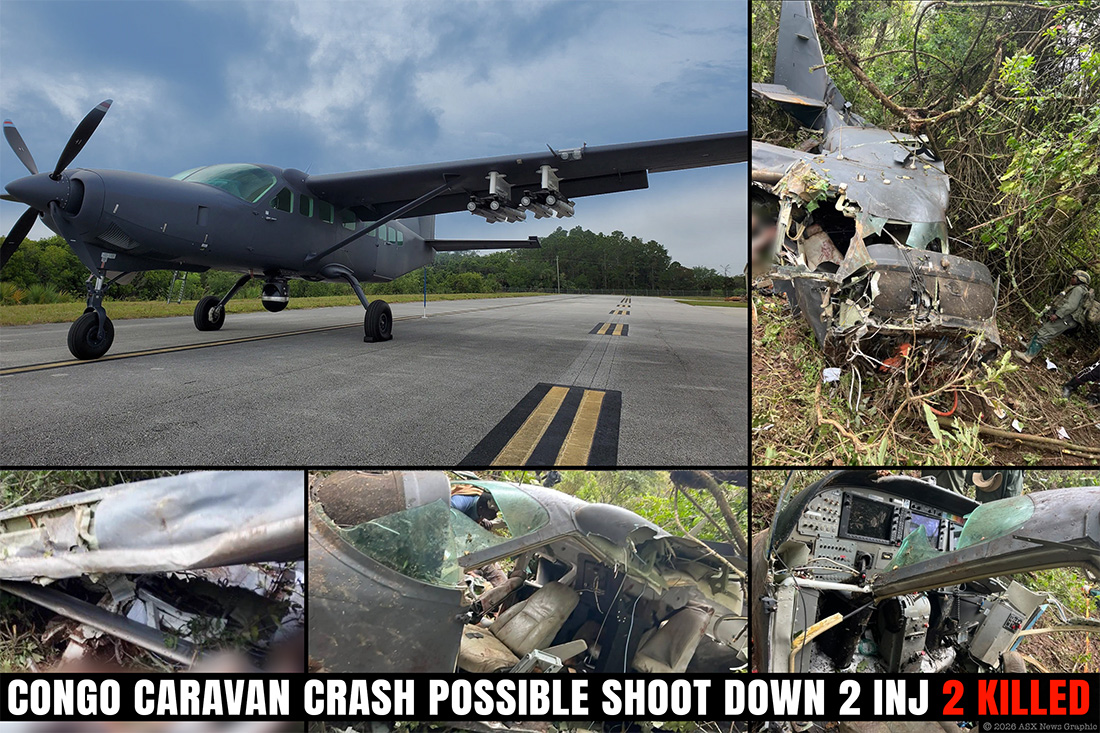
Photographs and video released following the incident show a dark-gray aircraft with extensive structural damage in dense vegetation. The wreckage includes portions of the cockpit, fuselage, tail assembly, and wing structure. The images provide important physical evidence of the aircraft’s configuration and condition following impact.
Four Occupants, Two Fatalities
Regional reporting identifies four people aboard the aircraft, with two fatalities and two survivors. SOS Médias Burundi reported that the surviving occupants included a South African pilot and a Ugandan national, citing information released by the FRN. The South African was identified in the group’s account by the name Alendre, although another regional report used the name Andre.
Images circulated following the crash show an injured man being assisted by individuals on the ground. Regional journalists identified him as a surviving foreign pilot. The FRN indicated that surviving personnel had been taken into its custody or protection.
The identities of the two deceased occupants have not been established in the available reporting. Photographs from the scene show individuals wearing civilian-style clothing rather than recognizable military camouflage uniforms. Clothing alone, however, does not establish whether the occupants were civilian contractors, military personnel, or individuals serving in another capacity.
Rebel Forces Claim Responsibility
Lawrence Kanyuka, spokesperson for the FRN, announced on November 22 that the movement had destroyed an aircraft operating over Minembwe. His initial statements described the aircraft as a fighter jet, although subsequent photographic examination and regional reporting identified a Cessna Caravan rather than a conventional jet-powered combat aircraft.
The FRN maintained that its forces had engaged the aircraft while it was preparing to attack civilian populations. The accusation was accompanied by photographs and video purportedly documenting the wreckage and surviving occupants.
The assertion that the airplane was shot down is supported by the FRN’s claim of responsibility, but the publicly available wreckage photographs do not independently establish the weapon employed or the precise sequence of events leading to impact. No verified record of a missile launch, gunfire engagement, or documented in-flight structural breakup has been established in the material reviewed by ASX News.
Neither the Congolese military nor the Burundian military had issued a detailed public account of the incident in the regional reports published on November 22.
Aircraft Identification: Cessna 208B and AC-208B Combat Caravan
The aircraft has been identified in aviation accident records as a Cessna 208B Grand Caravan. The Bureau of Aircraft Accidents Archives describes the occurrence as the crash of an AC-208B Combat Caravan near Kalonge, resulting in two fatalities and two injured survivors.
The Cessna 208B is a single-engine, high-wing turboprop aircraft originally developed for civilian passenger, cargo, and utility operations. Its combination of relatively low operating costs, useful payload, and short-field performance has also made the platform attractive for military transport, surveillance, reconnaissance, and specialized operations.
The AC-208B Combat Caravan represents an armed adaptation of the basic airframe. Military configurations can incorporate surveillance equipment, specialized communications, targeting systems, and external weapon installations. Such equipment allows the aircraft to undertake missions beyond conventional transport duties, including armed reconnaissance and precision-attack support.
Photographs of an armed Caravan configuration circulated in connection with the Kalonge incident show a dark-gray airframe, tinted cockpit glazing, and external weapons carried beneath the wing. These images illustrate the type of military adaptation discussed in regional reports.
Photographs of the Kalonge wreckage show a similarly dark-gray finish and green-tinted glazing. The extent of damage and the absence of a readable aircraft identification in the available photographs prevent a conclusive manufacturer-serial-number identification from the imagery alone.
The Registration and Serial Number Question
An Aviation Safety Network WikiBase entry for the November 22 accident lists manufacturer serial number 208B2060, identifying the aircraft as a 2008-built Cessna 208B. The entry does not provide a confirmed registration for the aircraft at the time of the crash.
Independent historical aircraft records associate serial number 208B2060 with registrations N2140X and F-HDNT. Photographic records of F-HDNT show a conventionally configured civilian Grand Caravan operating in Europe, including documented appearances in Germany during 2020 and 2021.
This creates an important aircraft-history question. The ASN serial-number entry identifies a specific previously documented airframe, but the available evidence does not establish the chain of ownership, registration cancellation, subsequent transfer, or possible military conversion that would connect F-HDNT directly to the aircraft destroyed at Kalonge.
Aircraft registration markings are not discernible in the published crash photographs reviewed by ASX News. Consequently, the serial-number association remains an investigative lead rather than a fully documented identification of the destroyed aircraft.
Wreckage Examination and Structural Damage
Photographs from the crash location show the aircraft resting amid dense trees and undergrowth. The forward fuselage and cockpit exhibit substantial deformation, with large sections of the nose and windshield structure torn away or displaced. Interior equipment, wiring, and structural components are exposed.
The cockpit imagery reveals extensive damage around the instrument panel and surrounding structure. Additional photographs show sections of the wing and supporting components separated or distorted, consistent with a high-energy impact involving substantial structural disruption.
The tail assembly remains recognizable in one view, while the forward cabin has sustained considerably more extensive destruction. The surrounding vegetation and tree branches indicate that the aircraft came to rest in a wooded environment where contact with terrain and vegetation could have contributed to the observed damage.
Although the photographs establish significant impact damage, they do not provide sufficient information to distinguish conclusively between damage sustained before impact and damage resulting from the collision with terrain. The distribution of debris, condition of the engine and propeller, and evidence of possible projectile penetration would be particularly relevant to establishing whether hostile fire initiated the accident sequence.
The Military and Operational Environment
The Kalonge crash occurred within a region experiencing sustained military confrontation between Congolese government forces, Burundian military units, allied armed groups, and the FRN movement. The fighting has involved ground operations, artillery, drones, and aircraft employed in support of opposing forces.
SOS Médias Burundi reported that the Congolese-Burundian coalition had been engaged in intensive operations across the South Kivu highlands, with recent advances and reversals. The publication also described the use of foreign personnel in certain aviation and drone-related military activities.
The aircraft’s reported involvement in government-aligned operations is consistent with the broader conflict environment. Nevertheless, the precise mission being conducted on November 22 has not been independently documented. Whether the aircraft was performing reconnaissance, transport, armed overwatch, or another military task cannot be established solely from the published photographs.
For a relatively slow turboprop aircraft operating at low altitude in contested territory, exposure to hostile ground fire is an important operational consideration. The Caravan’s utility and endurance provide advantages in remote environments, but the platform does not possess the speed or survivability characteristics of a purpose-built high-performance combat aircraft.
Conflicting Descriptions and the Emerging Record
The earliest reports described a fighter jet being brought down over Minembwe. Subsequent reporting, supported by photographs of the wreckage, identified a Cessna 208 Caravan in a military configuration. The distinction is significant because the aircraft’s design, capabilities, likely operating profile, and vulnerability differ substantially from those of a conventional fighter aircraft.
The Bureau of Aircraft Accidents Archives records the accident as occurring during flight near Kalonge, with four occupants, two fatalities, and two survivors. Its account describes a crash in hilly, wooded terrain without establishing the initiating event.
Regional publications including SOS Médias Burundi, TIC-TAC Hebdo, and KivuMedia independently reported the occurrence and the FRN’s claim of responsibility. Their accounts broadly agree on the location, date, and casualty figures, although the exact aircraft variant, occupants’ identities, and circumstances of the reported engagement remain incompletely documented.
ASX News Assessment
The available evidence establishes a fatal crash involving a military-configured Cessna Caravan near Kalonge on November 22, 2026. Four people were aboard, two were killed, and two survived. The aircraft was associated in regional reporting with Congolese government-aligned military operations, and the FRN publicly claimed responsibility for its destruction.
The crash-site photographs provide a substantial visual record of the wreckage, including the aircraft’s dark-gray finish, tinted glazing, cockpit structure, and extensive impact damage. They also provide a basis for examining the possibility that the airplane was configured for specialized military operations.
The reported manufacturer serial number, 208B2060, is traceable to a previously documented civilian aircraft registered F-HDNT. The missing link is a verified documentary or physical connection between that aircraft’s recorded history and the Kalonge wreckage.
The central investigative question is whether the Caravan was brought down by hostile fire or experienced another initiating event during flight over contested territory. The FRN has claimed responsibility, and the operational environment makes hostile engagement a credible possibility. The available public evidence does not yet identify the specific mechanism that caused the aircraft to crash.
What is clear is that a military-configured single-engine turboprop was lost during active hostilities in eastern Congo, leaving two people dead, two survivors, and a wreckage field that may ultimately provide the strongest evidence of what happened.
Sources
SOS Médias Burundi. (2026, November 22). Minembwe : un avion militaire de la coalition FARDC-FDNB s’écrase à Kalongi, deux morts et deux survivants.
Bureau of Aircraft Accidents Archives. (2026). Crash of a Cessna AC-208B Combat Caravan in Kalonge: 2 killed.
TIC-TAC Hebdo. (2026, November 22). Minembwe : un Cessna militaire des FARDC abattu, selon le FRN — Rodriguez Katsuva identifie l’appareil.
KivuMedia. (2026, November 22). Minembwe : un avion militaire tombe à Kalongi, le FRN revendique.
UNE.CD. (2026, November 22). Minembwe : la rébellion du FRN affirme avoir neutralisé un avion de chasse de l’armée congolaise.
Derek’s Caravan Site. Cessna Caravan production list, manufacturer serial number 208B2060.
Aviation Safety Network WikiBase. (2026, November 22). Cessna 208B Grand Caravan accident near Kalonge, Democratic Republic of the Congo.