

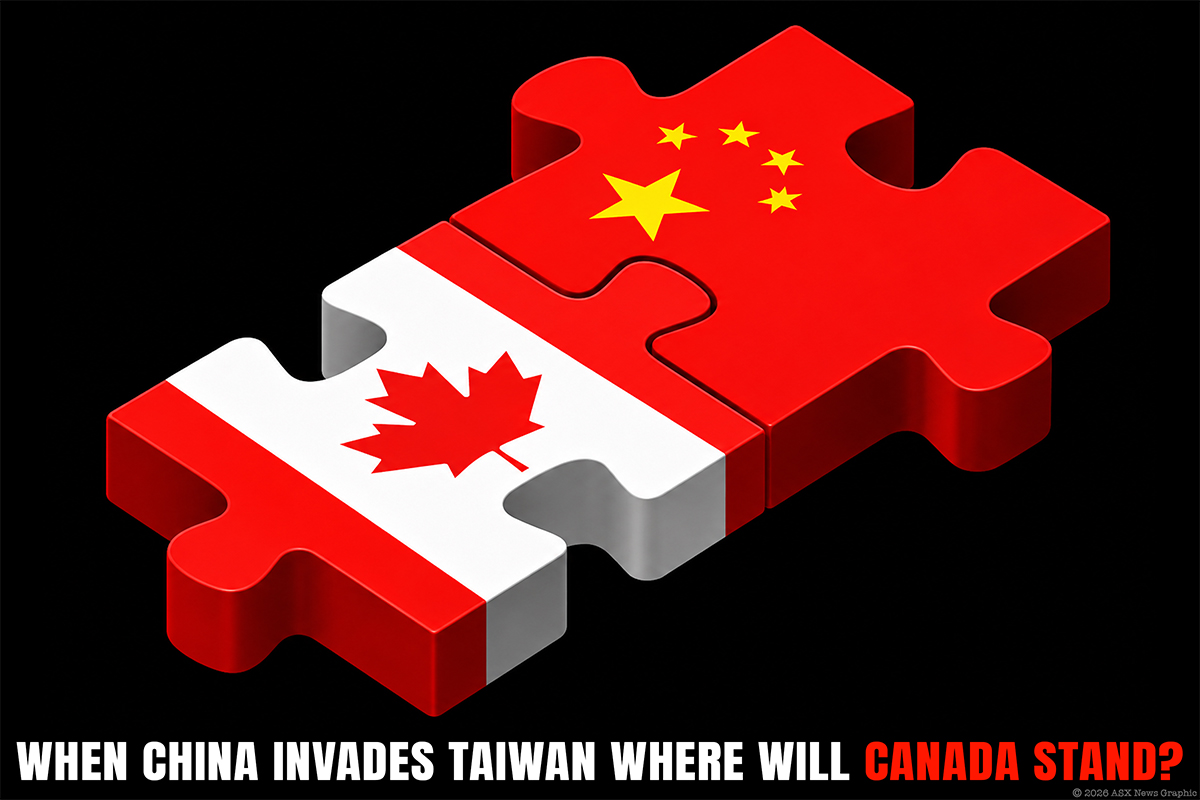
November 22, 2026 — Imagine Chinese warships surrounding Taiwan. Commercial shipping is being turned away. American naval forces are moving into position. Financial markets are collapsing under the weight of uncertainty, and governments around the world are being forced to decide whether to confront Beijing, support Washington, or attempt the increasingly dangerous proposition of neutrality.
Now imagine Canada receiving two telephone calls. One comes from Washington, requesting military cooperation and support for a coalition responding to Chinese military operations. The other comes from Beijing, warning that Canadian involvement will carry devastating economic consequences.
Which call does Ottawa answer first?
For Canadian Prime Minister Mark Carney, that question is becoming more than an abstract geopolitical exercise. His government is seeking closer commercial relations with China while maintaining longstanding security relationships with the United States and other Western allies. The contradiction is manageable during peacetime. In a major military confrontation over Taiwan, it could become one of the most consequential decisions in modern Canadian history.
And Taiwan has just delivered a warning that Ottawa would be unwise to dismiss.
Taiwan’s Warning: Be Careful Whose Hand You Shake
Speaking to the Associated Press at the Halifax International Security Forum on November 21, Taiwanese Deputy Foreign Minister Chen Ming-chi expressed concern about Carney’s efforts to expand Canada’s relationship with Beijing.
The warning followed Carney’s meeting with Chinese President Xi Jinping in Shenzhen, where the leaders agreed to additional tariff reductions amid Canada’s efforts to diversify its international trade relationships.
Carney’s economic reasoning is understandable. The United States has threatened punishing tariffs against Canadian industries, including automotive manufacturing. Ottawa is searching for alternatives to an increasingly unpredictable commercial relationship with its largest trading partner.
But Taiwan sees a potentially dangerous contradiction. Canada is attempting to escape economic coercion by strengthening its relationship with a government that Taiwan accuses of repeatedly using economic dependence as an instrument of political pressure.
Chen invoked the detention of Canadians Michael Kovrig and Michael Spavor, who were held in China from 2018 until 2021 following Canada’s arrest of Huawei executive Meng Wanzhou on an American extradition request. Their detention became a defining crisis in Canada-China relations. Beijing denied that the detentions were politically motivated.
The message to Ottawa was unmistakable: commercial opportunity does not necessarily provide protection from geopolitical confrontation.
According to figures cited by Chen, Taiwan reduced the share of its outbound investment directed toward China from more than 80 percent in 2010 to just 3.8 percent in 2025. Taiwanese exports destined for China and Hong Kong also fell from nearly 44 percent of total exports in 2020 to approximately 27 percent in 2025.
Those figures illustrate a deliberate effort to reduce economic vulnerability. Taiwan’s warning to Canada is that dependence can become a strategic liability precisely when a government most needs freedom of action.
Canada’s Chinese Trade Ambitions Meet an Uncomfortable Reality
Canada’s effort to expand trade with China is not inherently an endorsement of Beijing’s territorial ambitions. Countries routinely trade with governments whose political systems and foreign policies they oppose. Indeed, Ottawa has argued that diversification is essential to reducing the risks associated with excessive dependence on any single trading partner.
Carney has also distinguished Canada’s commercial relationship with China from that of the United States. Canadian exports to China are concentrated heavily in commodities, agricultural products, and energy rather than the advanced technologies that dominate many American national-security disputes.
Nevertheless, the distinction between ordinary trade and strategic dependence can disappear quickly during a crisis.
Consider a hypothetical Chinese blockade of Taiwan. Washington requests Canadian participation in maritime surveillance, intelligence sharing, and coordinated economic sanctions. Beijing responds by threatening Canadian agricultural imports, energy contracts, and access to Chinese markets.
Would Ottawa accept substantial economic damage to support the security interests of its allies? Would it attempt to negotiate an exemption? Could it maintain profitable commercial relations with Beijing while contributing to operations intended to frustrate Chinese military objectives?
None of these questions has a simple answer. Yet they expose the strategic problem behind Canada’s present balancing act: the more economically important China becomes, the more expensive a future confrontation with Beijing could be.
Canada Recognizes Beijing, but That Does Not Mean Supporting an Invasion
There is a fundamental distinction that is frequently lost in discussions about Taiwan.
Canada recognizes the People’s Republic of China as the sole legitimate government of China under its longstanding One China Policy. However, according to Global Affairs Canada, Ottawa takes note of Beijing’s position concerning Taiwan without either endorsing or challenging that specific claim.
Canada also maintains substantial unofficial relations with Taiwan, including cooperation involving trade, investment, technology, supply chains, and democratic governance.
Most importantly, Canada’s official policy opposes unilateral attempts to change the status quo in the Taiwan Strait by force or coercion.
That position creates a clear diplomatic distinction between recognizing Beijing’s government and accepting a military operation against Taiwan.
China considers Taiwan part of its territory and has not renounced the use of force to achieve unification. Taiwan operates as a self-governing democracy with its own elected government and armed forces. The dispute over Taiwan’s political future is therefore not simply a commercial disagreement; it is a potential flashpoint involving sovereignty, military power, international law, and the strategic balance of the Pacific.
Canada’s existing policy offers no automatic commitment to defend Taiwan militarily. But neither does diplomatic recognition of Beijing obligate Ottawa to support a Chinese attack.
The Military Alliance China Cannot Ignore
Canada’s strategic relationship with the United States extends far beyond tariffs, trade agreements, and political disagreements between national leaders.
The two countries share an integrated continental aerospace defense system through the North American Aerospace Defense Command, commonly known as NORAD. Canada is also a founding member of NATO and maintains extensive military cooperation with American and other allied forces.
These relationships involve military planning, intelligence exchange, command arrangements, surveillance capabilities, and operational interoperability developed over decades.
Canada’s own 2026–2027 defense planning calls for continued naval deployments to the Indo-Pacific, expanded cooperation with regional partners, and exercises involving allied forces. Its Operation HORIZON includes activities supporting navigational rights in the Taiwan Strait and South China Sea.
These are not the actions of a country preparing to abandon its Western security relationships in favor of a military partnership with Beijing.
However, an important legal distinction remains. NATO’s collective-defense provisions do not automatically require Canada to fight in a conflict over Taiwan. A Chinese attack on Taiwan would not, by itself, trigger an automatic Canadian obligation under Article 5.
Canada would still face major decisions about whether to participate in sanctions, intelligence operations, logistics, maritime deployments, or combat operations.
The existence of a military alliance establishes strategic relationships and obligations within defined circumstances. It does not eliminate political discretion in every possible conflict.
What If American and Chinese Warships Start Shooting?
The strategic dilemma becomes considerably more dangerous if a confrontation over Taiwan develops into direct hostilities between American and Chinese forces.
Suppose an American destroyer is attacked while operating near Taiwan. Washington requests allied naval assistance. Canadian vessels are already deployed elsewhere in the Indo-Pacific, conducting multinational exercises or supporting freedom-of-navigation operations.
Would Canadian ships be ordered toward the confrontation, withdrawn from the region, or assigned supporting missions outside the immediate combat area?
Would Canadian intelligence facilities contribute to American operational awareness? Would Canadian aircraft support maritime surveillance? Would Ottawa authorize logistical assistance while declining direct combat participation?
These are hypothetical decisions, not announced Canadian war plans. Nevertheless, they illustrate how a conflict can draw countries into operational involvement without an initial decision to enter a full-scale war.
There is also the possibility of direct Canadian exposure. Canadian warships periodically operate in the Taiwan Strait and surrounding waters. A major regional confrontation could threaten Canadian personnel and vessels even if Ottawa initially intended to avoid combat.
In that environment, neutrality would not necessarily guarantee safety.
China Would Have Economic Weapons of Its Own
Military force is only one instrument available to a major power. Trade restrictions, customs delays, export controls, market access, investment restrictions, and pressure on supply chains can all become instruments of economic coercion.
China possesses significant commercial influence, particularly in manufacturing, industrial processing, and critical-mineral supply chains. Canada possesses valuable energy, agricultural, mineral, and industrial resources, but its exporters can still be vulnerable when access to major foreign markets becomes politically contested.
Beijing could potentially respond to Canadian participation in sanctions or allied operations with measures directed at Canadian exports and businesses. The scale and effectiveness of such measures would depend on the economic relationship existing at the time, the actions taken by both governments, and the availability of alternative markets.
Washington would also possess economic leverage over Canada, particularly through continental manufacturing networks and cross-border trade.
Consequently, Ottawa could face pressure from both sides, with neither Washington nor Beijing willing to treat Canadian economic interests as the overriding consideration during a major military confrontation.
The danger is not simply that Canada might become dependent on China. It is that Canada could find itself exposed to coercive pressure from multiple major powers simultaneously.
The Taiwan Blockade Scenario May Be More Complicated Than an Invasion
A full-scale Chinese amphibious assault against Taiwan would represent an unmistakable military crisis. But the opening stages of a confrontation might be considerably less clear.
Chinese naval and coast guard forces could attempt to restrict commercial access to Taiwan through inspections, exclusion zones, or a maritime quarantine. Beijing might describe such measures as domestic law enforcement rather than acts of war.
Taiwanese Deputy Foreign Minister Chen warned in his November 21 interview that Chinese maritime activity could represent preparation for precisely such a scenario. His interpretation has not been established as a confirmed Chinese operational plan.
Nevertheless, the distinction between a quarantine and a military blockade could create serious diplomatic difficulties.
Would Canada condemn the restrictions but continue commercial relations with China? Would Ottawa support international efforts to escort merchant vessels? Would it impose sanctions before shots were fired? Would Canadian warships participate in operations intended to challenge Chinese control of maritime approaches to Taiwan?
Each option would carry economic and security consequences.
A blockade or quarantine could also disrupt semiconductor production, maritime transportation, electronics manufacturing, and industrial supply chains far beyond East Asia. Canada would face the consequences even without direct military involvement.
In other words, staying out of the shooting would not necessarily mean staying out of the conflict.
Could Canada Actually Side With China?
The question is deliberately provocative because it forces a distinction between what is politically conceivable and what is supported by current Canadian policy.
Canada’s official security strategy, military relationships, and stated opposition to coercive changes in the Taiwan Strait are inconsistent with supporting a Chinese military attack on Taiwan.
That does not mean every Canadian government would necessarily participate in a military defense of the island. Ottawa could oppose Chinese operations diplomatically while declining combat involvement. It could support sanctions but refuse to deploy warships. It could assist allied intelligence operations while pursuing negotiations.
Such choices would create controversy, but they would not automatically amount to siding with Beijing.
Conversely, a government could deepen trade with China while maintaining security cooperation with Taiwan and the United States. Economic engagement and strategic alignment are related, but they are not identical.
The real test would come if those relationships became incompatible under wartime pressure.
That is when political statements about diversification, sovereignty, international law, and national interests would confront decisions involving Canadian lives, economic stability, and the possibility of military escalation.
Carney’s Gamble: Can Canada Trade With China and Confront It?
Prime Minister Carney’s central challenge is not whether Canada should maintain commercial relations with China. It is whether those relations can be structured so that Canada retains meaningful freedom of action during a major international crisis.
Economic diversification can strengthen national independence when it reduces concentration and creates alternatives. It can weaken that independence when it simply exchanges one dominant source of leverage for another.
Taiwan’s warning is therefore more consequential than an ordinary diplomatic objection to a trade agreement.
It asks whether Canada is preparing for the strategic consequences of the commercial relationships it is building today.
Carney may calculate that expanding trade with Beijing strengthens Canada’s bargaining position with Washington. His critics may argue that it creates new vulnerabilities at the very moment Chinese military pressure around Taiwan is intensifying. Both arguments must ultimately be judged against the actual structure of Canada’s trade relationships and its ability to withstand economic retaliation.
What cannot be ignored is that a Taiwan crisis could transform commercial decisions into national-security liabilities with very little warning.
When the Shooting Starts, Canada May Not Have the Luxury of Ambiguity
Canada has spent decades building its security relationships with the United States and other allies. It has also recognized Beijing diplomatically for more than half a century and has substantial economic interests involving China.
Those relationships coexist today because economic competition and military confrontation have not yet forced every contradiction into the open.
A war over Taiwan could change that.
Ottawa might be asked to choose between protecting trade and supporting allied military operations. Canadian naval forces might be required to operate in contested waters. Canadian companies might face retaliatory restrictions. And the government could confront domestic pressure from industries, security officials, political opponents, and citizens with sharply different views about Canada’s responsibilities.
The choice would not necessarily be a simple declaration of allegiance to China or Taiwan. It could emerge through dozens of decisions involving sanctions, intelligence, military deployments, trade restrictions, and diplomatic recognition.
But the cumulative effect of those decisions would reveal where Canada’s strategic commitments actually lie.
Taiwan is warning Canada that economic dependence can become political vulnerability. China is offering commercial opportunities. The United States remains central to Canada’s defense and economic security, even as trade tensions complicate the relationship.
And Carney is attempting to navigate all three realities simultaneously.
The question facing Canada is not merely whether it can profit from Chinese trade during peacetime.
It is whether Canada can afford the consequences of that relationship if the Pacific erupts into war.
Sources and References
Associated Press. (2026, November 21). Taiwan warns Canada’s Carney that deeper ties with China come with risks.
Global Affairs Canada. (2026). Appearance at the House of Commons Standing Committee on Foreign Affairs and International Development on Main Estimates 2026–27 and Supplementary Estimates (A).
Global Affairs Canada. (n.d.). Canada’s Indo-Pacific Strategy.
Department of National Defence. (2026). 2026–27 Departmental Plan.
Department of National Defence. (2021). Key issues: Canada-China defence relations.