


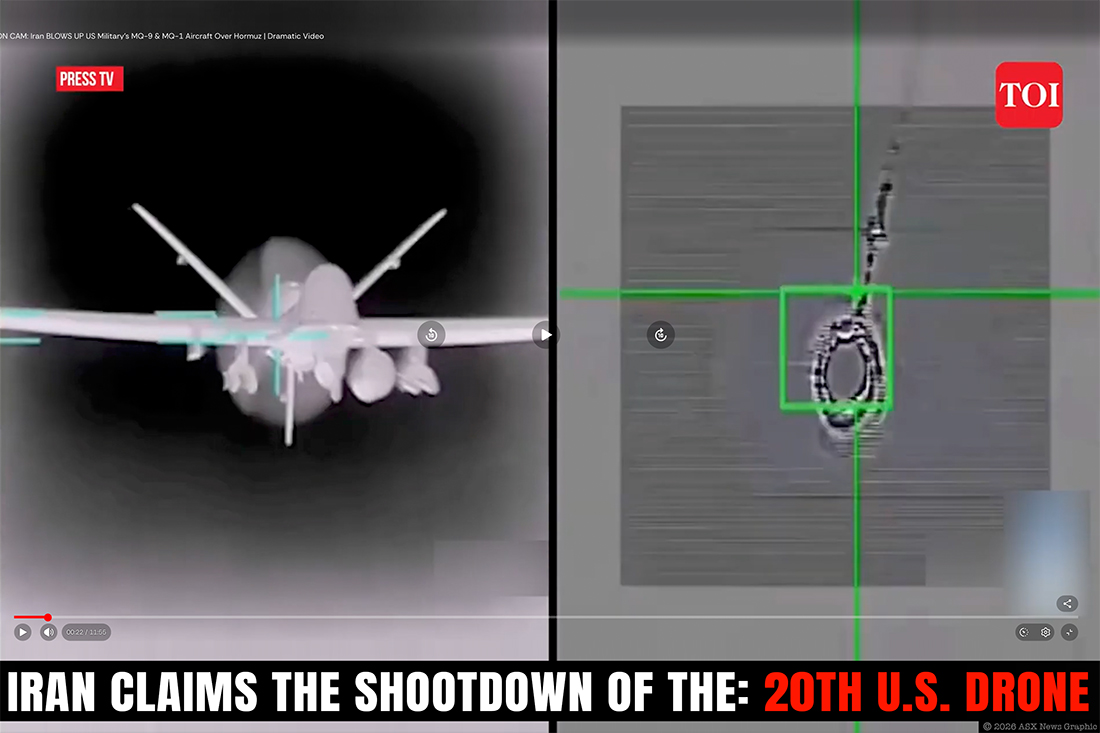
November 23, 2026 — Iran’s Islamic Revolutionary Guard Corps (IRGC) announced on November 22 that its air defense forces had destroyed another American MQ-1 unmanned aircraft east of the Strait of Hormuz, describing the engagement as its 20th successful interception of that aircraft type since the beginning of the war and the fourth within 24 hours.
The announcement followed Iranian claims that missile and drone attacks had targeted two American Patriot air-defense radars at military installations in Bahrain. Together, the incidents represent an intensifying campaign against American surveillance aircraft and the ground-based systems protecting U.S. military operations throughout the Persian Gulf.
Although the precise circumstances of the November 22 drone loss remain independently unverified, the Iranian announcement was reported by Anadolu Agency and Al Jazeera. Separately, Bahrain confirmed Iranian aerial attacks against its territory, including an incident that caused a fire at a civilian industrial facility.
The distinction between confirmed attacks, acknowledged losses, and contested battlefield claims is essential. Iranian military statements establish what Tehran says its forces accomplished. They do not, by themselves, establish the actual number of American aircraft destroyed or the extent of damage to U.S. air-defense installations.
Nevertheless, the latest developments occur against a documented background of substantial American unmanned-aircraft losses, repeated Iranian attacks on Gulf installations, and an increasingly dangerous confrontation over one of the world’s most strategically important maritime corridors.
November 22: Iran Announces Another MQ-1 Shootdown
On Sunday, November 22, the IRGC announced that its air-defense units had intercepted and destroyed an American MQ-1 reconnaissance-combat unmanned aircraft over the eastern Strait of Hormuz.
According to the announcement, carried by Iranian state broadcaster IRIB and subsequently reported by Anadolu Agency, the aircraft represented the 20th American drone of that type intercepted since hostilities began in February 2026.
The IRGC further claimed that four such aircraft had been destroyed during the preceding 24-hour period.
Iranian military officials reiterated that unauthorized penetration of Iranian airspace would be met with a military response.
The announcement did not provide independently verifiable information identifying the aircraft’s military serial number, operating unit, launch location, flight profile, or assigned mission.
Neither the precise engagement location nor the weapon responsible for the reported destruction could be established from the available reporting.
These omissions are significant because identifying the aircraft and reconstructing its final flight would be necessary to determine whether the incident involved a confirmed combat loss, an unsuccessful interception attempt, or another outcome.
Source: Anadolu Agency, November 22, 2026 — Iran Claims It Downed US MQ-1 Drone Near Hormuz.
The Aircraft Identification Problem: MQ-1 Predator or MQ-1C Gray Eagle?
An Aviation Safety Network WikiBase entry dated November 22 identifies the reported aircraft as a General Atomics MQ-1C Gray Eagle operated by the United States Army. It records the location as the Strait of Hormuz, Iran, and classifies the aircraft as destroyed during combat.
However, the entry’s cited sources are an X social media post and a Telegram publication. The record is user-contributed and does not establish that the identification has been independently verified.
Other contemporary reporting describes the Iranian announcement simply as involving an MQ-1 drone, without identifying the precise variant.
This distinction matters because the original General Atomics MQ-1 Predator and the MQ-1C Gray Eagle are different unmanned aircraft systems.
The MQ-1 Predator was developed primarily for U.S. Air Force reconnaissance and later armed operations. The U.S. Air Force retired the Predator in 2018, transitioning to the larger and more capable MQ-9 Reaper.
The MQ-1C Gray Eagle, by comparison, is an Army-operated development of the Predator family designed to provide persistent intelligence, surveillance, reconnaissance, and strike capabilities in support of ground forces.
Although both aircraft share a technological lineage, their operating organizations, configurations, performance characteristics, and mission equipment differ.
Identifying a reported loss as an MQ-1C therefore implies a specific aircraft and service affiliation that cannot be established merely from the generic MQ-1 designation appearing in Iranian announcements.
The November 22 aircraft’s exact model remains unresolved in the available independent reporting.
Without an identifiable airframe, authenticated wreckage, or corroborating operational records, the ASN entry should be treated as an investigative lead rather than definitive confirmation of a particular aircraft loss.
Iran’s Drone-Loss Claims Are Becoming Extraordinary
The November 22 announcement is part of a much larger series of Iranian claims involving American unmanned aircraft operating over or near the Persian Gulf.
On November 21, Al Jazeera reported an IRGC announcement claiming the destruction of another American MQ-9 Reaper over the Strait of Hormuz.
Iran described that engagement as its 58th successful destruction of an MQ-9 during the conflict.
Additional Iranian accounts have claimed the destruction of numerous MQ-1-series aircraft and the capture or disruption of other unmanned systems through electronic warfare.
These cumulative figures should not be confused with independently documented American losses.
However, the underlying attrition problem is real.
Al Jazeera’s November 21 report cited August reporting by The Washington Post indicating that the United States had lost 45 MQ-9 aircraft during operations against Iran, representing approximately one-quarter of the American fleet and more than $1.3 billion in aircraft losses.
That reported figure provides a substantially stronger basis for assessing American unmanned-aircraft attrition than Iran’s unverified cumulative totals.
It also demonstrates why the latest claims deserve investigation rather than automatic dismissal.
Even when individual Iranian announcements cannot be corroborated, the documented scale of unmanned-aircraft losses indicates that the operating environment has imposed serious costs on American surveillance and strike operations.
Why American Unmanned Aircraft Are Vulnerable
The MQ-1C Gray Eagle and MQ-9 Reaper are designed for extended surveillance, target acquisition, and precision-strike missions. Their operational advantages include endurance, sophisticated sensors, remote operation, and the ability to maintain surveillance over areas that would otherwise require repeated manned-aircraft sorties.
However, these systems are not designed to possess the survivability characteristics of modern stealth fighters.
Large unmanned aircraft generally operate at comparatively modest speeds and rely on mission planning, altitude, electronic protection, and the broader suppression or avoidance of hostile air-defense systems to reduce exposure.
Against an adversary operating integrated surveillance radars, surface-to-air missiles, electronic warfare systems, and other detection equipment, these characteristics can become serious vulnerabilities.
Once detected and tracked, an aircraft operating at predictable speeds and flight profiles may present an engagement opportunity for capable ground-based defenses.
Electronic warfare adds another dimension. Interference with navigation signals, command links, or communications can complicate unmanned-aircraft operations, although such interference does not automatically result in the capture or destruction of an aircraft.
The precise mechanism responsible for any particular loss must be established through evidence rather than inferred from the aircraft type alone.
Nevertheless, the continuing reports of MQ-1-series and MQ-9 losses illustrate the operational challenge of maintaining persistent unmanned surveillance in contested airspace.
Bahrain: Iranian Attacks Target the American Air-Defense Network
The reported November 22 drone shootdown followed another major development: Iranian attacks against installations in Bahrain, a strategically important host nation for American military operations.
On November 21, the IRGC announced that its Aerospace Force had conducted a combined missile and drone operation against American military positions at Al-Riffa and Awali.
Iran claimed the attacks destroyed two radars associated with U.S. Patriot air-defense systems.
According to Iranian accounts, the operation was retaliation for alleged American MQ-1 and MQ-9 incursions into Iranian airspace and a U.S. attack against an Iranian radar installation on Hengam Island.
Bahrain confirmed that Iranian aerial attacks had occurred. Its authorities reported a fire at a civilian industrial facility in Sitra, while also describing interceptions of other incoming threats.
However, confirmation of an attack is not equivalent to confirmation that the intended military targets were destroyed.
Available independent reporting does not establish that both Patriot radar systems were rendered inoperative.
The actual condition of the claimed targets, including any damage to radar equipment, power systems, communications infrastructure, or associated launch components, remains unverified.
Source: Al Jazeera, November 21, 2026 — Bahrain Says Iranian Attack Caused Fire at Industrial Facility.
What Destroying a Patriot Radar Would Actually Mean
The American MIM-104 Patriot system is a ground-based air and missile defense platform designed to detect, track, and engage hostile aircraft, cruise missiles, and certain ballistic missile threats.
A conventional Patriot fire unit incorporates radar, engagement-control equipment, launch stations, communications systems, and supporting power and maintenance infrastructure.
The radar is particularly important because it provides the detection, tracking, and engagement information required for the system to perform its defensive mission.
Depending on the system configuration, the radar may perform surveillance, target tracking, missile guidance support, and engagement-related functions.
If a radar is destroyed or rendered inoperative, the affected fire unit may lose its ability to conduct engagements independently until the radar capability is restored or an appropriate alternative arrangement is established.
That does not necessarily mean every missile launcher associated with the unit has been destroyed. Nor does it establish that all surrounding air-defense coverage has disappeared.
Modern air-defense networks may incorporate overlapping coverage, multiple radar systems, command-and-control links, and additional defensive layers.
Nevertheless, a successful attack against a critical radar can produce effects disproportionate to the physical size of the target.
It can reduce surveillance coverage, complicate engagement decisions, force changes in defensive positioning, and require replacement equipment or operational reconfiguration.
That is why Iran’s claims involving Patriot radars are militarily significant even before the precise damage is established.
Iran is not merely claiming to attack individual aircraft. It is claiming to target the defensive infrastructure that supports American military operations throughout the Gulf.
The Earlier Bahrain Attack and CENTCOM’s Denial
The November 21 operation was not the first recent Iranian attack involving American radar infrastructure in Bahrain.
On November 17, Reuters reported that Iranian forces had launched drones toward an American military radar installation at Sheikh Isa Air Base.
The IRGC claimed the operation targeted U.S. radar equipment in response to alleged American violations of Iranian airspace.
Bahrain and U.S. Central Command reported that the incoming drones had been intercepted.
CENTCOM rejected Iran’s assertion of successful damage, stating that American equipment had not been damaged and U.S. personnel had not been injured.
That documented disagreement is important when evaluating subsequent Iranian claims.
The November 17 incident establishes that Iran was actively attempting to strike American radar infrastructure. It does not establish that the attack achieved its intended result.
The November 21 claims concerning Al-Riffa and Awali must therefore be evaluated separately, based on evidence specific to those installations and that operation.
Iran Also Claimed to Damage an American F-16
The escalation has included Iranian claims against manned American combat aircraft.
On November 21, Iranian military officials claimed that their air-defense forces had damaged an American F-16 fighter over the Persian Gulf during an engagement the preceding evening.
According to the Iranian account, the aircraft was forced to abandon its mission and make an emergency landing.
U.S. Central Command directly denied the allegation.
CENTCOM stated that Iran had not successfully attacked an American F-16 and that American fighter aircraft in the region were accounted for.
This dispute provides another example of why battlefield announcements cannot be treated as verified aircraft-loss records without independent supporting evidence.
Aircraft damage, mission termination, emergency landings, and actual aircraft destruction are distinct operational outcomes.
Each requires specific evidence.
Source: Al Jazeera, November 22, 2026 — What’s Behind Iran’s Escalation of Attacks in the Gulf?.
The Strait of Hormuz: A Strategic Chokepoint Under Pressure
The Strait of Hormuz connects the Persian Gulf with the Gulf of Oman and the Arabian Sea. It is one of the world’s most important maritime passages, particularly for petroleum and liquefied natural gas exports.
Before the current conflict, approximately one-fifth of global oil and gas trade passed through the waterway.
The confrontation between Iran and the United States has placed this strategic corridor under sustained military and economic pressure.
American operations have included a naval blockade and sanctions intended to constrain Iranian maritime activity and energy exports.
Iran has responded with attacks against military installations, threats to maritime navigation, and operations involving commercial shipping.
Al Jazeera reported on November 22 that approximately 25 tankers had been struck in or around the Strait of Hormuz during the preceding week.
British maritime authorities also reported incidents involving vessels struck by unidentified projectiles near the waterway.
The United Kingdom Maritime Trade Operations organization recorded 263 vessel transits between November 12 and November 18, a reduction of approximately 15 percent from the preceding week and 20 percent from the week before that.
These figures illustrate how military activity can disrupt maritime transportation even when a complete physical closure of the strait has not occurred.
The operational consequences extend beyond individual military engagements.
Shipping companies must consider vessel security, insurance exposure, route availability, crew safety, and the possibility of additional attacks.
Energy markets respond to uncertainty over the continuity of Gulf exports.
And military forces operating in the region must simultaneously defend installations, maintain surveillance, protect shipping, and preserve freedom of navigation.
Source: Al Jazeera, November 22, 2026 — What’s Behind Iran’s Escalation of Attacks in the Gulf?.
The Strategic Connection Between Drones, Radars, and Maritime Control
The reported aircraft losses and attacks against Patriot radars should not be examined as unrelated events.
They affect different components of the same regional military operating environment.
Unmanned aircraft provide surveillance, reconnaissance, target identification, and, in armed configurations, precision-strike capability.
Ground-based radar and air-defense systems help protect military installations, deployed personnel, aircraft, and critical infrastructure against incoming threats.
Naval and maritime surveillance systems support the monitoring of shipping routes, hostile vessels, and possible threats to commercial traffic.
Disrupting one component can impose additional demands on the others.
For example, the loss of persistent unmanned surveillance may require alternative aircraft, different flight profiles, or greater reliance on other intelligence sources.
Damage to a ground-based radar may require defensive coverage to be redistributed or temporarily supplemented.
Attacks against commercial shipping can force military commanders to devote additional resources to maritime protection and threat detection.
These effects are not necessarily evidence of a centrally coordinated Iranian operational plan in every instance. However, the reported targets are consistent with a broader effort to contest American freedom of action in the Gulf.
From a military systems perspective, the most important question is not simply how many aircraft or radars Iran claims to have destroyed.
It is whether the cumulative effects of these operations are reducing American surveillance persistence, air-defense effectiveness, and the ability to maintain secure maritime operations.
The Cost of Unmanned-Aircraft Attrition
The reported American MQ-9 losses carry financial and operational consequences.
The Washington Post’s August reporting, subsequently cited by Al Jazeera, placed the number of American MQ-9 aircraft lost during the conflict at 45, with a combined value exceeding $1.3 billion.
Beyond procurement cost, replacing a lost aircraft requires manufacturing capacity, equipment availability, trained personnel, communications infrastructure, and integration into operational units.
Unmanned aircraft also carry specialized sensor systems and mission equipment that may be costly or difficult to replace quickly.
Aircraft losses can reduce the number of simultaneous missions available to commanders and increase operational demands on surviving systems.
However, a financial estimate does not establish the full operational effect. The consequences depend on the aircraft inventory, replacement rate, deployment priorities, and availability of alternative surveillance platforms.
Likewise, Iranian claims of additional aircraft destroyed cannot be converted into reliable financial totals without establishing which losses actually occurred.
The independently reported attrition is already substantial enough to warrant close attention without inflating the figures through unverified announcements.
What the Available Evidence Establishes
Several important facts can be established from the available reporting.
Iran announced on November 22 that its forces had destroyed an American MQ-1-series unmanned aircraft east of the Strait of Hormuz.
Iran described the engagement as its 20th interception of that aircraft type and the fourth within 24 hours. Those numerical claims have not been independently verified.
An ASN WikiBase entry identifies the reported aircraft as an MQ-1C Gray Eagle operated by the U.S. Army, but the available supporting material does not independently establish the exact model or airframe.
Iran announced attacks against two Patriot radar installations in Bahrain on November 21. Bahrain confirmed Iranian aerial attacks, including an incident that caused a fire at a civilian industrial facility.
The claimed destruction of two Patriot radars has not been independently established.
Reuters documented an earlier Iranian attack against radar infrastructure at Sheikh Isa Air Base on November 17, which U.S. Central Command said was intercepted without damage to American equipment.
Separate reporting establishes that American MQ-9 losses during the conflict have been substantial, although Iranian cumulative loss claims remain contested.
Taken together, these findings describe an active and increasingly dangerous campaign involving unmanned aircraft, air-defense infrastructure, military installations, and maritime transportation.
A War of Attrition, Surveillance, and Competing Claims
The latest developments demonstrate how modern military operations depend on interconnected aircraft, sensors, communications systems, defensive networks, and logistical support.
Iran is attempting to contest American military operations in a region where the United States has long maintained substantial air and naval capabilities.
American forces are attempting to preserve surveillance, protect regional installations, and maintain maritime access despite persistent threats.
The confrontation is being fought not only through missiles and aircraft, but also through information, competing damage assessments, electronic warfare, and efforts to shape public perceptions of military success.
The November 22 MQ-1 announcement is significant because it fits a documented pattern of American unmanned-aircraft attrition. The Bahrain radar claims are significant because they concern infrastructure central to defending American military assets.
Neither development requires exaggerated figures to demonstrate the seriousness of the situation.
The operational question is whether Iran’s continuing attacks are producing lasting degradation of American surveillance and defensive capabilities, or whether U.S. forces can absorb the losses, restore coverage, and maintain their regional military objectives.
For the international community, the stakes extend well beyond the military balance between Washington and Tehran.
The security of the Strait of Hormuz affects international shipping, global energy supplies, regional stability, and the possibility of renewed large-scale hostilities.
As the conflict continues, individual aircraft losses and radar engagements may become important indicators of a much larger strategic struggle.
And in that struggle, the difference between an announced victory and a documented military result remains fundamental.
Sources
Anadolu Agency. (2026, November 22). Iran claims it downed US MQ-1 drone near Hormuz.
Al Jazeera. (2026, November 21). Iran’s IRGC downs US drone over Hormuz as efforts to end war remain stalled.
Al Jazeera. (2026, November 21). Bahrain says Iranian attack caused fire at industrial facility.
Al Jazeera. (2026, November 22). What’s behind Iran’s escalation of attacks in the Gulf?
Reuters. (2026, November 17). Bahrain says it intercepts Iranian air attacks; IRGC says it targets US radar.
ABC News. (2026, November 22). Iran live updates: IRGC says Bahrain attacks targeted US Patriot sites.
Aviation Safety Network WikiBase. (2026, November 22). General Atomics MQ-1C Gray Eagle, Strait of Hormuz, Iran. User-contributed incident record.