

Poland has spent more than three decades rebuilding its aviation system. What began as an effort to escape Soviet-era military doctrine has evolved into one of Europe’s most consequential transformations in airpower, commercial aviation, and strategic infrastructure.
In the third and final installment of his Polish aviation research trilogy, Albert N. Clark examines how NATO membership, European market integration, advanced combat aircraft, and the war in Ukraine have reshaped Poland’s role in European security.
From Warsaw Pact to NATO
Poland entered the post-Cold War era with experienced pilots, established aircraft factories, and substantial technical knowledge, but much of its aviation infrastructure and operating doctrine remained tied to the Soviet system.
Joining NATO in 1999 demanded far more than replacing aircraft. Polish aviation organizations had to adopt new command procedures, training systems, communications, logistics, and operational standards.
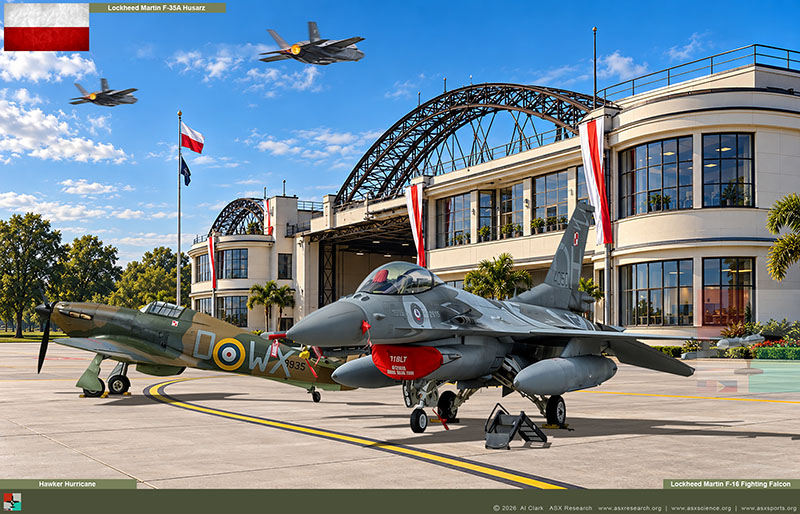
The acquisition of 48 F-16C/D Block 52+ fighters became a defining milestone. The program transformed not only combat capability but also the institutions responsible for maintaining and operating a modern Western air force.
A Civil Aviation Revolution
Poland’s entry into the European Union in 2004 helped open its commercial aviation market to new airlines and passengers. Low-cost carriers expanded access, regional airports developed international connections, and air travel became increasingly accessible to ordinary Polish citizens.
Polish airports handled 66.1 million passengers in 2025, according to the research, illustrating the scale of the country’s transformation.
Meanwhile, LOT Polish Airlines, the proposed Central Communication Port, and the aerospace manufacturing cluster known as Aviation Valley have become important parts of Poland’s economic and transportation strategy.
F-35s, F-16s, and a Changing Threat
Russia’s invasion of Ukraine accelerated Poland’s military aviation modernization. The country is acquiring 32 F-35A fighters, upgrading its F-16 fleet, and introducing Korean-built FA-50 aircraft.
But the research argues that advanced fighters alone cannot guarantee national security. Modern air defense requires the integration of aircraft, ground-based missiles, radar, unmanned systems, electronic warfare, intelligence, and command networks.
Russian drone incursions into Polish airspace have further demonstrated the importance of detecting and defeating inexpensive unmanned threats without exhausting costly defensive resources.
Airports as Strategic Infrastructure
Poland’s aviation geography has also taken on new importance. Rzeszów-Jasionka Airport has become a major logistics gateway for international assistance to Ukraine, demonstrating how civilian airports can acquire essential military and humanitarian functions.
Runways, fuel supplies, maintenance facilities, rail connections, and communications systems are increasingly part of the country’s broader defense resilience.
Poland’s Next Challenge: Integration
The study’s central conclusion is that Poland’s greatest challenge is no longer simply acquiring modern aircraft. It is creating a sustainable system that can connect those aircraft with trained personnel, defensive networks, industrial capacity, infrastructure, and NATO partners.
Modernization announcements are not the same as operational readiness. A resilient aviation system must continue functioning even when its airfields, supply chains, communications, and supporting infrastructure are threatened.
After a century of struggling against its geographic vulnerabilities, Poland may be turning its location into a strategic advantage for the entire NATO alliance.
Read the complete 23-page ASX Research paper: From Soviet Shadow to NATO’s Air Shield: Poland’s Aviation Transformation and the Making of an Eastern-Flank Power — ASX Research Journal and Database, September 20, 2026. Third article in the Polish aviation trilogy.