

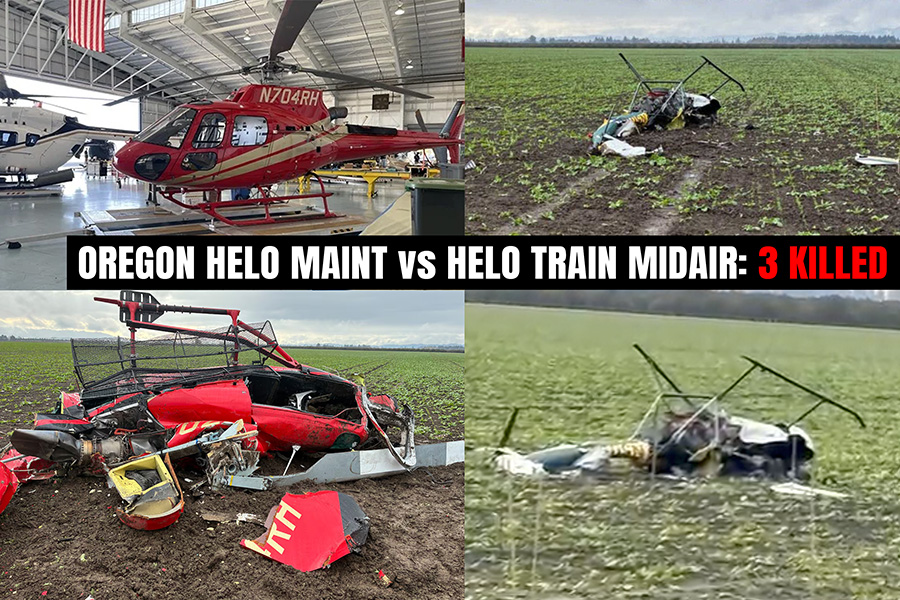
McMINNVILLE, OREGON — Three people were killed on Thursday, October 29, 2026, when two helicopters collided in midair southeast of McMinnville Municipal Airport (KMMV/MMV), Oregon. The accident involved a Robinson R22 helicopter conducting an instructional flight and an Airbus AS350-series helicopter reportedly conducting a maintenance flight. Both aircraft crashed into an agricultural field near Oregon Highway 233 in Yamhill County, killing everyone aboard.
The victims were identified by the Yamhill County Sheriff’s Office as 22-year-old flight instructor Maddie Aasbo of Texas, a student pilot from the United Kingdom whose identity was being withheld pending family notification, and 38-year-old Tyler Delane Sturdevant of Newberg, Oregon. Aasbo and the student occupied the Robinson R22. Sturdevant was the sole occupant of the Airbus helicopter.
The National Transportation Safety Board (NTSB) and Federal Aviation Administration (FAA) are investigating the collision. Newly reported information concerning the respective purposes of the two flights provides additional operational context, but the aircraft’s precise flight paths, collision geometry, and the circumstances that prevented the collision remain undetermined.
Accident Location and Initial Emergency Response
According to the Yamhill County Sheriff’s Office, witnesses reported the collision to the Yamhill Communications Agency at approximately 2:10 p.m. Pacific Daylight Time on October 29. The aircraft came down near the intersection of Southeast Amity-Dayton Highway, also designated Oregon Highway 233, and Southeast Cruickshank Road, southeast of McMinnville.
An earlier emergency notification received by the sheriff’s office at approximately 2:14 p.m. described the incident in the vicinity of Southeast Lafayette Highway and Southeast Stringtown Road. The subsequent official release identified the wreckage location more specifically near Highway 233 and Cruickshank Road.
Responding agencies included the Yamhill County Sheriff’s Office, McMinnville Police Department, Oregon State Police, fire personnel, and emergency medical responders. Emergency crews located the wreckage of both helicopters in a field adjacent to Highway 233 and confirmed that all three occupants had died.
The Oregon Department of Transportation closed Highway 233 approximately one mile west of Dayton. Additional restrictions affected surrounding roads while emergency personnel secured the area and investigators began examining the wreckage.
McMinnville Municipal Airport remained operational during the initial response, according to contemporaneous reporting. The accident occurred outside the airport’s immediate operating surfaces, although its proximity to the airport makes local flight operations and traffic patterns important subjects for the federal investigation.
Aircraft One: Airbus Helicopters H125 / AS350 Series
The first aircraft was a 2018 Airbus AS350-series helicopter, identified in Aviation Safety Network records as an H125 (AS350B3), registration N704RH, manufacturer serial number 8467. The aircraft was registered to Valiar LC Trustee.
The H125 is the current commercial designation associated with the AS350B3 family of single-engine turbine helicopters. Aircraft in the wider AS350 family are used for passenger transportation, aerial observation, utility operations, flight training, and specialized commercial missions.
The Yamhill County Sheriff’s Office identified the aircraft as a 2018 Airbus AS350B3. The FAA described the helicopter as an Airbus H125. Some secondary reports attributed an AS350B2 designation to the NTSB. Because these descriptions are not entirely consistent, the precise certified variant should ultimately be reconciled against the aircraft’s registration and manufacturer records and the accident-specific NTSB documentation.
The helicopter’s sole occupant was identified as Tyler Delane Sturdevant, 38, of Newberg, Oregon. He was killed in the collision, and the aircraft was destroyed.
According to CNN reporting citing the NTSB, the Airbus was conducting a maintenance flight. This description is significant because it provides an initial indication of the flight’s operational purpose. However, it does not establish the particular maintenance activity involved, whether the flight followed scheduled maintenance, or whether any aircraft system was being evaluated.
There is no verified evidence at this stage that an aircraft malfunction contributed to the accident. A maintenance-related flight should not be interpreted as evidence of a mechanical defect without supporting investigative findings.
Aircraft Two: Robinson R22 Beta
The second helicopter was a 1995 Robinson R22, a two-seat, piston-engine aircraft widely used for primary helicopter flight instruction. The helicopter was associated with Jerry Trimble Helicopters, a flight-training organization operating at McMinnville Municipal Airport.
The Robinson has been provisionally associated with registration N501HL. FAA Civil Aviation Registry records confirm that N501HL is a 1995 Robinson R22 Beta, manufacturer serial number 2500, registered to Aarow Aircraft Leasing LLC at 4050 Southeast Nimbus Loop in McMinnville, Oregon.
These registry details correspond with the aircraft’s reported manufacturing year and local operating associations. Nevertheless, the registry entry does not independently establish that N501HL was the helicopter involved in the October 29 collision. Its accident-specific identity remains subject to confirmation through an FAA accident record, NTSB documentation, or other authoritative evidence.
The Robinson carried flight instructor Maddie Aasbo, 22, of Texas, and a student pilot from the United Kingdom. Both occupants were killed. The British student’s name had not been publicly released in the official sheriff’s statement examined for this update.
According to CNN’s reporting of an NTSB statement, the Robinson was conducting an instructional flight. That description is consistent with the presence of an instructor and student and the aircraft’s association with a helicopter flight-training organization.
The R22 is commonly used for initial helicopter certification and recurrent instructional activities. Its operating characteristics, relatively low mass, and two-seat configuration distinguish it from the larger turbine-powered Airbus helicopter.
Although the Robinson was conducting an instructional flight, investigators have not established whether the aircraft was practicing a specific maneuver, operating in an airport traffic pattern, conducting a navigation exercise, or performing another instructional activity at the time of the collision.
Authorities Resolve Initial Confusion About Aircraft Occupants
Early accounts of the accident contained conflicting information concerning the distribution of occupants between the two helicopters. Initial FAA information, repeated in some early news reports, indicated that the Robinson carried one person while the Airbus carried two.
The Yamhill County Sheriff’s Office subsequently established the opposite distribution through its official October 29 release. The Robinson carried two occupants: Maddie Aasbo and the British student pilot. The Airbus carried one occupant: Tyler Delane Sturdevant.
This correction is important because early accident reporting frequently develops before investigators have completed occupant identification, wreckage examination, and coordination with responding agencies.
The confirmed occupant assignments should supersede the earlier preliminary descriptions. The identities and aircraft assignments in this updated article follow the sheriff’s official release.
Witness Accounts and the Collision Sequence
Witnesses reported seeing the helicopters collide while airborne near McMinnville Municipal Airport. The two aircraft subsequently descended into a private agricultural field near Highway 233.
In reporting carried by CNN, witness Leo Rodriguez described hearing a loud impact and seeing the helicopters collide before falling to the ground. Rodriguez reportedly contacted emergency services after observing the accident from his family’s vineyard.
Such eyewitness accounts can provide important information about the approximate location, timing, and visible sequence of an accident. However, they cannot independently establish the aircraft’s precise altitudes, headings, speeds, or relative positions immediately before impact.
The wreckage was described in contemporary reporting as comprising a heavily damaged red helicopter and a green helicopter that came to rest inverted. Photographs released by the Yamhill County Sheriff’s Office documented the accident scene.
Federal investigators will need to reconstruct the aircraft’s movements before drawing conclusions about the sequence of events. The available public record does not establish which helicopter first entered the other’s flight path, whether either pilot attempted evasive action, or whether either aircraft changed heading or altitude immediately before the collision.
Three Lives Lost
The Yamhill County Sheriff’s Office identified the three fatalities in its October 29 public release.
Maddie Aasbo, 22, of Texas, was identified as the flight instructor aboard the Robinson R22. She was accompanied by a student pilot from the United Kingdom whose identity was withheld pending notification of next of kin.
Tyler Delane Sturdevant, 38, of Newberg, Oregon, was identified as the sole occupant of the Airbus AS350-series helicopter.
The sheriff’s office confirmed that all three occupants were deceased when emergency personnel assessed the wreckage. No ground fatalities were reported.
Jerry Trimble Helicopters publicly acknowledged that one of its aircraft had been involved in the accident and expressed condolences to those affected. The organization stated that it was cooperating with the authorities investigating the collision.
Meteorological Conditions: A Critical Timeline
Weather observations from McMinnville Municipal Airport provide important environmental context for the accident. The available METAR reports indicate changing visibility, light precipitation, and variable cloud conditions during the period immediately surrounding the collision.
The reported accident time of approximately 2:10 p.m. Pacific Daylight Time corresponds to approximately 2110 UTC. This conversion is important when evaluating the timing of airport weather observations.
At 2053 UTC, approximately 17 minutes before the reported collision, McMinnville reported winds from 300 degrees at 4 knots, visibility of 3 statute miles in light rain and mist, scattered clouds at 700 feet above ground level, and a broken ceiling at 1,500 feet.
At 2107 UTC, approximately three minutes before the reported collision, the airport reported winds from 310 degrees at 5 knots, visibility of 9 statute miles in light rain, scattered clouds at 700 feet, and a broken ceiling at 1,400 feet.
At 2115 UTC, approximately five minutes after the reported collision, visibility was reported at 10 statute miles, with scattered clouds at 1,000 feet, broken clouds at 4,000 feet, and an overcast layer at 7,000 feet. Winds remained light from approximately 310 degrees at 5 knots.
The 2122 UTC observation, approximately 12 minutes after the reported collision, indicated winds from 300 degrees at 6 knots, visibility of 8 statute miles in light rain, few clouds at 700 feet, few clouds at 2,200 feet, and an overcast layer at 3,700 feet.
These observations establish that reported visibility and cloud conditions changed considerably during a relatively short period. The 2107 UTC report is particularly relevant because it was issued close to the reported collision time.
However, airport weather observations do not necessarily represent the exact conditions experienced by either helicopter. Localized precipitation, terrain, cloud backgrounds, and the aircraft’s positions relative to the observation station may have produced different visual conditions at the collision location.
No causal relationship between weather and the accident has been established. Investigators must determine whether visibility, cloud conditions, lighting, or other environmental factors influenced either pilot’s ability to detect the opposing helicopter.
Why the Different Flight Missions Matter
The NTSB’s reported identification of an instructional flight and a maintenance flight introduces an important operational distinction into the investigation.
Instructional flights may involve maneuvers, repeated approaches, changes in altitude, or exercises intended to develop a student’s aircraft-handling and situational-awareness skills. The specific activities depend on the lesson plan, pilot qualifications, operating environment, and instructor’s objectives.
A maintenance flight may involve evaluation of an aircraft’s performance or systems following maintenance activity. Its actual purpose, however, cannot be determined solely from the general designation. The Airbus’s maintenance-flight classification does not establish what procedures were being conducted or whether any unusual maneuver was planned.
The potential interaction between two aircraft conducting different types of operations is therefore relevant. Their respective speeds, headings, altitudes, maneuvering intentions, and use of local traffic procedures may have influenced how their flight paths converged.
Investigators will need to establish the purpose and sequence of each flight independently before assessing whether those operational differences contributed to the collision.
Airport Traffic Patterns and Helicopter Operations
Midair collisions near general aviation airports present complex safety challenges because aircraft may operate at different speeds, altitudes, and flight profiles within a comparatively confined area.
Helicopters may conduct approaches, departures, hovering operations, low-speed maneuvering, and other activities that differ from conventional fixed-wing traffic patterns. These capabilities create operational flexibility but also require careful coordination and awareness when multiple aircraft share the same airspace.
The proximity of the McMinnville collision to a municipal airport raises questions concerning the helicopters’ relationship to local traffic procedures. Investigators must determine whether either aircraft was arriving, departing, operating in a published or customary traffic pattern, or maneuvering outside the immediate airport traffic environment.
The available record does not establish whether either helicopter was transmitting on the airport’s common traffic advisory frequency, whether relevant traffic calls were made or received, or whether electronic traffic-awareness equipment was installed and operating.
Those questions should remain investigative priorities rather than assumptions about operational deficiencies.
The See-and-Avoid Problem
One of the central issues in any midair collision investigation is whether the pilots had a realistic opportunity to detect the other aircraft and respond before impact.
Visual collision avoidance depends on more than the theoretical presence of another aircraft within a pilot’s field of view. Relative bearing, closure rate, aircraft attitude, cockpit structure, background contrast, lighting, and pilot workload can all influence detection.
Aircraft on a collision course may exhibit relatively little apparent movement against the background, even as the distance between them decreases. This can complicate visual acquisition, particularly when a small aircraft is viewed against terrain, cloud, or other visually complex backgrounds.
The Robinson R22 and Airbus AS350 differ substantially in physical dimensions, cockpit configuration, powerplant, and operating performance. These differences may be relevant to the reconstruction of their respective flight profiles and visual conspicuity.
However, no conclusion concerning the effectiveness of either pilot’s visual scanning can be supported until investigators establish the relative positions of the helicopters, their flight paths, and the time available for recognition and avoidance.
NTSB and FAA Investigation
The National Transportation Safety Board is leading the federal accident investigation, with participation from the Federal Aviation Administration and other relevant organizations.
The NTSB’s investigative work is expected to include examination of the wreckage, documentation of the accident scene, analysis of aircraft operating records, and reconstruction of the helicopters’ movements before impact.
Investigators may examine maintenance documentation, pilot qualifications, instructional records, airport operating procedures, radio communications, available surveillance information, and witness accounts.
According to reporting published October 30, the NTSB dispatched investigators to the accident scene and planned to document, recover, and examine the wreckage at a secure facility.
The aircraft’s flight missions, including the Robinson’s instructional operation and the Airbus’s reported maintenance flight, will likely receive particular attention as investigators establish the operational context of the collision.
The NTSB has not established a probable cause in the publicly available material examined for this update. No evidence presently supports assigning responsibility to either pilot, the flight-training organization, maintenance personnel, or airport traffic procedures.
Registration and Aircraft Identification: What Remains Unconfirmed
The Airbus helicopter has been identified in Aviation Safety Network records as N704RH, a 2018 AS350B3/H125, manufacturer serial number 8467. Its precise variant should be reconciled against official accident-specific documentation because some reporting has used differing AS350 designations.
The Robinson has been provisionally associated with N501HL, a 1995 R22 Beta, manufacturer serial number 2500, registered to Aarow Aircraft Leasing LLC in McMinnville.
FAA registry records establish the existence, registered ownership, and aircraft characteristics of N501HL. They do not, by themselves, confirm that this specific helicopter was involved in the accident.
The distinction is important. Aircraft-registration databases describe registered aircraft, while accident-specific identification requires evidence linking a particular aircraft to the occurrence under investigation.
ASX News will continue treating the Robinson registration as provisional until an authoritative accident record confirms the identification.
Preliminary Accident Assessment
The confirmed occurrence is a fatal midair collision between a Robinson R22 and an Airbus AS350-series helicopter near McMinnville Municipal Airport on October 29, 2026. Both aircraft were destroyed, and all three occupants were killed.
The Yamhill County Sheriff’s Office has confirmed that two people occupied the Robinson and one occupied the Airbus. The NTSB has reportedly identified the Robinson’s operation as an instructional flight and the Airbus’s operation as a maintenance flight.
These developments substantially improve the factual foundation of the accident record, but they do not establish how the collision occurred.
The precise collision geometry, aircraft altitudes, headings, speeds, communications, and any attempted evasive maneuvers remain unknown. The role, if any, of weather, visibility, aircraft equipment, operational procedures, or pilot workload has not been determined.
The available evidence does not support attributing the accident to a specific failure of see-and-avoid procedures, flight instruction, maintenance operations, radio communication, or air traffic management.
ASX News Aviation Safety Analysis
The McMinnville collision presents an important opportunity to examine the interaction between helicopters performing different missions in airspace associated with a general aviation airport.
The distinction between an instructional flight and a maintenance flight may prove relevant to understanding the aircraft’s intended movements. However, operational purpose alone cannot explain a collision. Investigators must determine what each aircraft was actually doing immediately before impact.
The weather chronology is another important consideration. Airport observations indicate that visibility and cloud conditions varied substantially during the minutes surrounding the accident. Establishing the actual environmental conditions at the collision location may help investigators assess visual acquisition opportunities.
Equally important will be the reconstruction of the aircraft’s relative geometry. A meaningful see-and-avoid analysis requires more than determining whether the pilots were legally responsible for maintaining vigilance. It requires establishing whether the aircraft were visible, whether they could reasonably have been detected, and whether sufficient time existed to recognize the conflict and maneuver safely.
Investigators may also examine whether traffic information was available through radio communications, electronic equipment, or other operational procedures. The absence or presence of such information cannot be assumed from the currently available record.
For aviation safety researchers, the central challenge is to distinguish a pilot’s theoretical responsibility to avoid another aircraft from the practical limitations imposed by aircraft geometry, environmental conditions, human perception, and operational workload.
The loss of three lives makes this investigation particularly consequential. A credible safety assessment must remain grounded in documented evidence, with clear distinctions between established facts, reasonable investigative questions, and conclusions that cannot yet be supported.
ASX News will continue monitoring official NTSB findings, including confirmation of the Robinson’s registration, clarification of the Airbus’s precise model designation, reconstruction of the collision sequence, and any eventual safety recommendations arising from the investigation.
Sources and References
Associated Press. (2026, October 29). Three killed in helicopter collision that shut down part of an Oregon highway.
Aviation Safety Network. (2026). Airbus Helicopters H125 (AS350B3), N704RH: Accident near McMinnville Municipal Airport, Oregon. Aviation Safety WikiBase.
Aviation Safety Network. (2026). Robinson R22 Beta: Accident near McMinnville Municipal Airport, Oregon. Aviation Safety WikiBase.
CNN. (2026, October 29). Three dead after two helicopters collide midair near Oregon airport, sheriff says.
Federal Aviation Administration. (2026). Aircraft registration inquiry: N501HL. FAA Civil Aviation Registry.
Federal Aviation Administration. (2026). Aircraft registration records: N704RH. FAA Civil Aviation Registry.
Jerry Trimble Helicopters. (2026, October 29). Public statement concerning helicopter incident near McMinnville Municipal Airport.
Oregon Public Broadcasting. (2026, October 30). Authorities investigate midair collision between two helicopters southeast of McMinnville.
Yamhill County Sheriff’s Office. (2026, October 29). McMinnville (OR) helicopter collision. Official public information release.