


Across social media, independent news platforms, geopolitical commentary channels, and emergency-preparedness communities, an increasingly unsettling narrative is taking shape: something significant may be approaching, and the period following the November 3, 2026, United States midterm elections could mark the beginning of a dangerous new chapter in international affairs. Predictions range from renewed military operations against Iran to widespread infrastructure failures, economic disruption, and even nuclear terrorism in Europe. Some warnings arise from legitimate geopolitical concerns. Others depend on speculation, anonymous claims, or predictions that cannot be independently verified. Yet their convergence raises an important question: Is the world responding to identifiable signs of an approaching international crisis, or has an atmosphere of escalating uncertainty begun to generate its own expectation of catastrophe?
The distinction matters because global crises rarely announce themselves in the dramatic terms used by their eventual historians. They develop through political decisions, military preparations, intelligence assessments, diplomatic failures, economic vulnerabilities, and events whose significance may not become apparent until much later. History offers numerous examples of regional confrontations expanding beyond their original boundaries. It also offers examples of frightening predictions that never materialized. Understanding the difference requires examining what is actually happening rather than assuming that widespread anticipation is itself evidence of an impending disaster.
The November 3 Election: A Date That Has Acquired an Ominous Reputation
The American midterm elections have become a focal point for speculation about possible military escalation. Political calendars can influence the timing of consequential government decisions, particularly when leaders anticipate electoral consequences from foreign-policy actions. A president contemplating military operations may face different domestic political pressures before and after an election. However, that general principle does not establish that a particular operation has been authorized, that a military campaign is scheduled, or that an international emergency will follow the vote.
The concern becomes more substantial when viewed against the broader confrontation involving the United States, Iran, Israel, and their respective regional security relationships. Iran’s nuclear activities, ballistic missile capabilities, support for armed regional organizations, and disputes with Western governments have generated recurring fears of military confrontation. Israel’s security concerns, American defense commitments, and the strategic importance of Persian Gulf energy infrastructure create numerous pathways through which a limited confrontation could produce consequences far beyond the Middle East.
For observers attempting to identify a dangerous period, the weeks following a major American election may appear particularly sensitive. But there is an essential difference between recognizing a potentially consequential political window and asserting that a global disaster has been secretly scheduled for that window. No independently established evidence presented in this investigation demonstrates that November 3 serves as a confirmed trigger for an international military operation or coordinated global emergency.
Iran: The Most Obvious Flashpoint, but Perhaps Not the Only One
Iran occupies a central position in contemporary geopolitical risk assessments because a conflict involving Tehran could affect several interconnected systems simultaneously. Military escalation might threaten shipping routes, energy production, regional airspace, commercial aviation, diplomatic relationships, and international financial markets. The Strait of Hormuz remains especially important because disruptions affecting this maritime passage could influence energy supplies and prices across multiple continents.
A military campaign intended to degrade Iranian nuclear infrastructure or conventional military capabilities could also create uncertainty about Tehran’s response. Retaliation need not resemble a conventional exchange between opposing armed forces. Cyber operations, attacks involving regional armed groups, maritime interference, and threats to critical infrastructure are among the scenarios examined in established security analysis. These possibilities represent plausible categories of escalation, not verified predictions of specific operations.
One of the greatest dangers in such confrontations is the possibility that decision-makers underestimate the consequences of their initial actions. A strike intended to achieve a limited military objective may provoke retaliation against a different target, prompting another government to respond. Each participant may believe its actions are defensive or proportionate while the cumulative confrontation becomes increasingly difficult to control.
Iran, however, should not automatically be treated as the explanation for every alarming development elsewhere in the world. The international security environment includes multiple competing powers, independent regional conflicts, and vulnerabilities that could produce serious disruption without direct Iranian involvement. Concentrating exclusively on Tehran risks overlooking other mechanisms through which a broader crisis could emerge.
The Nuclear Rumor That Changes Everything
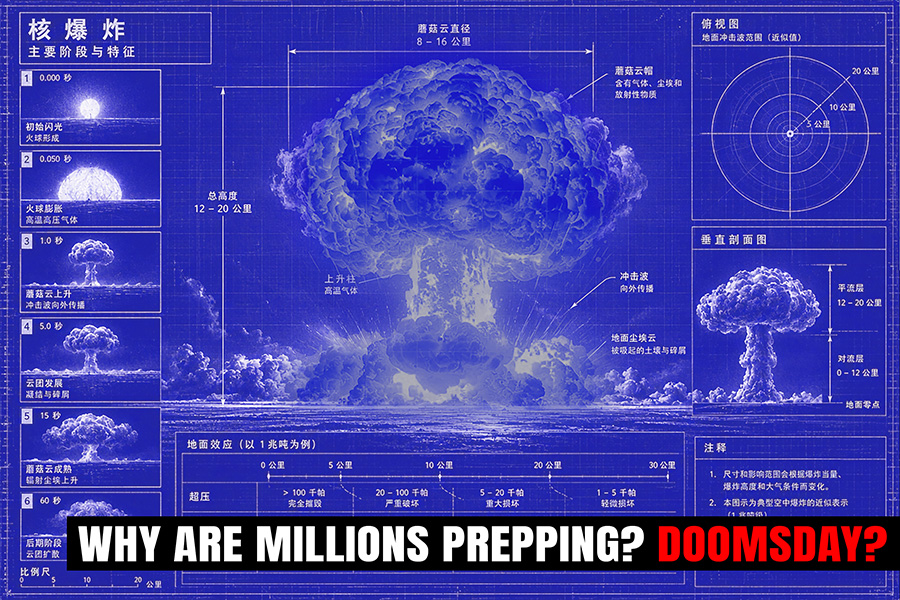
Among the most disturbing claims circulating within discussions of an approaching international emergency is the suggestion that an Iranian nuclear device could be detonated somewhere in Europe. Such a scenario would represent an extraordinary escalation, with potentially catastrophic humanitarian, political, economic, and military consequences. It would also raise immediate questions about nuclear attribution, intelligence failures, international retaliation, and the future of global security arrangements.
Yet the seriousness of the scenario must not be confused with evidence that it is imminent. No independently corroborated evidence established for this report demonstrates that Iran has deployed a nuclear explosive device in Europe, selected a European city for an attack, or initiated an operational plan to carry out such a detonation. Claims of an impending Iranian nuclear explosion should therefore be treated as unverified allegations rather than established intelligence findings.
There are also significant technical and intelligence distinctions between possessing nuclear material, producing weapons-grade material, constructing a functioning nuclear explosive device, and successfully transporting and deploying such a device. Each stage involves different capabilities, obstacles, and opportunities for detection. Public uncertainty surrounding Iran’s nuclear program does not establish that these stages have been completed.
Nevertheless, nuclear terrorism and the security of nuclear materials are legitimate subjects of international concern. The International Atomic Energy Agency maintains programs addressing nuclear security, safeguards, and the prevention of unauthorized use of nuclear and radioactive materials. Such programs exist because the consequences of failures could be severe, not because a particular rumored attack has been confirmed.
The responsible conclusion is therefore neither that nuclear terrorism is impossible nor that a European detonation is approaching. It is that the allegation requires extraordinary corroboration before being presented as a credible prediction. Until that corroboration exists, the rumor itself is a subject for investigation rather than a factual warning.
What if the Next Crisis Is Larger Than a War With Iran?
The more consequential question may concern the vulnerability of the international system as a whole. Modern societies depend on networks of energy production, telecommunications, transportation, financial settlement, digital infrastructure, food distribution, and international commerce. These networks have produced remarkable economic efficiency, but they also create relationships in which disruptions in one sector can affect several others.
A major regional conflict could produce consequences through mechanisms that are neither mysterious nor unprecedented. Energy prices could rise sharply. Shipping companies might avoid threatened waterways. Insurers could increase premiums or withdraw coverage. Airlines could reroute flights around contested airspace. Governments might introduce emergency security measures, while businesses and consumers respond to uncertainty by changing their spending and investment decisions.
These effects could reinforce one another. Higher energy costs influence transportation and manufacturing. Transportation disruptions affect food distribution and industrial production. Financial volatility complicates investment and borrowing. Public anxiety can increase demand for essential goods, placing additional pressure on supply chains even before any physical shortage occurs.
Such cascading effects explain why a geographically limited confrontation can become an international economic emergency. They do not, however, establish that a single catastrophic event is inevitable. The scale of any disruption would depend on the actions taken, the duration of the confrontation, the resilience of affected systems, and the effectiveness of diplomatic and emergency responses.
The Invisible Battlefield: Cybersecurity and Critical Infrastructure
Some of the most serious vulnerabilities in contemporary societies are not visible on conventional military maps. Electricity grids, water-treatment systems, communications networks, hospitals, airports, ports, and financial institutions increasingly rely on interconnected digital systems. Cybersecurity authorities have repeatedly warned that sophisticated threat actors can target critical infrastructure for espionage, disruption, or preparation for possible future operations.
The United States Cybersecurity and Infrastructure Security Agency, the National Security Agency, and international partner organizations have published advisories concerning state-sponsored cyber activity and infrastructure vulnerabilities. These warnings establish that the threat is real and that defensive preparations are warranted. They do not establish that a synchronized worldwide infrastructure attack has been scheduled for the aftermath of the American elections.
Cyber operations also complicate the early stages of an international crisis because attribution can be difficult. A major outage may result from equipment failure, severe weather, human error, criminal activity, or hostile state action. Prematurely attributing every disruption to an adversary can amplify public fear and increase the risk of political or military miscalculation.
For aviation, the implications deserve particular attention. Airports and airlines depend on communications, navigation, scheduling, fuel distribution, security screening, and digital coordination. Interruptions involving any of these systems can produce substantial operational consequences without an aircraft ever being directly attacked. Aviation safety and continuity planning must therefore consider infrastructure resilience alongside conventional physical security.
Europe: A Continent Facing Several Layers of Uncertainty
Europe occupies a distinctive position in the emerging security discussion because it is simultaneously connected to the war in Ukraine, NATO defense planning, energy security, international financial markets, and the wider confrontation involving Iran. Its geographic proximity to several major areas of tension makes developments elsewhere especially relevant to European governments.
The war in Ukraine has demonstrated the destructive potential of sustained conventional warfare and the international consequences of attacks on energy and civilian infrastructure. It has also renewed debate over nuclear deterrence, escalation management, defense spending, and the credibility of security guarantees. These concerns exist independently of claims about an Iranian nuclear device in Europe.
A European security emergency could emerge through several different pathways, including a military incident involving NATO territory, a major infrastructure disruption, an expansion of an existing conflict, or a severe economic shock. These scenarios vary considerably in probability and consequences. Grouping them together under a single prediction of approaching catastrophe may create dramatic headlines, but it does not produce a reliable forecast.
European preparedness initiatives must also be interpreted carefully. Governments routinely develop civil-protection guidance for natural disasters, industrial accidents, public-health emergencies, armed conflict, and infrastructure failures. The publication of such guidance is not, by itself, evidence that officials possess secret knowledge of an imminent nuclear attack or worldwide emergency.
Why Emergency Preparedness Is Suddenly Part of the Conversation
Emergency preparedness has increasingly entered mainstream public discussion because recent international events have demonstrated how quickly ordinary services can be interrupted. Severe weather, pandemics, power failures, cyber incidents, military conflicts, and transportation disruptions have all illustrated the practical value of maintaining essential household supplies and reliable emergency information.
The European Commission’s Preparedness Union Strategy, introduced in March 2025, encouraged greater readiness across European society and included guidance concerning household self-sufficiency during the initial stages of an emergency. Its widely discussed 72-hour preparedness objective addressed a broad range of hazards rather than identifying a specific future attack.
Comparable principles appear in emergency-management guidance elsewhere. Maintaining drinking water, essential medication, communications alternatives, basic food supplies, and access to official information can reduce vulnerability during many types of disruption. Such preparation is a rational resilience measure, not an admission that a predicted catastrophe is certain.
The difficulty arises when ordinary preparedness recommendations are circulated alongside unsupported claims that governments are secretly preparing for a known disaster. A recommendation to maintain several days of supplies can be transformed through repeated online commentary into an assertion that authorities expect society to collapse. The original guidance and the amplified interpretation are fundamentally different statements.
The Social Media Effect: When Warnings Begin to Reinforce One Another
The perception of an approaching global emergency can become stronger when numerous commentators repeat similar predictions. A viewer encounters one warning about Iran, another about European emergency supplies, a third about financial instability, and a fourth about possible cyberattacks. Together, these reports can create the impression that separate sources are describing different components of the same approaching event.
But apparent agreement does not necessarily establish independent confirmation. Several accounts may repeat the same original claim, cite one another, or interpret unrelated developments through a shared narrative. What appears to be a growing body of evidence may consist partly of information circulating repeatedly through the same network.
Research on misinformation and online information diffusion has demonstrated that false claims can spread rapidly and that emotionally compelling content may receive disproportionate attention. The landmark study by Vosoughi, Roy, and Aral, published in Science in 2018, found that false news diffused farther, faster, more deeply, and more broadly than true news in the Twitter dataset they examined. That finding does not mean every alarming report is false. It demonstrates why the popularity of a claim cannot substitute for verification.
There is also a psychological dimension. When people expect a major crisis, ambiguous events may begin to appear connected. A military exercise, an unusual aircraft movement, a government emergency notice, and a financial-market decline can be interpreted as parts of a coordinated sequence even when no evidence establishes a common cause. This is especially important during periods of genuine geopolitical tension, when some individual observations may be accurate but the overarching explanation remains speculative.
History’s Warning: Catastrophe Often Begins With Miscalculation
The possibility of a major international crisis should not be dismissed merely because specific predictions are unsupported. History demonstrates that geopolitical systems can deteriorate rapidly when military commitments, political pressures, and competing security objectives interact.
The outbreak of the First World War illustrates how a regional assassination and the decisions that followed produced a continental and eventually global conflict. The Cuban Missile Crisis of October 1962 demonstrates how nuclear-armed adversaries can approach catastrophic confrontation through escalating military and diplomatic pressure. Neither historical episode provides a timetable for present events, but both demonstrate the importance of communication, restraint, and accurate threat assessment.
Other crises have shown how uncertainty can affect international behavior even without deliberate military escalation. Financial shocks, public-health emergencies, and major infrastructure failures can cross national borders through interconnected economic and logistical systems. The modern world contains more technological safeguards than earlier societies, but it also depends on infrastructure whose failure can have widespread consequences.
History therefore supports vigilance, not prophecy. The fact that a catastrophe is possible does not establish that it is imminent. Conversely, the absence of a verified timetable does not eliminate the need to evaluate serious threats.
The Philippines and the Wider Indo-Pacific Cannot Be Ignored
For the Philippines, the consequences of a major international security crisis would extend beyond distant headlines. The country occupies a strategically significant position in the Indo-Pacific, maintains a longstanding defense relationship with the United States, and faces its own maritime-security challenges in the South China Sea.
A confrontation involving major powers could influence regional defense planning, commercial shipping, energy prices, aviation operations, overseas employment, and financial remittances. The Philippines’ exposure to international fuel markets and maritime commerce makes disruptions elsewhere relevant to households and businesses throughout the archipelago.
Philippine policymakers would also need to distinguish between developments directly affecting national security and events that create indirect economic or logistical pressures. A conflict in the Middle East does not automatically produce a military emergency in Southeast Asia, but its effects could reach the region through fuel costs, shipping disruptions, financial markets, and the safety of Filipinos working abroad.
For aviation authorities, airport operators, and commercial carriers, international instability reinforces the importance of contingency planning, alternate routing, reliable communications, and coordinated operational risk assessment. The relevant safety question is not whether an online prediction proves that disaster is approaching. It is whether institutions can maintain safe operations when the external environment changes unexpectedly.
What Would Constitute Genuine Evidence of an Approaching Crisis?
A serious assessment of international escalation requires evidence more substantial than anonymous predictions or unusually dramatic commentary. Confirmed government statements, independently documented military deployments, official diplomatic warnings, authenticated emergency directives, and corroborated intelligence disclosures can provide meaningful information about changing security conditions.
Even such indicators require careful interpretation. Military forces may deploy to deter conflict rather than initiate it. Embassies may issue security warnings as precautionary measures. Governments may conduct exercises to improve readiness. Financial institutions may prepare contingency plans for events they consider possible rather than probable.
The strongest assessments examine multiple independent sources, establish the chronology of events, identify what each source actually knows, and distinguish observable actions from interpretations of those actions. They also consider alternative explanations. Without that discipline, a collection of genuine but unrelated developments can be mistaken for proof of a coordinated global operation.
Equally important is the distinction between a proposed policy, an authorized decision, an operational deployment, and an event that has actually occurred. Public commentary frequently compresses these separate stages into a single dramatic narrative. Responsible reporting must preserve the differences.
The Most Dangerous Possibility May Not Be the One Everyone Is Predicting
The international security environment contains enough genuine uncertainty that a serious disruption cannot be ruled out. A confrontation involving Iran could expand. A separate conflict could intensify. A cyber incident could affect essential infrastructure. A financial shock could compound geopolitical instability. Several disturbances could also occur close together without having been coordinated by a single actor.
That final possibility deserves attention because complex systems can experience cascading failures without a central plan. An energy disruption may contribute to economic instability. Economic instability may increase political pressure. Political pressure may influence military decisions. Those decisions may generate additional uncertainty. The resulting crisis can appear coordinated in retrospect even when its individual components emerged from separate causes.
However, there is currently no established evidentiary basis in this report for asserting that governments have identified a specific, secretly scheduled worldwide catastrophe following November 3. Nor is there verified evidence that an Iranian nuclear explosion in Europe is imminent. Those claims remain distinct from the documented existence of international security tensions and infrastructure vulnerabilities.
The unsettling reality is that the world does not require a hidden master plan to experience a major crisis. Miscalculation, overlapping conflicts, technological dependence, economic fragility, and failures of communication can be sufficient. The possibility of a larger event deserves analytical attention precisely because its eventual form, if one occurs, may differ substantially from the predictions currently circulating.
Conclusion: After November 3, What Happens Next?
As the United States approaches its midterm elections, predictions of an approaching international emergency have become entangled with legitimate concerns about Iran, nuclear security, European preparedness, cyber threats, and the vulnerability of global infrastructure. Some of these concerns rest on established strategic realities. Others depend on allegations that remain uncorroborated.
The suggestion that a major crisis could emerge after the elections is a hypothesis worth examining, not a verified forecast. The allegation of an imminent Iranian nuclear detonation in Europe is substantially more specific and requires evidence that has not been established. Neither claim should be transformed into certainty through repetition.
Yet dismissing every concern as internet hysteria would be equally unhelpful. International security depends on the decisions of governments operating under pressure, sometimes with incomplete information and limited opportunities to reverse mistakes. The consequences of those decisions can extend far beyond the countries directly involved.
The coming weeks may pass without the dramatic events some commentators anticipate. They may instead bring diplomatic negotiations, military signaling, regional escalation, or developments that have little relationship to the most widely circulated predictions. No responsible analysis can identify the outcome in advance.
Perhaps the most important question is not whether a global disaster has been scheduled for the aftermath of an American election. It is whether the international system has become sufficiently interconnected, politically strained, and technologically vulnerable that an unexpected event could trigger consequences far greater than its originators intended.
The world may not be standing before a single predetermined catastrophe. It may be confronting something more difficult to anticipate: an accumulation of risks whose interactions cannot be predicted with confidence.
November 3 is a date on the political calendar. Whether history eventually assigns it greater significance will depend on events, not rumors. Until then, the most defensible response is informed vigilance, credible preparedness, and a refusal to mistake the growing volume of warnings for proof that the worst has already been decided.
Sources and References
Cybersecurity and Infrastructure Security Agency. (2023). Cross-sector cybersecurity performance goals. U.S. Department of Homeland Security.
European Commission. (2025, March 26). EU Preparedness Union Strategy. European Commission.
International Atomic Energy Agency. (2024). Nuclear security review 2024. International Atomic Energy Agency.
International Energy Agency. (2024). Oil 2024: Analysis and forecast to 2030. International Energy Agency.
North Atlantic Treaty Organization. (2022). NATO 2022 strategic concept. NATO.
United Nations Office for Disarmament Affairs. (2024). Nuclear weapons. United Nations.
United States Federal Emergency Management Agency. (n.d.). Build a kit. Ready.gov.
Vosoughi, S., Roy, D., & Aral, S. (2018). The spread of true and false news online. Science, 359(6380), 1146–1151.
World Economic Forum. (2025). The global risks report 2025 (20th ed.). World Economic Forum.