


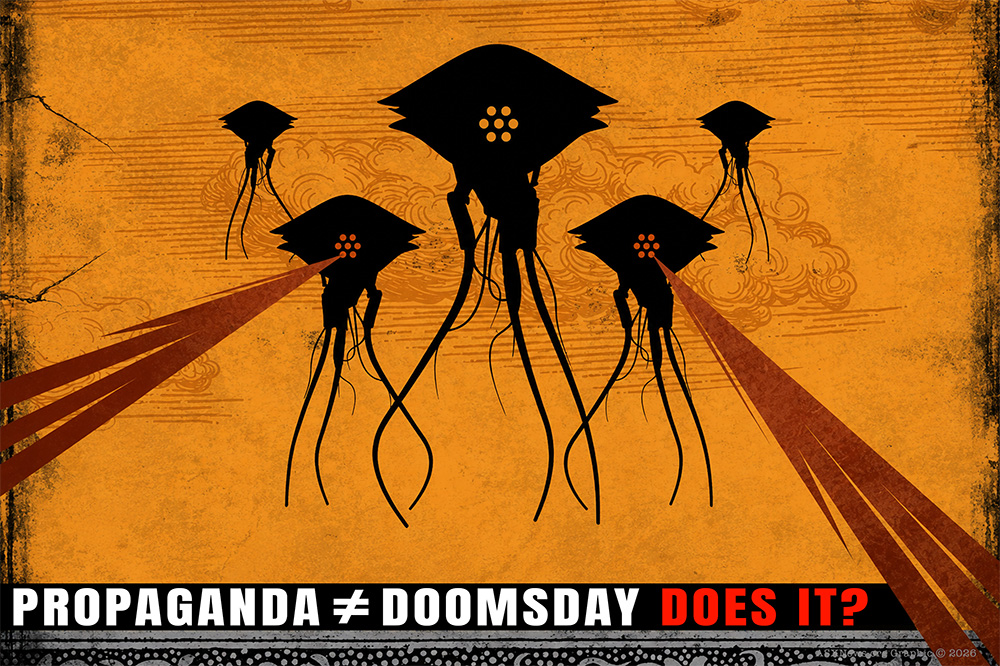
Imagine waking up tomorrow morning, opening your favorite social media platform, and discovering footage of an enormous extraterrestrial spacecraft hovering over Washington, D.C.
The footage is spectacular. Military aircraft are scrambling. People are running through the streets. The spacecraft casts a shadow over the Washington Monument. Multiple camera angles appear to confirm the event.
Your immediate reaction?
Artificial intelligence. Another fake.
You scroll past it.
Now imagine, for the sake of argument, that this particular video is real.
After years of exposure to increasingly sophisticated AI-generated imagery, fabricated encounters, sensational headlines, and predictions of extraterrestrial disclosure that never materialized, humanity may have developed an extraordinary defense mechanism against deception: disbelief.
Unfortunately, that same defense mechanism could render us incapable of recognizing the genuine article.
There is something darkly humorous about the possibility of a man refusing to believe in extraterrestrial life until he finds himself aboard an alien spacecraft undergoing an involuntary medical examination. At that point, the debate over whether aliens exist has been satisfactorily resolved. The opportunity to prepare for their arrival, however, has passed.
Absurd? Certainly.
But substitute the alien spacecraft with a catastrophic failure of the electrical grid, the collapse of national communications infrastructure, or a prolonged disruption of the financial system, and the analogy becomes considerably less amusing.
We are confronting an increasingly important distinction between two very different phenomena: the culture of doomsday and the infrastructure of doomsday.
One is an industry built around the anticipation of catastrophe. The other consists of the very real systems, dependencies, vulnerabilities, and human decisions capable of producing one.
Confusing the two may ultimately become one of the greatest threats to our ability to survive the latter.
Welcome to the Apocalypse Industry
Somewhere on the internet, civilization is ending.
It was ending yesterday. It will be ending tomorrow. And if you subscribe to enough YouTube channels, you can receive hourly updates on its imminent demise.
The financial system is about to collapse. The electrical grid is about to fail. A foreign adversary is about to launch an attack. Artificial intelligence is about to eliminate humanity. An election is about to destroy democracy. A mysterious object is about to reveal that we are not alone in the universe.
Every conceivable threat has acquired its own ecosystem of commentators, influencers, merchandise, survival equipment, subscription services, and audiences waiting for the next installment.
And when the catastrophe fails to materialize, the industry does not necessarily suffer a crisis of credibility. It simply moves on to the next catastrophe.
The modern information economy has created an unusual commercial relationship with fear. A calm, measured assessment of an infrastructure failure must compete for attention with a thumbnail depicting a burning city, an ominous countdown, and a headline announcing that the government knows something it is not telling you.
One offers information. The other offers an emotional experience.
Research published in the Proceedings of the National Academy of Sciences has demonstrated the disproportionate influence that emotionally charged moral language can have on the diffusion of social media content. The implications extend beyond politics: information that provokes a powerful emotional response can possess a significant advantage in an environment where attention determines visibility.
Fear, anger, and uncertainty are particularly effective raw materials for an industry that requires audiences to return tomorrow.
There is, of course, nothing inherently wrong with discussing catastrophic risks. Some of the most important advances in aviation safety, emergency management, public health, and national security have emerged from serious consideration of worst-case scenarios.
The problem begins when catastrophe ceases to be something we are attempting to understand or prevent and becomes something we require for entertainment, political validation, or commercial survival.
There is an important difference between investigating the possibility of disaster and developing an appetite for it.
The Strange Disappointment of a Disaster That Doesn’t Happen
Following the November 13, 2026, nationwide FAA ground stop, a particularly interesting observation emerged from an online commentary discussing the event alongside recent technological disruptions.
The commentator described attending a public gathering when news of the aviation shutdown began circulating. People checked their phones, expressed concern about their flights, and returned to enjoying themselves.
On social media, however, an entirely different world appeared to exist.
There were theories about foreign adversaries, coordinated cyberattacks, failing infrastructure, and the imminent collapse of American society.
The commentator observed that when airplanes eventually returned to the sky, some people almost appeared disappointed.
His discussion, available in this video, raises a fascinating question: have some segments of the online population become so invested in the prospect of catastrophe that its failure to materialize represents a personal disappointment?
It is a question worth asking.
Consider the psychological investment involved in spending years predicting the collapse of civilization. Every subsequent disruption becomes a potential validation of that prediction. Every technological failure, political upheaval, or unexplained event can be interpreted as another piece of the puzzle.
When the anticipated collapse fails to arrive, there are two possible responses. One is to reconsider the original prediction. The other is to reinterpret the absence of catastrophe as evidence that the catastrophe is still coming.
The second response is considerably more convenient for anyone whose identity, audience, or income depends on the prediction remaining alive.
This is the culture of doomsday.
It does not necessarily require a real disaster. It requires the continuing possibility of one.
But What If the Infrastructure Really Is Failing?
Here is where the discussion becomes considerably more complicated.
The existence of an exaggerated, sensationalized, and sometimes commercially manufactured culture of catastrophe does not establish that the underlying risks are imaginary.
It would be an extraordinary intellectual mistake to conclude that because thousands of people are behaving irrationally about a threat, the threat itself must be irrational.
The electrical grid does not become more reliable because an online personality has exaggerated the probability of its collapse.
An aging air traffic control system does not become less vulnerable because someone has incorrectly attributed an outage to a foreign cyberattack.
A hospital does not acquire an independent backup communications system because a conspiracy theory about artificial intelligence has been debunked.
The infrastructure of doomsday exists independently of the culture surrounding it.
And unlike the culture of doomsday, which depends on human attention, the infrastructure of doomsday is governed by engineering, physics, economics, maintenance practices, organizational competence, and the complex relationships between interconnected systems.
It does not care whether we believe in it.
In our recent investigation, Black Sky Event Horizon, ASX News examined the possibility that interconnected infrastructure failures could eventually reach a threshold beyond which conventional recovery mechanisms become inadequate.
The concept of a Black Sky Event describes a catastrophic disruption affecting essential infrastructure on a scale that can overwhelm normal emergency response and restoration capabilities. Our use of the term event horizon extends that concept into a question about the point at which cascading failures become self-reinforcing and extraordinarily difficult to reverse.
It is not a prediction that civilization is about to collapse.
It is an examination of how civilization could lose the ability to recover from a sufficiently complex series of failures.
And that distinction matters enormously.
The Router That Grounded a Nation
Consider the November 13 FAA nationwide ground stop.
Early speculation surrounding the disruption included the possibility of a cyberattack. Subsequent reporting attributed the communications failure to aging equipment that became overloaded during an upgrade. Officials reported no evidence of a cyberattack or a connection to the recent Microsoft outage, although the investigation was continuing.
As reported by The Washington Post, the nationwide restriction was lifted after approximately four and a half hours, but the disruption left thousands of canceled flights and substantial operational difficulties in its wake.
For the culture of doomsday, the absence of evidence of a coordinated attack may represent an unsatisfactory conclusion.
For those investigating the infrastructure of doomsday, however, the possibility that aging communications equipment could produce such widespread disruption is hardly reassuring.
In fact, the absence of a malicious actor may make the incident even more instructive.
America did not necessarily require a sophisticated foreign adversary to experience a nationwide aviation disruption. Its own technological infrastructure was apparently capable of producing one.
This is not unprecedented.
On January 11, 2023, the FAA imposed a nationwide departure ground stop following the failure of its Notice to Air Missions (NOTAM) system. The subsequent investigation identified the accidental deletion of computer files during work involving the synchronization of primary and backup databases.
The FAA reported no evidence of malicious intent or a cyberattack.
In testimony before Congress, the agency explained that it subsequently introduced safeguards intended to prevent defective data from propagating into backup systems, along with additional oversight requirements for database maintenance.
The significance of the incident was not that a sophisticated enemy had successfully attacked American aviation. It was that ordinary maintenance activity had exposed weaknesses in the relationship between operational infrastructure and its intended safeguards.
Redundancy, after all, is only useful if the redundant system remains available when the primary system fails.
Two systems that share the same vulnerability may provide considerably less protection than their existence suggests.
A backup system that fails for the same reason as the primary system is not necessarily a backup. It may simply be another component of the same failure.
Incompetence Does Not Require a Conspiracy
One of the more compelling observations in the aforementioned video was the suggestion that we should consider incompetence before assuming the existence of an elaborate, coordinated conspiracy.
This is closely related to a familiar principle known as Hanlon’s razor: do not attribute to malice what can adequately be explained by stupidity.
In the context of critical infrastructure, we might expand that principle to include negligence, deferred maintenance, organizational complacency, inadequate training, poor system design, insufficient investment, and an excessive confidence in technology.
These are not particularly glamorous explanations.
They do not provide the dramatic satisfaction of discovering a secret organization controlling world events. There is no sinister mastermind to expose, no hidden headquarters, and no spectacular revelation awaiting the audience in the next episode.
Nevertheless, they have the capacity to produce extraordinary damage.
A civilization does not need to be deliberately destroyed if it can become sufficiently incapable of maintaining the systems upon which it depends.
And that may be the more uncomfortable possibility.
A hostile adversary can theoretically be identified, deterred, or defeated. But how does a civilization defeat decades of accumulated technological complexity, institutional fragmentation, and economic incentives that reward efficiency while treating redundancy as an unnecessary expense?
How does it confront a threat that is not necessarily external, but embedded within its own definition of progress?
The Hospital Without a Computer
Another particularly revealing moment in the video involved an account of a hospital experiencing a computer system outage.
According to the commentator, some younger physicians and medical residents were uncertain how to continue seeing patients without access to the computer system.
The proposed solution was remarkably simple: write the information on paper.
The anecdote should not be mistaken for evidence that an entire generation of physicians is incapable of functioning without computers. It does, however, illustrate a question that deserves serious attention.
What happens when an alternative method of performing an essential task ceases to be part of an organization’s practical experience?
A hospital may possess emergency generators, printed downtime procedures, and sophisticated disaster recovery plans. But if its personnel have never practiced operating under prolonged digital disruption, the existence of those resources does not guarantee that they will be used effectively.
Furthermore, writing on paper is only one part of the problem.
What happens when medication histories are inaccessible? When laboratory results cannot be transmitted? When diagnostic equipment depends on network authentication? When pharmacies cannot verify prescriptions? When emergency departments cannot communicate with other hospitals?
Modern healthcare is not simply a collection of doctors using computers. It is a complex system of interconnected clinical, administrative, pharmaceutical, logistical, and technological processes.
And the same is true of virtually every other essential sector of modern civilization.
The ability to perform a task manually does not necessarily establish the ability to operate an entire system manually.
That is the infrastructure of doomsday.
The Architecture of Cascading Failure
The U.S. Cybersecurity and Infrastructure Security Agency (CISA) explicitly recognizes the importance of dependencies between critical infrastructure systems.
Its Infrastructure Resilience Planning Framework explains how essential services rely upon one another and how those relationships can become pathways through which disruptions propagate.
Consider electricity and communications.
Communications networks require electrical power. Electrical utilities, in turn, require communications networks to monitor equipment, coordinate operations, and manage the distribution of electricity.
Water treatment facilities require electricity to operate pumps and treatment systems. Electrical generation facilities may require water for cooling. Fuel distribution depends on electricity, communications, transportation, and financial transactions. Emergency generators depend on the continued availability of fuel.
Hospitals require all of these things.
The individual systems are complicated enough. Their collective behavior during a prolonged, simultaneous disruption is considerably more difficult to predict.
A hypothetical failure sequence might begin with an electrical outage. Communications infrastructure begins operating on emergency power. As the disruption continues, some backup batteries become depleted. Communications deteriorate, complicating restoration of the electrical grid. Fuel deliveries become more difficult to coordinate. Emergency generators begin running out of fuel. Water distribution and healthcare operations become increasingly compromised.
Each individual failure increases the difficulty of resolving the others.
At some point, the resources needed to restore a failed system may themselves become unavailable because of failures elsewhere.
This is the significance of the Black Sky Event Horizon concept.
The critical question is not simply whether a particular system can fail. It is whether the systems responsible for restoring it will remain functional long enough to accomplish that restoration.
There is no requirement for an alien invasion, a secret society, a foreign cyberattack, or a coordinated campaign of sabotage.
Those are possible scenarios in the broad universe of catastrophic risks. But they are not prerequisites.
Under sufficiently adverse conditions, the architecture of civilization itself can provide the mechanism for cascading failure.
The AI Paradox: Manufacturing the Disaster While Managing the Infrastructure
Artificial intelligence introduces a particularly disturbing dimension to this discussion because it is becoming increasingly relevant to both sides of the distinction.
On one side, generative AI can manufacture convincing images, videos, voices, and narratives depicting events that never occurred.
On the other, artificial intelligence is being incorporated into the management, monitoring, analysis, and optimization of increasingly important technological systems.
The same broad category of technology that can generate a convincing simulation of a catastrophic infrastructure failure may also be involved in monitoring or managing the infrastructure depicted in that simulation.
There is an extraordinary irony in this.
In November 2024, the National Institute of Standards and Technology published Reducing Risks Posed by Synthetic Content: An Overview of Technical Approaches to Digital Content Transparency.
The report examines technologies and practices intended to establish the origin and authenticity of digital material, identify synthetic content, and improve transparency through mechanisms such as provenance tracking and watermarking.
The very existence of this field of research illustrates how profoundly the relationship between visual evidence and public trust is changing.
For much of modern history, a photograph or video possessed a degree of evidentiary authority. It could be manipulated, staged, or misrepresented, but producing convincing deception often required considerable skill and resources.
Today, increasingly sophisticated synthetic content can be produced and distributed at a scale that was previously unimaginable.
The consequences extend far beyond the possibility of people believing something false.
There is also the possibility that people will cease believing things that are true.
Researchers and legal scholars have described a related phenomenon as the liar’s dividend: the existence of convincing fabricated media can make it easier for individuals to dismiss authentic evidence as fabricated.
But the implications may extend even further during an actual emergency.
Imagine authentic footage of a major infrastructure failure circulating alongside dozens of fabricated videos depicting even more spectacular destruction. Imagine contradictory emergency announcements, synthetic voices impersonating government officials, and automated accounts distributing false evacuation instructions.
Which information would the public trust?
How quickly could legitimate authorities establish authenticity?
Would people act upon genuine emergency instructions, or dismiss them as another manufactured crisis?
The problem is not merely that artificial intelligence can make a fictional catastrophe look real.
It can also make a real catastrophe look fictional.
The Boy Who Cried Wolf Was Not the Only Problem
Most people are familiar with the story of the boy who cried wolf.
A boy repeatedly raises a false alarm. The villagers respond until they discover that they have been deceived. Eventually, when a real wolf appears, nobody believes him.
The traditional interpretation focuses on the consequences of dishonesty.
But there is another way of examining the story.
The villagers eventually developed a rational response to an unreliable source of information. They stopped responding to the boy’s warnings because their previous experiences had demonstrated that those warnings were false.
Nevertheless, their rational response to repeated deception left them vulnerable to the genuine threat.
The wolf had not disappeared simply because the boy had repeatedly lied about its existence.
Modern society is experiencing a technologically amplified version of this problem.
We have millions of boys crying wolf, increasingly sophisticated artificial wolves, commercial enterprises selling wolf protection, political organizations accusing one another of manufacturing wolves, and audiences arguing about whether wolves exist at all.
Meanwhile, the actual wolf remains entirely independent of the discussion.
And this brings us to what may be the most consequential relationship between the culture and infrastructure of doomsday.
The culture of doomsday may ultimately undermine our ability to recognize the infrastructure of doomsday.
When every technological disruption is described as the beginning of the end, the next disruption becomes less remarkable.
When every political development is presented as an existential emergency, the public’s capacity to distinguish ordinary political conflict from genuine institutional danger may diminish.
When every unexplained event is interpreted as evidence of a coordinated conspiracy, legitimate evidence of hostile activity may become harder to separate from the surrounding speculation.
And when audiences have been repeatedly promised the collapse of civilization, the prospect of actual collapse may eventually become just another unfulfilled promise.
The greatest danger of manufactured doomsday may be that it discredits the real thing before it arrives.
When Normality Becomes Its Own Warning Sign
There is another side to this discussion that deserves consideration.
In the video that prompted this investigation, the commentator repeatedly contrasted the anxiety he encountered online with the relative normality of the people around him.
People were attending events, enjoying themselves, checking their phones, and continuing with their lives.
His observation was entirely reasonable. The internet is not necessarily an accurate representation of the emotional condition of the population.
But the existence of normality does not establish the absence of danger.
One of the most remarkable characteristics of modern infrastructure is its invisibility when functioning correctly.
Most people do not think about the electrical grid until the lights go out. They do not think about telecommunications infrastructure until their phones stop working. They do not think about the systems responsible for separating aircraft until thousands of airplanes are grounded.
The ordinary functioning of civilization conceals the extraordinary complexity required to maintain it.
Consequently, our perception of safety is often derived from the fact that nothing particularly bad has happened to us recently.
In aviation, that would be a dangerous basis upon which to evaluate the airworthiness of an aircraft.
An aircraft may complete hundreds of flights while a component progressively deteriorates. Each successful landing demonstrates that the aircraft completed that particular flight. It does not establish that the underlying deterioration has ceased.
Infrastructure must be evaluated through its condition, design, maintenance, redundancy, and demonstrated capacity to withstand abnormal circumstances—not simply through its ability to continue operating yesterday.
There is an important difference between a system that has not yet failed and a system that is incapable of failing under the conditions it may encounter.
The same distinction applies to recovery.
The fact that aircraft returned to the sky after the FAA ground stop is evidence that the particular disruption was resolved sufficiently to resume operations.
It is not, by itself, evidence that the national airspace system could withstand a simultaneous failure of communications, electrical power, navigation infrastructure, and supporting computer networks.
Recovery from an individual failure is not necessarily evidence of resilience against cascading failures.
Preparedness Without Paranoia
So where does this leave the ordinary individual?
Must we spend every waking hour monitoring global infrastructure failures, examining satellite imagery, purchasing survival equipment, and attempting to determine which foreign government is responsible for the latest internet outage?
Of course not.
That would represent a victory for the culture of doomsday rather than an intelligent response to the infrastructure of doomsday.
The purpose of preparedness is to reduce the consequences of uncertainty, not to eliminate uncertainty itself.
We do not install smoke detectors because we believe our homes will burn down tomorrow. We do not carry automobile insurance because we are convinced that our next journey will end in a collision. Aircraft do not carry emergency equipment because pilots expect every flight to end in disaster.
These precautions exist because the consequences of certain events justify preparation even when their probability is relatively low.
Emergency preparedness should operate according to the same principle.
A reasonable supply of drinking water, food, essential medications, alternative communications, accessible financial resources, and the ability to function during a temporary electrical outage can provide protection against a wide range of disruptions.
These preparations do not require belief in a particular conspiracy or prediction.
They are useful during natural disasters, technological failures, severe weather, local emergencies, and disruptions that never come remotely close to the collapse of civilization.
At the institutional level, the same philosophy should be applied with considerably greater sophistication.
Critical infrastructure operators should examine whether their backup systems share vulnerabilities with primary systems. They should conduct exercises involving simultaneous failures across multiple sectors. They should test the ability of personnel to operate when normal digital resources become unavailable. They should evaluate whether emergency power systems can be sustained during prolonged interruptions of fuel distribution.
And they should ask whether their recovery plans depend upon the continued availability of systems that may themselves be compromised.
These are engineering and organizational questions, not ideological ones.
The objective is not to create a civilization obsessed with its own destruction.
It is to create a civilization capable of surviving the failure of some of its most important assumptions.
The Real Warning Signs
What, then, should we actually be looking for?
Not necessarily the spectacular events that dominate social media.
The more meaningful indicators may be considerably less dramatic: repeated failures involving the same underlying vulnerability; increasing recovery times; backup systems proving ineffective during actual emergencies; maintenance backlogs; dependence on obsolete equipment; shortages of specialized personnel; concentration of essential services within a small number of technology providers; and the gradual disappearance of practical alternatives to automated systems.
We should be particularly interested in failures that migrate beyond the boundaries of the system in which they originated.
An outage affecting a single organization is one thing. An outage affecting multiple unrelated organizations because they depend upon the same technological provider is another.
A temporary disruption of electrical power is one thing. A disruption that compromises communications, fuel distribution, water treatment, and the ability of utilities to restore power is another.
We should also distinguish between events occurring close together in time and events that are connected through demonstrable causal relationships.
Coincidence is not evidence of coordination.
But documented interdependence is evidence of a potential pathway for cascading failure.
That distinction should guide serious investigation.
The recent FAA disruption, Microsoft outage, and broader technological concerns discussed in our previous reporting warrant examination. Their temporal proximity alone, however, does not establish that they share a common cause or represent successive stages of an unfolding Black Sky Event.
What they can do is provide opportunities to investigate the vulnerabilities exposed by each event and determine whether those vulnerabilities are shared across other essential systems.
The question is not whether we can assemble a collection of alarming headlines.
The question is whether we can identify a collection of mechanisms through which one failure could contribute to another.
Before the Aliens Arrive
Let us return, for a moment, to our unfortunate hypothetical passenger aboard the extraterrestrial spacecraft.
His skepticism was not necessarily irrational.
He had been exposed to countless fabricated videos, sensational predictions, and supposed revelations that never materialized. His refusal to believe the latest extraordinary claim was entirely understandable.
His mistake was not necessarily his disbelief.
His mistake was allowing disbelief to become a substitute for an independent assessment of risk.
There is a profound difference between refusing to accept an extraordinary claim without adequate evidence and refusing to acknowledge the possibility of an extraordinary event until it has already occurred.
The first is skepticism.
The second may be a failure of imagination.
We do not need to believe that extraterrestrial spacecraft are approaching Earth to understand the value of distinguishing authentic evidence from fabricated imagery.
Likewise, we do not need to believe that a coordinated campaign is underway to destroy civilization to recognize that modern civilization possesses significant technological vulnerabilities.
We do not need to predict the precise date of a Black Sky Event to examine whether our infrastructure could withstand one.
And we certainly do not need to wait until an actual catastrophe has overwhelmed our recovery capabilities to determine whether those capabilities were adequate.
Conclusion: Doomsday Does Not Need an Audience
The culture of doomsday and the infrastructure of doomsday are not the same phenomenon.
The former is psychological, cultural, political, and increasingly commercial. It feeds upon anticipation, uncertainty, fear, and the human desire to find meaning in seemingly unrelated events.
The latter is physical, technological, organizational, and systemic. It consists of real dependencies, finite resources, aging equipment, maintenance requirements, human limitations, and the consequences of increasingly complex relationships between essential services.
The culture of doomsday can exaggerate the infrastructure of doomsday.
It can misrepresent it, politicize it, commercialize it, and manufacture fictional versions of it.
But it cannot make the underlying vulnerabilities disappear.
Nor should the existence of those vulnerabilities be used to justify every extraordinary claim circulating on the internet.
Our responsibility is to maintain the distinction.
We must remain sufficiently skeptical to reject manufactured catastrophes, sufficiently informed to recognize genuine vulnerabilities, and sufficiently prepared to withstand disruptions whose precise nature and timing we cannot predict.
Perhaps the most dangerous outcome would be a civilization so exhausted by the culture of doomsday that it becomes incapable of responding to the infrastructure of doomsday.
A civilization that has heard the warning so many times that it no longer listens.
Because when the actual Black Sky Event arrives—if it ever does—it will not require our belief, our permission, or our participation in the discussion.
The infrastructure of doomsday does not need an audience.
And by the time it provides indisputable evidence of its existence, the most important opportunities for preparedness may already have passed.
Sources and Further Reading
1. ASX News. Black Sky Event Horizon. November 14, 2026.
2. ASX News. FAA Issues Nationwide Ground Stop Due to Extraordinary Circumstances. November 13, 2026.
3. Cybersecurity and Infrastructure Security Agency (CISA). Infrastructure Resilience Planning Framework. July 2024.
4. Federal Aviation Administration. FAA NOTAM Statement. January 19, 2023.
5. U.S. Department of Transportation. The Federal Aviation Administration’s NOTAM System Failure and Its Impacts on a Resilient National Airspace. Congressional testimony, February 2023.
6. The Washington Post. FAA Lifts Ground Stop at U.S. Airports, Leaving Travel Chaos. November 13, 2026.
7. National Institute of Standards and Technology. Reducing Risks Posed by Synthetic Content: An Overview of Technical Approaches to Digital Content Transparency. NIST AI 100-4. November 2024.
8. Brady, W. J., et al. Emotion Shapes the Diffusion of Moralized Content in Social Networks. Proceedings of the National Academy of Sciences, 114(28), 7313–7318. 2017.
9. Chesney, R., and Citron, D. K. Deep Fakes: A Looming Challenge for Privacy, Democracy, and National Security. California Law Review, Vol. 107. 2019.
10. YouTube commentary discussing disaster culture, infrastructure failures, artificial intelligence, and personal preparedness. Original video. Discussion of hospital downtime at approximately 4:48–5:09; disaster-related media consumption and preparedness throughout.