


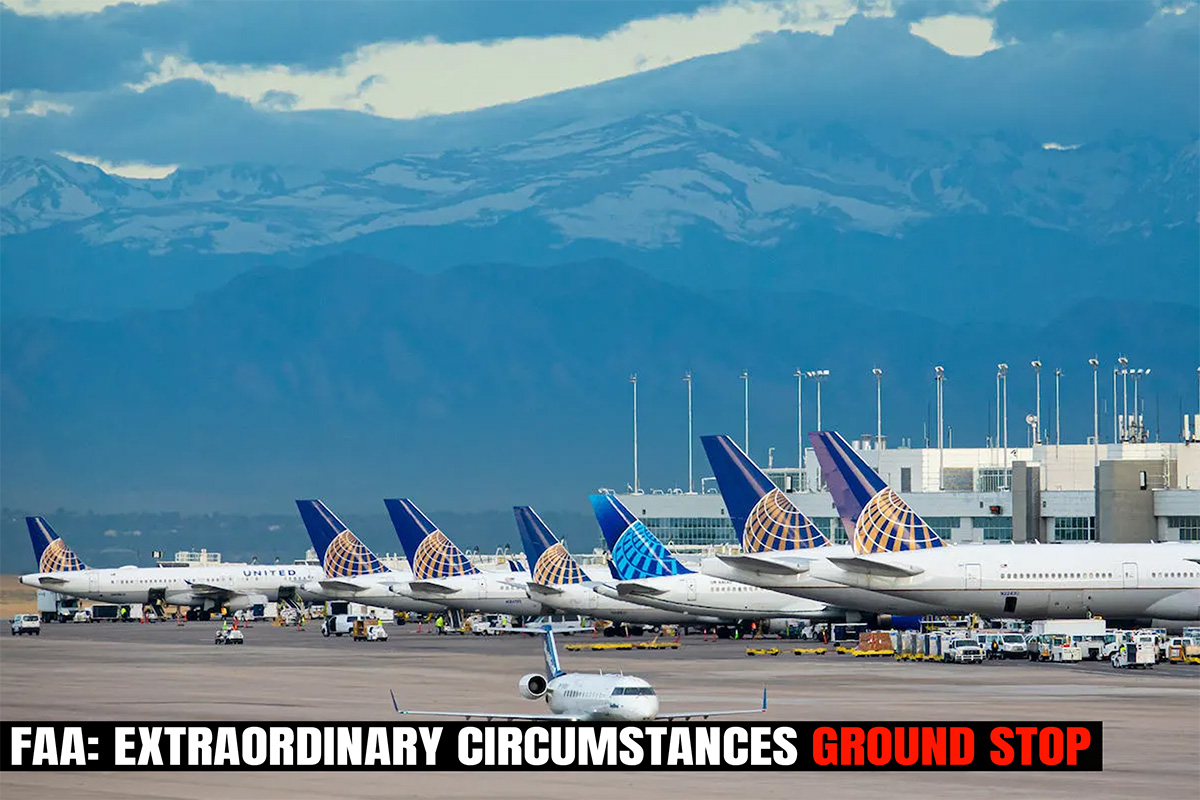
WASHINGTON, D.C. — November 13, 2026 — The Federal Aviation Administration (FAA) has ordered an extraordinary nationwide ground stop at airports across the United States following a major communications disruption affecting the nation’s air traffic control infrastructure, bringing departures across the country to an abrupt halt and presenting controllers with the formidable challenge of managing thousands of aircraft already airborne.
The unprecedented scope of the communications disruption prompted federal aviation authorities to issue an emergency directive suspending departures until further notice. International flights already inbound to the United States are being managed individually as authorities work to determine the extent of the failure and restore normal operations.
U.S. Transportation Secretary Sean Duffy confirmed Friday afternoon that the disruption involved communications affecting Air Route Traffic Control Centers (ARTCCs), the facilities responsible for managing aircraft across vast sectors of American airspace.
FAA technicians are investigating the failure. The specific technical cause has not yet been publicly identified.
The incident represents only the second nationwide suspension of departures since the terrorist attacks of September 11, 2001, and the first since the January 2023 failure of the FAA’s Notice to Air Missions (NOTAM) system.
FAA Issues Extraordinary Nationwide Safety Directive
The FAA’s Air Traffic Control System Command Center issued the nationwide ground stop shortly before 4 p.m. Eastern Standard Time, citing extraordinary circumstances and aviation safety concerns.
The directive instructed aircraft operators to suspend departures at airports throughout the United States. International arrivals would be evaluated individually rather than subjected to a blanket prohibition on entering American airspace.
Unlike the localized ground stops routinely issued during thunderstorms, equipment failures, airport congestion, or runway closures, Friday’s action encompasses the entire national airport network.
The FAA’s decision to suspend departures nationwide reflects the seriousness of the communications disruption and the need to prevent additional aircraft from entering an already challenged air traffic control environment.
For the latest official operational information, the FAA maintains its National Airspace System Status website.
Thousands of Aircraft Already Airborne
While stopping aircraft from departing is relatively straightforward, managing the thousands of aircraft already in flight presents an entirely different operational challenge.
At approximately 4:38 p.m. EST, flight-tracking service Flightradar24 reported that roughly 3,100 airborne aircraft were bound for airports in the United States, according to The Guardian’s live coverage.
Each aircraft represents a separate operational consideration involving fuel reserves, destination weather, airport availability, traffic separation, crew limitations, and potential diversion requirements.
Aircraft approaching their destinations may be instructed to enter holding patterns, accept revised routing, or divert to alternate airports, depending on the availability of air traffic control services and local operational conditions.
However, aircraft cannot remain airborne indefinitely. Fuel management becomes increasingly critical as delays accumulate, particularly for aircraft nearing the end of long international or transcontinental flights.
Early reporting has included indications of airborne holding associated with equipment outages. Other reports have indicated that aircraft already airborne remain able to land. The nationwide ground stop itself should not be interpreted as a universal prohibition on landings.
Controllers and flight crews must manage these conditions according to the circumstances of individual flights, with priority given to aircraft requiring immediate assistance.
Chicago Equipment Outage Preceded National Ground Stop
One of the most significant developments in the emerging timeline occurred in Chicago shortly before the FAA expanded its restrictions nationwide.
Both Chicago O’Hare International Airport (ORD) and Chicago Midway International Airport (MDW) were subjected to ground stops following an equipment outage, according to CBS News.
The subsequent nationwide directive raises important questions about whether the Chicago disruption was an early indication of a broader communications infrastructure failure.
Chicago is one of the country’s most important aviation hubs, and disruptions affecting its air traffic control infrastructure can generate cascading delays across the national aviation network.
Nevertheless, authorities have not established that the Chicago outage was the origin of Friday’s nationwide disruption. The relationship between the two events remains an important subject for investigators.
What Are Air Route Traffic Control Centers?
Air Route Traffic Control Centers form the backbone of the United States’ en route air traffic management system.
While airport control towers primarily manage aircraft operating on runways and in the immediate vicinity of airports, and Terminal Radar Approach Control facilities (TRACONs) manage arriving and departing traffic in terminal airspace, ARTCCs oversee aircraft traveling between metropolitan areas and across extensive regions of controlled airspace.
These centers coordinate aircraft separation, altitude assignments, routing changes, traffic handoffs between sectors, and the orderly movement of aircraft across the National Airspace System.
Their operations depend upon an interconnected network of communications systems, surveillance infrastructure, automation platforms, telecommunications circuits, and coordination systems linking controllers with pilots and neighboring facilities.
A failure affecting multiple centers can therefore have consequences extending far beyond the geographic boundaries of any individual airport.
Importantly, a communications disruption does not necessarily mean that every controller has lost contact with every aircraft. Modern air traffic control incorporates multiple communications channels, backup systems, and established contingency procedures.
The precise systems affected on Friday, and the availability of their associated backup capabilities, have not yet been publicly established.
Why This Incident Differs From the January 2023 NOTAM Failure
The last nationwide departure suspension occurred on January 11, 2023, when the FAA experienced a failure involving its Notice to Air Missions system.
NOTAMs provide pilots and flight dispatchers with essential information about temporary hazards, runway closures, navigation equipment outages, airspace restrictions, and other operational conditions that may affect flight safety.
The 2023 outage prevented the reliable distribution of this critical information, prompting the FAA to temporarily suspend domestic departures while the system was restored.
Friday’s disruption involves a different category of aviation infrastructure: communications supporting air traffic control operations.
The distinction is fundamental. Whereas the NOTAM system primarily distributes information necessary for safe flight planning and operations, air traffic control communications support the real-time coordination of aircraft moving through controlled airspace.
Depending on the nature and extent of the failure, a communications outage may require controllers to reduce traffic volumes, increase aircraft spacing, utilize alternate frequencies, coordinate through backup telecommunications systems, or implement contingency procedures.
Friday’s nationwide ground stop is therefore a particularly significant test of the resilience of America’s air traffic control infrastructure.
America’s Aging Air Traffic Control Infrastructure Under Scrutiny
The nationwide disruption comes amid an extensive federal effort to modernize the United States’ aging air traffic control system.
Congress approved $12.5 billion in July 2025 to support modernization and controller recruitment, following mounting concerns over obsolete equipment, staffing shortages, telecommunications failures, and recurring operational disruptions.
The modernization program includes replacing legacy copper telecommunications infrastructure with fiber-optic connections, upgrading radio communications equipment, modernizing automation systems, and improving the technological capabilities available to air traffic controllers.
In a striking coincidence of timing, the White House and Department of Transportation requested an additional $30.1 billion in aviation infrastructure funding on Friday, the same day the nationwide ground stop was issued.
According to Reuters reporting, the additional request includes $10.1 billion for air traffic control modernization, $2 billion for control tower improvements and replacements, and $18 billion for airport infrastructure projects.
The air traffic control portion includes funding for modern controller workstations, a common automation platform, and cloud computing infrastructure.
Friday’s communications failure will almost certainly intensify scrutiny of the modernization effort and the vulnerability of critical aviation systems during the transition from legacy infrastructure to newer technologies.
However, no evidence has yet established that the age of the equipment, an ongoing modernization project, or a particular software deployment caused the current disruption.
A Troubling Pattern of Communications Disruptions
Friday’s incident follows other significant telecommunications failures that have disrupted American aviation operations.
On September 21, 2026, airports across the northeastern United States experienced substantial disruption following telecommunications failures involving a Philadelphia air traffic control facility and a damaged fiber-optic cable in New Jersey.
According to Fox Business, the Philadelphia facility experienced a failure of its primary communications circuit, while an alternate fiber connection had also been severed.
The incident illustrated a critical principle of infrastructure resilience: redundancy is effective only when backup systems remain available and sufficiently independent of the systems they are intended to replace.
Friday’s nationwide disruption raises a much broader question about the architecture of the communications network supporting America’s air traffic control centers.
If geographically separated facilities experienced related communications failures within a short period, investigators will need to examine whether those facilities share telecommunications providers, network infrastructure, software platforms, or other common dependencies.
Determining whether the disruption resulted from a common point of failure, a cascading network event, or multiple independent failures will be central to understanding the incident.
Could the Disruption Be Cybersecurity-Related?
The extraordinary scale of the ground stop will inevitably generate speculation regarding cybersecurity, malicious interference, and the possibility of a coordinated attack against critical American infrastructure.
At this stage, however, there is no verified evidence that Friday’s communications disruption resulted from a cyberattack, sabotage, or hostile foreign activity.
Large-scale telecommunications failures can originate from numerous non-malicious causes, including hardware malfunctions, software configuration errors, network routing failures, power disruptions, damaged physical infrastructure, and unsuccessful system upgrades.
Investigators will need to establish the technical sequence of events before any reliable conclusions can be drawn regarding the origin of the failure.
The FAA has confirmed the communications disruption, but confirmation of a disruption is not equivalent to confirmation of its cause.
Potential Consequences for Global Aviation
The United States is one of the world’s largest and most interconnected aviation markets. A nationwide suspension of departures can rapidly produce operational consequences extending well beyond American borders.
International airlines operating flights to the United States must evaluate departure timing, destination availability, fuel requirements, and potential alternate airports as the situation develops.
Aircraft scheduled to depart the United States for destinations in Europe, Asia, Latin America, and elsewhere may experience delays that subsequently affect aircraft rotations and return services.
Even after the FAA authorizes departures to resume, the recovery process could take considerably longer than the communications disruption itself.
Airlines must reposition aircraft, reorganize crews, accommodate displaced passengers, and manage congested airport facilities. Air traffic controllers must also prevent a sudden surge of departures from overwhelming available airspace capacity.
Depending on the duration of the ground stop, delays and cancellations could extend into the following day.
What We Know — And What Remains Unknown
As of the initial reporting Friday afternoon, the FAA has confirmed a nationwide departure suspension associated with air traffic control communications problems. Transportation Secretary Sean Duffy has confirmed that federal technicians are investigating the disruption.
Earlier equipment-related ground stops at Chicago O’Hare and Midway have also been confirmed, although their relationship to the nationwide event remains undetermined.
The exact technical cause, the specific equipment or communications networks affected, the status of redundant systems, and the full operational impact have not yet been publicly established.
Authorities have not confirmed a cybersecurity incident, and a verified nationwide resumption of departures has not yet been established at the time of this report.
ASX News Analysis: A National Infrastructure Warning
Friday’s nationwide ground stop is more than a major disruption to commercial air travel. It is a stark reminder of the extent to which modern aviation depends upon the continuous operation of highly interconnected technological infrastructure.
The safety of the National Airspace System relies not only on aircraft reliability and the professionalism of pilots and controllers, but also on the resilience of the communications networks that connect them.
The FAA’s decision to halt departures nationwide represents a precautionary measure intended to prevent an uncertain technical situation from becoming a more complex operational emergency.
Grounding aircraft is disruptive. Allowing additional aircraft to enter a system experiencing significant communications difficulties could introduce substantially greater operational risk.
The central question now facing investigators is not simply what failed, but how a communications disruption could become sufficiently widespread to justify suspending departures across the entire United States.
With billions of dollars already committed to modernization and billions more being requested, the answers will carry significant implications for the future architecture, reliability, and resilience of American air traffic control.
This is a developing story. ASX News will continue to follow official FAA announcements and verified operational updates as additional information becomes available.
Sources and Further Information
Federal Aviation Administration — National Airspace System Status
FAA Air Traffic Control System Command Center — Operational Advisories
Reuters — US FAA Grounds All Departing Flights Due to Extraordinary Circumstances, Safety Reasons
CBS News — FAA Issues Nationwide Ground Stop
Axios — FAA Issues Nationwide Ground Stop Due to Extraordinary Circumstances
The Guardian — Live Coverage of the Nationwide FAA Communications Disruption
Reuters — White House Urges Congress to Provide $30.1 Billion for Aviation Reform
Fox Business — FAA Resumes Northeast Airport Operations After September Telecommunications Outage