


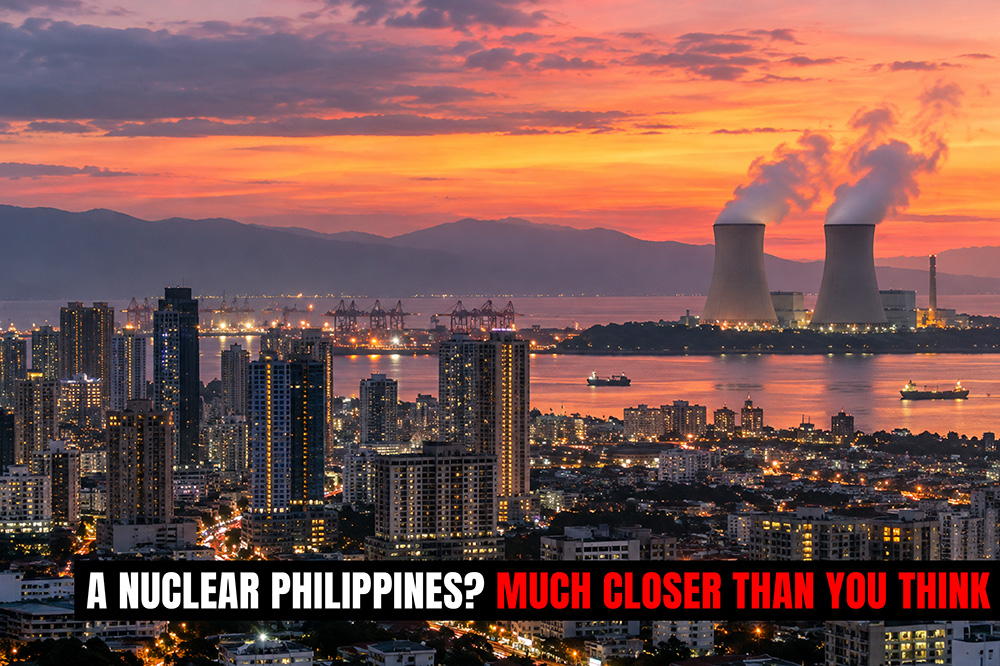
MANILA, PHILIPPINES — Could the Philippines be on the verge of entering the nuclear age? The United States is discussing a financing package worth as much as $5 billion to help develop nuclear power generation in the Philippines, potentially transforming the country’s electricity supply and its energy relationship with Washington.
The announcement has attracted attention across the Philippines, where electricity costs, power reliability, and dependence on imported fuels remain major concerns. But the proposed financing also raises a fundamental question: Is the country ready to build, regulate, and safely operate nuclear power plants?
The $5 billion is not yet an approved investment, a government grant, or a signed financing agreement. It represents potential financial support under discussion with American institutions, and any actual projects would require additional negotiations, regulatory approvals, and private investment.
America’s $5 Billion Proposal
On October 26, 2026, Philippine Department of Energy Undersecretary Giovanni Carlo Bacordo disclosed discussions with the United States International Development Finance Corporation (DFC) concerning potential financing for private companies interested in developing nuclear power facilities.
According to Bacordo, the discussions included possible financing of up to $5 billion, with repayment periods extending as long as 25 years. Such long-term financing could help address one of nuclear energy’s largest obstacles: the substantial initial cost of constructing a power plant.
The DFC is a U.S. government development-finance institution that supports qualifying private-sector projects. Its involvement could provide access to financing mechanisms that would otherwise be difficult for nuclear developers to obtain.
However, there is an important distinction between discussing financing and committing funds. No publicly confirmed $5 billion financing agreement has been identified in the information available for this report.
In other words, America has expressed interest in helping finance a nuclear-powered future for the Philippines, but it has not written a $5 billion check.
Why the Philippines Wants Nuclear Power
The Philippines faces a difficult energy challenge. As electricity demand grows, the country must find ways to increase generating capacity while reducing vulnerability to fuel-price fluctuations and supply disruptions.
Nuclear power offers a potential source of continuous, large-scale electricity generation. Unlike solar and wind facilities, nuclear reactors do not depend on daily weather conditions to produce electricity, although they require planned maintenance, reliable cooling systems, and extensive safety infrastructure.
For an archipelagic country experiencing rapid urban development, industrial growth, and increasing demand from digital infrastructure, reliable electricity generation is an economic priority.
Nuclear power could also reduce dependence on imported fossil fuels, although its financial competitiveness would depend on construction costs, financing terms, operating performance, fuel procurement, and eventual decommissioning expenses.
The government has established a target of introducing approximately 1,200 megawatts of nuclear generating capacity by 2032, increasing to 2,400 megawatts by 2035 and 4,800 megawatts by 2050.
These figures represent national energy-development objectives rather than guaranteed completion dates. Whether the first commercial projects can meet the proposed schedule will depend on financing, construction, licensing, infrastructure, and workforce readiness.
Washington and Manila Move Closer
The financing discussions follow an October 10–17, 2026 visit to the United States by Philippine officials examining American nuclear technologies, financing arrangements, regulatory systems, and workforce development.
The visit reflects a broader effort to deepen cooperation between the two countries in civilian nuclear energy.
Philippine Energy Secretary Sharon Garin has been involved in the government’s nuclear-energy initiatives and engagement with American counterparts. The Department of Energy is also exploring possible assistance from the Export-Import Bank of the United States and financing opportunities involving the Asian Development Bank.
The United States has an economic interest in exporting nuclear technology, engineering services, equipment, and expertise. For the Philippines, American cooperation could offer access to technical assistance and financing while strengthening an already important bilateral relationship.
Nevertheless, financial cooperation does not automatically determine which reactor designs will be selected, which companies will build the plants, or where the facilities will be located.
Small Reactors, Big Expectations
Among the technologies under consideration are small modular reactors, commonly known as SMRs.
These reactors are designed to produce electricity using smaller generating units than many conventional nuclear power stations. Depending on the technology, multiple units could potentially be installed at a single site or deployed in stages as demand increases.
Supporters argue that modular construction and smaller initial generating capacities could provide flexibility for electricity systems that do not require enormous nuclear generating stations.
However, smaller reactors are not automatically cheaper, simpler to license, or easier to operate. Their commercial performance depends on the maturity of the design, manufacturing capacity, construction experience, regulatory requirements, and the number of units deployed.
Some advanced reactor designs remain in development or have limited commercial operating histories. Philippine authorities would therefore need to distinguish established technology from proposed systems whose costs and performance have not yet been demonstrated at scale.
The Shadow of Bataan
No discussion of nuclear power in the Philippines can avoid the Bataan Nuclear Power Plant.
Constructed during the administration of President Ferdinand Marcos Sr., the facility became one of the country’s most controversial infrastructure projects. Although substantially completed, it never entered commercial operation.
Its history continues to influence public attitudes toward nuclear energy, particularly concerning construction costs, governance, site safety, and the long-term financial consequences of major energy investments.
The existence of the Bataan facility does not mean that it can simply be switched on. Any proposal involving the site would require extensive engineering assessments, safety evaluations, regulatory review, and consideration of whether rehabilitation would be technically and economically justified.
The Philippines must therefore confront both the opportunities of modern nuclear technology and the institutional lessons of its earlier nuclear ambitions.
Who Will Keep the Reactors Safe?
Financing a nuclear power plant is only the beginning. Before a reactor can operate, the country must establish and maintain an effective system for nuclear safety regulation, emergency preparedness, environmental protection, radioactive-waste management, and physical security.
Nuclear power facilities require independent oversight throughout their operating lives, beginning with site selection and extending through construction, commissioning, operation, eventual shutdown, and decommissioning.
Regulatory authorities must have the technical expertise, legal authority, staffing, and institutional independence necessary to evaluate reactor designs and enforce safety requirements.
For the Philippines, natural hazards deserve particular attention. Earthquakes, volcanic activity, typhoons, flooding, coastal hazards, and extreme rainfall must be evaluated during site selection and plant design.
These hazards do not automatically make nuclear power unsuitable for the country. They do, however, make site-specific engineering and independent safety assessment essential.
Emergency planning must also account for nearby communities, transportation networks, hospitals, communications infrastructure, and the practical difficulties of coordinating emergency operations across islands.
International Atomic Energy Agency safety standards and review mechanisms provide established frameworks that can help the Philippines develop and evaluate its nuclear-energy infrastructure.
Ultimately, the credibility of the program will depend not only on the technology purchased but also on the country’s demonstrated ability to regulate it effectively.
What About Nuclear Waste?
Another unavoidable question concerns radioactive waste and spent nuclear fuel.
Commercial nuclear reactors produce materials requiring controlled handling, storage, transportation, and, in some cases, long-term disposal. The specific requirements depend on the reactor technology, fuel cycle, and national waste-management strategy.
The Philippines would need clear legal and financial arrangements identifying who is responsible for waste management, how facilities will be funded, and what obligations remain after a power plant stops generating electricity.
Any agreement with a foreign reactor supplier would also need to address fuel procurement, technical support, spent-fuel arrangements where applicable, and long-term liabilities.
These questions are not reasons to reject nuclear power automatically. They are responsibilities that must be resolved before commercial operations begin.
Will Nuclear Power Lower Electricity Bills?
For Filipino households, the most immediate question may be whether nuclear energy will make electricity more affordable.
Nuclear power plants can generate substantial amounts of electricity over long operating periods, but their economics depend heavily on construction costs and financing.
Delays, cost overruns, interest expenses, fuel costs, maintenance requirements, and eventual decommissioning obligations can substantially influence the final price of electricity.
Long-term financing could improve the economics of a project by spreading capital costs across decades. However, favorable financing alone does not guarantee lower electricity rates.
Consumers would ultimately need transparent information about projected generation costs, contractual obligations, government guarantees, and any financial risks transferred to electricity customers or taxpayers.
A New Generation of Filipino Nuclear Professionals
A domestic nuclear-power industry would create demand for engineers, technicians, scientists, safety specialists, emergency planners, and other highly trained professionals.
Universities and technical institutions could play an important role in preparing the workforce required to construct, operate, maintain, and regulate nuclear facilities.
Training would need to extend beyond reactor engineering to include radiation protection, industrial safety, quality assurance, cybersecurity, environmental monitoring, and emergency management.
International cooperation could accelerate this process, but a sustainable program would require long-term investment in Philippine institutions and personnel.
The Questions Still Unanswered
Despite the excitement surrounding the proposed American financing, several important matters remain unresolved.
There is no publicly confirmed commitment establishing that the full $5 billion will be provided. The final financing structure, participating developers, reactor technologies, project locations, and construction schedules have not been established in the information reviewed for this article.
It also remains unclear which proposed projects could realistically achieve commercial operation by 2032.
These uncertainties matter because nuclear power development requires long planning horizons and major financial commitments, even before construction begins.
Public enthusiasm should therefore be accompanied by transparency concerning costs, safety requirements, environmental assessments, and the allocation of financial risk.
ASX News Analysis: A Nuclear Philippines?
The Philippines is approaching a potentially consequential decision about its energy future.
American interest in providing billions of dollars in potential nuclear financing represents a significant opportunity, particularly for a country seeking greater energy security and additional generating capacity.
But the real measure of success will not be the size of a financing announcement. It will be whether the Philippines can develop nuclear facilities that are safe, economically sustainable, independently regulated, and capable of delivering reliable electricity for decades.
The involvement of the United States may provide access to financing, technology, and expertise. It cannot eliminate the responsibilities that come with operating nuclear power plants.
Those responsibilities will remain with Philippine institutions, project developers, regulators, and the professionals entrusted with protecting the public.
The country has an opportunity to build a modern nuclear-energy sector without repeating the financial and institutional mistakes of the past.
Whether it succeeds will depend on decisions made long before the first reactor begins producing electricity.
America is interested. The Philippines is exploring the possibilities. But the most important question remains unanswered: Can the country turn a multibillion-dollar nuclear ambition into safe, affordable power for its people?
Sources and References
Department of Energy, Republic of the Philippines. (2026). Public statements concerning nuclear-energy development, financing discussions, and national generating-capacity targets.
International Atomic Energy Agency. (2015). Milestones in the development of a national infrastructure for nuclear power (IAEA Nuclear Energy Series No. NG-G-3.1, Rev. 1).
International Atomic Energy Agency. (2016). Governmental, legal and regulatory framework for safety (General Safety Requirements Part 1, Rev. 1).
International Atomic Energy Agency. (2018). Site evaluation for nuclear installations (Specific Safety Requirements No. SSR-1).
United States International Development Finance Corporation. (n.d.). Official institutional information concerning development financing and investment.
United States Trade and Development Agency. (2026). Philippine nuclear-energy cooperation and October 2026 United States study visit.
World Nuclear Association. (n.d.). Nuclear power in the Philippines.