


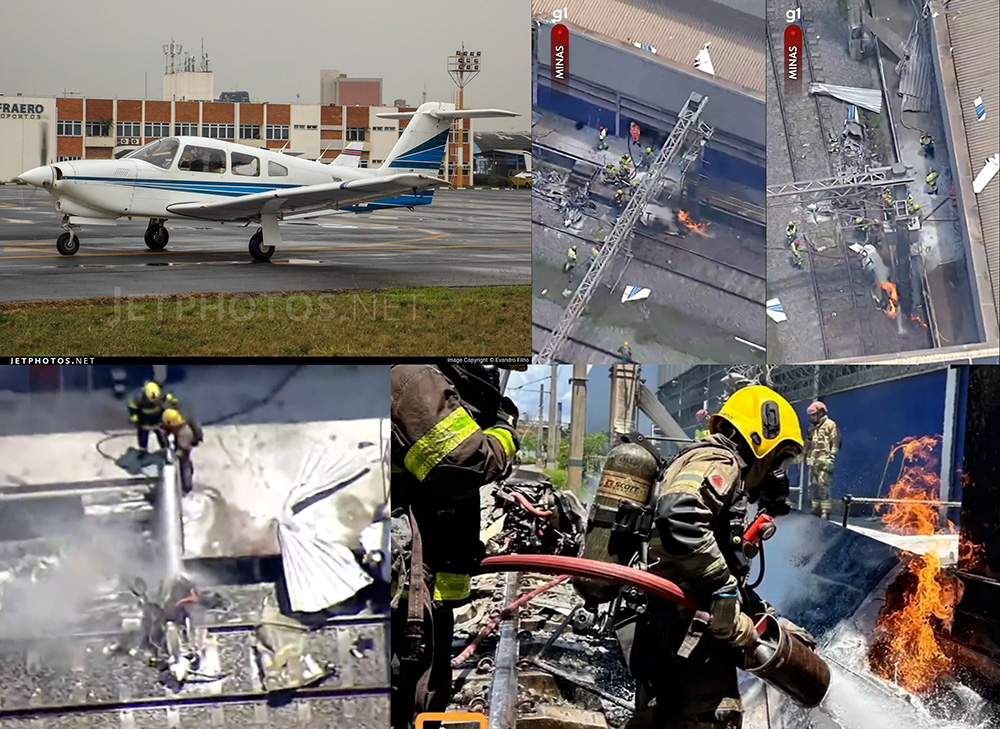
BELO HORIZONTE, BRAZIL — October 9, 2026. A pilot was killed Friday morning when an Embraer/Neiva EMB-711ST Corisco II Turbo crashed into a maintenance facility belonging to the Belo Horizonte metropolitan rail system shortly after departing Carlos Drummond de Andrade Airport, commonly known as Pampulha Airport. The aircraft struck a maintenance building and electrical infrastructure before coming to rest on railway tracks, where it caught fire.
The accident occurred at approximately 11:15 a.m. local time in the São Gabriel neighborhood of Belo Horizonte, Minas Gerais. The aircraft, registered PT-VHE, was conducting a private flight and carried only its pilot. Emergency responders confirmed that the pilot died in the accident. No injuries were reported among railway employees or other people on the ground.
Aircraft and Flight Information
The aircraft was a 1988-manufactured Embraer/Neiva EMB-711ST Corisco II Turbo, manufacturer serial number 711462. The four-seat, single-engine aircraft is a Brazilian-built derivative of the Piper PA-28RT Turbo Arrow family. Its registration, PT-VHE, was listed in the Brazilian Aeronautical Registry under Bello Fruit Importação e Exportação Ltda.
According to information released by Brazilian authorities, the aircraft departed Pampulha Airport in Belo Horizonte and was expected to land at an airfield in Juatuba, approximately 50 kilometers from the city, before returning to its departure airport. The accident occurred during the initial climb, a particularly demanding phase of flight in which altitude, airspeed, aircraft performance, and the availability of emergency landing areas can become critical considerations.
Brazil’s National Civil Aviation Agency (ANAC) indicated that the aircraft’s registration status was regular. That administrative status does not, by itself, establish the aircraft’s mechanical condition at the time of the accident.
Impact and Emergency Response
The aircraft came down in the São Gabriel rail maintenance complex, near the São Gabriel metro station. Reports from the scene indicate that it struck part of a maintenance building and a pole associated with the facility’s electrical infrastructure before crashing onto auxiliary tracks used for moving railway vehicles undergoing maintenance.
The impact was followed by a fire involving the aircraft wreckage. Firefighters from the Minas Gerais Military Fire Department deployed multiple response units and used firefighting foam to control the flames. Crews also managed the remaining aviation fuel to reduce the possibility of further ignition or explosion.
Although the aircraft struck railway infrastructure, no metro trains were involved in the collision. Metrô BH reported that none of its employees were injured and that normal passenger service was not interrupted. Electrical power was disconnected in the affected maintenance area to protect emergency personnel.
Initial Climb and Investigation
NAV Brasil, the country’s air navigation services organization, reported that the aircraft departed normally under visual flight rules. Following departure, the control tower lost visual contact with the airplane and observed dark smoke in the extended departure path.
Witness accounts reported by Brazilian news organizations described the aircraft flying at a low altitude before the crash. These observations are preliminary and do not establish whether the aircraft experienced a powerplant malfunction, a loss of control, a performance limitation, or another emergency.
The Brazilian Air Force confirmed that investigators from the Third Regional Aeronautical Accident Investigation and Prevention Service (SERIPA III), operating under the Center for Investigation and Prevention of Aeronautical Accidents (CENIPA), were assigned to the occurrence.
Investigators are responsible for documenting the wreckage, preserving relevant evidence, examining aircraft damage, and gathering operational information. The investigation may consider aircraft systems, maintenance history, pilot actions, weather, flight performance, and other circumstances as supported by the evidence. The Brazilian Civil Police also initiated investigative procedures.
At the time of the initial reports, authorities had not established an official probable cause. Reports that the aircraft had undergone maintenance shortly before the accident had not been established as causally related to the crash.
Aviation Safety Significance
Accidents during the initial climb present distinctive safety challenges because pilots have limited altitude and time to diagnose an abnormal condition, maintain control, and identify a survivable landing area. In densely developed urban environments, those challenges can be compounded by buildings, electrical installations, roads, and other obstacles surrounding the departure path.
Nevertheless, the circumstances of this accident should not be interpreted as evidence of an engine failure or any particular pilot decision. Determining what happened to PT-VHE requires a systematic examination of the available physical, operational, and testimonial evidence.
The destruction of the aircraft, the fatality of its sole occupant, and the proximity of railway personnel and infrastructure underscore the potential consequences of an aviation accident beyond the aircraft itself. The absence of additional injuries prevented an already fatal occurrence from becoming a larger ground-casualty event.
ASX News will continue to distinguish confirmed investigative findings from preliminary reports as Brazilian authorities examine the accident.
Accident Summary
Date: October 9, 2026
Time: Approximately 11:15 a.m. local time
Location: São Gabriel metro maintenance complex, Belo Horizonte, Minas Gerais, Brazil
Aircraft: Embraer/Neiva EMB-711ST Corisco II Turbo
Registration: PT-VHE
Manufacturer Serial Number: 711462
Year Manufactured: 1988
Operator/Registered Owner: Bello Fruit Importação e Exportação Ltda.
Departure: Carlos Drummond de Andrade Airport (SBBH), Belo Horizonte
Intended Destination: Juatuba, Minas Gerais
Flight Phase: Initial climb
Occupants: 1
Fatalities: 1
Ground Injuries: None reported
Aircraft Damage: Destroyed
Investigating Authority: CENIPA / SERIPA III
Cause: Under investigation
Sources
Agência Brasil — Pilot Dies Following Aircraft Crash at Belo Horizonte Metro Maintenance Yard
G1 / TV Globo — Aerial Images Show Burning Aircraft on Belo Horizonte Metro Tracks
CNN Brasil — Aircraft Crash Near Belo Horizonte Metro Station and Official Statements
AERO Magazine — Corisco PT-VHE Crashes at Belo Horizonte Metro Facility
Aviation Safety Network — Aviation Safety Database