

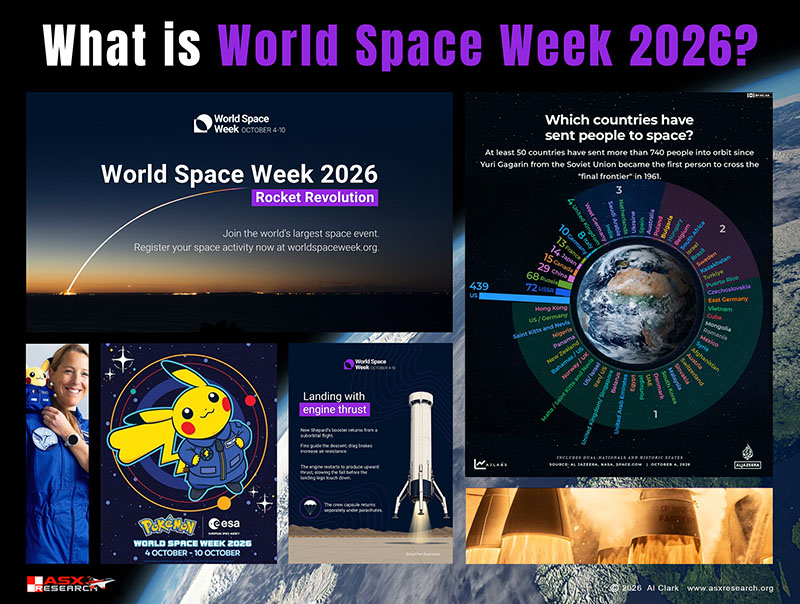
World Space Week 2026 is underway as rockets, reusable launch systems, commercial spacecraft, military space operations, and renewed lunar exploration transform access to orbit. ASX Research examines how this year’s “Rocket Revolution” reflects a much larger shift in the way humanity uses—and increasingly depends upon—space.
World Space Week 2026 arrives at a moment when access to space is changing faster than at almost any point since the beginning of the Space Age. Observed October 4–10 under the theme “Rocket Revolution,” this year’s event highlights far more than rockets themselves. Reusable launch vehicles, commercial spaceflight, renewed lunar exploration, military dependence on orbital systems, mega-constellations, environmental concerns, and intensifying international competition are collectively transforming space from an extraordinary destination into increasingly routine global infrastructure.
The observance traces its symbolic foundations to two defining moments in space history: the launch of Sputnik 1 on October 4, 1957, and the entry into force of the Outer Space Treaty on October 10, 1967. Nearly seven decades after Sputnik transformed geopolitics and science, the central question is no longer simply whether nations can reach space. Increasingly, it is how routinely they can reach it, who controls that access, and what happens when civilian, commercial, scientific, and military interests converge in the same orbital environment.
The most visible change is economic. Reusable launch systems are pushing spaceflight away from the traditional model in which rockets were expensive, largely disposable machines built for comparatively rare missions. As launch cadence increases and hardware is recovered and flown again, access to orbit begins to resemble transportation infrastructure rather than a succession of extraordinary national projects. That transition is at the heart of the 2026 “Rocket Revolution” theme.
The United States remains central to that transformation, but the modern space environment is increasingly multipolar. China, Russia, India, Europe, Japan, and emerging space nations are expanding their capabilities while private companies assume roles once reserved almost exclusively for governments. Lunar exploration, satellite communications, Earth observation, navigation, launch services, and national-security missions are increasingly interconnected, making space simultaneously a scientific frontier, commercial marketplace, strategic domain, and arena of international competition.
The same systems enabling commercial growth and scientific discovery have also become indispensable to modern military operations. Satellites support communications, navigation, missile warning, reconnaissance, weather forecasting, and battlefield awareness, while commercial spacecraft increasingly provide services with direct strategic value. The war in Ukraine demonstrated how quickly the boundary between civilian and military space infrastructure can blur, raising difficult questions about vulnerability, responsibility, and the possibility that future conflicts on Earth could extend into orbit.
That growing dependence makes orbital sustainability impossible to separate from the Rocket Revolution. Thousands of active satellites now share space with defunct spacecraft, spent rocket stages, fragments, and other debris capable of damaging or destroying operational systems at orbital velocity. Mega-constellations add another dimension, expanding global connectivity while increasing congestion and concerns about collision risk, astronomical interference, and the long-term stewardship of near-Earth space.
The environmental consequences of launch activity are becoming harder to ignore as launch frequency rises. Rocket emissions can affect atmospheric chemistry, while discarded stages and spacecraft introduce additional sustainability concerns. Reusability may reduce some forms of material waste, but a genuine revolution in access to space will ultimately be judged not only by how often humanity can launch, but by whether that increased activity can occur without degrading the orbital and atmospheric environments on which future missions depend.
World Space Week also remains fundamentally educational. Its worldwide events connect students, educators, researchers, space agencies, companies, and the public with technologies that can otherwise seem remote or inaccessible. In 2026, that educational role carries particular weight: the generation watching reusable rockets land, commercial spacecraft proliferate, and humans prepare for renewed exploration beyond low Earth orbit may be the generation responsible for deciding how those capabilities are governed.
The larger significance of World Space Week 2026 may therefore lie beyond the rockets themselves. Humanity is approaching a point at which reaching space could become sufficiently routine that the launch vehicle gradually disappears into the infrastructure behind the mission, much as aircraft, ships, highways, and fiber-optic networks support modern civilization without defining every activity they enable. The real revolution will begin when getting to space is no longer the hardest part.
A newly published ASX Research analysis, “What Is World Space Week 2026?”, examines these developments in greater depth, tracing the observance from Sputnik and the Outer Space Treaty through reusable launch technology, commercial expansion, military dependence on space systems, orbital debris, environmental effects, international competition, and the question of equitable access to humanity’s increasingly crowded frontier.
World Space Week 2026 celebrates the machinery capable of carrying humanity away from Earth, but its greater significance may be the questions that machinery is forcing humanity to confront. The challenge is no longer simply reaching space. It is learning how to expand commercial activity, scientific discovery, exploration, and strategic capability without making orbit unusable, surrendering public responsibility, widening global inequality, or allowing competition to make conflict inevitable.
Read the complete ASX Research analysis: What Is World Space Week 2026?
