


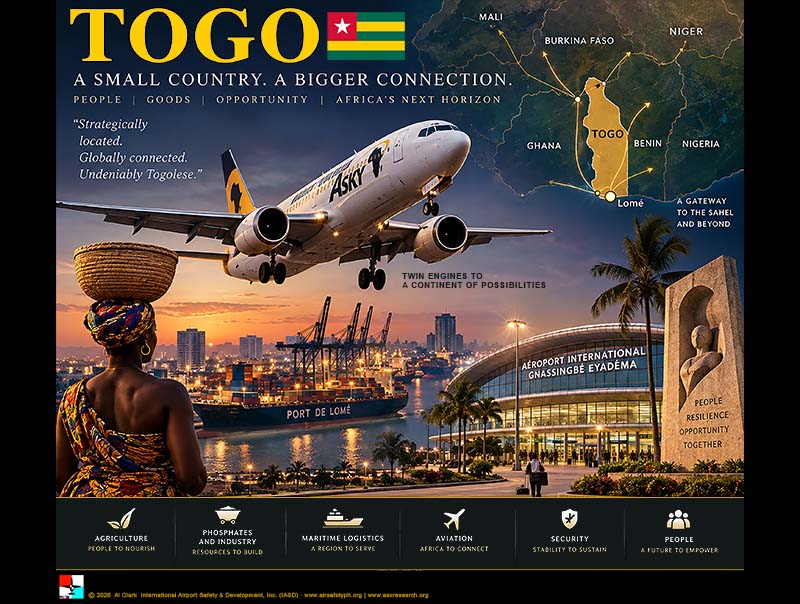
One visitor from Togo appeared in the analytics of an independent research journal operating from the Philippines. That single visit prompted a question: What makes this narrow West African country important enough to investigate?
The answer became an 18-page ASX Research study examining a nation whose geographic position, transportation infrastructure, commercial networks, and political history have given it an international role far larger than its territory might suggest.
Togo occupies a strategic corridor between the Gulf of Guinea and the landlocked countries of the Sahel. Its capital, Lomé, combines a major seaport, an international aviation hub, industrial development, and regional diplomatic activity.
But the country’s ambitions coexist with significant challenges involving poverty, political representation, and growing insecurity along its northern frontier.
A Country Shaped by Colonial Partition
Long before European colonialism, the territory now called Togo contained diverse communities whose cultural and commercial relationships crossed today’s national borders.
Germany established the protectorate of Togoland in 1884. Following Germany’s defeat in the First World War, Britain and France divided the territory.
British-administered Togoland eventually became part of Ghana, while French Togoland gained independence as the Republic of Togo on April 27, 1960.
The partition divided communities and left unresolved questions concerning national identity, sovereignty, and regional relationships.
Independence, Coups, and Political Continuity
Togo’s first president, Sylvanus Olympio, was killed during a military coup on January 13, 1963, an event widely recognized as the first successful military overthrow of a government in post-independence sub-Saharan Africa.
Gnassingbé Eyadéma seized power in 1967 and remained in office until his death in 2005. His son, Faure Gnassingbé, subsequently assumed power amid constitutional controversy and disputed elections.
Political reforms during 2024 and 2025 established a parliamentary system under Togo’s Fifth Republic. Faure Gnassingbé became president of the Council of Ministers in May 2025, while Jean-Lucien Savi de Tové assumed the substantially ceremonial presidency of the republic.
Supporters describe the constitutional restructuring as parliamentary modernization. Critics argue that it preserved the concentration of executive power under a different institutional arrangement.
The ASX Research study examines this continuity alongside the country’s repeated efforts at democratization and the historical influence of military institutions.
Why Togo’s Geography Matters
Togo stretches roughly 600 kilometers northward from the Gulf of Guinea toward Burkina Faso.
That elongated geography makes the country a potential transportation corridor linking Atlantic shipping with inland West African markets.
Its capital, Lomé, lies near the Ghanaian border and connects maritime commerce with regional roads, industrial facilities, financial services, and international aviation.
For neighboring landlocked economies, access to an efficient coastal gateway can influence transportation costs, trade opportunities, and supply-chain reliability.
The Port of Lomé: A Gateway Beyond National Borders
The Port of Lomé serves more than Togo’s domestic economy. Cargo moving through the port can continue toward Burkina Faso, Niger, Mali, and other inland destinations.
The research describes investments intended to improve port access, reduce road congestion, strengthen transportation corridors, and connect the port with the Adétikopé Industrial Platform.
Industrial development could allow Togo to process more goods locally rather than depending primarily on revenue from cargo passing through its territory.
That distinction is important: the economic value of a transport corridor depends not only on how much cargo moves through it, but also on how much employment and production it creates for the surrounding population.
ASKY Airlines and the Aviation Advantage
Aviation gives Togo another way to capitalize on its geographic position.
Gnassingbé Eyadéma International Airport in Lomé serves as the operating hub for ASKY Airlines, whose network connects destinations across Africa.
The September 2026 research reports that ASKY operated a network reaching 30 destinations in 28 African countries, with approximately 336 weekly flights and 24,000 passengers per week.
It also cites Togolese statistics showing approximately 1.58 million airport passengers in 2025, including more than 465,000 transit passengers, and 17,354 tonnes of freight.
Those transit passengers illustrate the airport’s regional role. Many travelers use Lomé not because Togo is their final destination, but because it connects them to somewhere else.
ASKY’s strategic relationship with Ethiopian Airlines extends those connections into a larger international aviation network.
Combined with maritime shipping and inland transport, the airport gives Togo the foundations of a multimodal logistics system.
Agriculture, Industry, and the Challenge of Shared Prosperity
Agriculture remains essential to livelihoods and food security in Togo. Important crops include maize, cassava, yams, cotton, soybeans, cashews, coffee, and cocoa.
Phosphate mining, cement production, manufacturing, transport, trade, and services also contribute to the economy.
Yet national economic growth does not automatically translate into secure employment or improved living conditions.
The research cites an African Development Bank estimate of 6.3 percent economic growth in 2025 alongside extreme poverty affecting approximately 39.3 percent of the population.
Studies of agricultural investment, food-price inflation, education, and household welfare reveal persistent obstacles to turning economic activity into widely distributed prosperity.
For Togo, the question is not simply whether its economy can expand. It is whether that expansion improves opportunities for people throughout the country.
The Growing Security Threat in Northern Togo
The country’s strategic north-south corridor also exposes it to instability spreading from the Sahel.
Armed extremist violence affecting Mali, Burkina Faso, and Niger has increasingly threatened the northern regions of coastal West African states.
Togo’s Savanes Region has experienced cross-border attacks since 2021, prompting security deployments and emergency measures.
The study emphasizes that insecurity can intersect with agricultural vulnerability, climate pressures, limited employment, and inadequate public services.
Military operations are therefore only one part of the challenge. Economic opportunity, institutional legitimacy, and community resilience also influence long-term stability.
Diplomacy and Regional Influence
Togo participates in the African Union, the Economic Community of West African States, the United Nations, and other international organizations.
Lomé has hosted regional negotiations, while Togolese officials have maintained relationships with a wide range of governments and political blocs.
For a relatively small state, diplomatic relevance can arise from its ability to connect competing interests and facilitate cooperation.
This approach mirrors the country’s economic strategy: creating influence through access, connectivity, and services rather than territorial size.
Can Togo Turn Its Advantages Into Lasting Development?
Togo’s port, airport, industrial investments, agricultural resources, and geographic location provide opportunities for continued development.
But infrastructure alone cannot resolve questions about political accountability, educational inequality, poverty, public services, and security.
The central argument of the ASX Research study is that Togo’s future importance will depend on converting its geographic advantages into resilient institutions and prosperity extending beyond Lomé.
A small country can become internationally consequential when larger regional systems depend on its connections.
And in Togo’s case, the entire investigation began with one anonymous reader whose visit to an aviation research website prompted a much larger examination of West Africa.
Read the complete 18-page ASX Research paper: Togo at the Hinge of West Africa: History, Power, Connectivity, and the Future of a Small Strategic State — ASX Research Journal and Database, September 7, 2026.