


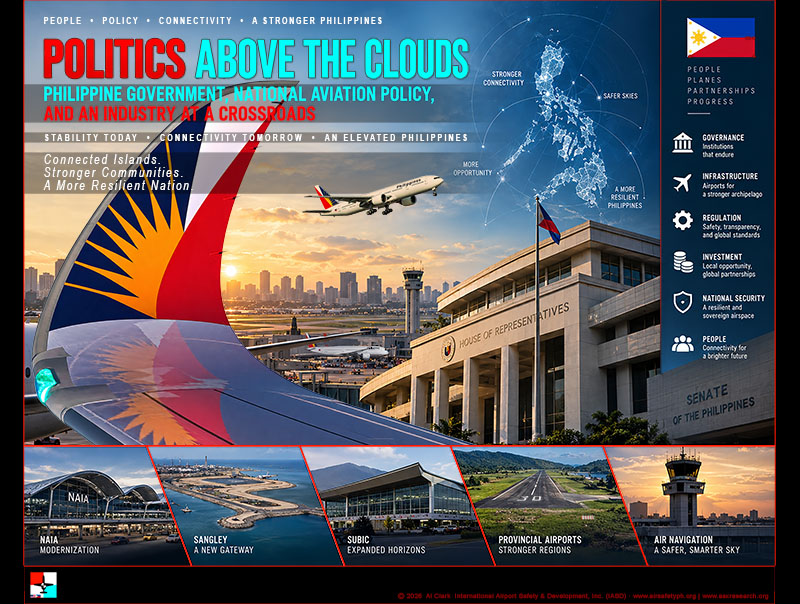
The Philippines is expanding its aviation infrastructure through new airports, private investment, international partnerships, and regulatory reform. But behind the construction projects lies a more consequential question: Can the country build the institutions necessary to manage its growing aviation system safely and effectively?
A 19-page investigation published by ASX Research examines how Philippine aviation policy intersects with national politics, economic development, airport governance, foreign investment, and regional security.
The study, published September 6, 2026, argues that the future of Philippine aviation depends not simply on building more airports, but on ensuring that regulation, technical expertise, and long-term planning survive changes in political leadership.
Why Aviation Matters More in the Philippines
In an archipelago of thousands of islands, aviation serves purposes extending far beyond tourism and commercial passenger transportation.
Airports connect communities separated by water, support emergency medical transportation, move critical supplies, facilitate disaster response, and provide access to national and international markets.
For decades, Philippine aviation operated under substantial government control. Executive Order No. 219 in 1995 advanced liberalization, while Republic Act No. 9497 established the Civil Aviation Authority of the Philippines (CAAP) in 2008.
These reforms helped move the industry toward a commercially competitive system, although significant regulatory and institutional challenges remain.
The Government’s Airport Expansion Strategy
The administration of President Ferdinand Marcos Jr. has pursued a broad aviation development program combining public funding, public-private partnerships, foreign participation, and provincial airport investment.
The September 2026 ASX Research study identifies ₱6.2 billion allocated to the Department of Transportation’s Aviation Infrastructure Program in the 2026 national budget, including ₱2.5 billion for New Dumaguete Airport.
Other projects identified in the research include Tacloban, Laoag, New Naga, Ormoc, Busuanga, Kalibo, Bukidnon, Antique, Central Mindanao, and Catbalogan.
Rather than relying exclusively on one metropolitan gateway, the emerging strategy seeks to distribute aviation capacity across multiple locations.
That approach could improve regional connectivity, but it also creates coordination challenges involving financing, infrastructure priorities, airspace management, and technical oversight.
NAIA and the Rise of Private Airport Operators
The modernization of Ninoy Aquino International Airport represents one of the country’s most prominent public-private partnerships.
In March 2024, the Department of Transportation and Manila International Airport Authority signed a concession agreement with the consortium that became New NAIA Infra Corp., involving San Miguel interests and Incheon International Airport Corporation.
The arrangement transfers important operating and investment responsibilities to a private concessionaire without necessarily transferring permanent ownership of the public asset.
That distinction matters. The government remains responsible for ensuring that airport fees, safety requirements, investment obligations, service quality, and contractual performance serve the public interest.
The ASX Research paper examines similar questions involving airport concessions and proposals at Laguindingan, Bohol-Panglao, Puerto Princesa, Davao, and Subic.
The Overlooked Question: Who Controls Air Navigation?
Airport terminals attract attention, but aviation safety also depends on systems passengers rarely see.
Air traffic control, communications, surveillance, navigation, aeronautical information, and contingency procedures form the infrastructure that allows aircraft to operate safely within national airspace.
CAAP’s 2025 accomplishment report, cited in the research, documented an unsolicited proposal concerning Philippine Air Navigation Services, with negotiations beginning in November 2025.
The study argues that any restructuring of these safety-critical services must maintain a clear separation between commercial operating incentives and independent regulatory oversight.
Cybersecurity, emergency continuity, military coordination, staffing, data sovereignty, and the ability to maintain services during national emergencies are essential considerations.
Modernization should strengthen aviation safety—not merely change who operates the equipment.
CAAP Reform and Aviation Safety Oversight
The Civil Aviation Authority of the Philippines occupies a particularly important position because it combines regulatory responsibilities with functions associated with airport operation and air-navigation services.
CAAP’s Philippine Aviation Safety Plan 2025–2027 reported an overall International Civil Aviation Organization effective-implementation score of 68.99 percent.
Within that assessment, air-navigation services scored 45.28 percent and aerodromes and ground aids scored 45.87 percent.
These figures, cited in the September 2026 study, demonstrate why investment in oversight and operational systems must accompany physical airport expansion.
Congress has considered proposals to reorganize airport governance and strengthen CAAP, including possible new airport authorities or corporations.
The central question is whether regulatory independence, service provision, and commercial airport management can be assigned sufficiently distinct responsibilities.
Sangley, Subic, and the Importance of Regional Gateways
Sangley Point International Airport in Cavite illustrates the complicated relationship between local initiative and national aviation planning.
In August 2026, President Marcos issued Administrative Order No. 44 directing government agencies and project partners to accelerate coordination on Sangley’s development.
The project involves transportation, aviation regulation, environmental oversight, defense, reclamation, and provincial authorities.
Subic International Airport represents another potential development opportunity, with modernization and operating proposals advancing through a comparative-challenge process in August 2026.
For provincial airports, the research emphasizes that success should be measured by genuine transportation and economic needs rather than political prestige.
A smaller facility supporting tourism, emergency services, agricultural trade, or regional access may provide greater public value than an oversized airport built without sufficient demand.
Foreign Investment and National Control
Philippine aviation is also becoming increasingly accessible to foreign investors.
The research discusses Executive Order No. 113, effective May 2, 2026, and changes to foreign-investment restrictions affecting airports and certain transportation services.
Foreign participation can introduce capital, engineering expertise, operating experience, and international business connections.
But investment openness also raises questions about critical infrastructure, data, economic regulation, and the country’s ability to maintain essential services during commercial or geopolitical disruptions.
The study’s position is that foreign investment should strengthen Philippine aviation capability without weakening the government’s independent authority over safety and national interests.
Aviation, Defense, and Disaster Resilience
Philippine aviation infrastructure increasingly intersects with national defense and Indo-Pacific security considerations.
Clark, Subic, Sangley, and facilities associated with defense cooperation illustrate how airfield access and transportation infrastructure can serve overlapping civilian and strategic purposes.
That does not mean every civilian airport project is a military initiative.
Rather, the same improvements that support airline operations—including communications, surveillance, emergency planning, alternate airports, fuel systems, and cybersecurity—can also improve national resilience during typhoons, earthquakes, infrastructure failures, and security emergencies.
Effective policy must protect civilian aviation safety while ensuring that government agencies coordinate when national circumstances require it.
Political Conflict and the 2028 Transition
Political uncertainty adds another dimension to aviation planning because major infrastructure commitments frequently extend decades beyond an elected administration.
The September 2026 ASX Research investigation examines impeachment proceedings involving Vice President Sara Duterte as part of the broader political environment.
Importantly, the study found no substantiated evidence, as of September 5, 2026, that those proceedings had directly delayed identified airport projects, changed CAAP safety regulations, or caused aviation investors to withdraw.
Its concern is instead institutional continuity: changes in leadership, legislative priorities, appointments, and public financing can influence long-term aviation development.
Airport concessions, runways, navigation systems, and safety institutions must continue operating through multiple political administrations.
Transparent contracts, independent oversight, measurable performance requirements, and stable technical planning can help protect sound projects from political disruption.
The Workforce Behind the Infrastructure
Modern airports require far more than terminals and runways.
The Philippines needs trained air traffic controllers, inspectors, engineers, cybersecurity specialists, meteorologists, aircraft maintenance professionals, emergency responders, safety managers, and accident investigators.
Those personnel must be recruited, trained, retained, and supported while domestic airlines, foreign employers, defense organizations, and private aviation businesses compete for many of the same skills.
The ASX Research study warns that airport construction can advance faster than the regulatory and technical workforce required to operate the resulting system.
Professional capability must therefore be treated as an essential infrastructure investment rather than an administrative afterthought.
The Real Test of Philippine Aviation Modernization
The Philippines has significant opportunities to improve regional connectivity, attract investment, modernize airports, and strengthen its role in international aviation.
But the ultimate measure of progress will not be the number of construction projects announced or terminals opened.
It will be whether airport development, air-navigation modernization, regulatory independence, workforce capability, national security, and public accountability function as a coherent system.
The September 2026 investigation concludes that Philippine aviation policy must remain effective long after the political leaders responsible for today’s projects have left office.
Read the complete 19-page ASX Research paper: Politics Above the Clouds: Philippine Government, National Aviation Policy, and an Industry at a Crossroads — ASX Research Journal and Database, September 6, 2026.