


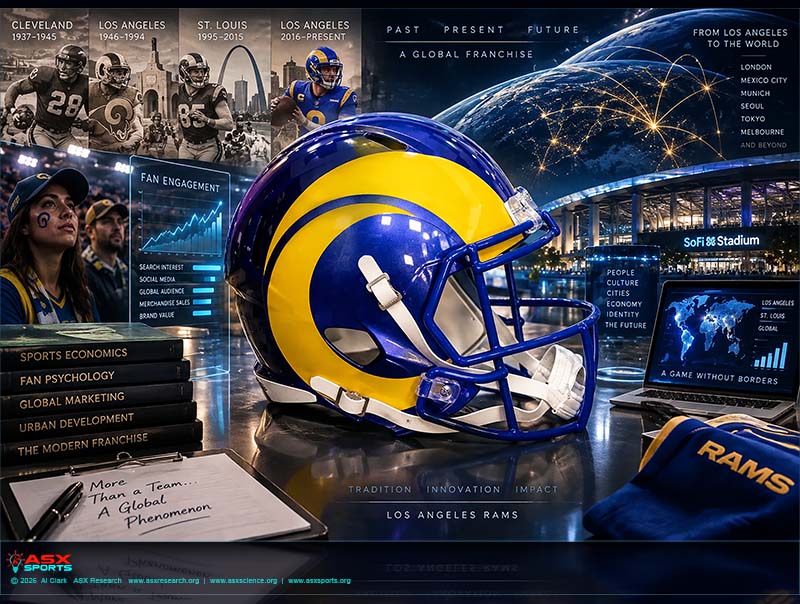
The Los Angeles Rams have survived three cities, multiple reinventions, championship triumphs, and some of professional football’s most painful defeats. But on September 10, 2026, their story entered an entirely new chapter: Australia.
Before 100,021 spectators at the Melbourne Cricket Ground, the Rams faced their longtime rivals, the San Francisco 49ers, in the first NFL regular-season game played in Australia. The result was a 27–7 defeat for Los Angeles, but the significance extended far beyond the scoreboard.
A 17-page ASX Research study published September 12 examines how the Rams evolved from a struggling Cleveland franchise into a multibillion-dollar global sports institution—and why their Australian humiliation may ultimately prove more historically important than the loss itself.
From Cleveland to California
The franchise began in Cleveland in 1937, when professional football was still developing its place in American popular culture. After winning the 1945 NFL championship behind rookie quarterback Bob Waterfield, the Rams moved to Los Angeles in 1946.
The relocation established the NFL’s first West Coast franchise and helped expand professional football into a truly national enterprise.
The Rams also contributed to the league’s racial reintegration by signing Kenny Washington and Woody Strode in 1946. Their early Los Angeles years combined competitive success, enormous crowds, and a growing entertainment identity.
By 1951, the Rams had captured another NFL championship. Their distinctive horned helmets, introduced in 1948, became one of professional football’s most recognizable visual trademarks.
The Players Who Built the Legend
Generations of exceptional players established the Rams’ identity. Deacon Jones, Merlin Olsen, Jack Youngblood, Eric Dickerson, and Jackie Slater became enduring names in the franchise’s history.
From 1973 through 1979, the Rams won seven consecutive NFC West championships. They reached Super Bowl XIV but lost to the Pittsburgh Steelers, 31–19.
The research examines why these achievements matter beyond statistics. Sports-psychology studies show that supporters often incorporate teams into their personal identities, creating emotional connections that survive individual seasons and players.
The St. Louis Years and the Greatest Show on Turf
In 1995, the Rams left Southern California for St. Louis, demonstrating how franchise relocation can fracture the relationship between a team and its supporters.
Four years later, the franchise achieved one of football’s most remarkable transformations. Led by Kurt Warner, Marshall Faulk, Isaac Bruce, and Torry Holt, the Greatest Show on Turf defeated Tennessee 23–16 in Super Bowl XXXIV.
The Rams returned to the Super Bowl two seasons later, losing to New England.
Those years added another layer to an already complicated identity. Cleveland, Los Angeles, and St. Louis could all claim a meaningful place in Rams history.
Returning Home and Winning Again
Owner Stan Kroenke returned the Rams to Los Angeles in 2016. Sean McVay became head coach in 2017, bringing a new offensive identity and rapidly restoring the franchise to championship contention.
After reaching Super Bowl LIII, Los Angeles acquired quarterback Matthew Stafford from Detroit in 2021. The move culminated in a 23–20 victory over Cincinnati in Super Bowl LVI, played at the Rams’ own SoFi Stadium.
The championship restored the Rams to the top of professional football while strengthening the franchise’s commercial and cultural position.
A $13.5 Billion Sports Institution
According to the September 2026 research, Forbes estimated the Rams’ value at $13.5 billion, placing them second among NFL franchises.
The figure reflects considerably more than athletic performance. Los Angeles, media rights, league membership, intellectual property, commercial development, and SoFi Stadium all contribute to the organization’s economic value.
The study also distinguishes franchise profitability from broader public benefit. Research on stadium subsidies raises serious questions about whether expensive professional sports facilities generate the economic returns often promised to taxpayers.
The Rams Entered 2026 With Championship Expectations
Matthew Stafford entered the 2026 season as the reigning NFL Most Valuable Player following a 2025 campaign in which he threw for 4,707 yards and 46 touchdowns.
Los Angeles had finished 12–5 and reached the NFC Championship Game, losing 31–27 to Seattle.
Rather than retreat, the organization pursued additional star talent. The research describes major defensive acquisitions involving Trent McDuffie and Myles Garrett, along with Aaron Donald’s return from retirement.
The resulting expectations were enormous. Then came Melbourne.
The Melbourne Disaster
On September 10, the Rams met San Francisco before 100,021 spectators at the Melbourne Cricket Ground. Despite their formidable roster and preseason expectations, Los Angeles managed only seven points.
The 49ers won 27–7. The Rams converted just two of nine third downs, and Stafford completed 15 of 25 passes for 155 yards before Stetson Bennett handled the final possession.
For a franchise expected to contend for another championship, the defeat was humiliating. But the event also placed the Rams at the center of an unprecedented international football spectacle.
Did Travel Preparation Matter?
The teams approached the Australian journey differently. San Francisco arrived approximately a week early to adjust, while Los Angeles maintained its American training schedule and arrived shortly before the game.
The contrasting strategies raised questions about jet lag, circadian rhythms, preparation, and the physical demands of international competition.
However, the ASX Research study cautions that one football game cannot scientifically establish that travel timing caused the Rams’ defeat.
The broader lesson concerns the extraordinary logistical complexity of exporting an NFL game across the Pacific: athletes, equipment, broadcasting, security, transportation, spectators, and time zones must all function together.
Why the Rams Captured Global Attention
The research argues that the Rams’ sudden prominence in internet searches resulted from a convergence of circumstances rather than a permanent transformation in worldwide popularity.
A historic Australian debut, a crowd exceeding 100,000, a bitter divisional rivalry, a reigning MVP quarterback, championship expectations, and a surprising defeat created an unusually powerful international news event.
Search activity measures attention, not necessarily loyalty. Nevertheless, the Melbourne game exposed the Rams to an audience extending far beyond their traditional American fan base.
Football’s International Future
The NFL’s international expansion is transforming the economics of professional football. Streaming, social media, merchandise, and international games allow supporters to develop relationships with teams thousands of kilometers away.
Los Angeles possesses particular advantages in that environment. The city is already a globally recognizable entertainment brand, and the Rams combine a famous visual identity, a modern stadium, championship history, and recognizable star players.
Yet attracting temporary attention is different from building lasting loyalty. The study identifies repeated engagement, community, emotional identification, and continuity as essential ingredients in creating international supporters.
More Than a Football Team
From Cleveland in 1937 to Melbourne in 2026, the Rams have repeatedly demonstrated that professional sports franchises are simultaneously athletic organizations, commercial properties, historical institutions, and communities of identity.
The Melbourne defeat was disastrous on the scoreboard, but its long-term importance may lie elsewhere. It demonstrated how an American football franchise could become the centerpiece of a major sporting event on another continent.
The Rams’ challenge is now to transform that temporary worldwide attention into durable international support while preserving the history and identity that made the franchise valuable in the first place.
Read the complete 17-page ASX Research paper: The LA Rams: From Cleveland to the Melbourne Disaster — ASX Research Journal and Database, September 12, 2026.