


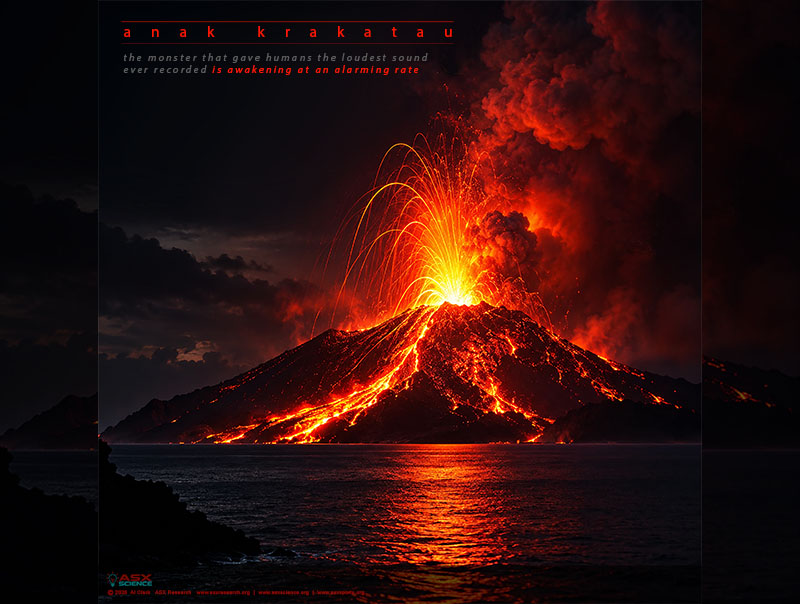
In 1883, Krakatau unleashed an explosion heard thousands of kilometers away. Atmospheric pressure waves circled the planet, much of the volcanic island disappeared, and tsunamis devastated the coastlines of Java and Sumatra, killing approximately 36,000 people.
More than 140 years later, the volcanic system is still alive—and its successor, Anak Krakatau, has demonstrated that its greatest threat may no longer be the size of an explosion.
A 16-page ASX Research study published September 13, 2026, examines renewed volcanic activity in Indonesia’s Sunda Strait, the devastating lessons of the 2018 tsunami, and the possibility that the next major catastrophe could begin with a collapsing mountainside rather than an enormous eruption.
The Child of Krakatau
After the 1883 destruction, a new volcanic cone emerged from the submerged caldera in the late 1920s. It became known as Anak Krakatau, meaning Child of Krakatau.
Repeated eruptions gradually built a new island above the Sunda Strait. Scientific investigations have identified a complex magma system extending deep into the crust, with evidence of magma storage at depths approaching 26 kilometers.
What appears at the surface is only a small part of the volcanic system beneath it.
The Tsunami That Arrived Without a Major Earthquake
On December 22, 2018, a large portion of Anak Krakatau’s southwestern flank collapsed into the sea, generating a deadly tsunami.
More than 400 people died. Coastal communities received little conventional earthquake-based warning because the tsunami was generated by a volcanic landslide rather than a major tectonic rupture.
Subsequent research determined that approximately half the island failed. Field investigations recorded tsunami runup of approximately 13.5 meters on populated coastlines, with even greater heights near the volcanic source.
The disaster demonstrated that Anak Krakatau does not need another explosion comparable to 1883 to produce a deadly regional emergency.
Renewed Eruptions in 2026
According to the research, thermal anomalies and sulfur dioxide emissions were detected beginning in June 2026. Renewed eruption on July 2 prompted Indonesian authorities to raise the volcanic alert to Level III, with a three-kilometer exclusion radius.
On September 4, a sustained eruptive episode began and continued for approximately 25 hours. The study describes incandescent activity, lava fountains, and ash reaching aviation altitudes approaching 50,000 feet.
Eight airports temporarily suspended operations, disrupting thousands of flights and affecting hundreds of thousands of passengers before operations resumed.
For modern aviation, volcanic ash is a serious hazard. Its consequences can extend far beyond the volcano through interconnected airline networks, airport operations, and international travel.
The Volcano Remains Active Beneath the Surface
Following the sustained eruption, Anak Krakatau continued producing intermittent Strombolian explosions, ejecting incandescent material and ash.
Monitoring described in the September study recorded low-frequency, hybrid, shallow volcanic, and deep volcanic earthquakes, together with continuous tremor.
The pattern was consistent with an active magmatic system, although it did not establish that a catastrophic eruption or collapse was imminent.
Did a Powerful Earthquake Trigger the Eruption?
A deep-focus earthquake on September 12 attracted attention because of its apparent proximity to the volcanic region.
However, the study emphasizes that geographic proximity on a map is misleading when earthquake depth is ignored. The earthquake originated hundreds of kilometers below the surface, far beneath Anak Krakatau’s magma system.
More importantly, the volcano had already been erupting for months, and its major September episode began approximately a week before the earthquake.
Large earthquakes can sometimes perturb volcanic systems through passing seismic waves, but the research identifies no demonstrated causal relationship between this earthquake and Anak Krakatau’s activity.
Indonesia’s Volcanoes Are Not a Chain Reaction
Several Indonesian volcanoes were active during the same period, creating the impression of a coordinated geological awakening across the archipelago.
The research finds no credible evidence of a domino-like volcanic chain reaction. Indonesia occupies a highly complex tectonic environment in which separate volcanic systems can become active independently.
Simultaneous eruptions do not, by themselves, demonstrate that one volcano is triggering another.
Eight People Missing in the Sunda Strait
The study also documents a speedboat carrying eight people, including five journalists, that disappeared after departing Carita on September 7 to cover the volcanic activity.
Search-and-rescue operations were underway, but the reports available when the study was published still described the eight people as missing.
The research explicitly cautions against attributing their disappearance to the volcano without evidence. It also reports no confirmed deaths directly caused by the September 2026 eruption as of its publication.
The Greater Danger May Be a Collapsing Flank
Recent research has shown that Anak Krakatau rapidly rebuilt portions of its volcanic cone after the 2018 collapse.
New volcanic material adds weight to an already complex structure. Fractures, weakened internal layers, hydrothermal alteration, and gravitational deformation can contribute to instability.
That does not mean another landslide is imminent. It means the hazard cannot be dismissed simply because the volcano survived its previous collapse.
Unlike a sustained eruption, a catastrophic flank failure can occur quickly, potentially leaving very little time for coastal evacuation.
The study highlights the importance of detecting deformation and flank movement, rather than relying exclusively on eruption intensity or earthquake-based tsunami warnings.
What Happens Next?
The research considers continued episodic eruptions, changing seismic activity, gas release, and intermittent ash production more likely in the near term than a repetition of the 1883 catastrophe.
But a lower-probability, higher-consequence scenario remains: continued volcanic construction and weakening followed by partial flank collapse and tsunami generation.
Krakatau’s history contains a powerful warning. In 1883, the volcano devastated surrounding coastlines through an enormous eruption. In 2018, its successor generated a deadly tsunami through structural collapse. In 2026, renewed activity again demonstrated its ability to disrupt aviation and threaten nearby communities.
The next dangerous event need not resemble the last.
Read the complete 16-page research paper: The Loudest Sound Ever Heard: Krakatau Awakens Again in a Restless Indonesian Archipelago — ASX Research Journal and Database, September 13, 2026.