


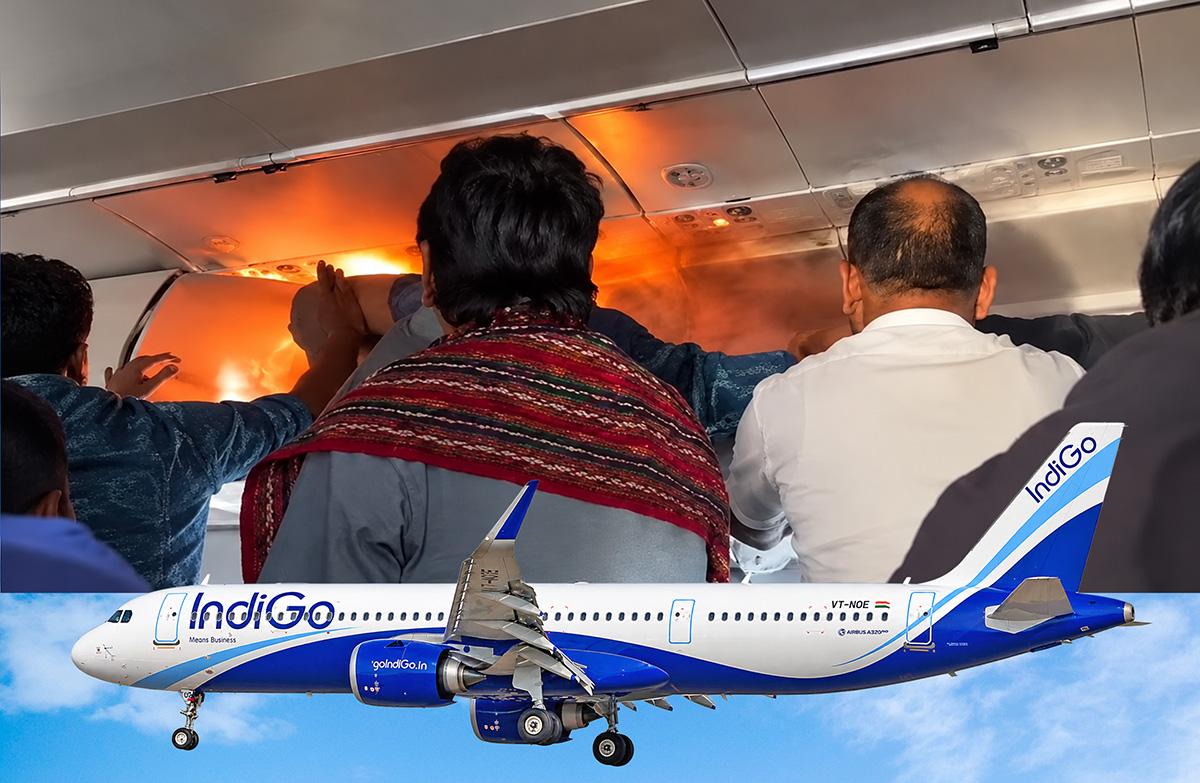
An IndiGo Airbus A321neo operating a scheduled passenger flight from New Delhi to Chennai diverted to Hyderabad on Sunday, October 11, 2026, after a passenger’s portable electronic device reportedly experienced a battery fire inside an overhead luggage compartment. The incident prompted an immediate cabin crew response and a precautionary diversion, with the aircraft landing safely at Rajiv Gandhi International Airport.
Flight 6E 6115: The Incident
The aircraft, an Airbus A321-251NX registered VT-NOE (manufacturer serial number 13254), was operating IndiGo Flight 6E 6115 from Indira Gandhi International Airport (DEL/VIDP) to Chennai International Airport (MAA/VOMM).
According to the Aviation Safety Network’s preliminary incident record, the aircraft was cruising at approximately 15,000 feet when a passenger’s power bank suffered a reported thermal runaway, resulting in a fire in an overhead luggage compartment. The occurrence was recorded at approximately 09:20 UTC, north of Hyderabad, India.
Passenger video circulated by Indian news outlets showed an intense orange glow and visible flames near the overhead compartment, with passengers gathered beneath the affected area. The images illustrate the urgency of an onboard fire emergency, particularly in a confined passenger cabin where smoke and combustion products can rapidly threaten visibility and breathing conditions.
Cabin Crew Contain the Emergency
IndiGo confirmed that smoke was detected from a customer’s personal electronic device and that cabin crew responded promptly, bringing the situation under control. The airline did not publicly identify the precise device or establish the technical cause in its initial statement.
Indian news organizations, citing sources familiar with the occurrence, identified the device as a passenger’s power bank stored in an overhead bin. Reports indicate that cabin crew extinguished the fire before the aircraft landed.
The flight crew diverted to Rajiv Gandhi International Airport (HYD/VOHS) at Hyderabad rather than continuing to Chennai. The aircraft landed safely, and no injuries were reported among passengers or crew.
IndiGo subsequently arranged an alternative aircraft for the passengers’ onward journey to Chennai. The airline also reported providing refreshments and updates during the disruption.
The Aircraft: Airbus A321neo VT-NOE
Flight-tracking records identify the incident aircraft as VT-NOE, an Airbus A321neo operated by IndiGo. The Aviation Safety Network lists the aircraft as an Airbus A321-251NX, manufacturer serial number 13254, powered by CFM International LEAP-1A32 engines.
The preliminary Aviation Safety Network entry categorizes the occurrence as an incident, with minor aircraft damage and no fatalities. These classifications are preliminary and should not be confused with the findings of a completed technical investigation.
Why Lithium-Ion Battery Fires Matter in Aviation
Portable power banks typically contain rechargeable lithium-ion cells. When such a battery experiences thermal runaway, an internal failure can produce rapidly increasing temperatures, combustible gases, smoke, and potentially sustained flames. Heat from one cell may also affect adjacent cells, making complete control more difficult than extinguishing an ordinary localized flame.
In a passenger cabin, the hazards extend beyond the burning device itself. Smoke can impair visibility, combustion gases may threaten occupants, and heat can damage overhead-bin materials or nearby baggage. These risks make rapid recognition, trained cabin crew intervention, and flight crew coordination essential.
International aviation safety guidance treats lithium-battery incidents as events requiring immediate crew attention. Established procedures emphasize controlling visible flames, cooling an affected device when appropriate, monitoring for renewed heating, and assessing whether a diversion is necessary. The exact response depends on the device, the location of the fire, and the operator’s approved emergency procedures.
The IndiGo occurrence also reinforces why passengers should follow airline restrictions concerning spare lithium batteries and power banks. These devices generally belong in cabin baggage rather than checked baggage, subject to applicable airline and regulatory limits, so potential overheating or smoke can be detected and addressed promptly.
Safety Outcome and Investigation
The successful diversion of Flight 6E 6115 demonstrates the importance of coordinated cabin and flight deck emergency response. Cabin personnel controlled the immediate hazard while the pilots selected an alternate airport and brought the aircraft safely to the ground.
However, the precise initiating failure, battery condition, device characteristics, and extent of aircraft damage have not been independently established in the initial reporting. Those details would require additional evidence or formal investigative findings.
For the aviation industry, the event provides another reminder that small personal electronic devices can generate disproportionately serious hazards in flight. The absence of injuries is an encouraging outcome, but the underlying safety challenge remains relevant to airlines, regulators, manufacturers, and passengers worldwide.
Sources
Asian News International (ANI): Delhi–Chennai IndiGo Flight Makes Emergency Landing in Hyderabad
Press Trust of India via ThePrint: Power Bank Catches Fire Aboard Chennai-Bound IndiGo Flight
The New Indian Express: IndiGo Flight Diverted Following Power Bank Fire
The Times of India: IndiGo Statement on Electronic Device Incident
Flightradar24: Flight 6E 6115 History and Aircraft Registration