


We have sent spacecraft beyond the planets, landed machines on Mars, and photographed galaxies billions of light-years away. Yet humanity has barely penetrated the surface of the world beneath its own feet.
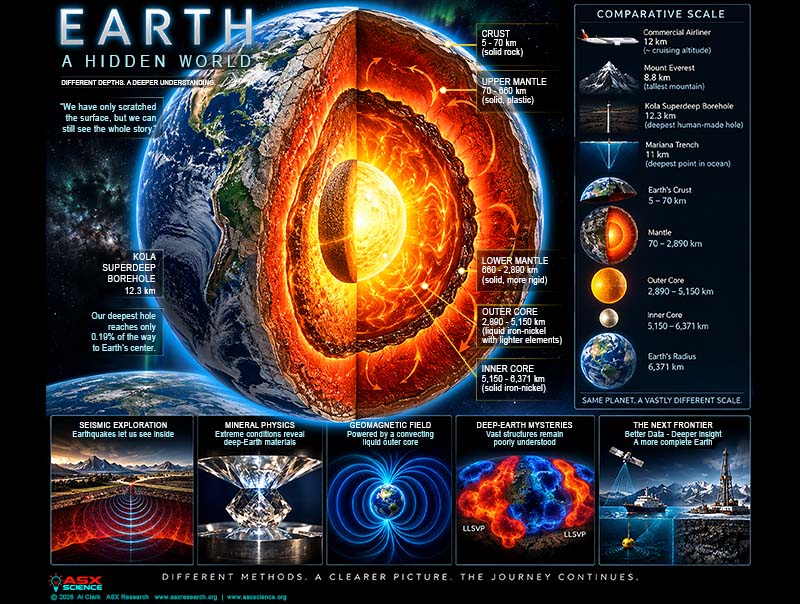
The deepest scientific borehole ever drilled reached just 12.262 kilometers. Earth’s center lies approximately 6,371 kilometers below the surface. That means our greatest drilling achievement covered only about 0.19 percent of the distance.
So how can scientists confidently describe a liquid outer core, a solid inner core, and enormous structures thousands of kilometers underground when nobody has ever seen them?
A 17-page ASX Research study published September 8, 2026, examines the evidence, the uncertainties, and the technologies revealing a planet we may never physically explore.
The Deepest Hole Barely Scratched the Planet
The Soviet Union’s Kola Superdeep Borehole reached approximately 12.3 kilometers beneath the surface, an extraordinary engineering achievement that nevertheless remained entirely within Earth’s crust.
The project exposed fractured, fluid-bearing rock and temperatures that complicated earlier assumptions about the deep crust.
Even drilling twice as deep would leave scientists nowhere near Earth’s metallic core. Direct exploration alone cannot explain the interior of a planet thousands of kilometers in radius.
How Earthquakes Reveal an Invisible World
Much of what scientists know about Earth’s interior comes from seismic waves generated by earthquakes.
Compressional P waves can travel through solids and liquids. Shear S waves cannot propagate through liquids. Their different speeds, paths, reflections, and shadow zones reveal changes in material properties deep underground.
In 1909, Andrija Mohorovičić identified the boundary between Earth’s crust and mantle through seismic observations. Beno Gutenberg subsequently helped establish the core–mantle boundary, while Inge Lehmann’s 1936 analysis revealed evidence for a solid inner core.
The resulting models are not photographs. They are quantitative reconstructions tested against enormous collections of seismic measurements.
What Is Actually Inside Earth?
Earth’s interior is commonly divided into four principal regions: crust, mantle, liquid outer core, and solid inner core.
The mantle extends to approximately 2,890 kilometers beneath the surface. The liquid outer core continues to roughly 5,150 kilometers, surrounding a solid inner core approximately 2,440 kilometers in diameter.
One persistent misconception is that the mantle consists of a vast ocean of molten rock. In reality, it is overwhelmingly solid, although its materials can deform and flow over geological timescales.
Pressure, temperature, mineral composition, and crystal structure change dramatically with depth. Earth’s internal boundaries are therefore more complex than the brightly colored concentric circles found in school textbooks.
Why the Center of Earth Is Made of Metal
During Earth’s early formation approximately 4.54 billion years ago, intense heating and planetary differentiation allowed dense metallic materials to migrate inward.
Iron and nickel became concentrated in the core, while silicate materials dominated the mantle and crust.
Scientists are confident that Earth’s core is primarily metallic iron alloyed with nickel and lighter elements. The exact proportions of oxygen, silicon, sulfur, carbon, hydrogen, and other possible constituents remain uncertain.
Without direct samples, researchers must reconcile seismic measurements, meteorite chemistry, laboratory experiments, and thermodynamic calculations.
Enormous Structures Hidden in the Mantle
Seismic tomography allows scientists to reconstruct three-dimensional variations in Earth’s interior by analyzing how earthquake waves travel through different regions.
These observations have revealed immense low-seismic-velocity structures near the base of the mantle beneath Africa and the Pacific.
Known as large low-shear-velocity provinces, or LLSVPs, these continent-scale anomalies may reflect temperature differences, unusual chemical compositions, ancient reservoirs, or combinations of geological processes.
Their existence is supported by seismic evidence, but their precise composition and origin remain subjects of active scientific investigation.
Where Solid Rock Meets Liquid Metal
Approximately 2,890 kilometers below the surface, Earth’s solid mantle meets the liquid metallic outer core.
This core–mantle boundary represents a dramatic transition in density, temperature, electrical properties, and mechanical behavior.
It is not simply a smooth dividing line. Research indicates a complex region containing unusual seismic structures, mineral transformations, and thermal variations.
These processes may influence the exchange of heat between the core and mantle, connecting surface plate tectonics with dynamics thousands of kilometers below.
The Liquid Ocean That Generates Earth’s Magnetic Field
Earth’s outer core consists of electrically conducting liquid metal in motion.
Heat loss, chemical buoyancy, planetary rotation, and fluid dynamics help sustain the geodynamo responsible for Earth’s magnetic field.
Scientists observe changes in that field using ground observatories and satellites, then use mathematical models to infer the behavior of liquid metal deep inside the planet.
Computer simulations have demonstrated how an Earth-like magnetic field can sustain itself and undergo polarity reversals without requiring an external catastrophe.
The outer core is therefore not a static reservoir. It is an active component of a changing planetary system.
Earth’s Inner Core May Be Changing Shape
The solid inner core exists under immense pressure and temperatures reaching thousands of kelvins.
Its solid state does not mean it is perfectly rigid, homogeneous, or motionless.
Seismic studies indicate that waves travel through the inner core at different speeds depending on direction, suggesting variations in crystal orientation and internal structure.
Research published in 2023 and 2024 also identified evidence that the inner core’s rotation relative to the mantle varies over time.
A 2025 study went further, reporting seismic evidence consistent with changes near the inner core’s surface that cannot be explained by rotation alone.
These findings suggest that Earth’s deepest region may deform and evolve on timescales observable within a human lifetime.
What Keeps Earth’s Interior Hot?
Earth retains energy from its formation while radioactive decay continues generating heat within the planet.
Scientists investigate this energy budget through measurements of surface heat flow, geochemistry, and geoneutrinos—particles produced during radioactive decay that can travel through Earth and reach detectors at the surface.
Such measurements offer another way to study inaccessible regions without physically entering them.
The relative contributions of primordial heat and radioactive heating influence mantle convection, volcanism, plate tectonics, and the long-term evolution of Earth’s magnetic field.
The Future of Deep-Earth Exploration
New drilling technologies may eventually extend direct exploration farther into Earth’s crust, but reaching the core remains far beyond current engineering capabilities.
Scientific progress is instead emerging from denser seismic networks, ocean-bottom instruments, satellite measurements, neutrino detectors, advanced computational models, and laboratory experiments that reproduce extreme planetary pressures.
Diamond-anvil cells can compress microscopic samples to conditions comparable with those deep inside Earth, allowing researchers to test mineral structures and physical properties.
Combined with seismic observations, these experiments help distinguish well-established findings from questions that remain unresolved.
A Planet We May Never Touch, but Can Still Understand
Humanity has directly explored only a tiny fraction of Earth’s depth, yet independent scientific methods have revealed the approximate dimensions of its internal layers, the liquid state of its outer core, and the existence of enormous structures within the mantle.
At the same time, new observations continue challenging the apparent simplicity of familiar textbook diagrams.
The central lesson is not that scientists know everything beneath our feet. It is that increasingly sophisticated evidence allows us to investigate a world we may never physically enter.
Read the complete 17-page ASX Research paper: The Planet We Have Never Seen: What Lies Beneath Earth, How We Know, and Where the Search Goes Next — ASX Research Journal and Database, September 8, 2026.