

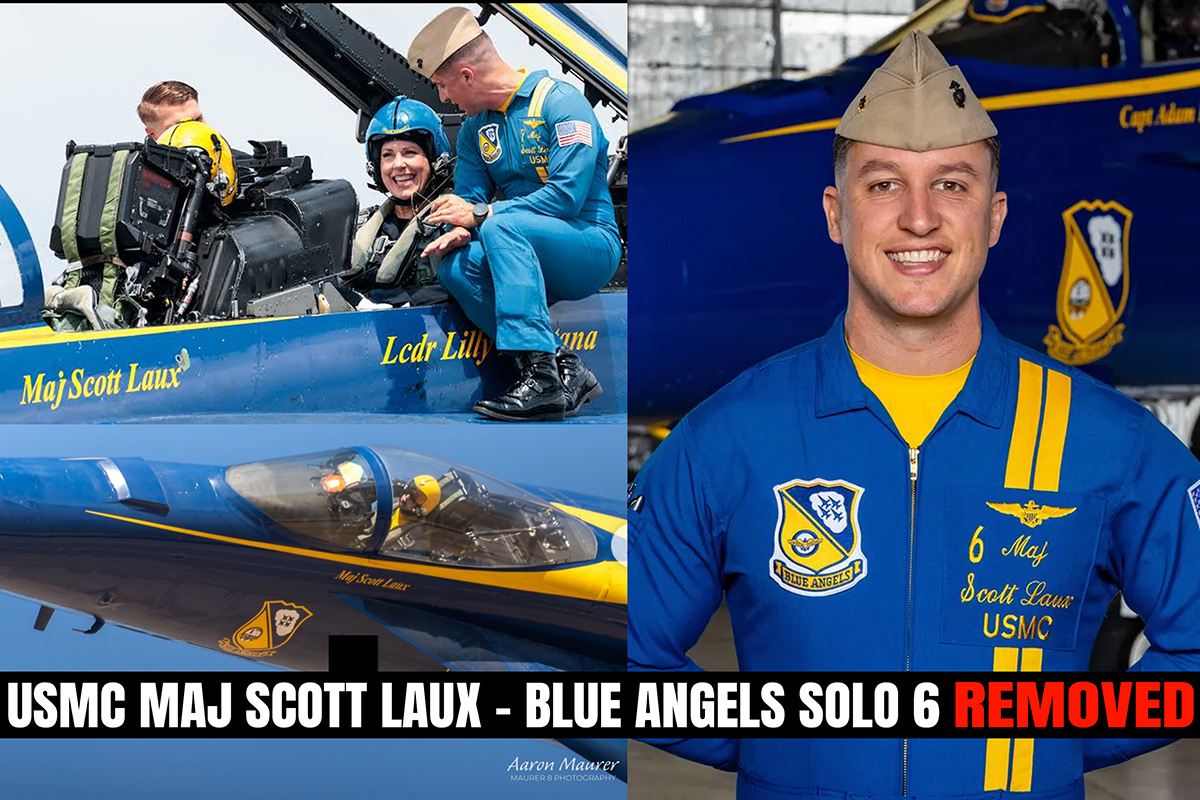
PENSACOLA, FLORIDA — The United States Navy has removed Marine Corps Maj. Scott Laux, the Blue Angels’ No. 6 opposing solo pilot, from its elite flight demonstration squadron, citing his failure to meet the standards expected of team members. The decision became public on November 6, 2026, as the Blue Angels prepared to conclude their season at Naval Air Station Pensacola.
The removal left one of the world’s most recognizable military aviation demonstration teams without a member of its customary six-jet formation during its homecoming performance, drawing attention to the professional standards governing one of naval aviation’s most prestigious assignments.
The Navy Confirms the Removal
The Chief of Naval Air Training (CNATRA) confirmed Laux’s removal to the Pensacola News Journal on November 6. According to the command’s public affairs office, Blue Angel No. 6 had been removed for failing to uphold the standards expected of members of the Navy Flight Demonstration Squadron and would not participate in the team’s remaining performance of the season.
The command did not publicly identify the conduct or circumstances that prompted the decision. Officials also did not immediately provide the precise date on which Laux was removed.
Those omissions are significant. Although the Navy has confirmed that a standards-related decision was made, the available statement does not establish whether the matter involved professional conduct, administrative requirements, operational performance, or another concern.
There has been no publicly substantiated finding connecting the removal to a specific flight-safety incident. The distinction between an official personnel action and an established aviation-safety violation must be maintained.
Who Is Maj. Scott Laux?
Laux is a United States Marine Corps aviator who served as the opposing solo pilot for the Blue Angels’ 2026 demonstration season. He was a second-year member of the squadron when the removal was reported.
The opposing solo position, designated Blue Angel No. 6, is among the most visually demanding assignments in the demonstration. The solo pilots perform carefully choreographed maneuvers that emphasize aircraft control, precise timing, spatial awareness, and coordination with the larger demonstration sequence.
The position places the pilot in a particularly visible role before large public audiences. However, assignment to the Blue Angels also carries responsibilities beyond flying demonstrations, including representing the military services and maintaining the professional expectations associated with the squadron.
Five Jets Instead of Six at Pensacola
The removal became especially visible during the Blue Angels Homecoming Air Show at Naval Air Station Pensacola, scheduled for November 6–7, 2026. The event marked the conclusion of the team’s 2026 demonstration season and coincided with celebrations recognizing the installation’s 200-year anniversary.
During the November 6 performance, the Blue Angels flew five demonstration jets rather than their customary six. The absence of the opposing solo pilot altered the familiar presentation associated with the team’s standard demonstration lineup.
Public reporting did not establish that the squadron had designated or qualified an immediate replacement for Laux’s position during the homecoming event.
Operating with a modified demonstration lineup is not, by itself, evidence of an unsafe performance. Military flight demonstration teams rely on established procedures, rehearsal, crew coordination, and operational judgment when determining which maneuvers can be conducted with available personnel.
Why Professional Standards Matter in Demonstration Aviation
The Blue Angels are not simply an aerobatic exhibition. As the Navy Flight Demonstration Squadron, the organization represents the professionalism, discipline, teamwork, and technical capabilities of United States naval aviation before domestic and international audiences.
Its pilots operate high-performance military aircraft in tightly coordinated sequences where timing, formation geometry, and procedural consistency are fundamental to successful execution. That operating environment demands exceptionally high levels of individual competence and collective trust.
In aviation safety management, professional accountability and technical proficiency are related but distinct concepts. A pilot may be technically capable of operating an aircraft while being subject to a separate personnel or disciplinary determination. Conversely, a personnel decision should not automatically be interpreted as proof of deficient flying ability.
For aviation organizations, the broader lesson is the importance of applying established standards consistently, particularly when individuals occupy positions of unusual visibility, prestige, or operational responsibility.
Leadership, Accountability, and Public Confidence
The removal of a demonstration pilot near the end of a flying season is an unusual and consequential personnel development. It raises legitimate questions about how elite aviation organizations maintain accountability while preserving operational continuity and public confidence.
Nevertheless, the Navy’s limited public explanation does not support conclusions about Laux’s personal conduct, flight proficiency, or the specific decision-making process that led to his removal.
The decision should therefore be understood within its confirmed boundaries: the Navy removed a serving Blue Angels pilot for failing to meet squadron standards, and the team continued its homecoming demonstration without its customary No. 6 aircraft.
The Standard Is Bigger Than the Individual
For the Blue Angels, precision flying is only the most visible expression of a larger institutional commitment to discipline and professionalism. The team’s reputation depends not merely on what happens during a demonstration, but also on the conduct and judgment expected of those selected to represent naval aviation.
Maj. Scott Laux’s removal demonstrates that membership in an elite military aviation organization is conditional upon continuing to meet its established expectations. The Navy has publicly confirmed that those expectations were not met in this instance, without disclosing the underlying circumstances.
The immediate operational consequence was visible over Pensacola: five Blue Angels aircraft performing where spectators ordinarily expected six. The broader significance lies in the continuing obligation of aviation organizations to distinguish confirmed facts from speculation while maintaining professional accountability.
Sources
Pensacola News Journal. (2026, November 6). Blue Angels pilot Scott Laux removed from team for failing to uphold standards.
Chief of Naval Air Training. (2026, November 6). Public affairs statement concerning the removal of Blue Angel No. 6, as reported by the Pensacola News Journal.
U.S. Navy Flight Demonstration Squadron. (2026). Blue Angels 2026 show schedule.
NAS Pensacola Homecoming Air Show. (2026). Official 2026 homecoming air show information.