


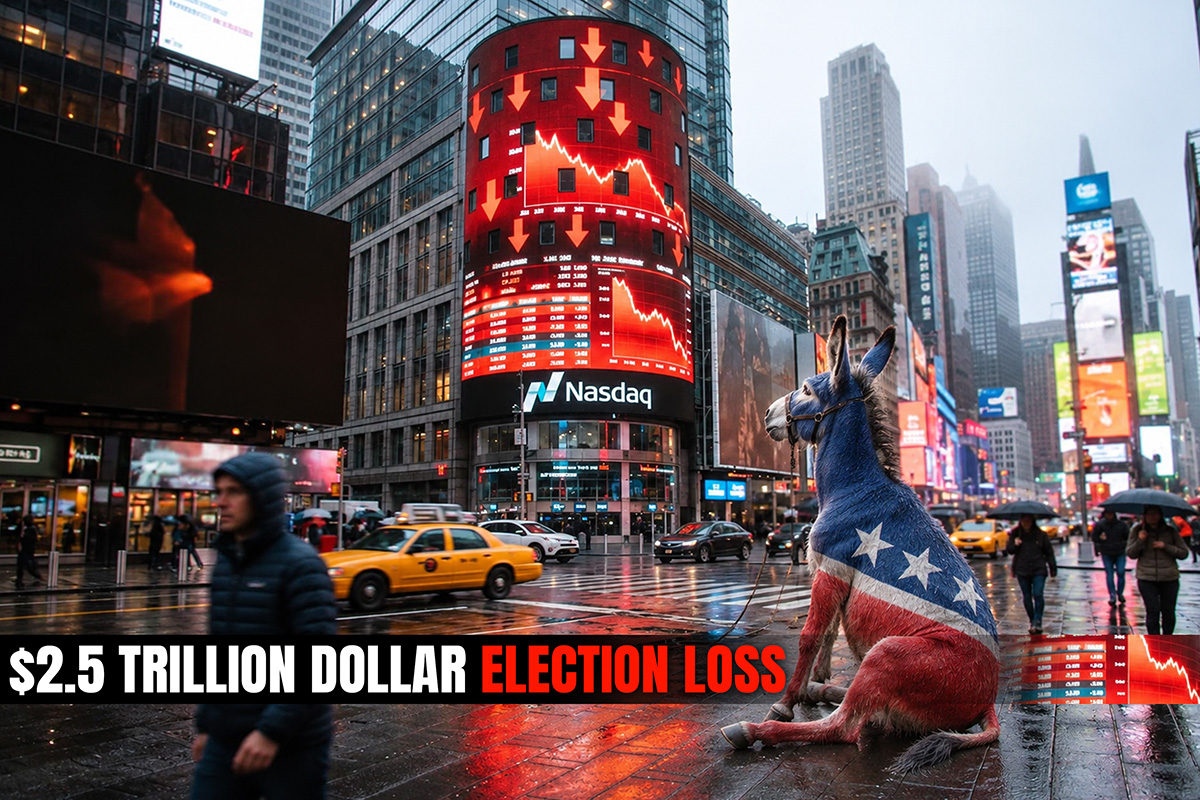
WASHINGTON — Americans voted for a change in political leadership. Within two days, Wall Street delivered a staggering response: approximately $2,500,000,000,000 in market value disappeared from the Nasdaq 100 during a single trading session. The timing was extraordinary, the financial damage substantial, and the political implications impossible to ignore.
On November 3, 2026, Democrats delivered a sweeping midterm election victory, capturing both chambers of Congress and making significant gains in state governments. On November 5, the Nasdaq 100 plunged approximately 6.4%, wiping out an estimated $2.5 trillion in market capitalization. Reuters directly connected the selloff to investor concerns that the incoming Democratic Congress could impose new restrictions on artificial intelligence and data-center development.
For a political party celebrating its electoral triumph, the market’s response was an unwelcome reminder that winning votes and inspiring investor confidence are two very different accomplishments.
The $2.5 Trillion Warning
Thursday’s collapse was not an ordinary day of market volatility. The Nasdaq Composite fell approximately 5.5%, the S&P 500 declined 4.36%, and the Dow Jones Industrial Average lost 3.44%. Semiconductor stocks suffered particularly severe damage, with the Philadelphia Semiconductor Index plunging more than 12%.
Nvidia, a central company in the American artificial intelligence industry, lost more than 9% of its market value in the session. The Nasdaq Composite entered correction territory, having fallen at least 10% from its October record.
The $2.5 trillion figure represents the reduction in the Nasdaq 100 companies’ combined market capitalization, not cash physically withdrawn from the financial system. Nevertheless, the losses reflected a dramatic repricing of businesses whose valuations depend heavily on expectations of future growth.
That distinction does not diminish the scale of the event. Retirement accounts, pension funds, investment portfolios, and other financial holdings can all be affected when publicly traded companies experience severe declines in value.
Democratic Victory, Regulatory Anxiety
The central political question is straightforward: Why did investors become so concerned about the future of American technology investment immediately after Democrats won control of Congress?
Reuters reported that the election results heightened fears of tougher oversight of artificial intelligence and restrictions on data-center expansion. Democratic gains in states including Texas and Georgia attracted particular attention because these states are important locations for energy-intensive technology infrastructure.
The concern was not simply that Democrats might introduce new legislation. Investors were reassessing the likelihood that projects already requiring enormous commitments of capital, electricity, land, and financing could face additional political obstacles.
For companies spending billions of dollars to build the physical infrastructure supporting artificial intelligence, delays and regulatory uncertainty can change the economics of an investment. A facility that becomes more expensive to construct, takes longer to complete, or faces new operating restrictions may generate lower returns than originally anticipated.
Those concerns created an immediate political vulnerability for Democrats: their victory was accompanied by fears that their approach to regulating a rapidly expanding industry could undermine the growth expectations supporting some of America’s most valuable companies.
Wall Street’s First Reaction Was Actually Positive
The chronology contains an important complication. On Wednesday, November 4, Wall Street initially rallied after the Democratic victory. Reuters reported that investors welcomed reduced political uncertainty and the prospect of divided government. Major artificial intelligence companies rose, even as some data-center operators declined.
That initial rally matters because it demonstrates that investors did not uniformly reject the election result. The subsequent collapse reflected a more complicated reassessment of technology valuations, future regulation, and existing economic vulnerabilities.
Nevertheless, the speed of the reversal was remarkable. Within approximately 24 hours, optimism about political stability had given way to intense selling pressure in industries particularly exposed to potential policy changes.
Democrats cannot reasonably be assigned responsibility for every dollar lost during Thursday’s session. They can, however, be expected to explain how their policy priorities will affect investment, infrastructure development, technological competitiveness, and the financial interests of American households.
Artificial Intelligence Became the Political Fault Line
Artificial intelligence is no longer a narrow technology industry. Its expansion involves semiconductor manufacturers, electric utilities, construction contractors, financial institutions, real-estate developers, cloud-computing providers, and thousands of businesses supplying equipment and services.
The enormous scale of planned investment has helped support stock valuations. It has also made the industry increasingly vulnerable to changes in interest rates, financing conditions, construction schedules, and government policy.
Democratic proposals for stronger oversight may reflect legitimate concerns about electricity consumption, environmental impacts, consumer protection, and the concentration of corporate power. Yet regulation also carries economic costs, particularly when companies have already committed substantial capital based on existing assumptions.
Thursday’s market reaction illustrated how quickly those costs can become relevant to investors. Even before new legislation is enacted, expectations of future restrictions can influence share prices and investment decisions.
The political challenge for Democrats is therefore substantial: demonstrate that greater oversight can coexist with continued American leadership in artificial intelligence, rather than allowing regulatory uncertainty to become an obstacle to growth.
The Market Was Already Vulnerable
Blaming the entire collapse on an election would ignore important economic conditions that existed before Americans went to the polls.
Investors had already begun questioning whether the enormous sums committed to artificial intelligence infrastructure would produce profits quickly enough to justify elevated valuations. Some major technology companies were relying increasingly on debt financing to support expansion, while higher borrowing costs complicated the outlook.
Concerns about inflation, energy prices, geopolitical instability, and future Federal Reserve decisions were also affecting investor confidence. Disappointing earnings expectations and doubts about the profitability of AI investments contributed to an increasingly fragile market.
The election did not create all these vulnerabilities. It introduced another potential source of uncertainty at a moment when investors were becoming less willing to tolerate risk.
That distinction is essential. A politically significant event can trigger or accelerate a market decline without being its sole underlying cause.
The Selling Spread Beyond Technology
Thursday’s market turmoil extended beyond individual artificial intelligence companies. Reuters reported that hedge funds reduced exposure to major technology holdings, while leveraged investment products faced substantial selling pressure.
Analysts estimated that leveraged exchange-traded funds could need to sell approximately $47 billion in equities near the closing bell. The market’s closely watched volatility index also surged, reflecting rapidly increasing demand for protection against additional declines.
International markets were affected as well. South Korean technology shares suffered severe losses on Friday as concerns about American AI investment spread into semiconductor-related industries overseas.
This international reaction underscored the importance of American technology policy to global capital markets. Decisions made in Washington can influence investment expectations far beyond the United States.
Friday’s Rebound Did Not Erase the Damage
Wall Street recovered part of Thursday’s losses on Friday, November 6. The Nasdaq Composite gained approximately 1.1%, while the S&P 500 advanced 0.3%. The Dow Jones Industrial Average, however, declined approximately 0.5%.
The broader weekly results remained negative. The Nasdaq Composite lost approximately 3.4% over the five trading days, the S&P 500 declined 2.7%, and the Dow fell 0.9%.
Friday’s partial recovery demonstrated that investors were willing to return selectively to beaten-down technology shares. It did not establish that the underlying concerns about regulation, profitability, financing, or inflation had disappeared.
Nor should the $2.5 trillion one-day loss be confused with the total market-value change for the full week. The figures measure different periods and cannot be treated interchangeably.
Democrats Have Won an Election. Now Comes the Economic Test.
The Democratic Party’s midterm victory gave it substantial new political influence. The immediate financial aftermath exposed a difficult question about the consequences of exercising that influence.
Investors are not entitled to dictate public policy, and financial markets do not determine the legitimacy of democratic elections. But governments cannot disregard the economic consequences of uncertainty, especially in industries responsible for enormous capital investments and significant employment.
Democrats now face the challenge of explaining how their legislative priorities will affect an American technology sector already confronting questions about profitability, infrastructure costs, and international competition.
The party’s supporters may regard stronger regulation as necessary oversight. Its critics may view the same policies as threats to investment and innovation. Thursday’s selloff demonstrated that those competing interpretations have consequences in financial markets even before new laws take effect.
The numbers are unmistakable: approximately $2.5 trillion erased from the Nasdaq 100 on Thursday, followed by a partial rebound that left major indexes lower for the week.
Whether the Democratic victory ultimately strengthens or weakens the American economy will depend on policies and outcomes still to come. But the market has already delivered an unmistakable message: investors are deeply concerned about the future of artificial intelligence, the cost of building it, and the political decisions that may determine its expansion.
Democrats won the election. They have not yet won Wall Street’s confidence.
Sources
Reuters, November 4, 2026: Wall Street ends higher after Democrats win Congress; data center stocks tumble.
Reuters, November 5, 2026: Investors wipe $2.5 trillion off Nasdaq as blue tsunami prompts AI fears.
Reuters, November 5, 2026: Nasdaq posts biggest daily drop in 19 months on fears of AI regulations.
Reuters, November 5, 2026: Democrats’ election wins spooks AI investors, hammering stocks.
Reuters, November 5, 2026: Phones ‘explode’ on Wall Street as ‘steamroller’ shows up for the AI trade.
Reuters, November 6, 2026: Wall St Week Ahead: As tech swoon roils market, US inflation data on tap.
Associated Press, November 6, 2026: How major US stock indexes fared Friday 11/6/2026.