


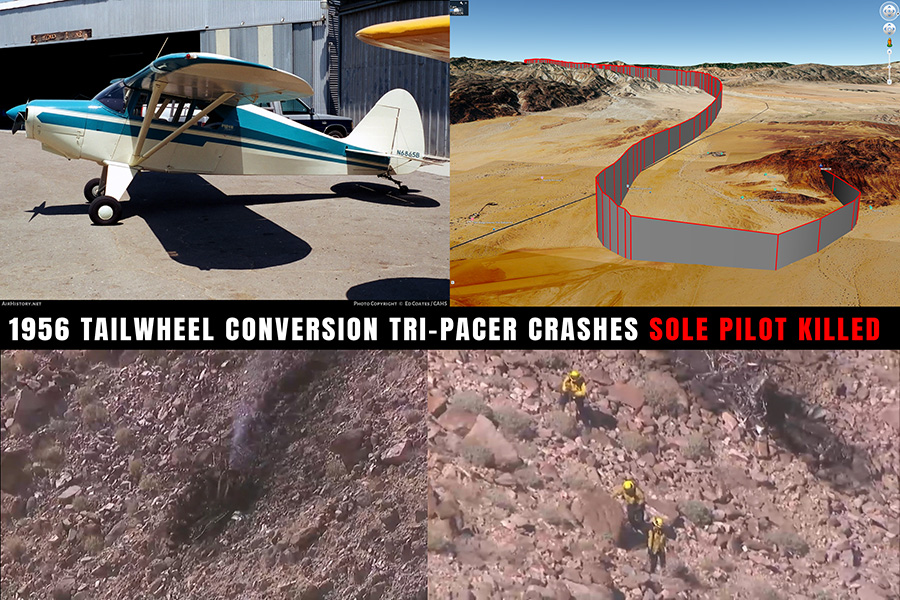
A pilot was killed on November 3, 2026, when a Piper PA-22-150 crashed into a remote desert hillside near Ocotillo Wells, California. The aircraft struck terrain at Blowsand Hill, near Quarry Road and State Route 78 in eastern San Diego County, shortly before 9:30 a.m. local time. The pilot was the sole occupant, and the aircraft was destroyed in a post-impact fire.
The National Transportation Safety Board confirmed that it is investigating the accident involving a Piper PA-22-150. The Aviation Safety Network identifies the aircraft as N6865B, a 1956 Piper Tri-Pacer that had previously undergone conversion from tricycle landing gear to conventional tailwheel configuration. The registration reported by ASN has not yet been independently confirmed in a publicly available federal accident record for the November 2026 occurrence.
Aircraft Strikes Blowsand Hill
According to CAL FIRE and local news reports, the accident occurred within the Ocotillo Wells State Vehicular Recreation Area, a remote desert recreation region near the San Diego–Imperial county boundary. Initial reports described an airplane striking a hillside and catching fire.
A San Diego County Sheriff’s Department helicopter located the wreckage on Blowsand Hill. Emergency personnel subsequently approached the accident site through difficult terrain, with firefighters making their way to the wreckage on foot.
CAL FIRE Captain Josh Cormode confirmed that the airplane had burned extensively and that the fire remained confined to the immediate crash location. Responders located the deceased pilot at the site. No additional occupants were reported.
Emergency communications collected and published by DispatchSD provide further insight into the response. Radio traffic around 9:38 a.m. indicated that responders had located the presumed accident site. Subsequent communications described difficult access, steep terrain, and efforts to reach the wreckage using ground vehicles and helicopters.
By approximately 10:45 a.m., an airborne crew reported that the airplane appeared to be a total loss. Ground personnel subsequently reached the site and confirmed one fatality shortly before 11:00 a.m. The response was later transferred to California State Parks personnel, who were coordinating with federal aviation investigators.
The Aircraft: A 1956 Piper PA-22-150
The Aviation Safety Network identifies the aircraft as Piper PA-22-150 Tri-Pacer N6865B, manufacturer serial number 22-4165, constructed in 1956. Federal Aviation Administration registration records independently confirm that N6865B corresponds to a Piper PA-22-150 bearing that serial number.
The FAA registry identifies Ray Lynn Ellis of Lakeside, California, as the registered owner in its available record. That historical ownership information does not establish who was operating or piloting the aircraft during the November 2026 accident.
The Piper PA-22 Tri-Pacer was developed as a tricycle-landing-gear derivative of the earlier PA-20 Pacer. Although the PA-22 was originally manufactured with a nosewheel, some aircraft were subsequently modified to conventional landing gear, placing the main wheels forward and installing a tailwheel beneath the aft fuselage.
Conversion to PA-22/20 Tailwheel Configuration
Historical aircraft documentation and an earlier NTSB accident report establish that N6865B had undergone such a conversion. In its June 2019 pilot/operator accident report, the aircraft was identified as a Piper PA22/20, with conventional tailwheel landing gear.
A historical photographic listing on AirHistory.net independently describes N6865B, serial number 22-4165, as a Piper PA-22-150 Tri-Pacer tailwheel conversion. The listing places the aircraft at Santa Paula, California, sometime between 1990 and 2000, indicating that the conversion had occurred by that period.
Tailwheel conversions of the PA-22 are established aircraft modifications rather than experimental improvisations. Univair Aircraft Corporation holds Supplemental Type Certificate SA45RM, which provides an approved method of converting eligible PA-22 aircraft from tricycle landing gear to conventional landing gear.
The modification involves relocating the main landing gear, installing structural fittings, adding a tailwheel assembly, and modifying associated fuselage components and control systems. Depending on the installation, changes can include rudder controls, brake arrangements, and structural reinforcements.
The specific supplemental type certificate or approval used for N6865B has not been established from the records reviewed. The existence of an approved conversion method does not demonstrate that any particular aircraft used that method.
The conversion is operationally significant because conventional-gear aircraft have different ground-handling characteristics from their tricycle-gear counterparts. Their center-of-gravity relationship to the main landing gear requires particular attention to directional control during taxiing, takeoff, and landing.
However, the November 2026 accident occurred during flight near mountainous desert terrain. No available evidence establishes that the landing-gear conversion contributed to the occurrence.
A Previous Accident Involving N6865B
The aircraft identified by ASN has a documented accident history. On June 9, 2019, N6865B was involved in a landing accident at Flabob Airport in Riverside, California. The NTSB investigated that occurrence under accident number GAA19CA333.
The aircraft was being operated as a personal flight under 14 CFR Part 91. According to the pilot/operator report, the flight departed Gillespie Field in El Cajon, California, at approximately 10:15 a.m., bound for Flabob Airport.
The pilot, Ray Lynn Ellis, reported encountering a downdraft during the approach to Runway 24, followed by a strong crosswind that displaced the airplane toward the left side of the grass landing surface.
During the landing rollout, the airplane struck a runway light and entered a ground loop to the right. The aircraft sustained substantial damage, including damage to the tailwheel assembly, elevator, rudder, and aft fuselage. Neither of the two occupants was injured.
The NTSB determined that the probable cause of the 2019 accident was the pilot’s failure to maintain runway heading during a crosswind landing, resulting in collision with runway lighting and a subsequent ground loop.
The pilot reported no preaccident mechanical failures or malfunctions that would have prevented normal operation. In his submitted safety recommendation, he identified additional crosswind training as a preventive measure.
The previous accident is relevant to the aircraft’s documented operational and maintenance history. It does not establish a mechanical or operational connection with the fatal November 2026 accident, and the available records do not establish whether the same pilot was involved in both occurrences.
Reported Flight Route
The Aviation Safety Network lists Gillespie Field (KSEE), near San Diego, as the departure airport for the November 2026 flight and Ocotillo Airport (L90) as its intended destination.
Gillespie Field was also the departure airport recorded in the aircraft’s 2019 accident report. Although this is an interesting historical coincidence, it does not establish any relationship between the two flights.
The November 2026 departure and destination information remains attributed to ASN pending independent confirmation through flight records or federal investigation documents.
Accident Location and Terrain
Blowsand Hill is a prominent sandy formation within the Ocotillo Wells State Vehicular Recreation Area. The surrounding desert contains dunes, ridges, and irregular terrain, creating a geographically distinctive operating environment for low-altitude aircraft.
The accident location and reported impact with rising terrain make the aircraft’s altitude, flight path, visibility, and maneuvering immediately before impact important subjects for examination.
At present, no verified flight-track reconstruction, cockpit communication record, or eyewitness account establishes the airplane’s precise final flight path. There is insufficient evidence to classify the event as controlled flight into terrain, loss of control, or an accident involving mechanical failure.
Federal Investigation
The NTSB is investigating the November 3 accident, with the FAA also involved. Investigators will seek to establish the aircraft’s final flight sequence, operating condition, pilot information, environmental conditions, and circumstances surrounding the terrain impact.
The aircraft’s conversion history and previous accident documentation provide useful background for the investigation, particularly regarding its configuration and historical maintenance requirements. Those records must nevertheless be distinguished from evidence directly associated with the fatal occurrence.
As of November 4, 2026, the pilot’s identity had not been independently verified in the sources reviewed for this report. No confirmed evidence has established a specific mechanical malfunction, weather-related event, or pilot action as the initiating factor.
Sources and Documentation
National Transportation Safety Board, Aviation Investigation Final Report GAA19CA333, June 9, 2019. Official NTSB final report.
National Transportation Safety Board, Accident Docket GAA19CA333, including pilot/operator report and accident photograph. Official NTSB docket.
Federal Aviation Administration, Aircraft Registry, N6865B, serial number 22-4165. FAA registration record.
Univair Aircraft Corporation, Piper PA-22 Taildragger Conversion, STC SA45RM. Manufacturer conversion documentation.
AirHistory.net, Aircraft Photo Record 172164, N6865B, Piper PA-22-150 Tailwheel Conversion. Historical aircraft identification record.
City News Service, November 3, 2026, reporting on the fatal Ocotillo Wells accident. Accident reporting.
KOGO News, November 3, 2026, CAL FIRE statements concerning the accident and post-impact fire. Emergency response reporting.
DispatchSD, November 3, 2026, published emergency communications and incident chronology. Incident communications.