


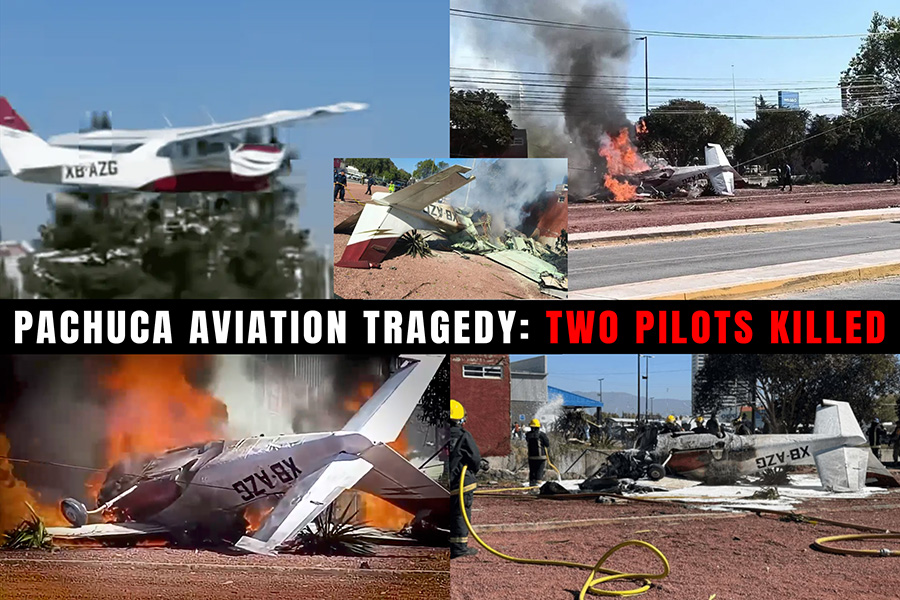
November 3, 2026 — PACHUCA, HIDALGO, MEXICO — Two aviators were killed on Monday morning, November 2, when a privately operated Cessna T210N Turbo Centurion crashed into an urban area of Pachuca, Hidalgo, shortly after departing the city’s Ingeniero Juan Guillermo Villasana Airport. The aircraft, registered XB-AZG, struck the ground near Avenida El Tezontle in the Venta Prieta neighborhood and caught fire, leaving both occupants dead and prompting an extensive emergency response.
The aircraft was identified as a Cessna T210N Turbo Centurion, serial number 21064098, operated by Grupo Aeroespacial Avspace, S.A. de C.V., an aviation company based in Cuernavaca, Morelos. According to Mexican aviation records cited by national news organizations, the company provides aviation training services. The aircraft was registered for private operation, although the specific purpose of Monday’s flight has not been established in the available reporting.
The Two Aviators Who Lost Their Lives
Hidalgo authorities preliminarily identified the deceased as Moisés González Meléndez, the pilot, and José Jaime Jarquín Ramos, the copilot. Their names were reported in connection with Hidalgo Civil Protection’s incident bulletin SSPCyGR-305-2026. Subsequent reporting indicated that relatives assisted with identifying the victims.
Both men were aboard the aircraft when it crashed. No surviving occupants were reported. The aircraft was destroyed in the impact and ensuing fire.
ASX News extends its condolences to the families, friends, and aviation colleagues of both men.
Departure from Pachuca and the Final Minute of Flight
According to information attributed to the Agencia Federal de Aviación Civil (AFAC), the Cessna departed Ingeniero Juan Guillermo Villasana Airport in Pachuca at approximately 9:30 a.m. local time on November 2. The flight’s intended destination was Cuernavaca, Morelos, where the aircraft’s operating company was based.
The crew had communicated its intended destination to the airport control tower before departure. Hidalgo Civil Protection subsequently reported that the aircraft’s last recorded signal occurred at approximately 9:31 a.m., one minute after departure.
AFAC’s account, as reported by La Jornada and El Informador, placed the accident during the initial climb, approximately 500 meters from the threshold of runway 21. Other accounts described the crash location as approximately 600 meters from the runway threshold. These distances are reported figures rather than independently surveyed measurements.
At approximately 9:35 a.m., emergency services received notification that an aircraft had crashed along the road to El Tezontle in the Venta Prieta neighborhood. The difference between the reported final signal and the emergency notification is important: the 9:35 time represents the reported emergency call, not necessarily the exact moment of impact.
A Fatal Impact in a Populated Urban Area
The accident occurred near commercial establishments, residential properties, and the Mexican Army’s 18th Military Zone. Several reports placed the wreckage near a Sam’s Club retail facility, while others described the impact area as an open space adjacent to commercial property and a roadway.
The aircraft caught fire following impact. Flames and a column of smoke were visible from surrounding areas, drawing the attention of motorists, nearby workers, and residents.
Eyewitness accounts published by Mexican news organizations described an aircraft descending into the area and encountering overhead cables. One account suggested that contact with the cables may have prevented the aircraft from striking nearby homes directly. Such descriptions reflect witness observations and do not establish the aircraft’s precise flight path or the sequence of contact with obstacles.
Reporting by Excélsior placed the wreckage approximately 15 meters from nearby residential structures. Despite the crash occurring in a populated neighborhood, the confirmed fatalities were the two aircraft occupants. An early report raised the possibility of another injured person, but subsequent accounts reviewed for this article did not establish a confirmed third casualty.
Emergency Response and Fire Suppression
Personnel from the Hidalgo Secretariat of Public Security, state and municipal Civil Protection agencies, the Hidalgo Fire Department, municipal police, and the Mexican Army responded to the scene.
Emergency crews extinguished the aircraft fire, secured the immediate impact area, and restricted access to surrounding roads. Military personnel assisted with perimeter security while emergency workers assessed the wreckage and the immediate danger to nearby structures and businesses.
Reports also described assistance from workers at a nearby commercial establishment who initially attempted to fight the fire with portable extinguishers before the arrival of additional emergency personnel.
Authorities subsequently confirmed that both occupants had died. The wreckage was described as extensively damaged or destroyed by the impact and fire.
The Aircraft: Cessna T210N Turbo Centurion XB-AZG
The Cessna T210N Turbo Centurion is a high-performance, single-engine, high-wing aircraft equipped with retractable landing gear and a turbocharged piston engine. The type belongs to Cessna’s 210 Centurion family and is commonly associated with personal, business, and cross-country aviation.
The aircraft involved in this accident carried Mexican registration XB-AZG and manufacturer’s serial number 21064098. Mexican media citing AFAC’s civil aircraft inventory identified Grupo Aeroespacial Avspace, S.A. de C.V., as its owner and operator.
The company was reported to have its base in Cuernavaca, Morelos, and to provide aviation training services. However, its registration for aviation training does not, by itself, establish that this particular departure was an instructional flight.
The Turbo Centurion’s retractable landing gear, turbocharged engine, and relatively high performance distinguish it from simpler fixed-gear training aircraft. Those design characteristics provide technical context but do not establish any connection to the accident.
Video and Witness Accounts of the Crash
Mexican news organizations published or referenced video footage associated with the accident. Aristegui Noticias included footage of the emergency and crash scene, while Quinto Poder described surveillance-camera footage showing pedestrians reacting as the aircraft descended and a fire erupted near the impact location.
The available descriptions of the recordings support the reported occurrence of a sudden crash and post-impact fire. They do not, on their own, establish the aircraft’s airspeed, engine power, flight-control condition, or the reason for its descent.
The proximity of overhead electrical lines, roads, commercial premises, and homes illustrates the extremely limited space available to an aircraft experiencing difficulty at low altitude over an urban area.
The Aviation Safety Significance of the Initial Climb
The accident occurred during one of the most demanding phases of flight: the initial climb after takeoff. At this stage, an aircraft operates relatively close to the ground while transitioning from takeoff configuration into its planned climb and departure profile.
For a single-engine aircraft, maintaining adequate airspeed, directional control, and a viable flight path is particularly important because the available altitude and time for responding to an unexpected event can be severely limited.
The reported proximity of the impact site to runway 21 places this accident within the airport’s immediate departure environment. The surrounding urban development further underscores the hazards associated with low-altitude emergencies where suitable forced-landing areas may be scarce.
These observations describe the operational environment, not the cause of this particular accident. The available information does not establish an engine failure, aerodynamic stall, mechanical malfunction, pilot error, or adverse weather as the initiating event.
A Flight Intended for Cuernavaca That Never Reached Its Destination
The planned journey from Pachuca to Cuernavaca ended almost immediately after departure. Within minutes, emergency personnel were confronting a burning aircraft in a populated neighborhood, and two aviation professionals had lost their lives.
The documented sequence is brief but significant: a departure at approximately 9:30 a.m., a final reported signal at 9:31 a.m., an impact during initial climb near the runway 21 departure area, and an emergency notification at approximately 9:35 a.m.
The tragedy illustrates how quickly a routine departure can become catastrophic when an aircraft encounters an unrecoverable situation close to the ground. It also highlights the potential consequences for communities located immediately beyond airport boundaries.
For the families of Moisés González Meléndez and José Jaime Jarquín Ramos, the loss is personal and permanent. For the aviation community, the accident is another reminder that the first moments after takeoff leave exceptionally little margin for error or unexpected loss of performance.
Sources and Reporting
Aristegui Noticias, November 2, 2026: Aeronave se desploma en Pachuca; hay dos muertos. Aircraft registration, operator, training-services registration, and crash location.
El Universal, November 2, 2026: Se desploma e incendia avioneta en Pachuca; reportan dos personas muertas. Initial reporting on the crash and fatalities.
La Jornada, November 2, 2026: Cae avioneta en Pachuca, Hidalgo. Hidalgo Civil Protection bulletin, victim identification, AFAC departure information, and reported runway proximity.
El Informador, November 2, 2026: Accidente aéreo en Pachuca: ¿A qué empresa pertenecía la avioneta?. Aircraft serial number, registered operator, and reported AFAC accident details.
Excélsior, November 2, 2026: Identifican a piloto y copiloto fallecidos tras desplome de avioneta. Victim identification, proximity to residences, and witness accounts.
El Financiero, November 2, 2026: Se desploma avioneta en Pachuca, Hidalgo. Emergency response, departure timeline, and crash location.
Quinto Poder, November 2, 2026: Revelan momento exacto en que avioneta se desplomó en Pachuca. Surveillance footage descriptions and additional reporting on the victims.