


Adam Robinson: The Man Behind the Marketing Empire
Adam Robinson was a successful American technology entrepreneur who built multimillion-dollar software businesses around a controversial proposition: What if companies could identify people visiting their websites, obtain their contact information, and market to them even when those individuals had never voluntarily supplied an email address?
On November 1, 2026, Robinson died alongside his wife, Helen Sharp, their two young children, and five other people when a Learjet 60 crashed in Palm Beach County, Florida. The aircraft was traveling from Austin, Texas, toward the Bahamas.
The deaths were devastating. Nothing about the business practices examined in this article diminishes the loss experienced by the victims’ families, friends, colleagues, and communities. ASX News extends its sincere condolences to everyone affected by the tragedy.
But Robinson’s death also brought renewed attention to a technology business whose commercial success raises questions about digital privacy, informed consent, unsolicited marketing, and the increasingly sophisticated methods companies employ to identify internet users.
Robinson did not conceal the central capabilities of his products. He described them openly, sometimes provocatively, in interviews, newsletters, and promotional appearances. His own words provide an unusually revealing examination of an industry that has become remarkably effective at converting anonymous internet activity into identifiable commercial prospects.
Was Adam Robinson a king of spam? The answer depends partly on what one means by spam. His companies were not simply conventional bulk-email operations. They supplied the identification technology and contact information that could enable businesses to contact people who had never directly volunteered their details to those businesses.
That distinction is commercially important. It does not necessarily make the practice less troubling.
From Wall Street to the Business of Personal Information
Robinson graduated from Rice University in 2003, where he studied economics, Spanish, and managerial studies. He also played varsity basketball.
His professional career began in finance, including work at Lehman Brothers and Barclays Capital. In a lengthy interview with the Hustle Nation Podcast, Robinson described working as a credit-default-swap trader during the years surrounding the 2008 financial crisis.
He later decided to abandon finance and pursue entrepreneurship. His first substantial software venture, Robly, operated in the competitive email-marketing industry.
Robinson acknowledged that building the business was difficult. He described years of financial uncertainty, limited product differentiation, and the struggle to compete against established email-marketing providers.
Eventually, however, he discovered a more lucrative opportunity: identifying website visitors who had not provided their email addresses.
That development changed the direction of his career.
Retention.com: Getting the Email Address You Never Gave
In 2019, Robinson and his collaborators launched GetEmails, which subsequently became Retention.com. The company developed identity-resolution technology that could connect otherwise anonymous website activity with identifiable individuals and email addresses.
The business proposition was straightforward. A consumer visits an online store, examines merchandise, and leaves without registering, purchasing, or completing a contact form. Ordinarily, the merchant might have no direct way to contact that visitor.
Retention.com’s technology was designed to change that outcome.
In an interview titled “Why Is Personal Branding Crucial for Startup Success?” on the Hustle Nation Podcast, Robinson explained that his software could identify an anonymous website visitor and obtain an email address even though the individual had not submitted one to the merchant.
He further explained that merchants could use the information to send marketing communications, including abandoned-cart and product-related messages.
That is the fundamental privacy question at the center of Robinson’s commercial achievement. A person may choose not to give a business an email address. Identity-resolution technology can nevertheless enable that business to acquire an address from another source.
From the merchant’s perspective, this represents a potential increase in customers and revenue. From the consumer’s perspective, it can mean receiving marketing communications from a business to which they never knowingly supplied contact information.
Retention.com’s own help documentation describes a process in which the system identifies an email address associated with a website visitor and, after a default 15-minute delay, delivers the contact information to the merchant if the visitor has not independently identified themselves during that period.
The company describes exclusions intended to avoid collecting certain already-known contacts, including previously unsubscribed addresses. Those controls are relevant, but they do not eliminate the broader question of whether a consumer reasonably understands that merely visiting a website may lead to identification and subsequent marketing.
RB2B: Turning Website Visitors Into Sales Targets
Robinson expanded the underlying concept into business-to-business marketing through RB2B, launched in 2024.
Rather than focusing primarily on consumer email addresses, RB2B was designed to connect website activity with professional identities, including names, LinkedIn profiles, business email addresses, and company information.
Its commercial attraction was obvious. A salesperson could potentially learn that an identifiable professional had visited the company’s website without that individual completing a contact form or requesting a sales conversation.
RB2B’s official website describes a process in which a business installs a tracking script, identifies visitors, and delivers information to applications such as Slack, Microsoft Teams, customer relationship management systems, and other sales platforms.
The company says its person-level identification is limited to United States traffic and describes privacy, security, and opt-out controls. It also claims that more than 100,000 websites use the service.
These are company-published descriptions and figures. They should not be confused with independent assessments of every implementation or every customer’s subsequent marketing behavior.
Nevertheless, the underlying commercial purpose is unmistakable: turn website visits into identifiable sales opportunities.
The visitor may believe they are simply browsing. The business may regard the same activity as an actionable sales signal.
The Question Robinson Knew People Would Ask
One of the most revealing moments in Robinson’s Hustle Nation interview occurs when the interviewer learns that the software can identify a visitor who has not supplied an email address.
The interviewer immediately asks how the practice can be legal.
Robinson acknowledges that this is a common reaction. Later in the interview, he identifies legality as one of the principal questions people ask about the technology.
His response was that the relevant consumer-identification technology operated in the United States, where the legal framework differs from the European Union’s privacy regime.
That distinction matters, but it is not a blanket legal exemption.
Under the federal CAN-SPAM Act, commercial email is not universally prohibited merely because the recipient did not affirmatively opt in. However, commercial messages remain subject to requirements concerning truthful sender information, nondeceptive subject lines, identification of advertising, postal addresses, and effective unsubscribe mechanisms.
Other federal and state laws may apply depending on how personal information is obtained, disclosed, processed, or used. Privacy notices, contractual restrictions, consumer opt-out rights, and specific data practices can also affect compliance.
Accordingly, it would be inaccurate to declare that Robinson’s companies necessarily violated anti-spam laws merely because their products facilitated non-opt-in marketing.
It would be equally inaccurate to suggest that compliance with minimum legal requirements automatically establishes meaningful consumer consent.
The difference between what a business can legally do and what consumers reasonably expect is precisely where this controversy resides.
Robinson’s Own Description of a Gray-Area Market
At approximately 42 minutes and 45 seconds into the Hustle Nation interview, Robinson discusses the commercial advantage of entering markets that competitors avoid.
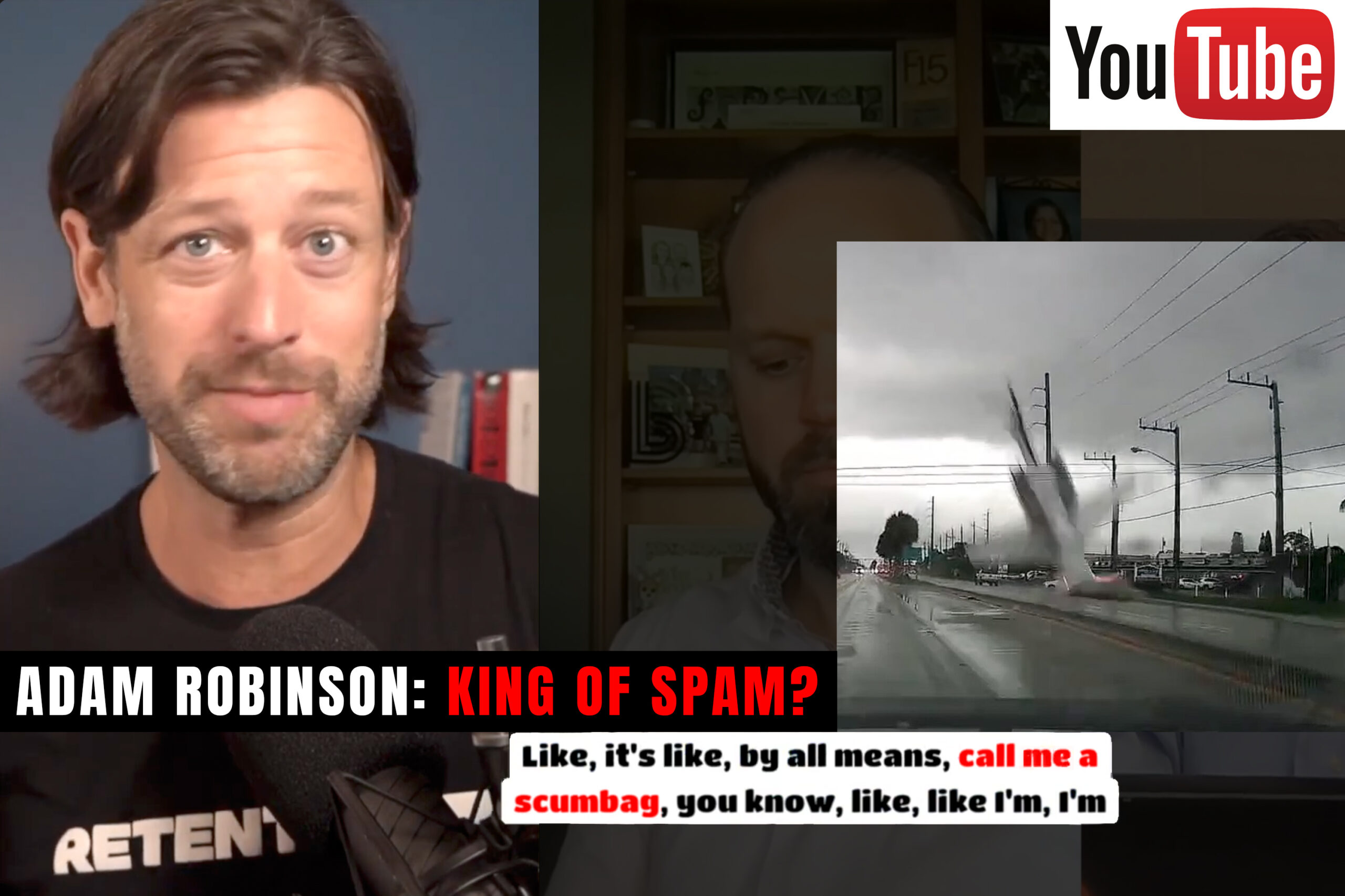
He characterizes the business as operating in a gray area and acknowledges that some people regard its practices unfavorably.
In one particularly candid remark, Robinson says: “By all means call me a scumbag.”
He then expresses satisfaction with the limited competition in the market.
The remark is revealing not because it proves unlawful conduct, but because it demonstrates his awareness that the business model could provoke serious ethical objections.
For Robinson, controversy could also represent competitive opportunity. If established companies avoided a product category because of reputational concerns, those concerns might create an opening for an entrepreneur willing to tolerate criticism.
That attitude helped distinguish his commercial personality. He did not always seek to reassure critics. Sometimes he appeared to regard their objections as evidence that he had found a lucrative market others were reluctant to enter.
Provoking Privacy Advocates as a Marketing Strategy
Robinson’s interview provides another unusually candid disclosure.
At approximately 37 minutes and 30 seconds, he describes running provocative Facebook advertising campaigns that emphasized the privacy implications of his products.
He says the campaigns were designed partly to antagonize privacy advocates and recounts responding to critics from the company’s account in ways intended to intensify their reactions.
In other words, public outrage could become part of the advertising strategy.
Controversy generated attention. Attention increased exposure. Exposure could create prospective customers.
This approach raises a legitimate question about corporate responsibility: When a company benefits financially from technology that challenges established expectations of privacy, should its leadership deliberately provoke people who object to those practices?
Robinson’s statements suggest that he sometimes viewed that reaction as commercially useful.
There is a distinction between confidently defending a controversial product and deliberately inflaming critics to generate marketing engagement. Robinson’s own account places at least some of his advertising tactics in the latter category.
The Personal Brand That Helped Sell the Technology
Robinson also became a prominent advocate of founder-led marketing, particularly on LinkedIn.
He published business updates, discussed company performance, criticized industry practices, and shared personal experiences intended to make his professional audience feel connected to him.
In the Hustle Nation interview, Robinson described his LinkedIn presence as a major marketing channel for RB2B. He explained that the audience following his business commentary overlapped with the potential customers for his products.
He also discussed employing ghostwriters and investing significant time in developing his online presence.
Robinson’s approach was based on a powerful commercial insight: people are often more willing to trust an individual they feel they know than a faceless corporation.
That strategy was not inherently improper. Personal branding is common throughout business, journalism, entertainment, and professional services.
But in Robinson’s case, the personal brand helped promote products whose underlying purpose was to identify other people who had not necessarily chosen to identify themselves to the businesses using those products.
That contrast deserves examination.
Artificial Intelligence and Automated Prospecting
By 2026, Robinson’s interest in data-driven marketing had expanded into artificial intelligence and automated outreach.
His newsletter archive includes a July 2, 2026, article titled “Am I a scumbag for this?” Its published description states that an AI system was sending iMessages to 1,335 prospects while impersonating him.
The significance of that disclosure is substantial. It raises questions not only about how businesses obtain contact information, but also about whether recipients understand when they are communicating with an automated system rather than the person whose identity appears in a message.
Automated outreach is not necessarily unlawful. However, particular methods may trigger laws and platform rules governing text messages, deceptive representations, consent, and automated communications.
The newsletter description does not, by itself, establish that Robinson violated those requirements. It does demonstrate that he publicly promoted or discussed aggressive forms of automated prospecting that warrant closer examination.
His newer venture, MoltSets, extended his interests into contact-data services and application programming interfaces for sales and artificial-intelligence applications.
Robinson announced the launch of MoltSets in October 2026, only weeks before his death.
How Much Money Was in the Business?
Robinson publicly described Retention.com as reaching approximately $22 million in annual recurring revenue within four years.
In May 2026, he reported that RB2B had reached approximately $9 million in annual recurring revenue.
These figures illustrate the potential commercial value of identity-resolution technology and business contact data. They are founder-reported revenue measures, not independently audited financial results.
Annual recurring revenue is not equivalent to profit, cash holdings, company valuation, or the personal net worth of an executive.
The figures nevertheless help explain why the industry has attracted entrepreneurs and investors. Identifying website visitors, enriching contact records, and enabling targeted outreach can generate substantial recurring subscription revenue.
Robinson also championed operating with relatively small teams and avoiding unnecessary outside investment. He argued that capital-efficient software companies could produce substantial financial results without the organizational structures traditionally associated with major technology enterprises.
His professional achievements were significant. The ethical questions surrounding the business model do not erase those achievements, just as commercial success does not settle the ethical questions.
Helen Sharp: A Career and Identity of Her Own
Robinson’s wife, Helen Sharp, was approximately 40 years old and had established her own professional and creative pursuits.
According to reporting by the Houston Chronicle, Sharp graduated from the University of Arizona in 2008 with a degree in art history and anthropology. She had also spent time living in Argentina.
Sharp founded a public-relations business in Austin and later devoted increasing attention to ceramics and artistic work.
Reporting indicates that she had moved to Aspen, Colorado, to establish a ceramics studio. Her professional history reflects interests extending well beyond her husband’s technology companies.
Following the accident, relatives described the couple as loving parents and generous individuals whose relationships with family and friends were central to their lives.
Whatever criticisms may reasonably be directed toward Robinson’s business practices, Helen Sharp’s independent life and accomplishments deserve recognition.
Emma and Charlie Robinson
Adam and Helen were the parents of Emma, age four, and Charlie, age two.
Both children died in the November 1 accident.
In a statement following the tragedy, relatives described Adam and Helen as devoted parents and emphasized the affection surrounding their children.
The deaths of Emma and Charlie are among the most heartbreaking dimensions of the disaster. Their lives were only beginning, and their loss has no connection to the commercial controversies surrounding their father’s businesses.
The surviving relatives deserve compassion, privacy, and respect.
The Friends and Caregiver Who Also Died
Three additional passengers were identified in reporting as Rachael Reed, Charmi Fehr, and Anita Maria Apellido Cetina.
Reed and Fehr were described as friends of the Robinson family. Anita helped care for the children and was remembered by relatives for her devotion to them.
All three died in the crash.
The family’s public statement recognized the lives and relationships of these individuals and extended condolences to the families of the pilots.
They should not be overlooked in reporting that focuses primarily on Robinson’s professional prominence.
The Learjet 60 Accident
On November 1, 2026, a Learjet 60, identified in contemporary reporting as registration N722BD, departed Austin-Bergstrom International Airport bound for North Eleuthera Airport in the Bahamas.
The aircraft carried seven passengers and two pilots.
During the flight, the crew reportedly encountered icing and turbulence. Subsequent air traffic control communications and flight information described a rapidly developing emergency followed by a steep descent.
The aircraft crashed near Greenacres, in Palm Beach County, Florida, killing all nine occupants.
Investigators were examining weather conditions, aircraft wreckage, flight communications, and evidence suggesting that portions of the aircraft may have separated before impact.
The National Transportation Safety Board is responsible for determining the accident’s probable cause. At the time of publication, no final probable-cause determination had been established.
Neither the passengers’ occupations nor Robinson’s business practices provide evidence concerning the cause of the crash. Any suggestion otherwise would be unsupported.
The Flight Crew
Contemporary reports identified Jeff Gregory as the captain and Nathalia Gadelha Filgueiras, age 20, as the copilot.
Both died in the accident.
As with every serious aviation investigation, the crew’s qualifications, training, operational decisions, aircraft systems, environmental conditions, and other relevant factors must be examined through documented evidence.
Neither pilot should be blamed through speculation before investigators establish the relevant facts.
What Happens to Retention.com, RB2B and MoltSets?
Robinson’s death leaves important questions about the future leadership and strategic direction of the companies he helped establish.
Retention.com identifies Tate Blahnik and Diana Ross as fellow founders. Its public company information also describes an established management team spanning engineering, operations, data, sales, marketing, and customer support.
The businesses therefore extended beyond Robinson’s individual public presence, although he played a prominent role in their branding and commercial strategy.
Whether his death will result in changes to ownership, leadership, product development, or privacy practices remains to be seen.
Those questions should be answered through company announcements and documented developments rather than speculation.
Was Adam Robinson Really a King of Spam?
The description is provocative, but it raises a serious issue.
Robinson’s companies developed and commercialized technology capable of connecting anonymous website activity with identifiable individuals. His own statements describe obtaining email addresses that visitors had not voluntarily supplied to merchants and enabling businesses to use those addresses for marketing.
He openly acknowledged the controversial nature of the market. He described deliberately provoking privacy critics, discussed the commercial advantages of operating in a gray area, and promoted increasingly automated methods of identifying and contacting potential customers.
These are not accusations invented by his detractors. Much of the evidence comes from Robinson’s own interviews, newsletters, and company documentation.
However, the available evidence does not establish that Robinson personally operated an unlawful spam enterprise or that every message enabled by his technology violated applicable law. The distinction between unsolicited marketing, aggressive data practices, and legally prohibited spam must be preserved.
His business model nevertheless depended on an uncomfortable commercial reality: information people do not knowingly provide to one business may still be obtained through data intermediaries and used to initiate marketing contact.
Robinson recognized the controversy and built substantial businesses in that environment.
Whether consumers regard that achievement as innovative marketing technology or an invasion of digital privacy is a legitimate matter of public debate.
For critics of unsolicited marketing, Robinson’s companies embodied a particularly troubling evolution: the transformation of anonymous browsing into a source of personal information for commercial outreach.
For his customers, those same capabilities represented valuable sales intelligence and new opportunities to acquire customers.
The two interpretations are not mutually exclusive.
Success, Privacy and Accountability
Adam Robinson was a talented and commercially successful entrepreneur. He developed software businesses, challenged conventional startup financing, and demonstrated considerable skill in attracting customers and building a professional audience.
He was also an unusually candid promoter of marketing technologies that challenge ordinary expectations of anonymity, privacy, and consent.
His death does not make those practices immune from examination. Nor does criticism of those practices diminish the humanity of the nine people who died in Florida.
There is a fundamental difference between investigating a person’s professional legacy and exploiting a family’s tragedy. Responsible journalism can recognize both Robinson’s accomplishments and the ethical concerns associated with his businesses without confusing one with the other.
The larger question extends far beyond one entrepreneur: Should visiting a website be sufficient to make an individual identifiable and reachable by marketers, even when that person never directly provided contact information to the business?
Robinson helped build a commercial industry around answering that question in the affirmative.
Whether the public ultimately accepts that answer may be the most consequential part of his professional legacy.
ASX News extends its condolences to the families and loved ones of Adam Robinson, Helen Sharp, Emma and Charlie Robinson, Rachael Reed, Charmi Fehr, Anita Maria Apellido Cetina, Jeff Gregory, and Nathalia Gadelha Filgueiras.
Sources and References
Associated Press. (2026, November). Reporting on the November 1 Learjet 60 accident in Palm Beach County, Florida.
Houston Chronicle. (2026, November 2). Who was Adam Robinson? Entrepreneur from Houston and his family killed in Florida plane crash.
Hustle Nation Podcast. (n.d.). Why is personal branding crucial for startup success? Adam Robinson, CEO Retention.com. Video interview and transcript.
Robinson, A. (2026). Adam Robinson. The RB2B Newsletter. Founder-authored articles and company updates.
Robinson, A. (2026, May 28). RB2B just hit $9M ARR — here’s why it’s insane. The RB2B Newsletter.
Robinson, A. (2026, July 2). Am I a scumbag for this? The RB2B Newsletter.
Robinson, A. (2026, October 9). MoltSets is LIVE. The RB2B Newsletter.
Retention.com. (2026). The identity data platform powering modern marketing. Company information.
Retention.com. (2026, January 20). How Retention.com attribution works. Help Center.
RB2B. (2026). About RB2B: Website visitor identification by Retention.com. Company information.
United States Federal Trade Commission. (n.d.). CAN-SPAM Act: A compliance guide for business.
Original Interview and Supporting Documentation
Adam Robinson’s remarks about website visitor identification, unsolicited email marketing, privacy criticism, and his business strategy can be examined in the Hustle Nation Podcast interview, “Why Is Personal Branding Crucial for Startup Success?”
Additional primary-source documentation is available from Retention.com’s company history, RB2B’s description of its identification technology, Retention.com’s explanation of its contact-identification process, and Robinson’s published newsletter archive.