


Something curious is happening in the digital world. While governments prepare for emergencies, military organizations investigate unidentified aerial phenomena, and scientists search distant worlds for signs of life, ordinary people are turning to Google with a remarkably simple question: Are we alone?
On November 1, 2026, a Google Trends snapshot identified “aliens” among active trending searches, showing more than 200 searches in the displayed reporting window and a 50% increase over its comparison period. The figures represent a short-term surge rather than evidence of a sustained global trend. Nevertheless, the appearance of extraterrestrial life among trending subjects raises a fascinating question: What makes humanity look toward the stars when uncertainty grows here on Earth?
Humanity’s Oldest Question Is Becoming a Modern Obsession
For thousands of years, human beings have contemplated whether life exists beyond Earth. Ancient civilizations observed the heavens, developed elaborate cosmologies, and assigned meaning to celestial events they could not explain. Today, the same fundamental curiosity is expressed through space telescopes, planetary probes, radio astronomy, artificial intelligence, and the internet.
The difference is that humanity now possesses scientific instruments capable of investigating questions that once belonged almost exclusively to philosophy and religion. Astronomers have confirmed thousands of planets orbiting distant stars, including worlds whose physical characteristics invite investigation into the possibility of habitable environments.
The discovery of an extraterrestrial civilization remains unconfirmed. But the scientific possibility that life exists elsewhere is no longer confined to speculative fiction. It is an active subject of research conducted by major universities, observatories, and space agencies.
The UFO Question Has Entered the Government Mainstream
Public interest in unidentified flying objects, now commonly described as unidentified anomalous phenomena (UAP), has changed substantially as the subject has received formal attention from the United States government.
Congressional hearings, military reporting procedures, intelligence assessments, and investigations by the Department of Defense have brought UAP discussions into institutions historically reluctant to engage publicly with the subject. The Pentagon’s All-domain Anomaly Resolution Office (AARO) was established to investigate reports involving unexplained observations across multiple operational environments.
NASA also commissioned an independent UAP study, publishing its findings in September 2023. The study emphasized the importance of scientific methodology, improved data collection, and reducing the stigma surrounding credible observations.
These developments do not establish that extraterrestrial vehicles have visited Earth. Indeed, official investigations have not produced publicly verified evidence demonstrating an extraterrestrial origin for reported phenomena. What they have established is that unusual observations can present legitimate scientific and national security questions worthy of disciplined investigation.
For the public, however, the distinction between an unexplained observation and an extraordinary explanation can become blurred. An unidentified object is not automatically an alien spacecraft. Yet every official hearing, released video, and newly disclosed investigation creates another opportunity for speculation to spread.
Why Uncertainty Sends People Looking Toward the Sky
The relationship between social uncertainty and extraordinary beliefs has attracted the attention of psychologists for decades. Research suggests that perceived loss of control can influence how individuals recognize patterns, interpret ambiguous information, and seek explanations for unfamiliar events.
In a frequently cited experimental study, Whitson and Galinsky (2008) found that diminished perceptions of control could increase illusory pattern perception. Their findings offer a useful framework for understanding why uncertain circumstances may encourage people to connect otherwise unrelated events.
Consider the modern information environment. Reports of geopolitical confrontation appear alongside warnings about cyberattacks, infrastructure vulnerabilities, natural disasters, artificial intelligence, and military modernization. A person encountering these subjects repeatedly may begin searching for a single explanation capable of connecting them.
Extraterrestrial intervention offers one such narrative. It is dramatic, difficult to disprove in its broadest forms, and capable of transforming disconnected anxieties into a seemingly coherent story.
That does not mean everyone searching for aliens believes an extraterrestrial event is imminent. Search interest may arise from entertainment, scientific discoveries, social media, breaking news, or simple curiosity. The important question is what particular event or combination of events produces each measurable surge.
Science Fiction Has Prepared the Public for First Contact
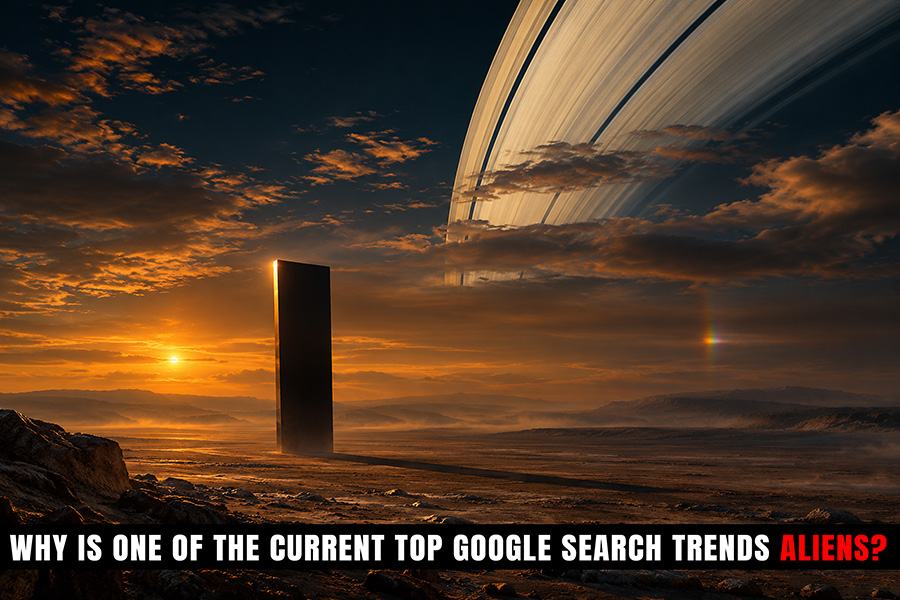
Popular entertainment has spent generations constructing the visual and emotional vocabulary of extraterrestrial contact. From the mysterious monolith in Stanley Kubrick’s 1968 film 2001: A Space Odyssey to the planetary invasion scenarios of modern cinema, fictional encounters have shaped how audiences imagine intelligence beyond Earth.
These stories frequently portray contact as a moment of profound disruption. Governments conceal information. Military forces mobilize. Scientists race to interpret unfamiliar technology. Ordinary people discover that their understanding of the universe was incomplete.
Such narratives are compelling because they transform an abstract scientific possibility into a recognizable human drama. They also influence the expectations audiences bring to real-world announcements about unusual aerial observations or new astronomical discoveries.
When governments issue emergency preparedness recommendations, some observers may interpret them through this fictional framework. The result can be a powerful narrative in which ordinary civil-defense planning becomes evidence of a concealed extraterrestrial threat.
There is no verified evidence that contemporary emergency preparedness programs are being coordinated in anticipation of alien contact. Nevertheless, the resemblance between fictional first-contact scenarios and real government contingency planning helps explain why the idea attracts attention.
What Governments Actually Know—and What They Do Not
One of the most consequential features of the extraterrestrial debate is the difference between classified information and demonstrated extraterrestrial evidence.
Governments routinely classify information involving military sensors, intelligence collection capabilities, surveillance systems, and national defense operations. A classified UAP report may contain sensitive information about how an observation was detected, even when the object itself has an ordinary explanation.
Secrecy therefore cannot, by itself, establish the existence of extraterrestrial technology. Nor does the absence of a public explanation necessarily mean that investigators possess a remarkable one.
At the same time, incomplete information creates an environment in which competing interpretations flourish. When official institutions acknowledge that some reports remain unresolved, audiences may reasonably ask what additional evidence exists and why certain details cannot be released.
The appropriate scientific response is neither automatic dismissal nor unquestioning acceptance. It is a demand for reproducible observations, independently verifiable evidence, transparent methodology, and conclusions proportional to the available data.
Artificial Intelligence Is Changing the Search for Life
Artificial intelligence introduces another dimension to humanity’s search for extraterrestrial intelligence. Machine-learning systems can assist researchers in identifying patterns within enormous astronomical datasets, including radio observations, planetary characteristics, and signals that might otherwise escape human attention.
At the same time, generative AI has made convincing fabricated imagery and video easier to produce. Images purporting to show alien spacecraft, extraterrestrial structures, or secret government facilities can circulate rapidly, sometimes reaching millions of viewers before their origins are established.
This creates a paradox. The same technological revolution that may help scientists recognize an authentic extraterrestrial signal can also make it more difficult for the public to distinguish genuine evidence from manufactured spectacle.
For researchers, journalists, and the public, source verification becomes essential. An extraordinary image is not evidence merely because it looks convincing. Its provenance, context, supporting observations, and independent corroboration matter far more than its visual impact.
What Would Genuine Extraterrestrial Evidence Look Like?
A credible discovery could emerge in several forms. Scientists might identify compelling chemical evidence of biological activity on another world, detect a repeatable artificial signal from a distant star system, or discover physical material whose characteristics require an explanation beyond known terrestrial processes.
Each possibility would demand careful investigation. Potential biological signatures could arise through nonbiological chemistry. Apparent radio signals could originate from terrestrial interference or natural astrophysical sources. Unusual materials could reflect unfamiliar manufacturing processes rather than extraterrestrial technology.
Scientific confidence grows when alternative explanations are tested and eliminated, when independent investigators reproduce findings, and when the evidence survives rigorous scrutiny.
The announcement of an authentic extraterrestrial discovery would represent one of the most consequential events in human history. Precisely because its implications would be extraordinary, the evidentiary standard must be exceptionally high.
Are We Witnessing a Cultural Shift?
The Google Trends observation raises a question larger than the search term itself. Are people becoming increasingly receptive to the possibility of extraterrestrial life, or are they simply responding to a temporary convergence of entertainment, news coverage, and social media discussion?
One screenshot cannot answer that question. Establishing a meaningful trend would require comparisons across longer periods, geographic regions, related search terms, and identifiable triggering events.
Nevertheless, the broader cultural environment is unmistakably different from that of earlier decades. Exoplanet discoveries are routine scientific news. UAP investigations receive congressional attention. Space agencies openly discuss the search for life. Artificial intelligence can analyze astronomical information on an unprecedented scale.
Humanity is no longer merely imagining what might exist beyond Earth. It is developing increasingly sophisticated methods for looking.
The Most Unsettling Possibility May Be the Simplest
Perhaps the current fascination with aliens reflects something more profound than fear of invasion or suspicion of government secrecy. Perhaps humanity is beginning to recognize that its long-standing assumption of cosmic isolation has never been scientifically established.
The universe contains an extraordinary number of stars and planetary systems. Whether life is common, rare, or unique to Earth remains unknown. Whether technological civilizations exist elsewhere is an even more difficult question.
There is presently no verified evidence that an extraterrestrial civilization is approaching Earth, that governments are preparing for its arrival, or that an imminent global emergency has an alien origin.
But the absence of such evidence does not make the underlying scientific question trivial. On the contrary, the possibility of life elsewhere remains one of the most significant unresolved questions in science.
And perhaps that is why a simple search for “aliens” continues to capture the human imagination. Beneath the sensational headlines, fictional invasions, classified reports, and internet speculation lies a question that civilization has never answered.
If someone—or something—is out there, how would we know?
References and Further Reading
All-domain Anomaly Resolution Office. (2024). Report on the historical record of U.S. government involvement with unidentified anomalous phenomena (UAP), Volume I. U.S. Department of Defense.
National Aeronautics and Space Administration. (2023). NASA unidentified anomalous phenomena independent study team report.
Whitson, J. A., & Galinsky, A. D. (2008). Lacking control increases illusory pattern perception. Science, 322(5898), 115–117.
National Aeronautics and Space Administration. (n.d.). NASA Exoplanet Archive. California Institute of Technology.