


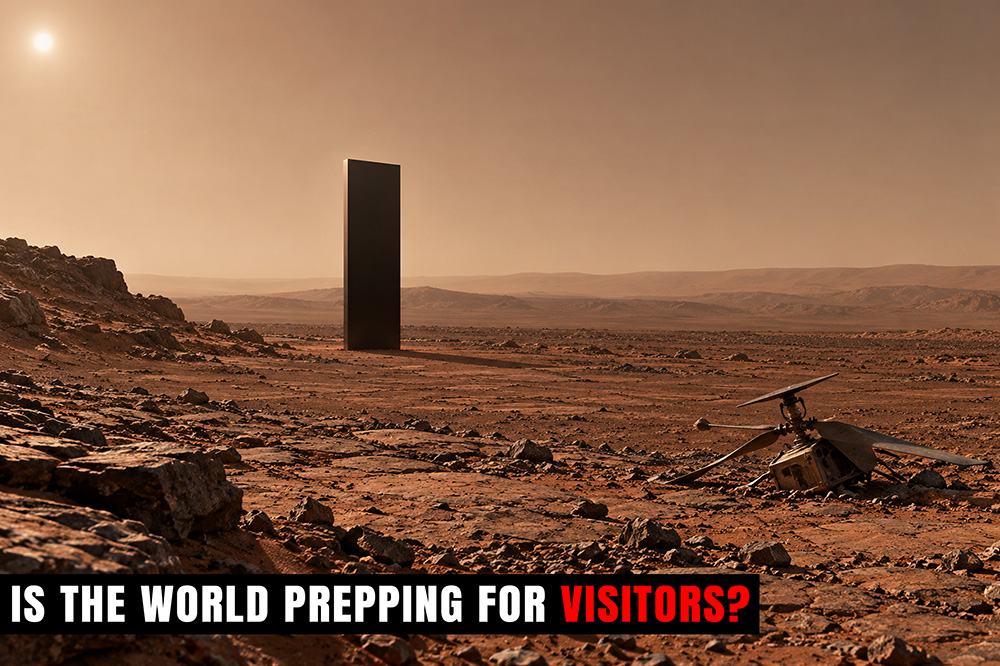
Something is happening across the world, and it deserves considerably more attention than it is receiving. Governments are urging citizens to stockpile food, water, batteries, and emergency supplies. Military installations are preparing to operate without civilian infrastructure. Nations are strengthening their defenses against cyberattacks, electrical grid failures, and disruptions to essential services. The warnings are coming from different countries, yet the underlying message is remarkably similar: prepare to survive without the systems that sustain modern civilization.
Why now? Why are governments separated by thousands of miles increasingly emphasizing the same fundamental survival requirements? Are they responding independently to familiar threats, or are their preparations revealing a shared assessment of dangers that the public does not fully understand? And there is another question, considerably more disturbing: what if the threat is not entirely terrestrial?
A World Preparing for the Unthinkable
In March 2025, the European Commission introduced its Preparedness Union Strategy, calling for a comprehensive approach to military, civilian, economic, and infrastructure resilience. Among its recommendations was the ability of households to sustain themselves for at least 72 hours during an emergency. The strategy also addressed critical supply chains, telecommunications, healthcare, transportation, and the possibility of simultaneous disruptions across multiple sectors.
By October 2026, international attention had intensified. Reporting from the United States described Pentagon preparations intended to allow military installations to maintain essential operations during prolonged failures of civilian infrastructure. The reported Fortress initiative included planning for extended independence from commercial electrical grids and vulnerable supply networks. The prospect of military bases preparing for 90 days of disruption raises a question that cannot be dismissed: what circumstances would make such extraordinary resilience necessary?
Japan has also attracted international attention. On October 29, 2026, reports confirmed that the Japanese government was preparing a November 2 public emergency-preparedness appeal associated with the establishment of a new disaster-management agency. Citizens would be encouraged to maintain at least three days of supplies, preferably a week. Japanese authorities characterized the initiative as disaster preparedness, not a warning of imminent war or catastrophe. Nevertheless, the announcement illustrates how seriously national governments are approaching the possibility of interrupted essential services.
The Infrastructure Problem Nobody Wants to Contemplate
Modern civilization operates through an extraordinary network of dependencies. Electricity supports communications, banking, transportation, hospitals, water treatment, food refrigeration, and industrial production. Satellite systems support navigation, aviation, maritime transportation, telecommunications, and financial timing. Digital networks connect nearly every important component of national economies.
The collapse of one system can compromise several others. An electrical outage can interrupt water distribution. Failed communications can interfere with emergency response. Transportation disruptions can prevent food and medical supplies from reaching communities. Financial interruptions can obstruct commerce even when physical goods remain available. These are not independent emergencies. They are potentially cascading failures within a civilization designed around continuous connectivity.
The frightening implication is that a disaster need not destroy a city to make that city temporarily uninhabitable. It may only need to interrupt the systems that allow millions of people to obtain drinking water, purchase food, access medical care, and communicate with the outside world.
What If the Threat Comes From Space?
When people hear the word extraterrestrial, they frequently imagine alien spacecraft or intelligent beings approaching Earth. But an extraterrestrial threat does not require an alien civilization. The universe contains natural phenomena capable of affecting the entire planet, including asteroid impacts, solar eruptions, energetic particles, and extreme geomagnetic disturbances.
The Sun presents one of the most credible examples. Powerful coronal mass ejections can disturb Earth’s magnetic environment, induce electrical currents in transmission systems, disrupt satellite operations, interfere with radio communications, and degrade satellite navigation accuracy. The National Oceanic and Atmospheric Administration has documented these mechanisms, while recent scientific research has examined the potentially enormous economic consequences of severe geomagnetic storms.
Consider what would happen if an exceptionally powerful solar disturbance damaged electrical infrastructure across multiple regions simultaneously. Communications could become unreliable. Navigation services could deteriorate. Essential services could face prolonged interruptions. A modern society accustomed to immediate access to electricity, information, and commerce would confront an emergency for which many households are poorly prepared.
Such a scenario is scientifically plausible. It does not mean that a specific catastrophic solar event has been predicted, or that government preparedness announcements are evidence of one. That distinction is essential. Nevertheless, the possibility demonstrates why space-origin hazards belong in any serious investigation of civilization-scale emergencies.
The Asteroid Question
Asteroids represent another extraterrestrial hazard with consequences that could exceed conventional national emergency planning. A sufficiently large impact could produce devastating blast effects, fires, tsunamis, atmospheric disturbances, and severe economic disruption. The magnitude would depend on the object’s size, composition, velocity, and impact location.
NASA and international astronomical organizations continuously monitor near-Earth objects and refine their orbital predictions. The case of asteroid 2024 YR4 demonstrates how this process works. Early calculations generated concern about possible future impacts, but subsequent observations substantially improved orbital certainty. By March 2026, NASA had ruled out a significant Earth-impact threat from that object through the next century and eliminated its previously considered 2032 lunar-impact possibility.
This example is important for two reasons. First, potentially hazardous objects are real and warrant continuous surveillance. Second, changing risk estimates are not evidence of deception. They are a normal consequence of acquiring better observational data. There is currently no verified astronomical evidence connecting the international preparedness initiatives discussed here to an undisclosed incoming asteroid.
Could an Intelligent Extraterrestrial Threat Explain the Preparations?
The most provocative hypothesis involves extraterrestrial intelligence. If a technologically advanced civilization were approaching Earth, or if governments had detected an unexplained phenomenon suggesting a potential threat, would the public necessarily be informed immediately? National security classifications, intelligence assessments, and military contingency planning could complicate the disclosure of sensitive information.
However, the existence of classified intelligence does not establish the existence of extraterrestrial visitors. Nor do emergency stockpiles, military exercises, or infrastructure-hardening programs demonstrate preparations for contact with another civilization. These measures have well-documented terrestrial explanations, including armed conflict, natural disasters, cyberattacks, and infrastructure vulnerability.
For the extraterrestrial-intelligence hypothesis to become scientifically persuasive, investigators would need independent evidence: authenticated observations, reproducible measurements, credible technical records, or other information that cannot be adequately explained by known natural or human activity. At present, the preparedness developments examined in this article do not provide that evidence.
The More Disturbing Possibility
Perhaps the most unsettling explanation requires no alien spacecraft, hidden asteroid, or secret astronomical discovery. Governments may simply be recognizing that the systems sustaining modern civilization have become dangerously interconnected and that several credible threats could overwhelm those systems at the same time.
Military conflict could interrupt energy supplies while a cyberattack disables communications. A severe natural disaster could destroy transportation infrastructure during an international supply-chain crisis. A geomagnetic storm could complicate emergency response while political tensions limit cooperation between countries. Individually, such emergencies may be manageable. In combination, their consequences could become substantially more difficult to contain.
And yet the possibility of an extraterrestrial origin should not be excluded from scientific risk assessment merely because it sounds extraordinary. Planetary defense and space-weather monitoring already recognize that hazards originating beyond Earth can threaten human civilization. What remains unsupported is the suggestion that today’s emergency-preparedness campaigns are secretly responding to a specific extraterrestrial event.
What Do Governments Know?
Governments possess intelligence assessments, contingency plans, and technical information that are not always available to the public. That reality justifies scrutiny, especially when major preparedness initiatives affect millions of citizens. It does not, by itself, establish that governments are coordinating a concealed warning about an approaching catastrophe.
The European Union’s preparedness strategy explicitly identifies geopolitical conflict, cybersecurity threats, climate change, and natural hazards. Japan’s government has publicly connected its latest appeal to disaster-management improvements. American military resilience planning addresses the operational consequences of infrastructure failure. These explanations are documented, although the public cannot independently examine every underlying classified threat assessment.
What deserves investigation is whether the pace, scale, and geographic distribution of preparedness measures have changed significantly, and whether those changes correlate with new scientific observations, military intelligence assessments, or emerging infrastructure risks. Establishing such connections requires evidence rather than coincidence.
The Question Humanity Cannot Afford to Ignore
Imagine waking tomorrow to discover that electronic payments no longer function, cellular networks are unavailable, electrical service has failed, and government agencies cannot say when normal operations will resume. Imagine the same situation affecting multiple countries simultaneously. Whether caused by warfare, cyberattack, solar activity, or another catastrophic event, the consequences would be immediate and deeply personal.
That is why the growing international emphasis on preparedness matters. The warnings do not prove that an extraordinary event is approaching, but they reveal an unmistakable concern about society’s ability to withstand major disruptions. A civilization capable of communicating instantly across the planet remains remarkably dependent on systems that can fail.
So is Earth preparing for an extraterrestrial threat? The available evidence does not establish that conclusion. But the universe contains genuine hazards, governments are strengthening their emergency capabilities, and the vulnerability of modern civilization is increasingly difficult to ignore.
Perhaps the most frightening question is not whether something is coming from space. It is whether humanity could survive the failure of the systems on which nearly everything depends.
And if an extraordinary threat were eventually identified, would the world’s governments tell us in time?
Sources and Further Reading
European Commission. (2025). EU preparedness union strategy. European Commission.
European Commission. (2025, March 26). EU Preparedness Union Strategy to prevent and react to emerging threats and crises. European Commission.
Lin, B. (2026, October 26). Pentagon orders bases to plan for 90 days without the grid as Britain urges families to stockpile food and water. Fortune.
National Aeronautics and Space Administration. (2026, March 5). New NASA asteroid observations eliminate chance of 2032 lunar impact. NASA Science.
National Oceanic and Atmospheric Administration. (n.d.). Space weather impacts. Space Weather Prediction Center.
Prime Minister’s Office of Japan. (2026). Disaster preparedness: What you can do in advance. Government of Japan.
Central News Agency. (2026, October 29). Japan clarifies November 2 emergency preparedness appeal as disaster-prevention campaign. CNA.
United States Geological Survey. (2026, September 4). Major space weather risks identified via coupled physics–engineering–economic modeling. USGS.