


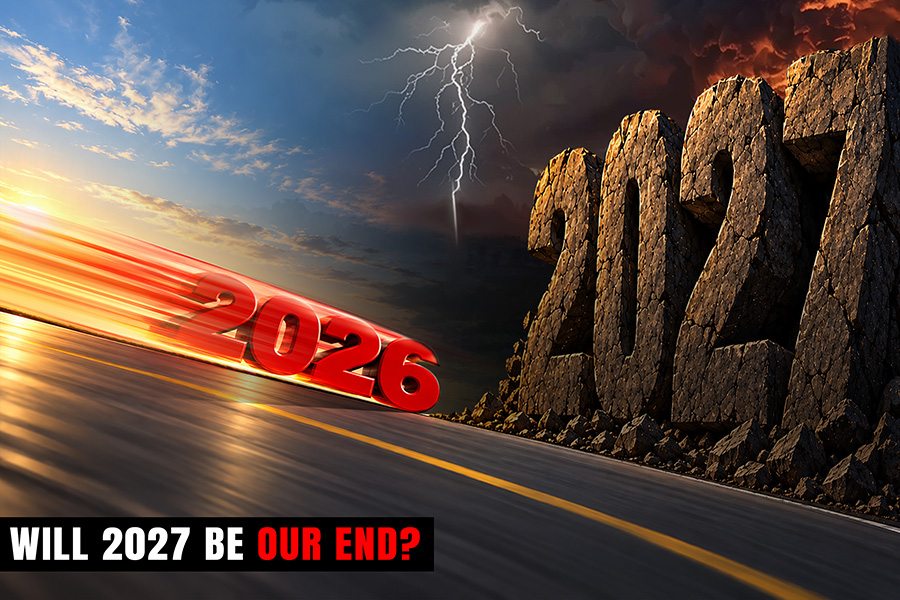
October 31, 2026 — Humanity is approaching 2027 at extraordinary speed, carrying an increasingly dangerous collection of unresolved wars, nuclear threats, economic vulnerabilities, technological risks, and environmental emergencies. Governments are telling their citizens to prepare for disruptions. Military planners are preparing for conflicts that could engulf entire regions. Financial institutions are warning that another major shock could expose weaknesses in an already strained global economy.
And the world is running out of places to hide from the consequences.
There is no scientific evidence that civilization will end in 2027. But there is considerable evidence that the coming year could test the world’s political, economic, technological, and humanitarian systems in ways few living generations have experienced simultaneously.
The danger is not necessarily a single spectacular catastrophe. It is the growing possibility that several crises will strike together, with each disaster magnifying the damage caused by the others.
Consider what is already happening. Nuclear-armed nations are modernizing their arsenals. Wars are destabilizing energy and food markets. Governments are distributing emergency preparedness guidance. Artificial intelligence is accelerating the capabilities of cybercriminals and hostile states. The world’s oceans continue absorbing unprecedented amounts of heat. Meanwhile, millions of displaced people remain dependent on fragile humanitarian systems.
These are not predictions from an apocalyptic conspiracy website. They are developments documented by the United Nations, World Bank, International Monetary Fund, World Meteorological Organization, Stockholm International Peace Research Institute, and national emergency-management agencies.
In January, the World Economic Forum published its Global Risks Report 2026, drawing on the assessments of more than 1,300 experts. Half anticipated a turbulent or stormy global outlook over the next two years. Another 40% expected an unsettled world. Only 1% anticipated calm.
With that extraordinary assessment in mind, here is an extensive forecast of the threats accompanying humanity into 2027.
PART I: THE WORLD IS ARMING ITSELF
1. Nuclear Weapons: The Machinery of Extinction Remains Operational
In June 2026, the Stockholm International Peace Research Institute reported that the world’s nine nuclear-armed states possessed approximately 12,187 nuclear warheads at the beginning of the year. About 9,745 were in military stockpiles potentially available for use, while an estimated 2,100 to 2,200 deployed warheads remained on high operational alert.
Every one of the nine nuclear-armed countries continued strengthening its nuclear arsenal during 2025. Advances in delivery systems, deteriorating arms-control arrangements, and intensifying geopolitical competition are making nuclear weapons increasingly central to national security strategies.
Those numbers describe a civilization that still maintains the capacity to destroy itself on an unimaginable scale. The greatest danger may not be a deliberate decision to start a nuclear war, but a miscalculation, false warning, uncontrolled escalation, or conventional military confrontation that crosses the nuclear threshold.
Source: SIPRI Yearbook 2026.
2. Russia and NATO: The Risk of a Direct Confrontation
Russia’s war against Ukraine has demonstrated how quickly a regional military conflict can transform the strategic environment of an entire continent. European defense spending, military readiness, ammunition production, and civil preparedness have become central political concerns.
The most dangerous scenario is not necessarily a planned invasion of NATO territory. It could begin with a missile crossing a border, an aircraft interception going wrong, sabotage attributed to the wrong actor, or a military commander responding to incomplete intelligence.
A direct confrontation involving nuclear-armed Russia and NATO would create escalation risks far beyond the original incident. The continent’s dense transportation, communications, energy, and financial networks could transmit the disruption internationally within hours.
3. Ukraine: A War That Continues to Reach Beyond the Battlefield
The consequences of the war in Ukraine extend into grain shipments, fertilizer markets, energy infrastructure, defense production, refugee movements, and international relations.
Attacks on infrastructure can impose costs on populations far removed from the fighting. Disruptions to Black Sea shipping affect agricultural markets, while damage to energy production and distribution complicates European and global supply planning.
Entering 2027, a prolonged conflict would continue consuming military and economic resources. A sudden escalation could have consequences much more severe than the continuation of current hostilities.
4. The Middle East: A Regional War With Global Consequences
The Middle East remains one of the world’s most consequential geopolitical fault lines because regional military activity intersects with energy production, maritime transportation, religious and political rivalries, and the strategic interests of major powers.
The World Bank’s October 2026 Commodity Markets Outlook explicitly identifies the ongoing Middle East conflict as a major contributor to oil-market disruption. Its analysis warns that further escalation could drive energy prices higher and intensify global economic instability.
A missile strike on critical energy infrastructure, an extended interruption of tanker movements, or the widening of hostilities could quickly become an international economic emergency.
Source: World Bank, October 28, 2026.
5. Taiwan: A Potential Flashpoint for the Global Economy
Tensions surrounding Taiwan represent an extraordinary intersection of military danger and economic dependence. Taiwan occupies a central position in advanced semiconductor manufacturing, while the surrounding maritime region is strategically important to international commerce.
A blockade, military confrontation, or major disruption to semiconductor production could affect electronics, telecommunications, automobiles, medical equipment, industrial machinery, and artificial intelligence infrastructure.
The economic consequences could begin before a shot is fired. Insurance costs, investment decisions, shipping patterns, and supply-chain preparations could all change dramatically in response to a serious escalation.
6. The South China Sea: A Collision Waiting for the Wrong Moment
Territorial disputes in the South China Sea involve competing maritime claims, fishing resources, shipping routes, military installations, and increasingly confrontational encounters between government vessels.
The Philippines occupies a particularly vulnerable position because incidents involving Philippine vessels and Chinese forces could carry implications for its defense relationship with the United States.
A collision, injury, sinking, or armed confrontation could produce a diplomatic crisis before political leaders have time to establish what actually happened.
For Southeast Asia, the danger is immediate and regional. For the wider world, it is another possible pathway through which a localized confrontation could become an international emergency.
7. The Korean Peninsula: A War That Never Formally Ended
North Korea’s nuclear weapons and missile programs continue to complicate security calculations across Northeast Asia. South Korea, Japan, China, Russia, and the United States all have significant interests in the region.
A military incident could threaten densely populated urban areas, critical industrial facilities, ports, airports, and advanced manufacturing operations.
Even a limited confrontation could disrupt Asian markets and transportation networks. A major conflict would produce humanitarian and economic consequences extending well beyond the peninsula.
8. India and Pakistan: Nuclear Weapons Across a Contested Border
India and Pakistan possess nuclear weapons and have a history of military confrontations. Territorial disputes, militant attacks, domestic political pressures, and rapid military mobilization create recurring escalation risks.
SIPRI’s 2026 assessment specifically identifies conflict between nuclear-armed India and Pakistan as a challenge to assumptions about nuclear deterrence.
When two adversaries possess nuclear weapons, conventional military superiority does not guarantee that a confrontation will remain conventional. A regional crisis could become a global catastrophe through a sequence of decisions that neither side originally intended.
9. Sudan and the World’s Neglected Wars
Sudan, Myanmar, Yemen, the Democratic Republic of the Congo, and other conflict-affected regions demonstrate that global instability is not limited to confrontations involving major powers.
Armed violence destroys agricultural production, hospitals, schools, housing, transportation, and public administration. It also creates displacement that can destabilize neighboring countries.
According to UNHCR, approximately 117.8 million people were forcibly displaced worldwide at the end of 2025. Although that represented a decline from 2024, it remained an extraordinary humanitarian burden.
Source: UNHCR Global Trends 2025, released June 2026.
10. The Militarization of Space
Modern warfare depends heavily on satellites for positioning, intelligence, surveillance, communications, missile warning, and precision navigation.
Disruption of these systems could affect civilian aviation, maritime navigation, telecommunications, financial timing, and emergency response as well as military operations.
Space is no longer merely a supporting environment for terrestrial conflict. It is becoming an increasingly contested strategic domain in which damage to a relatively small number of critical systems could have worldwide consequences.
PART II: GOVERNMENTS ARE PREPARING THEIR POPULATIONS
11. Europe Is Telling Citizens to Prepare for Disruption
One of the most revealing developments of recent years is the increasing emphasis on civilian emergency preparedness across Europe.
The European Commission’s Preparedness Union Strategy calls for guidelines enabling a minimum of 72 hours of population self-sufficiency. The strategy also emphasizes early warning, critical resources, public-private cooperation, and civil-military preparedness.
Germany’s Federal Office of Civil Protection and Disaster Assistance recommends maintaining approximately ten days of food and drink. Norway recommends that households be capable of managing independently for one week. Sweden has similarly promoted household preparation for a week of crisis or war.
These recommendations address a range of emergencies, including extreme weather, infrastructure failure, sabotage, pandemics, and armed conflict. They are not announcements that a particular catastrophe has been scheduled.
Nevertheless, the practical message is unmistakable: governments increasingly want households to be capable of surviving without immediate access to ordinary public services.
Sources: European Commission; Germany’s BBK; Norway’s DSB.
12. The 90-Day Question: Preparing for a Longer Emergency
Claims that governments are ordering entire civilian populations to stockpile 90 days of supplies require careful examination. The publicly verified national recommendations cited above generally concern several days to approximately ten days, not a universal three-month civilian stockpiling order.
However, the distinction between an initial emergency kit and a prolonged crisis is critically important. A severe war, extended infrastructure breakdown, or major supply-chain interruption might last considerably longer than the period covered by a standard household emergency kit.
Norway’s emergency agency explicitly acknowledges that many crises and wars last longer than one week. Its recommendation is intended to give households and authorities time to respond and organize additional support.
The disturbing question is therefore not whether every government has secretly announced a 90-day emergency. It is what happens when a population prepared for three days confronts a disruption lasting three months.
13. The Electricity Grid: The First Domino
Modern society depends on electricity to operate water pumps, sewage systems, hospitals, telecommunications, banking networks, refrigeration, transportation, fuel distribution, and industrial production.
A prolonged blackout is not simply an inconvenience involving darkened buildings. It can interrupt the infrastructure that makes densely populated modern life possible.
Norway’s civil protection authorities specifically warn that power outages can disrupt water, sewage, payment systems, mobile communications, refrigeration, and medical equipment.
Consider the consequences of a regional blackout during a severe heat wave, followed by fuel shortages and communications failures. The emergency would no longer be limited to electricity. It would become a public-health, transportation, economic, and potentially political crisis.
14. Water and Sanitation: The Emergency Behind the Emergency
When electricity fails, water systems may fail with it. Pumps stop operating, treatment facilities lose power, and sewage systems can become compromised.
Flooding, drought, contamination, and damaged infrastructure can create similar consequences even when the electricity remains available.
Water insecurity can rapidly become a medical emergency through dehydration, poor sanitation, and infectious disease. In densely populated communities, a prolonged loss of safe drinking water can create conditions far more dangerous than the event that originally caused the disruption.
15. When Electronic Payments Stop Working
Many households now rely almost entirely on electronic banking, payment cards, mobile applications, and internet-connected financial services.
A major cyberattack or prolonged telecommunications outage could prevent people from purchasing essential supplies even when they still possess money in their accounts.
Norway’s emergency guidance specifically recommends keeping some cash and multiple payment cards available because ordinary payment systems may not function during a crisis.
A society that cannot process transactions can experience shortages, confusion, and disorder long before its physical supplies are exhausted.
PART III: THE GLOBAL ECONOMY IS UNDER PRESSURE
16. The World Bank’s October Warning
On October 28, 2026, the World Bank released a troubling commodity-market forecast. It projected that overall commodity prices would increase 23% in 2026, driven by multiple international shocks.
Energy prices were projected to rise 32% during 2026, while food commodity prices were expected to increase approximately 10% in 2026 and another 7% in 2027.
Those figures represent serious pressure on households already struggling with the cost of basic necessities.
The World Bank also outlined an adverse scenario involving intensified conflict, energy disruption, attacks on grain shipments, and a very strong El Niño. Under that combination, Brent crude oil could average $105 per barrel in 2027, while food commodity prices could exceed the baseline forecast by 12%.
These are conditional forecasts, not guaranteed outcomes. Their significance lies in the fact that a major international financial institution has formally examined how several simultaneous shocks could produce a much more severe crisis.
Source: World Bank Commodity Markets Outlook, October 2026.
17. Inflation: The Slow-Motion Emergency
Inflation does not need to reach historic extremes to destabilize households. Sustained increases in food, energy, transportation, housing, and medical costs can steadily erode purchasing power.
The International Monetary Fund’s October 2026 outlook projected global headline inflation of 4.7% in 2026 and 4.1% in 2027.
Those global averages conceal substantial differences between countries and income groups. Families spending most of their income on essentials have little ability to absorb another surge in prices.
Inflation also carries political consequences. When wages and savings fail to keep pace with living costs, public dissatisfaction can intensify, increasing pressure on governments already confronting geopolitical and economic instability.
Source: IMF World Economic Outlook, October 2026.
18. Sovereign Debt: Governments With Less Room to Maneuver
High public debt becomes especially dangerous when governments must respond to unexpected emergencies.
Wars, natural disasters, financial rescues, and major public-health emergencies require extraordinary spending. Countries already struggling with debt servicing may have limited capacity to respond without borrowing more, cutting services, increasing taxes, or accepting financial assistance.
The IMF has warned that fiscal vulnerabilities and uneven economic resilience remain important downside risks.
The danger entering 2027 is not simply that governments owe money. It is that another major crisis could arrive when some governments have already exhausted much of their financial flexibility.
19. Trade Wars and Economic Nationalism
International trade is increasingly exposed to tariffs, sanctions, export restrictions, investment controls, and competition over strategically important industries.
The World Economic Forum identified geoeconomic confrontation as the leading global risk for 2026 and the highest-ranked risk in its two-year severity outlook.
Economic conflict can disrupt supplies without a military attack. Restrictions involving semiconductors, energy equipment, food products, pharmaceuticals, or critical minerals can impose costs across entire industrial sectors.
A fragmented world economy may also find it more difficult to coordinate an effective response when the next emergency occurs.
20. Financial Markets and the Artificial Intelligence Investment Boom
Artificial intelligence has become an important driver of investment, technology spending, and financial-market expectations.
The IMF identifies a reassessment of AI-related expectations as a potential downside risk to the global economy. If anticipated productivity gains fail to materialize quickly enough, valuations and investment plans could undergo significant adjustment.
The consequences could extend beyond technology companies. Data centers, electricity infrastructure, semiconductor manufacturing, financial markets, and businesses dependent on continued investment could all be affected.
The uncomfortable possibility is that the same technology boom helping support economic growth could become a source of instability if investor expectations reverse abruptly.
PART IV: FOOD, ENERGY, AND THE COST OF SURVIVAL
21. Global Food Prices: Hunger Becomes More Expensive
The World Bank’s October outlook identifies disrupted grain shipments, high energy costs, fertilizer prices, and El Niño-related agricultural risks as important drivers of food inflation.
Food insecurity is particularly dangerous because it can intensify almost every other humanitarian problem. Families reduce medical spending, children lose access to adequate nutrition, migration pressures increase, and governments face growing demands for assistance.
A poor harvest in one region may be manageable. Poor harvests combined with shipping disruption, expensive fertilizer, conflict, and weakened currencies can produce an international emergency.
Food prices are therefore not merely an economic indicator. They are a measure of how much strain ordinary people can absorb before survival itself becomes difficult.
22. Fertilizer: The Hidden Vulnerability of Modern Agriculture
Modern agricultural production depends heavily on fertilizer, fuel, transportation, machinery, and international trade.
The World Bank projected fertilizer prices would rise 14% in 2026. Higher input costs can reduce farmers’ profitability and influence planting decisions, crop management, and future production.
The effects of an agricultural input shock can persist beyond the original disruption. A farmer who cannot afford sufficient fertilizer during one growing season cannot simply recover the lost harvest after prices decline.
This creates the possibility of delayed consequences extending into 2027 and beyond.
23. Oil and Gas: A Global Economy Still Exposed
Despite the growth of renewable energy and electrification, oil and natural gas remain essential to transportation, industrial production, agriculture, heating, electricity generation, and global commerce.
The International Energy Agency’s 2026 State of Energy Policy report describes a prolonged period of energy disruptions associated with geopolitical conflict, supply-chain problems, trade restrictions, and extreme weather.
The World Bank’s October forecast further warns that oil inventories have been drawn down, leaving markets more exposed to additional supply shocks.
When energy becomes scarce or expensive, the consequences spread through nearly every other sector. Transportation costs rise. Food production becomes more expensive. Industrial output can slow. Household budgets deteriorate.
Source: International Energy Agency, State of Energy Policy 2026.
24. Shipping Chokepoints: The World’s Fragile Arteries
International trade depends on a relatively small number of strategically important maritime routes, canals, straits, and port facilities.
Military conflict, attacks on shipping, severe weather, accidents, and infrastructure failures can force vessels to take longer routes or suspend operations.
Longer voyages increase fuel consumption, insurance expenses, transportation costs, and delivery times. Disruptions involving food, energy, or industrial components can have effects far removed from the original incident.
Modern supply chains are efficient partly because they assume the continued availability of international transportation. When that assumption fails, efficiency can become vulnerability.
PART V: TECHNOLOGY IS CREATING NEW WAYS TO FAIL
25. Cyberwarfare: A Battlefield Without Borders
Cyberattacks can strike financial institutions, hospitals, government agencies, transportation systems, industrial operations, and communications networks without a conventional military invasion.
The European Union Agency for Cybersecurity reported in September 2026 that ransomware remained the most impactful short-term cyber incident category in its threat assessment. It also identified public administration as the most targeted sector and warned that emerging AI models were expected to support malicious operations.
Cyberwarfare is especially dangerous because an attack can create physical consequences. A disabled hospital network can interrupt medical treatment. A compromised logistics system can delay essential supplies. A successful attack on industrial controls can disrupt production.
Entering 2027, the growing interconnection of critical infrastructure creates more opportunities for an attack against one system to affect many others.
Source: ENISA Threat Landscape 2026.
26. Artificial Intelligence: An Unprecedented Acceleration
Artificial intelligence is developing capabilities that could transform research, medicine, manufacturing, education, military operations, and the global workforce.
But the same technology can also increase the scale and sophistication of fraud, disinformation, cybercrime, surveillance, and automated decision-making.
The World Economic Forum’s 2026 report identifies adverse AI outcomes as one of the risks rising most dramatically over longer time horizons.
The danger is not that every advanced AI system will suddenly become hostile. It is that institutions responsible for regulating, securing, and understanding the technology may struggle to keep pace with its deployment.
When capabilities develop faster than oversight, society becomes an experiment conducted in real time.
27. Deepfakes and the Collapse of Trust
AI-generated video, audio, images, and text are making it increasingly difficult for ordinary people to determine whether digital material is authentic.
Fabricated political statements, fraudulent emergency announcements, impersonated executives, and manipulated evidence can circulate rapidly through social media and messaging platforms.
In a tense geopolitical environment, a convincing fabrication could provoke public panic or influence decision-makers before investigators establish the truth.
The danger extends beyond believing false information. As synthetic media becomes more convincing, authentic evidence may also be dismissed as fake.
A society unable to agree on what actually happened becomes more vulnerable to manipulation during emergencies.
28. Autonomous Weapons and Machine-Speed Warfare
Military systems increasingly incorporate artificial intelligence, automation, remote sensing, and autonomous capabilities.
These technologies may improve surveillance, targeting, and defensive operations. They also create difficult questions about human oversight, accountability, reliability, and the speed of military escalation.
When automated systems identify threats and recommend responses within seconds, human decision-makers may face pressure to act before information has been fully verified.
The consequences of a software failure, sensor error, misclassification, or misunderstood military maneuver could become particularly serious in a confrontation involving heavily armed states.
29. Aviation and Transportation: Interconnected Vulnerabilities
Modern aviation relies on satellite navigation, digital communications, weather information, air traffic management, electronic maintenance records, fuel distribution, and complex international logistics.
Interference with navigation signals, cyberattacks, airspace closures, military activity, and major infrastructure failures can create operational disruptions across national borders.
Maritime transportation and rail networks face similar dependencies on communications, energy, scheduling systems, and functioning infrastructure.
Transportation emergencies can also complicate disaster response. When aircraft cannot operate, ports are closed, or roads are damaged, the delivery of medical supplies, emergency personnel, food, and equipment becomes significantly more difficult.
The world’s transportation systems are not isolated industries. They are essential components of civilization’s emergency response capability.
PART VI: THE NATURAL WORLD IS ADDING PRESSURE
30. Extreme El Niño: A Dangerous Climate Variable Entering 2027
On October 8, 2026, the World Meteorological Organization issued a seasonal climate update projecting further intensification of El Niño conditions during the final quarter of the year.
Its multi-model forecast indicated a Niño 3.4 sea-surface temperature anomaly of approximately +3.7°C during October through December, with warming expected to peak around December.
El Niño can alter rainfall, temperature, drought, and storm patterns across multiple regions. Its agricultural consequences can extend beyond the period when ocean temperatures peak.
Combined with already elevated food and energy prices, a major climate-related harvest disruption could worsen conditions for vulnerable populations during 2027.
Source: WMO Global Seasonal Climate Update, October 2026.
31. Ocean Heat: The Planet’s Growing Energy Imbalance
The World Meteorological Organization’s State of the Global Climate 2025 report confirmed that the years 2015 through 2025 were the eleven warmest years on record.
The report also identified record ocean heat content and an exceptionally large imbalance between the energy entering and leaving Earth’s climate system.
Ocean warming contributes to marine heat waves, coral reef stress, rising sea levels, and conditions capable of supporting intense tropical cyclones.
The consequences are particularly important for coastal communities, island nations, fishing industries, ports, and low-lying infrastructure.
Unlike an isolated weather event, accumulated ocean heat represents a long-term physical change that continues influencing environmental conditions over time.
Source: WMO State of the Global Climate 2025.
32. Flooding, Drought, and Extreme Heat
Floods, droughts, heat waves, and destructive storms have always existed. Their consequences, however, are shaped by changing climate conditions, population exposure, infrastructure resilience, and emergency preparedness.
Extreme rainfall can overwhelm drainage systems and destroy transportation infrastructure. Drought can damage crops, reduce water availability, and strain electricity generation. Severe heat can threaten public health while increasing electricity demand.
The greatest danger arises when these pressures overlap. A heat wave during an energy shortage can become a medical emergency. Flooding in a conflict zone can interrupt humanitarian assistance. Drought during a period of high food prices can intensify hunger.
Natural hazards do not need to become unprecedented to produce unprecedented consequences in a vulnerable society.
33. Earthquakes, Volcanoes, and Tsunamis
Major earthquakes, volcanic eruptions, and tsunamis remain among the most destructive natural hazards confronting humanity.
The United States Geological Survey states that scientists cannot reliably predict the exact timing, location, and magnitude of a major earthquake. Nevertheless, seismic hazard maps identify regions where destructive events remain a persistent possibility.
Populations concentrated near active faults, volcanoes, and vulnerable coastlines face potentially catastrophic losses when major events occur.
The danger entering 2027 is not a scientifically established increase in the frequency of major earthquakes. It is the possibility that an unpredictable geological catastrophe could strike a region already weakened by conflict, financial hardship, damaged infrastructure, or inadequate emergency resources.
Source: United States Geological Survey.
PART VII: HUMANITY’S HUMANITARIAN DEFENSES ARE STRAINED
34. Disease, Drug Resistance, and Medical Fragility
The COVID-19 pandemic demonstrated how quickly infectious disease can disrupt international transportation, healthcare, education, economic activity, and ordinary social life.
Another serious pandemic remains a global risk, but it is not the only medical threat. Antimicrobial resistance is steadily undermining the effectiveness of medicines used to treat dangerous infections.
The World Health Organization reported in July 2026 that approximately one in six laboratory-confirmed bacterial infections worldwide was resistant to antibiotics in 2023. Bacterial antimicrobial resistance was associated with more than 4.7 million deaths globally in 2021.
In an emergency involving damaged hospitals, displaced populations, poor sanitation, and interrupted medical supplies, drug-resistant infections could compound the humanitarian consequences.
Source: World Health Organization, July 2026.
35. Mass Displacement and the Erosion of Humanitarian Capacity
At the end of 2025, UNHCR estimated that 117.8 million people worldwide were forcibly displaced by persecution, conflict, violence, human rights violations, or serious disturbances to public order.
Displacement places extraordinary pressure on shelter, sanitation, healthcare, education, food supplies, host communities, and international assistance programs.
When multiple crises occur simultaneously, governments and humanitarian organizations must decide how to allocate limited personnel, money, transportation, and supplies.
A major new emergency could therefore affect people thousands of miles away by diverting resources from populations already struggling to survive.
That is one of the most troubling characteristics of a highly interconnected world: suffering in one region can intensify suffering in another, even without a direct physical connection between the two disasters.
PART VIII: THE MOST DANGEROUS THREAT IS THE COMBINATION
36. Cascading Failure: When One Emergency Becomes Ten
Imagine a severe geopolitical crisis interrupts energy supplies. Oil prices rise sharply. Transportation becomes more expensive. Fertilizer and agricultural production costs increase. Food prices climb. Inflation intensifies. Central banks confront difficult decisions. Financial markets weaken.
Now introduce a major climate-related agricultural disruption. Harvests decline in several important producing regions. Food-importing countries face additional pressure. Humanitarian organizations struggle to purchase and transport supplies.
At the same time, a coordinated cyberattack disables critical financial or transportation systems. Hospitals experience disruptions. Payment networks become unreliable. Governments confront rising public dissatisfaction.
Finally, a destructive natural disaster strikes a region already affected by economic hardship. Emergency response is delayed because equipment, fuel, transportation, and financial resources are already committed elsewhere.
None of these events needs to be unprecedented. None requires a mysterious force, an invented conspiracy, or a predetermined date.
The catastrophe emerges from their interaction.
This is the central danger confronting humanity as 2027 approaches: a world in which separate emergencies may no longer remain separate.
37. Political Polarization: A Crisis of Collective Action
Governments cannot manage major emergencies effectively without public cooperation, institutional trust, reliable information, and some degree of political consensus.
Yet polarization, misinformation, corruption, inequality, and declining confidence in institutions can weaken precisely those capabilities.
The World Economic Forum ranked societal polarization among the leading near-term global risks in its 2026 assessment, while misinformation and disinformation ranked second in its two-year outlook.
In an emergency, disagreement over policy is normal. A complete breakdown of trust can be far more dangerous.
When citizens reject official warnings, institutions conceal failures, political leaders exploit crises, or communities refuse to cooperate, the emergency response itself can become another casualty.
38. The Warning From the United Nations
The United Nations’ Global Risk Report 2026 surveyed approximately 1,300 stakeholders across 155 countries and found that political risks had moved toward the center of the global risk landscape.
Most strikingly, 36% of respondents expected a large-scale war within one year.
That figure is a measure of expert and stakeholder concern, not a calculated probability that world war will occur. Nevertheless, it reflects an extraordinarily troubled international outlook.
The same report identified climate inaction as the most important individual risk among those evaluated and recorded sharply increasing concern about artificial intelligence and frontier technologies.
Source: United Nations Global Risk Report 2026.
39. The Problem With Assuming Someone Else Will Save Us
Modern societies have developed extraordinary emergency response capabilities. They also depend on complex institutions and supply chains that ordinary citizens rarely see or understand.
When a storm strikes, people expect electricity to return. When shelves empty, they expect deliveries to resume. When communications fail, they expect technicians to restore service. When financial systems malfunction, they expect banks and governments to intervene.
Usually, those expectations are justified.
But simultaneous emergencies can overwhelm the personnel, equipment, supplies, and financial resources required to restore normal operations.
This is why government preparedness campaigns matter. They are an acknowledgment that emergency services may not be able to reach everyone immediately when a widespread crisis occurs.
The most dangerous assumption is not that catastrophe will never happen. It is that modern civilization has somehow made prolonged disruption impossible.
PART IX: WILL 2027 BE OUR END?
40. The Final Forecast
There is no credible basis for declaring that humanity will perish in 2027. The International Monetary Fund still projects positive global economic growth next year. International institutions continue working to reduce risks, governments maintain substantial emergency capabilities, and technological progress offers important opportunities to improve human welfare.
But the absence of a scheduled apocalypse should not be confused with the absence of extraordinary danger.
As October 2026 comes to a close, the world is carrying an unsettling collection of liabilities into the new year: thousands of nuclear weapons, active military confrontations, fragile trade relationships, mounting humanitarian needs, persistent inflationary pressures, exposed digital infrastructure, rapidly evolving artificial intelligence, and an increasingly stressed climate system.
Individually, many of these threats can be managed. Collectively, they present a much more difficult challenge.
Humanity has constructed a civilization of astonishing technological sophistication. Aircraft cross oceans in hours. Financial transactions move around the world in milliseconds. Food travels thousands of miles before reaching supermarket shelves. Hospitals depend on digital networks. Entire cities depend on electricity, telecommunications, and continuous deliveries of essential resources.
Every improvement in connectivity has created new capabilities. Many have also created new dependencies.
And dependencies can become points of failure.
Perhaps 2027 will bring diplomatic breakthroughs, scientific advances, economic recovery, and improvements in international security. History contains countless examples of societies overcoming dangers that once appeared insurmountable.
But perhaps the coming year will expose weaknesses that years of relative stability allowed us to ignore.
Perhaps the next major war will not remain regional. Perhaps the next energy shock will arrive during a food crisis. Perhaps a cyberattack will coincide with a natural disaster. Perhaps governments will discover that the emergency plans designed for isolated catastrophes are inadequate when several catastrophes occur together.
The question is no longer simply whether humanity possesses the technology, wealth, and knowledge to survive major emergencies.
It is whether we retain the cooperation, foresight, discipline, and institutional resilience necessary to use those resources when they are needed most.
We are racing toward 2027 with our eyes fixed on the road ahead, while warning lights illuminate the dashboard from nearly every direction.
The world may not end next year.
But the world we have taken for granted may prove considerably more fragile than we ever imagined.
And if several of these warnings become reality at once, humanity may discover that the most dangerous part of the journey was not the catastrophe waiting ahead.
It was our determination to keep accelerating toward it.