


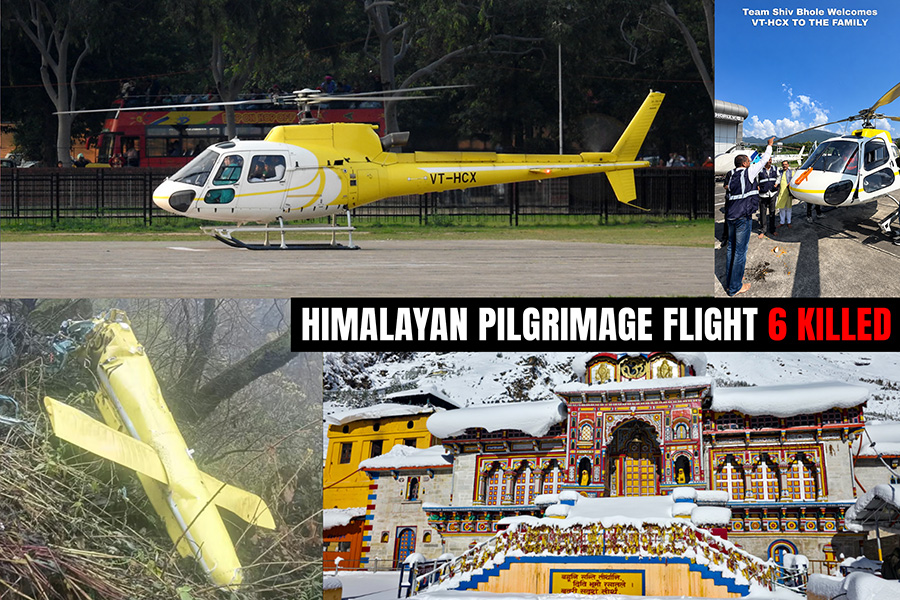
UTTARAKHAND, INDIA — Six people were killed on Friday, October 30, 2026, when an Airbus Helicopters H125 crashed in the mountainous Joshimath region of India’s Uttarakhand state. The helicopter, registration VT-HCX, was transporting five passengers from the Hindu pilgrimage destination of Badrinath toward Dehradun when communication and aircraft tracking were lost during deteriorating weather conditions.
The aircraft, operated by Trans Bharat Aviation Pvt. Ltd., was subsequently located near Chayee village in Chamoli district. Authorities confirmed that all five passengers and the pilot died in the accident. The helicopter was destroyed.
The crash occurred amid reports of heavy precipitation, poor visibility, and snowfall in the surrounding mountains. Although weather conditions are an important investigative consideration, no official determination has established what caused the aircraft to crash.
Aircraft Identification
The helicopter involved was an Airbus Helicopters H125, also identified as the AS350B3, bearing Indian registration VT-HCX. According to the Aviation Safety Network (ASN), the helicopter was manufactured in 2014 and carried manufacturer serial number 7958.
The aircraft was operated by Trans Bharat Aviation Pvt. Ltd., a commercial helicopter operator providing passenger transportation services in India. The accident flight was classified by ASN as a nonscheduled passenger operation.
The Airbus H125 is a single-engine, turbine-powered helicopter belonging to the AS350 Écureuil family. The model is widely used for passenger transportation, utility operations, aerial observation, and missions involving mountainous terrain.
Its performance capabilities make the H125 suitable for operations at elevated locations, although actual performance margins depend on aircraft weight, atmospheric conditions, altitude, wind, and the operating procedures applicable to each flight.
At the time of the accident, VT-HCX was carrying six people, including one pilot and five passengers. All six occupants were killed.
The Flight From Badrinath
According to the Uttarakhand Civil Aviation Development Authority (UCADA), the helicopter departed Badrinath at approximately 1:14 p.m. Indian Standard Time on October 30, 2026.
Its intended destination was Sahastradhara in Dehradun, a helicopter operating location serving the Uttarakhand capital.
Badrinath is a major Hindu pilgrimage destination situated in the Garhwal Himalayas. Helicopter transportation provides an alternative to lengthy road journeys through mountainous terrain, particularly for pilgrims traveling between religious destinations and regional transportation centers.
The flight was reportedly returning from Badrinath after transporting pilgrims. The five passengers aboard were reported to be residents of Bengaluru, Karnataka.
While the helicopter was traveling through the Joshimath valley, communication with the aircraft was lost. UCADA subsequently reported that the aircraft’s tracking signal had also disappeared.
The simultaneous loss of communication and tracking prompted concern about the aircraft’s status and led to the mobilization of search-and-rescue resources.
The available information does not establish the precise time at which the helicopter struck terrain. Although some early reports suggested an accident time around 2:20 p.m., this should not be confused with a verified impact time.
Crash Near Chayee Village
The wreckage was located in mountainous terrain near Chayee village in the Joshimath area of Chamoli district.
Contemporary reporting placed the accident in the vicinity of Hathi Parvat and the JP Power House area, although the precise coordinates and aircraft impact trajectory had not been established in the public material reviewed for this report.
Initial accounts described smoke and fire near the suspected crash location. Subsequent reports confirmed that the helicopter had crashed and that all six occupants had died.
Authorities reported that the aircraft’s occupants were found at the accident site. Chamoli Superintendent of Police Surjit Singh Panwar confirmed the fatalities and recovery of the victims’ bodies.
The wreckage was reported to have sustained extensive damage, with some accounts describing evidence of fire. Whether a fire began before impact or resulted from the collision with terrain remains undetermined.
Investigators will need to examine the distribution of wreckage, damage patterns, terrain characteristics, and any available evidence of fire to establish the accident sequence.
Victims Identified
The six fatalities included five passengers and the helicopter’s pilot.
Indian news organizations identified the passengers as Prathapa, Arun, Shankar Gowda, Sudheer K., and H. S. Natraja. The five passengers were reported to be from Bengaluru, Karnataka.
The pilot was identified in initial reporting as Captain Himanshu, with subsequent coverage identifying him as Himanshu Sabharwal of Delhi.
The identities were reported during the initial response and investigation period. Any differences in spelling or personal details should be reconciled against official identification records as they become available.
There were no reported survivors. No additional fatalities on the ground were identified in the reporting reviewed for this article.
Weather Conditions Under Scrutiny
Adverse weather conditions were reported across the Badrinath–Joshimath region on the day of the accident, raising important questions concerning visibility, terrain clearance, and the operational challenges associated with helicopter flights in mountainous environments.
The India Meteorological Department (IMD) had issued an orange weather alert for Chamoli district on October 30.
According to reporting by The Indian Express, the alert included thunderstorms, lightning, hail, and gusty winds of approximately 40–50 kilometers per hour in isolated locations.
Forecasts also indicated light to moderate rainfall across parts of the district, with rain and snowfall possible along the Badrinath–Joshimath route.
Contemporary reports described poor visibility and snowfall complicating the search for the missing helicopter.
These conditions are relevant to the investigation because mountainous terrain can produce rapidly changing weather over relatively short distances.
Cloud layers, precipitation, valley winds, terrain-induced turbulence, and reduced visibility can create significant operational challenges for helicopter crews.
However, a regional weather warning does not establish the precise conditions encountered by VT-HCX at the time and location of the accident.
A complete meteorological reconstruction would require examination of available weather observations, satellite and radar information, local reports, terrain conditions, and any communications describing the weather encountered during the flight.
At present, there is no verified basis for concluding that weather alone caused the crash.
Search and Rescue Operations
Following the disappearance of the helicopter, authorities initiated a coordinated search involving the Indian Army, Chamoli district administration, Uttarakhand State Disaster Response Force (SDRF), and other emergency agencies.
According to The Indian Express, Joshimath police received information concerning a possible helicopter accident at approximately 2:21 p.m.
SDRF teams from Joshimath and Pandukeshwar were dispatched toward the suspected accident location shortly afterward.
Additional helicopters were reportedly deployed to assist with aerial searches, although difficult weather and mountainous terrain complicated the operation.
Uttarakhand Chief Minister Pushkar Singh Dhami publicly acknowledged the crash and said that he was personally monitoring the emergency response.
Dhami stated that the district administration, disaster management authorities, and SDRF were participating in the operation. He also directed emergency personnel to arrange medical evacuation if survivors requiring advanced treatment were located.
Later reports confirmed that none of the six occupants survived.
Operator’s Fleet Grounded
Following the accident, the Uttarakhand Civil Aviation Development Authority announced that the fleet operated by Trans Bharat Aviation Pvt. Ltd. had been grounded as a precautionary measure.
The grounding is an important regulatory development, but it should not be interpreted as a finding that the operator violated aviation regulations or that a mechanical defect caused the accident.
Precautionary groundings may allow aviation authorities to review operating procedures, aircraft documentation, maintenance records, pilot qualifications, and other safety-related matters while the circumstances of an accident are investigated.
The duration of the grounding and the specific requirements for returning the operator’s aircraft to service had not been established in the reporting available for this article.
Mountain Flying and Terrain Hazards
The Himalayan operating environment presents challenges that differ substantially from those encountered during helicopter operations over relatively flat terrain.
Mountain valleys can restrict available flight paths and maneuvering space. Rising terrain may reduce the options available to a pilot when visibility deteriorates or when an unexpected change in weather occurs.
At higher elevations, reduced air density can also affect helicopter performance, including available engine power, rotor efficiency, and the margins associated with hovering and climbing.
The Airbus H125 is designed for demanding operations, including high-altitude missions. Nevertheless, the aircraft’s capabilities do not eliminate the operational limitations imposed by atmospheric conditions, terrain, aircraft loading, and pilot decision-making.
One investigative consideration is whether the helicopter remained in visual meteorological conditions throughout the flight or encountered reduced visibility that affected the pilot’s ability to maintain terrain clearance.
Another consideration is whether terrain, cloud formations, or precipitation restricted the available route through the valley.
Neither controlled flight into terrain nor inadvertent flight into instrument meteorological conditions has been established as the cause of this accident. Both are general safety considerations that investigators may evaluate if the evidence warrants them.
Loss of Communication and Tracking
UCADA reported that communication with VT-HCX was lost while the helicopter was operating over the Joshimath valley. The authority also stated that the aircraft’s tracking system stopped displaying its position.
These developments helped trigger the search response but do not independently identify the cause of the accident.
Radio communication in mountainous regions can be affected by terrain shielding, line-of-sight limitations, equipment characteristics, and the aircraft’s position relative to receiving stations.
Similarly, interruptions in aircraft tracking can arise from limitations in signal coverage, equipment operation, data transmission, or the loss of an aircraft.
Investigators will need to establish what tracking equipment was installed, how the information was transmitted, and whether the final available position corresponds with the wreckage location.
The timing and circumstances of the final communication may prove important in reconstructing the flight’s last known movements.
Accident Investigation
The accident will require examination by India’s aviation safety authorities, including the Aircraft Accident Investigation Bureau (AAIB), with the Directorate General of Civil Aviation (DGCA) responsible for relevant regulatory oversight.
The public reporting reviewed for this article had not established the appointment of a specific investigation team or the release of an official preliminary accident report.
A comprehensive investigation would ordinarily examine the aircraft’s maintenance history, pilot qualifications, flight planning, operational control, weather information, and available communications and tracking data.
Investigators may also examine aircraft performance, loading, fuel status, terrain clearance, flight-path reconstruction, and physical evidence recovered from the wreckage.
Determining whether the aircraft experienced a technical malfunction, encountered an environmental hazard, or became involved in another sequence of events will require evidence beyond the initial news reports.
No probable-cause determination was available at the time of this report.
Helicopter Safety in Uttarakhand
Uttarakhand’s mountainous geography and major religious pilgrimage destinations create substantial demand for helicopter transportation.
Commercial helicopter services connect passengers with locations that may otherwise require lengthy journeys on narrow and weather-sensitive mountain roads.
These operations require careful consideration of terrain, changing meteorological conditions, aircraft performance, and the availability of suitable landing sites.
According to figures cited by The Tribune from India’s Ministry of Civil Aviation, Uttarakhand accounted for seven of 12 helicopter crashes recorded nationally during the 2020–2025 period, with 21 fatalities reported in the state.
These historical figures provide context for the safety challenges associated with helicopter operations in the region. However, accident totals alone do not establish comparative operational risk without accounting for flight hours, passenger movements, and other measures of exposure.
The October 30 accident will likely intensify scrutiny of weather-related operating decisions, commercial helicopter oversight, and emergency-response capabilities in the Himalayan region.
Preliminary Accident Assessment
The established facts are that an Airbus Helicopters H125, registration VT-HCX, crashed near Joshimath in Uttarakhand on October 30, 2026, while operating a passenger flight from Badrinath toward Dehradun.
The helicopter carried five passengers and one pilot. All six occupants were killed, and the aircraft was destroyed.
UCADA reported that communication and tracking were lost during the flight. The aircraft was subsequently located in mountainous terrain near Chayee village.
Adverse weather conditions were reported in the region, and the India Meteorological Department had issued warnings covering Chamoli district.
However, the available information does not establish the precise flight path, altitude, impact sequence, aircraft configuration, or circumstances immediately preceding the accident.
No verified evidence presently establishes a mechanical failure, pilot error, controlled flight into terrain, or weather-related loss of control as the cause.
The grounding of Trans Bharat Aviation’s fleet is a precautionary regulatory action and does not constitute a determination of responsibility.
ASX News Aviation Safety Analysis
The fatal crash of VT-HCX raises important questions concerning helicopter operations in mountainous terrain where rapidly changing weather can complicate flight planning, navigation, and emergency response.
The aircraft’s reported loss of communication and tracking will be central to establishing its final known position and reconstructing the flight’s movements.
The reported meteorological conditions also warrant careful examination. A regional weather warning is relevant to operational decision-making, but investigators must determine the actual conditions encountered by the helicopter rather than assuming that forecasts accurately describe the accident location.
The investigation should also examine the relationship between the aircraft’s performance capabilities, the planned route, the surrounding terrain, and any changes in flight conditions that may have occurred after departure.
For commercial helicopter operators, mountainous passenger routes require continuous assessment of weather, available escape options, aircraft performance, and the suitability of continuing a flight when conditions change.
However, the presence of difficult weather does not, by itself, demonstrate that the pilot continued into unsafe conditions or that the operator failed to exercise appropriate oversight.
A defensible accident analysis must distinguish the known occurrence from possible accident mechanisms and avoid assigning causation before investigators have examined the evidence.
Six people lost their lives during a flight through one of India’s most demanding aviation environments. Establishing what happened to VT-HCX will be essential not only for understanding this accident but also for identifying any lessons that may improve the safety of future Himalayan helicopter operations.
ASX News will continue monitoring official investigative findings, regulatory developments, and any subsequent safety recommendations associated with the accident.
Sources and References
Aviation Safety Network. (2026, October 30). Airbus Helicopters H125 (AS350B3), VT-HCX: Accident near Chayee village, Uttarakhand. Aviation Safety WikiBase.
ABP Live. (2026, October 30). Uttarakhand helicopter lost contact over Joshimath valley, tracking signal disappears moments before crash.
Business Upturn. (2026, October 30). Uttarakhand chopper emergency: Six aboard as Badrinath-bound helicopter goes missing near Joshimath.
Hindustan Times. (2026, October 30). Helicopter lost communication, tracking over Joshimath valley, moments before crash.
India Meteorological Department. (2026, October 30). Weather warnings for Chamoli district, Uttarakhand, as reported by The Indian Express.
Indian Express. (2026, October 30). Pilot, pilgrims among six dead in Uttarakhand helicopter crash in bad weather.
Moneycontrol. (2026, October 30). Uttarakhand helicopter crash: All six people including pilot on board dead, bodies found near Joshimath.
NDTV. (2026, October 30). Delhi pilot, Bengaluru cop, lawyer among six dead in Uttarakhand chopper crash.
News18. (2026, October 30). Uttarakhand helicopter crash: Five passengers, pilot confirmed dead; charred bodies found.
New Indian Express. (2026, October 30). Uttarakhand helicopter crash kills all six on board near Joshimath, bodies recovered.
Reuters. (2026, October 30). Six feared dead in helicopter crash in Indian Himalayan state, media report.
The Tribune. (2026, October 30). Badrinath–Dehradun chopper carrying six crashes near Joshimath; search operation on.
Times of India. (2026, October 30). Uttarakhand chopper crash near Joshimath: Wreckage found, all six on board dead.