


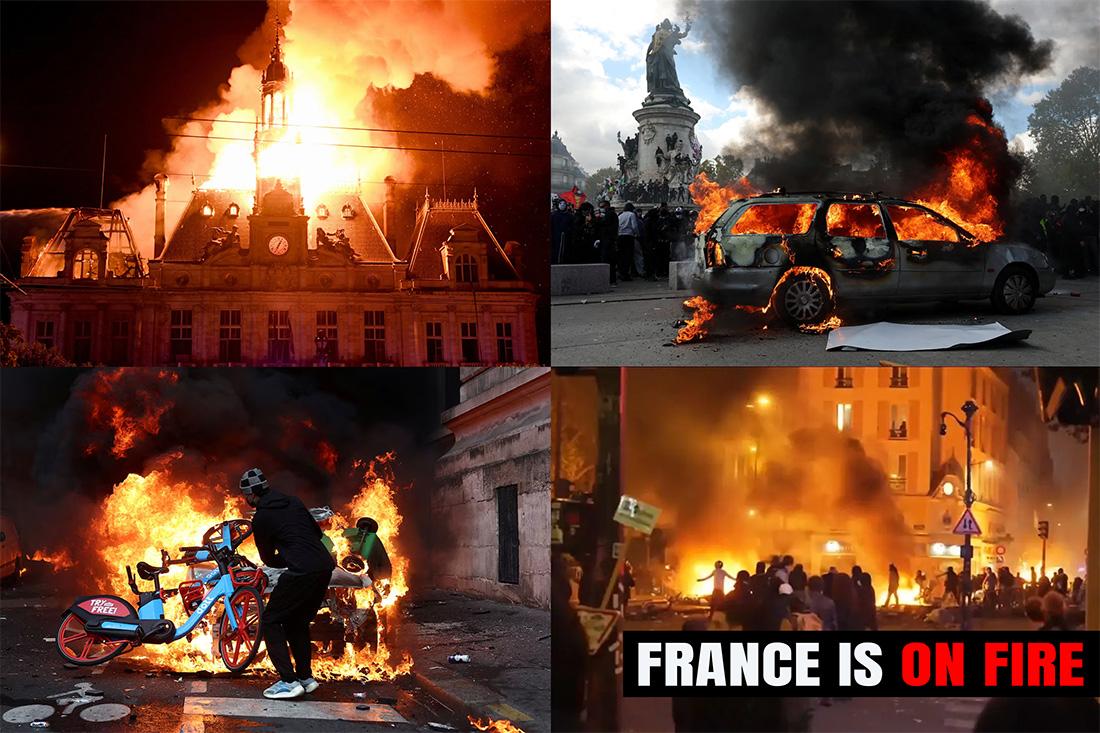
France, a nation whose modern political identity was forged through revolution, is confronting another extraordinary period of civil unrest. Streets have burned, businesses have been looted, public buildings have been attacked, and thousands of people have been arrested following demonstrations that began with grievances over education and expanded into a national confrontation over economic inequality, political leadership, and the future of the French social model.
The violence that erupted on October 17, 2026, was among the most destructive France has experienced in years. Yet the images of burning barricades, shattered storefronts, and heavily equipped riot police tell only part of the story. Behind them lies a deeper question: Why have so many French citizens lost confidence in their government’s ability to provide economic security, functioning public services, and a credible political future?
For President Emmanuel Macron, approaching the end of his presidency, the crisis represents a profound challenge to his political legacy. For France’s opposition parties, it presents both an opportunity and a dangerous test of leadership. For ordinary citizens, it raises fundamental questions about democratic protest, public safety, and whether political institutions remain responsive to the people they govern.
A National Crisis That Began in the Classroom
The current wave of unrest did not begin with burning vehicles or violent confrontations in central Paris. According to Reuters, the movement emerged in September from high schools in working-class northern suburbs of the capital, where students protested teacher absences, deteriorating facilities, and what they regarded as inadequate government support for education.
These complaints resonated beyond the schools themselves. Parents, teachers, and other citizens recognized similar difficulties across public services. Frustration over education became part of a larger conversation about healthcare, purchasing power, public spending, and the widening distance between political leaders and the people who depend on government institutions.
As the movement spread, students were joined by trade unionists, established protest organizations, and participants associated with the Yellow Vest movement that had challenged Macron’s government beginning in 2018. Their individual demands were not identical, but they shared a conviction that the economic and social burdens of modern France were being distributed unfairly.
The convergence of these groups transformed a series of education-related demonstrations into a nationwide movement. It also created a difficult challenge for authorities: the protests no longer had a single leadership structure, a unified set of demands, or a clearly defined negotiating partner.
October 17: The Day France’s Streets Erupted
On Saturday, October 17, demonstrators gathered across France in one of the largest protest mobilizations of the current crisis. Authorities estimated approximately 550,000 participants, while the CGT trade union reported a figure closer to 800,000. The difference reflects the longstanding disagreement between government and union estimates of demonstration attendance.
Most participants demonstrated peacefully. However, serious violence erupted in Paris, Marseille, Lyon, Bordeaux, Limoges, and other cities as groups of rioters attacked property, confronted police, erected barricades, and set fires.
In Paris, clashes spread through commercial districts and around major public spaces. Police deployed tear gas and other crowd-control equipment as businesses were damaged and looted. Similar confrontations developed elsewhere, overwhelming security personnel who had been deployed in anticipation of a large but more manageable day of protest.
The scale of the disorder became clearer over the following days. Arrest totals rose as police continued investigations and detained additional suspects. By October 21, Reuters reported approximately 2,500 arrests, with more than 900 people facing prosecution. Earlier reports had cited smaller totals because the figures were still being updated.
Authorities also reported extensive injuries among police and gendarmes, while demonstrators suffered serious injuries of their own. The human consequences of the unrest extend well beyond the dramatic photographs that circulated internationally.
The Burning of Limoges Town Hall
Among the most shocking events was the destruction of much of the historic town hall in Limoges, a nineteenth-century civic landmark. The building was set ablaze during the unrest, producing images that quickly became symbols of the crisis.
The destruction was significant not merely because of the architectural loss. Town halls in France represent the local presence of the Republic itself. They are places where citizens register births and marriages, conduct administrative business, and interact directly with government.
Attacking such a building carries a political and symbolic weight far beyond ordinary property damage. It transforms a confrontation over government policy into an assault on an institution that serves the local population, including people who may sympathize with the demonstrators’ underlying grievances.
Other municipal buildings were attacked or vandalized, while businesses suffered broken windows, theft, fire damage, and interrupted operations. In Lyon, a tourist office was set ablaze. In several cities, shopkeepers and residents returned to streets littered with debris and evidence of violent confrontations.
For business owners, the consequences were immediate: lost inventory, damaged premises, interrupted income, and uncertainty about whether another round of demonstrations might produce further destruction.
Why France’s Security Forces Were Overwhelmed
One of the most troubling aspects of the October 17 unrest was the apparent failure of security planning and intelligence assessments.
France deployed approximately 60,000 police officers and gendarmes in anticipation of the demonstrations. Nevertheless, security forces struggled to control multiple outbreaks of violence occurring simultaneously across geographically separated locations.
Reporting by Le Monde described how the scale and organization of the demonstrations surprised authorities. Some groups in Paris reportedly approached within several hundred meters of the Élysée Palace, the official residence and workplace of the French president.
The problem was not simply a shortage of personnel. Demonstrators and violent groups moved rapidly, assembled through social media, dispersed, and regrouped elsewhere. Traditional crowd-control arrangements proved less effective against fragmented gatherings operating across numerous locations.
Interior Minister Laurent Nuñez subsequently acknowledged that police had lost control in certain areas. The government promised a review of intelligence gathering, operational preparation, and the deployment of security personnel.
The failures exposed a difficult reality of modern public-order operations. Governments must protect the right to demonstrate while simultaneously preventing violence, protecting public infrastructure, and responding to groups whose intentions may be entirely different from those of peaceful protesters.
The Human Cost: Injuries, Fear, and Allegations of Excessive Force
Although images of burning vehicles and damaged buildings dominated international coverage, the unrest also produced serious human suffering.
AFP reported that a 17-year-old boy in Saint-Étienne lost his right hand following an incident involving a crowd-control grenade. In Mulhouse, a 17-year-old girl reportedly lost an eye. These incidents intensified scrutiny of the weapons and tactics employed by French police during demonstrations.
Police officers and gendarmes also suffered extensive injuries. Some were struck by projectiles, confronted by violent groups, or injured while attempting to restore order and protect public property.
France’s internal police watchdog has been investigating allegations of excessive force arising from the broader protest movement. Such investigations are essential because the legitimacy of law enforcement depends not only on its ability to maintain public order but also on its adherence to legal standards governing the use of force.
The distinction between peaceful protest and criminal violence must remain central to any fair assessment of these events. Citizens have a legitimate democratic interest in challenging government policy. That right does not extend to arson, looting, or physical attacks on other people.
Likewise, the presence of violent individuals within a demonstration does not automatically justify treating every participant as a criminal. Public trust depends on authorities making those distinctions carefully and consistently.
The Economic Pressures Behind the Anger
France’s unrest has developed against a background of prolonged concern over living costs, public debt, government spending, and the sustainability of the country’s social protections.
Households have faced pressure from energy prices, food costs, housing expenses, and other necessities. These pressures are particularly difficult for lower-income families and residents of communities where wages have not kept pace with everyday expenses.
For many protesters, the issue is not simply the price of a particular product. It is the belief that economic progress has become increasingly difficult to achieve, even while working, paying taxes, and participating in the formal economy.
France also faces the challenge of maintaining expensive public services while managing substantial government debt. Education, healthcare, pensions, transportation, and other programs form important parts of the French social model, but sustaining them requires political decisions about taxation, borrowing, and spending priorities.
These decisions have become increasingly contentious. Policies intended to stabilize public finances can appear to ordinary citizens as reductions in services or benefits. Conversely, expanding public spending without sustainable financing can increase concerns among investors and weaken confidence in the government’s fiscal management.
Reuters has reported that rising French government borrowing costs reflect investor concern over political instability and the country’s fiscal outlook. This introduces another dimension to the crisis: public unrest can complicate the very economic decisions that governments must make to address underlying grievances.
The Return of the Yellow Vests
The reappearance of the Yellow Vest movement is particularly significant because it connects the present unrest with one of the defining political confrontations of Macron’s presidency.
The movement emerged in 2018 in opposition to higher fuel taxes, particularly on diesel. It quickly expanded into a broad protest against living costs, economic inequality, and the perceived concentration of political power in Paris.
Its name came from the fluorescent safety vests that French motorists are required to carry in their vehicles. Those inexpensive garments became a powerful symbol of ordinary citizens challenging established political authority.
The movement attracted people from different political backgrounds, making it difficult to classify within traditional left-right divisions. Some participants were primarily concerned about taxation and household expenses; others demanded deeper changes to democratic institutions and political representation.
Macron’s government eventually introduced concessions, including financial measures intended to ease public dissatisfaction. The movement subsequently lost much of its momentum, but the underlying concerns did not disappear.
The Yellow Vests’ renewed participation suggests that a portion of the French public views the present crisis not as an isolated emergency but as a continuation of grievances that have remained unresolved for years.
Why France Has Such a Powerful Tradition of Protest
To understand the current demonstrations, it is necessary to appreciate the unusual place that public protest occupies in French political culture.
France’s national identity is deeply connected to the Revolution of 1789 and the subsequent development of republican government. Demonstrations, strikes, and mass mobilizations have repeatedly influenced political decisions throughout the country’s modern history.
Major protest movements helped shape the country’s labor protections, social institutions, and political debates. The events of May 1968, for example, demonstrated how student protests could expand into a nationwide confrontation involving workers, universities, and government authority.
For many French citizens, public demonstration is not simply a last resort after conventional politics has failed. It is an established form of civic participation through which people seek to influence decisions made by elected leaders.
That tradition does not mean that violence is universally accepted or that every protest movement represents the majority of the population. It does mean that governments in France must anticipate a level of public mobilization that may be unfamiliar in countries where demonstrations are less central to political life.
The present crisis reflects both the strength and the vulnerabilities of this tradition. Peaceful collective action can bring neglected grievances into public debate, while destructive violence can undermine public sympathy, injure innocent people, and shift attention away from the original demands.
Macron’s Response: Restore Order Without Silencing Dissent
President Emmanuel Macron has condemned the destruction and promised a stronger security response while acknowledging the legitimacy of peaceful protest.
In a national address on October 18, Macron criticized the violence, pledged support for affected businesses, and called for a review of the failures that allowed rioters to overwhelm security forces.
The president also faced criticism from opposition parties that accused his administration of failing to anticipate the scale of the unrest and protect the public.
Prime Minister Sébastien Lecornu subsequently authorized targeted curfews in some locations and announced a substantially reinforced security operation ahead of further demonstrations scheduled for October 24.
The government also discussed deploying military personnel in support of security arrangements, an approach that immediately raised questions about the appropriate role of armed forces in domestic public-order operations.
Macron’s administration faces a difficult balance. A response perceived as too weak could encourage further violence and deepen public fears about safety. A response viewed as excessively aggressive could increase anger, produce additional injuries, and strengthen claims that the government is attempting to suppress legitimate dissent.
Successful crisis management will therefore require more than police deployments. It will depend on whether the government can restore confidence in both public safety and the institutions responsible for addressing citizens’ concerns.
The Political Battle Ahead of the 2027 Presidential Election
The timing of the unrest is especially consequential because France is approaching its 2027 presidential election. Macron, constitutionally barred from seeking a third consecutive term, will leave office after a presidency defined by economic reform, European leadership, political confrontation, and repeated public protests.
The National Rally, associated with Marine Le Pen and Jordan Bardella, has criticized the government’s inability to maintain order. Its leaders argue that the unrest demonstrates the exhaustion of Macron’s political approach and the need for a different direction.
On the political left, Jean-Luc Mélenchon and France Unbowed have emphasized the grievances that brought demonstrators into the streets, arguing that the government must address inequality, public services, and the economic frustrations of younger citizens.
These competing interpretations reveal how the same events can become political evidence for very different arguments. One side emphasizes disorder and state authority; another emphasizes inequality and government accountability.
Neither interpretation, by itself, fully explains the crisis. The public’s dissatisfaction encompasses economic, institutional, generational, and political concerns that cannot be reduced to a single party’s platform.
The danger for France is that the coming election could become increasingly dominated by fear, anger, and mutual accusations rather than substantive discussion about how to improve the country’s economic and social conditions.
International Political Reactions and the Immigration Debate
The French unrest has also attracted attention from political figures outside Europe, including United States President Donald Trump, who publicly linked the disorder to immigration.
That interpretation has been disputed. Reporting by Reuters and other international news organizations identifies the principal drivers of the current demonstrations as education-related grievances, economic hardship, dissatisfaction with public services, and broader political frustration.
Immigration remains a major subject of political debate in France, but the existence of that debate does not establish immigration as the cause of the October demonstrations or the subsequent riots.
Assigning responsibility for complex civil unrest requires evidence about the participants, organizers, underlying grievances, and specific criminal incidents. Broad claims about entire populations cannot substitute for that evidence.
Macron has criticized foreign political commentary that he believes misrepresents the unrest. The exchange illustrates how domestic crises can become international political controversies, particularly when governments and opposition movements seek to use events abroad to reinforce their own political arguments.
France Is Not Alone: A Wider European Warning
The demonstrations have coincided with protests elsewhere in Europe, including Belgium, Italy, and Portugal, where citizens have also expressed concern over living costs and economic conditions.
These movements are not necessarily coordinated, and their local circumstances differ. Nevertheless, their simultaneous appearance suggests that dissatisfaction with purchasing power, public services, and economic insecurity extends beyond France.
European governments face similar structural challenges: aging populations, expensive social programs, energy costs, pressure on public finances, and the need to maintain economic competitiveness.
Political leaders must address these issues while preserving public confidence that the costs of reform are being shared fairly.
France’s unrest therefore matters internationally. It provides a visible example of how economic frustration can combine with political polarization and institutional distrust to produce a crisis that extends far beyond the original grievances.
The Economic Damage Extends Beyond Burned Buildings
The immediate destruction has been substantial. Businesses have lost merchandise, public facilities have been damaged, and municipalities face expensive cleanup and reconstruction work.
Reuters reported that more than 3,000 businesses were affected by the violence, while insurers and government officials discussed compensation and assistance for those suffering losses.
However, the broader economic consequences may be more difficult to measure. Repeated unrest can discourage tourism, interrupt transportation, reduce consumer activity, and create uncertainty for businesses considering investment.
France is one of the world’s major economies and an important center of European finance, manufacturing, aviation, tourism, and international commerce. Political instability can influence borrowing costs, investor confidence, and the government’s ability to implement economic policy.
The relationship can become self-reinforcing. Economic dissatisfaction produces protests; protests disrupt commercial activity and government decision-making; the resulting uncertainty makes economic recovery more difficult.
Breaking that cycle requires both credible public-order measures and policies that address the conditions motivating widespread dissatisfaction.
What Happens on October 24?
Another major demonstration is planned for Saturday, October 24, involving Yellow Vest supporters and student organizations. Trade unions have also called for additional mobilization, including a nationwide action scheduled for November 5.
French authorities have promised a significantly larger and more coordinated security response than the one deployed during the October 17 demonstrations.
Prime Minister Lecornu has also sought discussions with labor representatives about maintaining the right to demonstrate while preventing violence. Such negotiations may help establish clearer arrangements for peaceful protest, although they cannot guarantee that unaffiliated groups will comply.
The next demonstrations will test whether the government has learned from its operational failures and whether protest organizers can maintain public support while distancing their movements from destructive conduct.
They will also provide an early indication of whether the unrest is beginning to subside or developing into a sustained national confrontation.
As of October 22, the outcome of the planned October 24 demonstrations remains unknown. Predictions of further violence should not be treated as established fact.
Can France Restore Public Confidence?
France’s crisis cannot be understood solely through the number of arrests, the value of damaged property, or the size of police deployments. Those figures describe the immediate emergency, but they do not fully explain the conditions that made it possible.
The underlying problem is a growing perception among many citizens that government institutions are unable or unwilling to address their concerns effectively.
For students, that concern may begin with an absent teacher or a deteriorating school building. For workers, it may involve wages that fail to keep pace with household expenses. For business owners, it may mean the destruction of a livelihood during violence they neither supported nor caused.
For police officers, it may mean being ordered into dangerous confrontations without adequate preparation. For political leaders, it means attempting to preserve public order while confronting economic and institutional problems that cannot be resolved overnight.
These experiences are different, but they converge on the same question: Can the French Republic provide security, opportunity, accountability, and a meaningful political voice to the people it serves?
Conclusion: A Nation at a Crossroads
France has survived revolutions, wars, political upheavals, and repeated periods of mass protest. Its democratic institutions have demonstrated considerable resilience, and the present crisis should not automatically be interpreted as evidence of an approaching collapse.
Nevertheless, the events of October 2026 reveal serious strains within French society. Economic anxiety, declining confidence in public institutions, political polarization, and increasingly confrontational protest tactics have combined to create an unstable environment.
The government has an obligation to protect citizens, enforce the law, and safeguard the right to peaceful assembly. Protest leaders have a responsibility to reject violence and articulate demands that can be addressed through democratic institutions. Political parties must decide whether they will help resolve the crisis or exploit it for short-term electoral advantage.
France’s future will not be determined solely by what happens on the streets of Paris, Marseille, or Lyon. It will depend on whether the country’s leaders and citizens can rebuild enough mutual confidence to confront difficult economic and political decisions without allowing disagreement to become destruction.
The central question is not whether France will experience another protest. Its history makes future demonstrations virtually certain.
The more important question is whether the French Republic can transform this moment of anger into meaningful reform—or whether the divisions exposed by the unrest will continue to deepen as the country approaches its next presidential election.
For a nation whose revolutionary history helped define modern democracy, the answer carries significance far beyond its borders.
Sources and Further Reading
Reuters — Mass Protests in France Spiral Into Worst Riots in Years, October 17, 2026
Reuters — France in Turmoil: What Might Follow a Weekend of Riots?, October 19, 2026
Reuters — France to Deploy Troops, Admits Failures Over Weekend Unrest, October 20, 2026
Reuters — Macron Vows Order as France Prepares for Fresh Demonstrations, October 21, 2026
Agence France-Presse — Macron Denounces Violence as France Faces New Clashes, October 18, 2026
Agence France-Presse — France Counts the Cost of Violent Protests, October 18, 2026
Associated Press — The History Behind France’s Tradition of Protests, October 2026
Le Monde — Police Overwhelmed by October 17 Protest Turnout, October 18, 2026
Al Jazeera — France Announces Curfews Following Violent Protests, October 19, 2026