


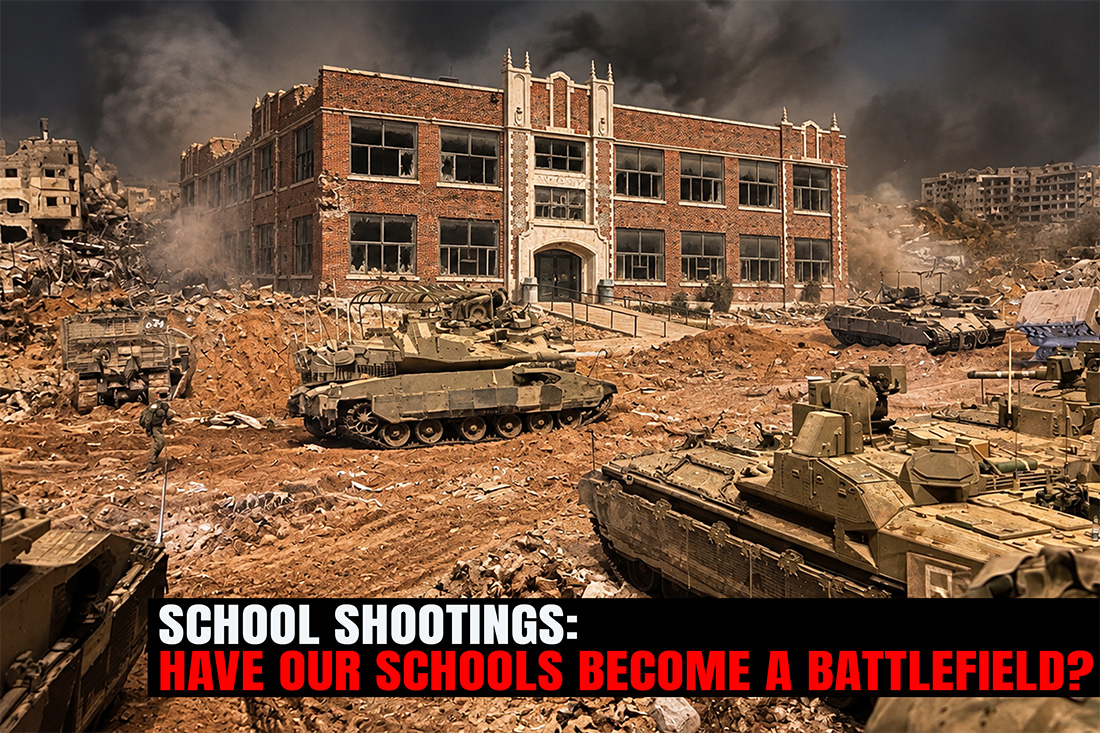
America has a school-shooting problem that continues to challenge educators, law enforcement, psychologists, policymakers, and families. Every major attack generates renewed demands for answers, and one question repeatedly returns to the national conversation: Could America’s fascination with violent computer games be contributing to the violence occurring inside its schools? A new ASX Research investigation examines that possibility through 20 peer-reviewed scholarly publications, separating scientific findings from speculation and examining whether the relationship is causal, coincidental, or substantially more complicated.
A Disturbing Question Worth Asking
The theory is straightforward and emotionally compelling. Millions of Americans spend countless hours navigating virtual battlefields, firing simulated weapons, eliminating opponents, and receiving rewards for successful combat. Could repeated participation in such environments condition some individuals to become more comfortable with violence? Research by Rapa et al. (2024) documents the serious and evolving problem of school firearm incidents in the United States, but does not establish computer gaming as their cause. The distinction between a plausible hypothesis and a demonstrated causal relationship is where this investigation begins.
The question becomes particularly challenging when investigators attempt to determine what distinguishes a school shooter from millions of otherwise ordinary gamers. Ferguson (2008) examined the proposed relationship between violent video games and school shootings, challenging the scientific foundation of claims connecting the two. The mere discovery that a perpetrator played violent games is insufficient to establish causation. A meaningful investigation must determine whether that activity contributed independently to the attack or simply represented a common recreational interest.
Does Simulated Violence Produce Real Aggression?
Some scientific findings support the proposition that violent gaming can influence aggressive thoughts and behavior. Anderson et al. (2010), in an influential meta-analysis, identified statistically significant relationships between violent video game exposure and several aggression-related outcomes. Their findings have frequently been cited in arguments that violent interactive entertainment can influence human behavior. However, the research did not establish that gaming produces school shootings, and its aggression measures cannot automatically be equated with planned homicide.
An assessment by Calvert et al. (2017) likewise identified associations between violent video game exposure and aggression-related outcomes. Yet the investigators acknowledged that the available evidence was insufficient to evaluate connections with delinquency or criminal behavior. This qualification is critically important. An increase in aggressive thoughts or reactions under experimental conditions does not demonstrate that an individual will commit a serious violent crime, much less a school shooting.
The scientific debate intensified when Hilgard et al. (2017) reexamined the evidence used in an influential earlier meta-analysis. Their research identified publication bias and found that adjustments substantially reduced estimates of certain effects. The implications extend beyond gaming: when published findings disproportionately favor statistically significant outcomes, the apparent strength of a psychological relationship can be exaggerated. Establishing the actual magnitude of gaming-related aggression requires careful methodological scrutiny.
What Happens After Years of Gaming?
Longitudinal studies attempt to determine whether behavioral effects persist beyond individual gaming sessions. Prescott et al. (2018) examined prospective research involving more than 17,000 participants and reported a small but statistically significant relationship between violent gaming and subsequent physical aggression. This finding deserves consideration, but physical aggression and school shootings are fundamentally different outcomes. The existence of one association does not establish the other.
Other investigators have reported considerably weaker results. Drummond et al. (2020), analyzing longitudinal research involving approximately 21,000 young people, found small overall associations and reported that studies employing stronger methodological practices produced effects statistically indistinguishable from zero. Their findings challenge the assumption that repeated exposure to violent games necessarily creates progressively more aggressive individuals.
Przybylski and Weinstein (2019) conducted a preregistered investigation of adolescent gaming and aggression and found no evidence supporting the predicted relationship between violent gaming engagement and aggressive behavior. Preregistration is particularly valuable because researchers establish their analytical methods before examining results. The conflicting findings across these investigations demonstrate why a serious assessment must evaluate research quality rather than simply count studies supporting a preferred conclusion.
Are Games the Cause, or Are They an Escape?
One of the most difficult questions concerns the direction of causation. A socially isolated or emotionally distressed teenager might spend extensive time playing computer games. But does gaming produce the isolation, or does the individual turn to gaming because isolation already exists? DeCamp and Ferguson (2017) examined gaming alongside family background and other influences on youth violence, illustrating why researchers must account for environmental and personal circumstances before assigning responsibility to entertainment habits.
Population-level evidence raises additional questions. Ferguson (2015) examined relationships between violent entertainment and societal violence, challenging the assumption that greater exposure necessarily corresponds with greater real-world violence. Such comparisons cannot eliminate every possible individual effect, but they do require advocates of a broad gaming-related explanation to account for historical patterns that do not consistently follow the theory.
What Do We Know About School Shooters?
Investigations specifically examining school-shooting perpetrators reveal considerable differences among individuals and incidents. Ferguson et al. (2011) reviewed psychological approaches to school shooters and criticized attempts to establish simplistic connections between violent games and school attacks. A common recreational interest cannot serve as a reliable perpetrator profile when millions of people share that interest without committing violence.
Research by Leary et al. (2003) examined 15 school-shooting incidents and identified experiences of acute or chronic social rejection in 13 cases. These experiences included bullying, ostracism, and romantic rejection. Although rejection cannot independently explain extreme violence, the findings suggest that social experiences and personal grievances may be important elements in certain perpetrators’ histories.
Newman and Fox (2009) examined rampage shootings in American educational settings and identified interacting explanatory dimensions involving social marginality, individual characteristics, cultural influences, institutional failures, and firearm availability. Their work illustrates why school shootings cannot be understood adequately through a single entertainment-related explanation. Cultural influences may matter, but they operate within broader personal and social circumstances.
Flannery et al. (2013) similarly emphasized the limitations of universal school-shooter profiles and the importance of comprehensive threat assessment. An investigative approach focused primarily on violent gaming could incorrectly characterize large numbers of nonviolent students while overlooking more meaningful indicators of developing threats. Observable behavior, credible threats, and individual circumstances offer a more appropriate foundation for prevention.
Dowdell et al. (2022) reviewed media reports involving 25 American male school shooters between 2013 and 2019. Their analysis identified reported adverse childhood experiences, bullying, and concerning social-media activity among recurring characteristics. Approximately 72% of the cases involved at least one reported adverse childhood experience, while 60% included reported bullying. Although media-based case studies have important limitations, the findings reinforce the importance of examining perpetrators’ broader developmental and social environments.
There Is One Factor a Computer Game Cannot Supply
However violent a digital environment becomes, a computer game does not provide the physical weapon used in a school shooting. Nassauer (2025) examined firearm culture and accessibility among school-shooting perpetrators, identifying the importance of firearms within perpetrators’ environments and their access to weapons. The distinction between imagining violence and possessing the means to commit it remains central to understanding how violent intentions become actual attacks.
Knapp and Fridel (2025) compared nonfatal school shootings with other forms of public gun violence and identified relatively limited differences in their individual and contextual correlates. Their findings suggest that at least some school firearm incidents share characteristics with broader patterns of American gun violence. Definitions matter considerably: an interpersonal dispute involving a firearm at school is not necessarily equivalent to a planned mass attack, and the causes of different incident categories should not be assumed identical.
Rees et al. (2019) examined two highly publicized school shootings through a root-cause analysis and identified numerous potential contributing conditions involving policy, personal circumstances, and environmental factors. Although the small number of cases limits generalization, their work demonstrates the analytical weakness of searching for one universal explanation. Extreme violence may emerge when multiple circumstances converge rather than from exposure to one form of entertainment.
Could Actual School Shootings Inspire More Violence?
Another research direction involves the possibility of imitation following real-world attacks. Towers et al. (2015) identified statistical evidence consistent with short-term contagion in mass killings and school shootings, with their model suggesting an elevated risk period of approximately 13 days following certain incidents. This research concerns patterns associated with actual violent events, not proof that fictional gaming environments produce school shootings. The distinction between exposure to simulated violence and publicity surrounding real attacks deserves particular attention.
Peterson et al. (2021) examined the presence of armed school officials and the numbers of fatal and nonfatal gunshot injuries during mass school shootings. Their investigation highlights the importance of studying prevention, security, and attack outcomes as separate questions. Policies intended to identify violent intentions, prevent weapon access, interrupt an attack, or reduce casualties address different stages of a potentially violent event. None can be assumed effective merely because it appears intuitively appealing.
America May Be Asking the Wrong Question
The evidence reveals substantial gaps in what researchers actually know about PC gaming and school shootings. Much existing research combines computer, console, and other gaming platforms rather than isolating PC gaming. Studies also differ in how they measure violent content, playing time, competitive behavior, problematic use, and aggression. Future investigations would benefit from independently verified perpetrator gaming histories, appropriate comparison groups, clearly defined shooting categories, and rigorous controls for social, developmental, psychological, and firearm-related variables.
The Conclusion: An Uncomfortable Answer
The ASX Research investigation does not establish that America’s obsession with PC gaming directly causes school shootings. Some peer-reviewed studies associate violent gaming with modest increases in aggression-related measures; others identify negligible or statistically insignificant effects. None of the evidence examined establishes a direct causal progression from playing violent computer games to committing a school shooting. Instead, the literature points toward interacting circumstances involving personal vulnerabilities, social experiences, threatening behavior, institutional responses, and access to firearms. This does not mean digital environments are beyond scientific scrutiny. It means that identifying the wrong cause of school shootings could distract society from circumstances and interventions more directly relevant to preventing them.
About the Research
This article is adapted from the 19-page ASX Research publication, “Are School Shootings a Direct Result of America’s Obsession with PC Gaming?” by Albert N. Clark, published October 23, 2026, in the ASX Research Journal and Database (ISSN 3068-3351). The original interdisciplinary literature review examines 20 peer-reviewed scholarly publications concerning violent gaming, aggression, school shootings, criminology, public health, and violence prevention.
Scholarly References
Anderson, C. A., Shibuya, A., Ihori, N., Swing, E. L., Bushman, B. J., Sakamoto, A., Rothstein, H. R., & Saleem, M. (2010). Violent video game effects on aggression, empathy, and prosocial behavior in Eastern and Western countries: A meta-analytic review. Psychological Bulletin, 136(2), 151–173.
Calvert, S. L., Appelbaum, M., Dodge, K. A., Graham, S., Nagayama Hall, G. C., Hamby, S., Fasig-Caldwell, L. G., Citkowicz, M., Galloway, D. P., & Hedges, L. V. (2017). The American Psychological Association Task Force assessment of violent video games: Science in the service of public interest. American Psychologist, 72(2), 126–143.
DeCamp, W., & Ferguson, C. J. (2017). The impact of degree of exposure to violent video games, family background, and other factors on youth violence. Journal of Youth and Adolescence, 46(2), 388–400.
Dowdell, E. B., Freitas, E., Owens, A., & Greenle, M. M. (2022). School shooters: Patterns of adverse childhood experiences, bullying, and social media. Journal of Pediatric Health Care, 36(4), 339–346.
Drummond, A., Sauer, J. D., & Ferguson, C. J. (2020). Do longitudinal studies support long-term relationships between aggressive game play and youth aggressive behaviour? A meta-analytic examination. Royal Society Open Science, 7(7), Article 200373.
Ferguson, C. J. (2008). The school shooting/violent video game link: Causal relationship or moral panic? Journal of Investigative Psychology and Offender Profiling, 5(1–2), 25–37.
Ferguson, C. J. (2015). Does movie or video game violence predict societal violence? It depends on what you look at and when. Journal of Communication, 65(1), 193–212.
Ferguson, C. J., Coulson, M., & Barnett, J. (2011). Psychological profiles of school shooters: Positive directions and one big wrong turn. Journal of Police Crisis Negotiations, 11(2), 141–158.
Flannery, D. J., Modzeleski, W., & Kretschmar, J. M. (2013). Violence and school shootings. Current Psychiatry Reports, 15(1), Article 331.
Hilgard, J., Engelhardt, C. R., & Rouder, J. N. (2017). Overstated evidence for short-term effects of violent games on affect and behavior: A reanalysis of Anderson et al. (2010). Psychological Bulletin, 143(7), 757–774.
Knapp, K. G., & Fridel, E. E. (2025). Are school shootings a unique form of violence? A comparison of the individual and contextual correlates of nonfatal school shootings and youth gun violence. Journal of Interpersonal Violence. Advance online publication.
Leary, M. R., Kowalski, R. M., Smith, L., & Phillips, S. (2003). Teasing, rejection, and violence: Case studies of the school shootings. Aggressive Behavior, 29(3), 202–214.
Nassauer, A. (2025). “The only friend I had was my gun”: A mixed-methods study of gun culture in school shootings. PLOS ONE, 20(4), Article e0322195.
Newman, K., & Fox, C. (2009). Repeat tragedy: Rampage shootings in American high school and college settings, 2002–2008. American Behavioral Scientist, 52(9), 1286–1308.
Peterson, J., Densley, J., & Erickson, G. (2021). Presence of armed school officials and fatal and nonfatal gunshot injuries during mass school shootings, United States, 1980–2019. JAMA Network Open, 4(2), Article e2037394.
Prescott, A. T., Sargent, J. D., & Hull, J. G. (2018). Metaanalysis of the relationship between violent video game play and physical aggression over time. Proceedings of the National Academy of Sciences, 115(40), 9882–9888.
Przybylski, A. K., & Weinstein, N. (2019). Violent video game engagement is not associated with adolescents’ aggressive behaviour: Evidence from a registered report. Royal Society Open Science, 6(2), Article 171474.
Rapa, L. J., Katsiyannis, A., Scott, S. N., & Durham, O. (2024). School shootings in the United States: 1997–2022. Pediatrics, 153(4), Article e2023064311.
Rees, C. A., Lee, L. K., Fleegler, E. W., & Mannix, R. (2019). Mass school shootings in the United States: A novel root cause analysis using lay press reports. Clinical Pediatrics, 58(13), 1423–1428.
Towers, S., Gomez-Lievano, A., Khan, M., Mubayi, A., & Castillo-Chavez, C. (2015). Contagion in mass killings and school shootings. PLOS ONE, 10(7), Article e0117259.