


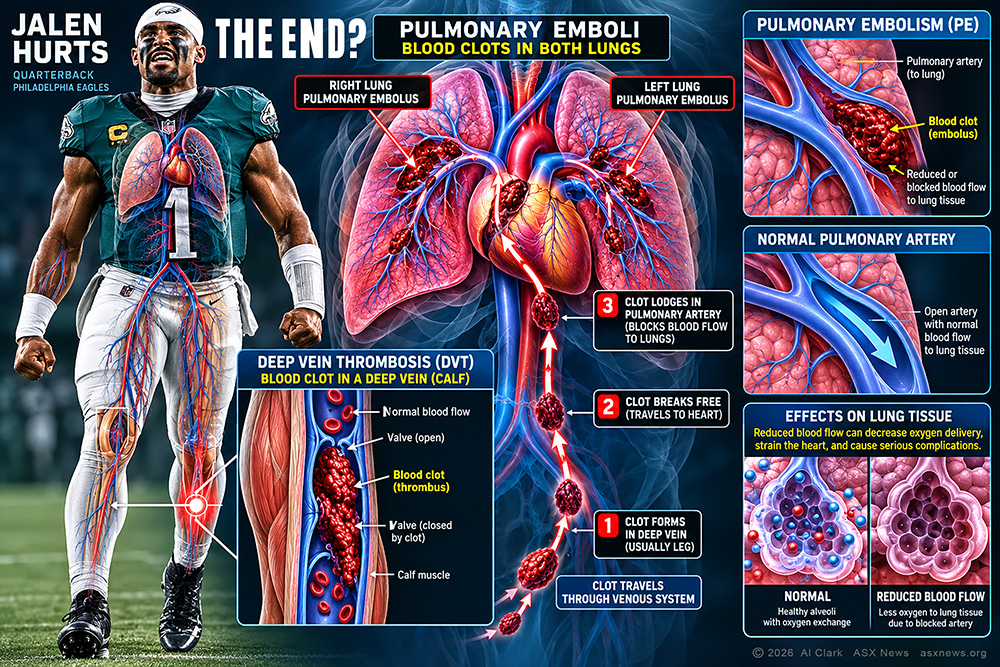
PHILADELPHIA, October 20, 2026 — Philadelphia Eagles quarterback Jalen Hurts is expected to miss the remainder of the 2026 NFL season after doctors diagnosed him with deep vein thrombosis (DVT) and bilateral pulmonary emboli, a potentially life-threatening condition involving blood clots in both lungs. The diagnosis, confirmed Monday in a joint statement from the Eagles and Hurts’ agent, Nicole Lynn, has prompted widespread concern about the quarterback’s health and renewed scrutiny of medical decisions made before and after the team’s October 11 game in London.
Hurts, 28, is reportedly clinically stable and has no significant functional limitations. His medical team expects a full recovery, but treatment with anticoagulant medications will prevent him from participating in contact football until physicians determine that it is safe to discontinue treatment. Although the Eagles have not announced an official return date, NFL Network and ESPN have reported that his recovery is expected to take approximately three months, making a return during the current season unlikely.
From a Calf Injury to Blood Clots in Both Lungs
The sequence began October 4, when Hurts sustained a cleat injury to his calf during Philadelphia’s game against the Los Angeles Rams. According to the chronology subsequently released by the Eagles, Hurts informed the team’s medical personnel about the injury on October 8 and received treatment. He participated fully in practice the following day before traveling with the team to London for its game against the Jacksonville Jaguars.
On October 10, medical specialists in London performed an ultrasound examination and identified superficial vein thrombosis in Hurts’ left calf. This condition involves clot formation in a vein near the skin’s surface. Although superficial thrombosis is generally less dangerous than a clot in a deep vein, its significance depends on its location, extent, and relationship to the deeper venous circulation.
Hurts subsequently played against Jacksonville on October 11, despite the documented clot and reports that he had undergone hospital evaluation during the preceding night. The Eagles lost the game 19–17. Following the contest, Hurts returned to the United States with the team, an international flight that has since attracted additional attention because prolonged immobility can contribute to venous clotting under certain circumstances.
Hurts received additional treatment after returning home and participated in a full practice on October 14. However, a follow-up ultrasound examination that evening revealed movement involving the previously identified clot. On October 15, the Eagles announced that Hurts would miss the upcoming game against the Carolina Panthers. He was subsequently placed on injured reserve.
On October 19, the Eagles and Lynn disclosed the more serious diagnosis: deep vein thrombosis and bilateral pulmonary emboli. Their statement indicated that Hurts would undergo anticoagulation treatment, remain involved with the team, and continue appropriate conditioning while avoiding contact activities. The organization expressed confidence that he would recover without lasting medical consequences.
Understanding Deep Vein Thrombosis and Pulmonary Embolism
Deep vein thrombosis occurs when a blood clot forms within a deep vein, most commonly in the legs. A clot may partially or completely obstruct normal venous blood flow, producing symptoms such as swelling, pain, tenderness, or discoloration. However, some patients experience few obvious symptoms, making the condition difficult to recognize without diagnostic imaging.
The principal danger arises when part of a clot detaches, travels through the venous circulation and heart, and becomes lodged in an artery supplying the lungs. This event is called a pulmonary embolism. Depending on the size, number, and location of the emboli, the resulting obstruction can impair oxygen exchange, place excessive strain on the right side of the heart, and, in severe cases, cause cardiovascular collapse or death.
Bilateral pulmonary emboli means that emboli are present in the pulmonary circulation of both lungs. Importantly, the term does not independently establish the severity of a patient’s condition. Physicians evaluate additional factors, including blood pressure, oxygen saturation, cardiac function, imaging findings, and evidence of right ventricular strain.
In Hurts’ case, the Eagles’ description of him as clinically stable without significant functional limitations is encouraging. Nevertheless, stability at the time of diagnosis does not make pulmonary embolism a trivial condition. Continued treatment and medical supervision are essential to reducing the risk of additional clot formation or complications.
Why Anticoagulants Could End His Season
Anticoagulants, commonly called blood thinners, are a primary treatment for DVT and pulmonary embolism. These medications reduce the blood’s ability to form additional clots and help prevent existing clots from extending while the body gradually breaks them down. They do not ordinarily dissolve an established clot immediately.
The treatment presents a particular challenge for professional football players. Because anticoagulants increase bleeding risk, the collisions and injuries associated with contact football can become especially dangerous. A seemingly routine tackle could produce internal bleeding or another complication that would otherwise be less likely in an athlete not receiving anticoagulation.
Medical specialists interviewed by The Philadelphia Inquirer have indicated that treatment may require at least three months, although individual treatment duration depends on the clinical circumstances and physician assessment. The Eagles have explicitly stated that Hurts will not participate in contact football while receiving anticoagulants. His eventual return will therefore depend on his medical recovery and treatment status rather than simply his physical conditioning.
Questions Surrounding the London Game
The case has also generated questions about whether Hurts should have played in London after doctors identified the initial superficial clot. Reports indicate that he underwent medical evaluation in the hours preceding the Jacksonville game. The decision to allow him to compete, followed by the team’s international flight home, has become a subject of public debate.
At a Monday press conference, Eagles head coach Nick Sirianni defended the organization’s handling of the situation, emphasizing his reliance on the team’s medical professionals. He stated that decisions about player health are made with the involvement of specialists and expressed confidence in the personnel responsible for evaluating Hurts.
Those explanations have not resolved every question. The precise location and extent of the original superficial clot, the medical reasoning supporting clearance to play, the evaluation of travel-related risks, and the timing of subsequent diagnostic findings are relevant to understanding the decisions made. The complete clinical record has not been publicly disclosed, and it would be premature to conclude that medical negligence occurred.
Likewise, the available information does not establish that the original superficial clot directly developed into the deep vein thrombosis or pulmonary emboli. Although related clotting processes are medically possible, determining the exact progression in Hurts’ case would require clinical evidence beyond the public statements.
Can Elite Athletes Develop Dangerous Blood Clots?
Hurts’ diagnosis illustrates an important medical reality: exceptional physical conditioning does not eliminate the risk of venous thromboembolism. Athletic fitness may provide numerous cardiovascular benefits, but clot formation can still occur in association with injuries, prolonged immobility, inherited clotting disorders, inflammation, or combinations of risk factors.
In professional sports, frequent travel and traumatic injuries introduce circumstances that warrant careful medical assessment. However, the presence of those circumstances does not establish that any particular factor caused Hurts’ condition. His individual risk factors and the precise mechanism of clot formation remain matters for his treating physicians.
The case also offers a broader public-health lesson. Sudden unexplained shortness of breath, chest pain, coughing blood, fainting, or rapid deterioration may indicate a pulmonary embolism and require emergency medical evaluation. Unexplained leg swelling or pain can also warrant prompt assessment for DVT. Early recognition and appropriate treatment can substantially improve outcomes.
What Happens Next for Philadelphia?
For the Eagles, the loss of their starting quarterback creates an immediate competitive challenge. Hurts led Philadelphia to its Super Bowl championship in February 2025 and remains a central figure in the team’s offensive identity. His prolonged absence will require adjustments to quarterback responsibilities, offensive planning, and the organization’s expectations for the remainder of the season.
For Hurts, however, the immediate priority is medical recovery. The team has indicated that he can remain active around the organization and continue conditioning within medically approved limits. His ability to resume contact football will depend on successful treatment, appropriate follow-up evaluation, and clearance from his physicians.
The Eagles’ expectation of a full recovery is reassuring, but the public should distinguish an encouraging prognosis from a guaranteed timetable. Pulmonary embolism is a serious diagnosis, and the absence of major current symptoms does not justify accelerating a return to high-impact professional competition.
A Career Temporarily Interrupted, Not Necessarily Ended
As of October 20, Hurts’ football future remains uncertain in the short term but encouraging in the longer term. Reports suggest that his 2026 season is likely over, while the Eagles and his agent anticipate that he can return to professional football once anticoagulation treatment is complete and his medical team authorizes contact activity.
The unfolding story now involves two separate questions: whether Hurts can recover safely, and whether the decisions surrounding his original diagnosis were medically appropriate. The first will be answered through treatment and follow-up examinations. The second requires a careful examination of documented facts rather than speculation.
For now, the most significant outcome would not be an early return to the field. It would be a complete recovery that allows Jalen Hurts to resume his career without compromising his long-term health.
Sources
Philadelphia Eagles. (2026, October 19). Eagles and Jalen Hurts’ agent Nicole Lynn provide an update on QB Jalen Hurts.
NFL.com. (2026, October 19). Eagles QB Jalen Hurts likely out for rest of 2026 season due to blood clots.
Reuters. (2026, October 19). Eagles quarterback Hurts set to miss rest of season due to blood clots.
ABC News. (2026, October 19). Eagles coach defends handling of Jalen Hurts’ blood clots diagnosis: What to know.
The Philadelphia Inquirer. (2026, October 19). Jalen Hurts’ pulmonary embolism means blood thinners and no football for the near future, Philly specialists explain.