


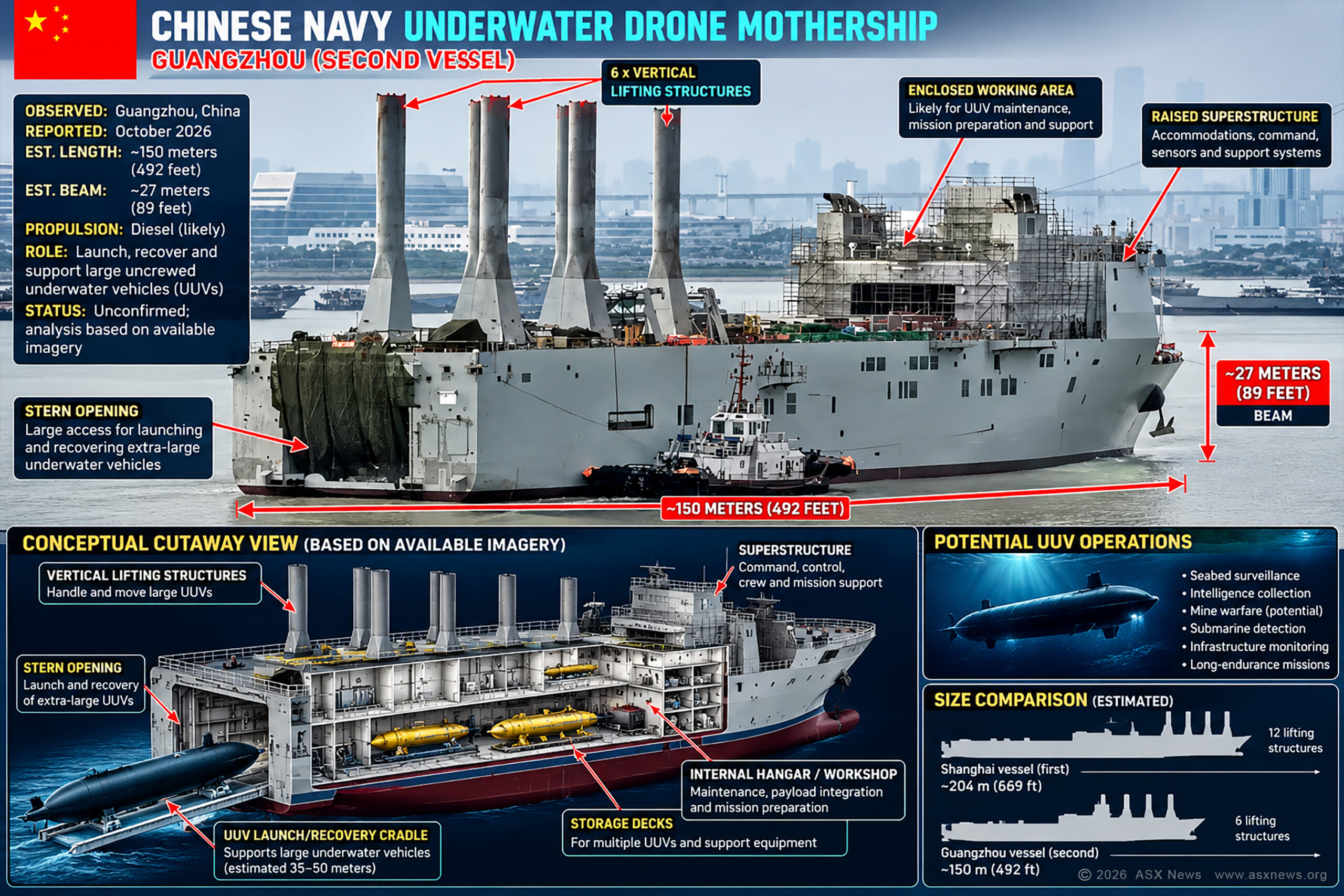
BEIJING — A second mysterious Chinese naval vessel has emerged from a shipbuilding center in southern China, strengthening suspicions that the People’s Liberation Army Navy (PLAN) is developing a new class of specialized ships capable of deploying and recovering enormous uncrewed underwater vehicles. The appearance of the vessel, reported on October 18, 2026, suggests that China’s ambitions in autonomous undersea warfare may extend considerably beyond experimental submarines and individual prototype systems.
The latest vessel was observed under tow on the Pearl River near Guangzhou, where video footage circulating on Chinese social media revealed an unusual stern arrangement, a large enclosed working area, and six prominent vertical structures that analysts believe could form part of an underwater vehicle handling system. Its appearance follows the discovery of a significantly larger and similarly configured ship under construction in Shanghai. Neither vessel’s intended mission has been officially confirmed by Chinese authorities.
Two Ships, One Intriguing Possibility
According to reporting by Naval News and The War Zone, the larger Shanghai vessel measures approximately 204 meters (669 feet) in length and 30 meters (98 feet) across its widest point. It has been under construction at the Hudong-Zhonghua shipbuilding complex on Changxing Island since at least April 2026. The ship features a large aft working area and twelve vertical lifting structures arranged around a stern opening that could accommodate an exceptionally large underwater payload.
The newly observed Guangzhou vessel appears smaller, with an estimated length of approximately 150 meters (492 feet). Its six lifting structures differ in configuration from those aboard the Shanghai ship, but the vessels share several important characteristics: raised forward superstructures, substantial enclosed working spaces, diesel exhaust arrangements, and large stern openings. These similarities have prompted analysts to consider whether both designs are intended to support the same emerging category of naval technology.
Importantly, the Guangzhou imagery has not been independently authenticated beyond doubt. Naval News reports that preliminary examinations of the circulating videos support their apparent authenticity, while acknowledging the possibility of digital enhancement. The vessel’s precise builder also remains uncertain. Several Guangzhou-area shipyards could have participated in construction or subsequent fitting-out.
What Is an Underwater Drone Mothership?
A mothership is a larger vessel designed to transport, deploy, recover, maintain, and support smaller craft. The concept is familiar in aviation, where aircraft carriers provide mobile operating bases for aircraft. Applied to underwater robotics, a mothership could perform a similar function for autonomous or remotely operated submersibles, allowing them to begin missions far from their original ports and return for servicing without necessarily making a lengthy voyage home.
Such a vessel could carry underwater vehicles, launch them through a stern opening or specialized cradle, and recover them following operations. Depending on its actual equipment, it might also provide electrical charging, fuel, communications support, mission preparation, mechanical maintenance, and the transfer of collected sensor data. These functions are potential capabilities of a dedicated UUV support ship, not confirmed features of either newly observed Chinese vessel.
The suspected lifting arrangements are particularly noteworthy. Analysts examining the Shanghai ship have identified a possible cradle system with sufficient space to handle payloads approaching 50 meters in length. If that interpretation proves correct, the vessel could accommodate underwater vehicles dramatically larger than the small reconnaissance drones commonly associated with autonomous maritime operations.
China’s Growing Fleet of Giant Underwater Vehicles
The suspected motherships are appearing against the backdrop of China’s development of increasingly large uncrewed underwater vehicles, or UUVs. Open-source analysts have identified experimental Chinese underwater craft estimated to measure approximately 35 to 45 meters in length. Vehicles of that size approach the dimensions of some crewed military submarines, creating engineering and logistical challenges far beyond those associated with conventional underwater drones.
Size matters because larger underwater vehicles can potentially accommodate more substantial energy systems, sensors, communications equipment, and mission payloads. Greater internal volume may also permit longer endurance, although actual range and operational capability depend on propulsion, power generation, hydrodynamic efficiency, payload demands, and other engineering factors that remain unknown for the Chinese designs.
For comparison, the United States has developed the Boeing Orca extra-large uncrewed underwater vehicle, an experimental system intended to demonstrate long-endurance autonomous underwater operations. China’s reported experimental vehicles are considerably larger in overall dimensions, but physical size alone does not establish superior performance, technological maturity, or combat effectiveness.
The appearance of specialized support ships would represent an important additional step. Building a large underwater drone demonstrates the ability to produce a vehicle. Developing ships to deploy, recover, and sustain those vehicles at sea suggests attention to the much more complicated problem of operating them as a repeatable naval capability.
From Experimental Technology to Naval Infrastructure
Military technologies frequently encounter their greatest obstacles after successful prototype demonstrations. Underwater drones must navigate without continuous satellite positioning, communicate through an environment that severely restricts conventional radio transmissions, conserve limited onboard energy, and operate safely around ships, seabed obstacles, and other underwater vehicles.
Recovery at sea presents another demanding engineering problem. Waves, currents, vessel movement, underwater visibility, and the relative motion between a large drone and its support ship complicate docking and retrieval. A specially designed stern cradle or lifting mechanism could address some of these challenges, particularly for vehicles too large to handle with conventional shipboard cranes.
If the Chinese vessels are ultimately confirmed as UUV motherships, their development could indicate that the PLAN is exploring ways to make autonomous underwater operations more sustainable and geographically flexible. Two different ship sizes might reflect competing experimental approaches, distinct operational requirements, or complementary support roles. The available evidence does not yet establish which explanation is correct.
Surveillance, Submarine Detection, and Seabed Operations
The military applications of large autonomous underwater vehicles are extensive. Depending on their design and payloads, such systems could collect oceanographic data, survey the seabed, monitor maritime traffic, investigate underwater infrastructure, or deploy acoustic and other sensors. Some designs could potentially support mine warfare, intelligence collection, or weapons delivery.
Long-endurance underwater vehicles could be particularly useful in establishing a persistent understanding of strategically important waters. A network of mobile or stationary sensors could supplement traditional ships, submarines, maritime patrol aircraft, and seabed surveillance systems. However, detecting and reliably tracking submarines remains a technically demanding task, and the presence of large underwater drones would not automatically create an effective anti-submarine warfare network.
There is also a significant distinction between collecting environmental information and conducting offensive military operations. At present, no publicly verified evidence establishes that either newly observed Chinese vessel carries armed underwater drones, that its vehicles have operational weapons, or that specific combat missions have been assigned.
Why the Philippines Should Pay Attention
For the Philippines, the possible development of mobile underwater drone support ships has important long-term security implications. The South China Sea contains contested maritime areas, major commercial shipping routes, submarine operating environments, and strategically valuable underwater infrastructure. Greater Chinese capacity to sustain autonomous undersea operations could eventually complicate regional maritime surveillance and defense planning.
Large UUVs might be used to survey underwater approaches, collect acoustic intelligence, examine seabed conditions, or monitor areas near important sea lanes. Such activities could support legitimate scientific research, military intelligence collection, or preparations for future operations, depending on the equipment carried and the circumstances of deployment. The same technology can serve multiple purposes, making intentions difficult to determine from appearance alone.
The Philippine Sea and the waters surrounding the Luzon Strait are also strategically significant because they connect the South China Sea with the wider Pacific. Any future ability to deploy large underwater vehicles from mobile support ships could influence how regional navies monitor maritime approaches, protect critical infrastructure, and assess underwater activity.
These are strategic possibilities rather than evidence that either newly observed vessel has operated near the Philippines. No verified deployment of the two suspected motherships into Philippine waters has been established by the reporting available as of October 19, 2026.
The Challenge for the United States and Its Allies
The United States, Japan, Australia, and other maritime powers are also investing in autonomous naval technologies. The emergence of potential Chinese UUV motherships underscores a broader technological competition involving underwater endurance, artificial intelligence, autonomous navigation, communications, and distributed maritime sensing.
Large numbers of autonomous underwater vehicles could eventually require naval planners to rethink established approaches to surveillance and undersea defense. Traditional anti-submarine warfare has largely focused on locating and tracking crewed submarines. Autonomous platforms introduce additional possibilities, including lower-cost persistent sensors, distributed missions, and systems that may operate without an onboard crew.
Yet underwater autonomy remains constrained by physics. Acoustic communications offer limited bandwidth, underwater positioning can accumulate errors, and complex environments make reliable autonomous decisions difficult. Successful naval integration will depend as much on maintenance, logistics, software reliability, and command arrangements as on the size or sophistication of individual drones.
What Happens Next?
Several developments could clarify the purpose of China’s unusual new ships. Additional photographs might reveal their launch and recovery mechanisms, communications equipment, specialized deck machinery, or internal working arrangements. Sea trials could demonstrate how the stern openings and lifting structures function. The appearance of hull numbers, military markings, or associated underwater vehicles would provide further evidence of their intended role.
Analysts will also be watching whether the two vessels are fitted out for operational service, remain experimental platforms, or lead to additional construction. Their different dimensions may ultimately prove as significant as their similarities, especially if China is testing multiple approaches to supporting exceptionally large underwater vehicles.
For now, the most important conclusion is also the most cautious: China has produced two unusual vessels whose configurations are consistent with the possibility of supporting very large underwater drones. Their exact missions remain unconfirmed. Nevertheless, the appearance of a second vessel makes the development harder to dismiss as an isolated shipbuilding experiment.
If these ships are indeed the first elements of a dedicated underwater drone support fleet, they could mark an important transition in naval warfare—from developing autonomous submarines as individual machines to establishing the infrastructure required to operate them as an enduring maritime force.
Sources and Further Reading
Rogoway, T. (2026, October 18). Second Chinese submarine drone mothership emerges. The War Zone. Read the report.
Luck, A. (2026, October 18). Second possible Chinese UUV mothership appears in Guangzhou. Naval News. Read the report.
China appears to be building a mothership for large uncrewed submarines. (2026, September). The War Zone. Read the background analysis.