


ASX News | Breaking News | October 17, 2026
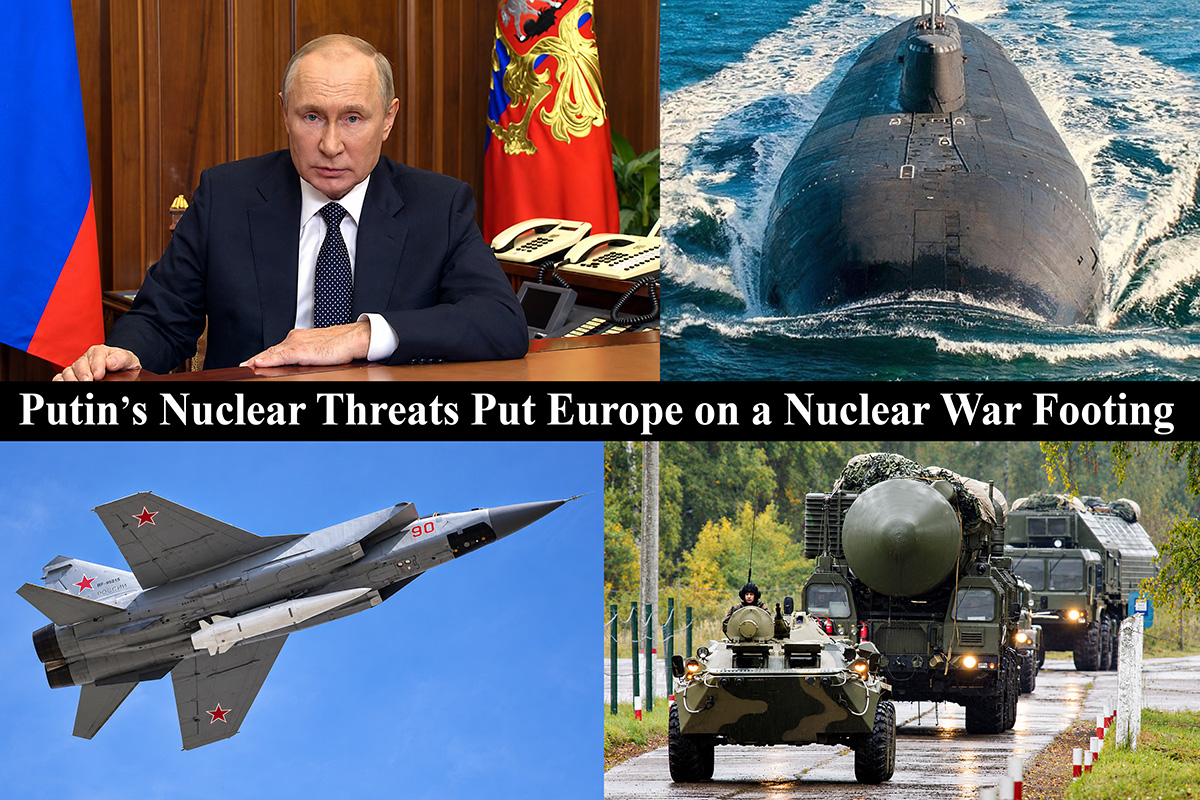
Europe is entering a new and increasingly dangerous phase of nuclear deterrence as Russian President Vladimir Putin renews threats against NATO, European governments reconsider their nuclear defense strategies, and military aircraft from 17 allied nations participate in a major nuclear exercise over Italy. The developments are unfolding against the backdrop of Russia’s continuing war against Ukraine, heightened tensions around the Baltic Sea, and growing European concern about the credibility and future of the continent’s nuclear security arrangements.
Although there is no publicly verified evidence that NATO has ordered an emergency deployment of nuclear warheads in preparation for imminent conflict, the changes taking place are significant. France has announced plans to expand its nuclear arsenal and potentially disperse elements of its nuclear-capable air forces across allied European territory. NATO is conducting its annual nuclear deterrence exercise, and Russian nuclear-capable bombers have again appeared over international waters near European airspace. Together, these developments reveal a continent placing renewed emphasis on its ability to deter, survive, and respond to a nuclear crisis.
Russia’s Latest Nuclear Warnings
The immediate escalation in rhetoric emerged in late September and early October, when Russian diplomatic representatives warned NATO against attempts to isolate Kaliningrad, Russia’s heavily militarized Baltic exclave situated between Poland and Lithuania. According to reporting examined by Poland’s Centre for Eastern Studies, Russian officials threatened to use their country’s full military arsenal in response to what Moscow characterized as aggression against the territory. Russian diplomatic missions also warned that NATO decision-making centers could become targets.
On October 1, Putin raised the prospect of nuclear retaliation in connection with a hypothetical attack on Kaliningrad. The warning was conditional, rather than an announcement of an impending strike, but it reinforced a pattern of nuclear signaling that has accompanied Russia’s war against Ukraine. Moscow has repeatedly invoked its nuclear capabilities when discussing Western military assistance to Kyiv, NATO involvement, and threats to Russian territory.
Analysts differ over how to interpret these statements. Some regard them primarily as coercive messaging intended to discourage NATO intervention and create political divisions among European governments. Others emphasize that repeated nuclear threats can themselves create dangerous conditions by increasing uncertainty, normalizing escalation, and making it harder to distinguish strategic intimidation from operational preparation. In either interpretation, the risks extend beyond the battlefield in Ukraine.
NATO Activates Its Annual Nuclear Exercise
On October 13, NATO began Steadfast Noon, its annual nuclear deterrence exercise, hosted this year by Italy and involving 17 allied countries. The exercise is scheduled to continue through October 23 and involves military aircraft, specialized personnel, supporting units, and the procedures necessary to conduct the alliance’s nuclear mission.
NATO officials have emphasized that Steadfast Noon is a regularly scheduled exercise, not a newly ordered response to Russia’s latest warnings. No live nuclear weapons are used. Nevertheless, the timing places one of NATO’s most sensitive military training activities in the middle of an unusually tense period of European security.
For participating air forces, the exercise is about considerably more than flying aircraft. Nuclear missions require highly controlled command structures, rigorous security procedures, dependable communications, coordinated air operations, and the ability to function under extraordinary operational pressure. Training tests whether those elements can operate together across national boundaries without sacrificing the safeguards surrounding nuclear weapons.
Italy’s role as host also highlights the importance of European airbases to NATO’s nuclear posture. Aircraft participating in nuclear-related exercises can include dual-capable platforms designed to perform conventional missions as well as assigned nuclear missions. The presence of such aircraft does not establish that they are carrying nuclear weapons, nor does participation in an exercise indicate authorization to use them.
The Aircraft at the Center of Europe’s Nuclear Defense
Airpower is one of the most visible and politically sensitive elements of nuclear deterrence. NATO’s nuclear-sharing framework relies in part on American nuclear weapons stationed in Europe and aircraft operated by participating allied nations under established political and military arrangements. Nuclear employment would require authorization through the applicable command procedures; allied pilots do not independently decide to launch nuclear attacks.
Historically, European nuclear-sharing missions have involved aircraft such as Germany’s Panavia Tornado and several variants of the F-16 Fighting Falcon. The introduction of the F-35A Lightning II is reshaping this capability. Its advanced sensors, survivability characteristics, and integration into allied command networks give participating air forces a different operational platform for the nuclear mission, although aircraft certification, national assignments, and operational readiness remain distinct requirements.
For aviation planners, the strategic issue is not simply how many aircraft are available. It is whether aircraft, crews, bases, maintenance systems, security organizations, communications networks, and political authorities can function as an integrated system during a crisis. Nuclear deterrence depends partly on an adversary believing that the system will remain credible under pressure.
France Announces a Major Strategic Shift
Perhaps the most consequential European policy change came on March 2, when French President Emmanuel Macron announced a new approach he called “forward deterrence.” Speaking at the Île Longue strategic submarine base, Macron said France would increase the number of nuclear warheads in its arsenal and stop publicly disclosing its stockpile figures.
More significantly for European aviation, Macron outlined the possibility of temporarily deploying elements of France’s strategic air forces to allied countries. The proposal would extend the geographical reach and operational flexibility of France’s airborne deterrent, potentially complicating an adversary’s calculations about where French nuclear-capable forces might operate during a crisis.
France identified Germany, Poland, the Netherlands, Belgium, Greece, Sweden, Denmark, and the United Kingdom as partners in discussions about deeper nuclear deterrence cooperation. The proposal does not transfer control of French nuclear weapons to those governments. Macron explicitly maintained that decisions about French nuclear employment would remain the exclusive responsibility of the French president.
The distinction between a proposed deployment framework and an actual deployment is essential. France has announced a policy under which elements of its strategic air forces could be stationed temporarily on allied territory. That announcement does not, by itself, establish that nuclear-armed aircraft or warheads have already been moved to those countries.
Germany and France Deepen Their Cooperation
In a joint declaration issued the same day, France and Germany announced the creation of a high-level nuclear steering group. The two governments agreed to coordinate discussions involving deterrence doctrine, missile defense, conventional capabilities, and the relationship between French nuclear forces and European security.
The agreement also envisages German conventional participation in French nuclear exercises and cooperation involving early warning, air defense, and long-range strike capabilities. These measures demonstrate how modern nuclear deterrence extends beyond the weapons themselves. Radar networks, satellites, communications systems, conventional aircraft, and missile defenses all influence the survivability and credibility of a nuclear force.
Paris and Berlin stressed that their initiative would complement rather than replace NATO’s nuclear arrangements. That position reflects Europe’s continuing reliance on American extended deterrence, even as European governments explore ways to assume greater responsibility for their own security.
Russian Bombers Return to the Baltic Skies
The aviation dimension became particularly visible on October 16, when Russia reported a flight by Tu-22M3 bombers over neutral waters of the Baltic Sea. Reuters reported that the mission lasted more than four hours and that foreign fighter aircraft accompanied the Russian bombers during portions of the flight.
The Tu-22M3 is a long-range bomber capable of carrying nuclear weapons, although the aircraft’s presence does not establish that nuclear weapons were aboard. Russia described the mission as planned, and such flights are a recurring feature of military aviation activity. Nevertheless, their location and timing give them strategic significance amid the confrontation over Kaliningrad and NATO’s ongoing nuclear exercise.
Military aircraft operating near national airspace boundaries can prompt identification and interception missions by neighboring air forces. These encounters are generally managed through established aviation procedures, but close proximity between opposing military aircraft creates opportunities for miscalculation, particularly when the broader political environment is tense.
A Nuclear Arms Race Without a Declaration?
Europe’s changing nuclear posture is not limited to October’s military activity. Research organizations including the European Council on Foreign Relations, the German Council on Foreign Relations, and the International Crisis Group have examined how Russia’s nuclear signaling, European strategic uncertainty, and the changing transatlantic relationship are influencing deterrence policy.
France’s decision to increase its arsenal, NATO’s continued investment in nuclear-capable aviation, and European discussions about additional deterrence arrangements point toward a long-term reassessment of nuclear security. These developments do not necessarily constitute a coordinated European nuclear buildup, and individual governments have different policies and responsibilities. They do, however, indicate that nuclear weapons are again occupying a central position in European defense planning.
Critics of nuclear deterrence exercises argue that rehearsing nuclear missions can normalize the possibility of nuclear war and perpetuate the dangers associated with maintaining nuclear arsenals. The International Campaign to Abolish Nuclear Weapons has criticized Steadfast Noon on those grounds. NATO, by contrast, argues that credible deterrence and rigorous training reduce the likelihood of an adversary attempting nuclear coercion or attack.
The competing positions reflect a longstanding strategic dilemma: maintaining nuclear capabilities may discourage aggression, while expanding or emphasizing those capabilities can also intensify insecurity and encourage rival military responses. The effectiveness of deterrence ultimately depends on political judgment, credible communication, and avoiding misunderstandings that could lead to uncontrolled escalation.
What Does a Nuclear War Footing Actually Mean?
The expression “nuclear war footing” captures the urgency of Europe’s changing defense environment, but it is not a formal NATO alert classification. It should not be confused with verified evidence that European governments have placed nuclear forces on an emergency launch posture.
There are three separate developments that must be distinguished. First, NATO is conducting a planned exercise involving nuclear mission procedures but no live nuclear weapons. Second, France has announced a significant change in future nuclear deterrence policy, including the potential temporary deployment of strategic air forces to allied territory. Third, Russia continues to employ nuclear threats and nuclear-capable aviation as elements of its military and diplomatic signaling.
None of those developments independently demonstrates that a nuclear exchange is imminent. Taken together, however, they show that the possibility of nuclear confrontation is receiving renewed attention from European political leaders, military commanders, and strategic planners.
The Danger of Miscalculation
One of the most serious risks in a period of heightened nuclear tension is the possibility that routine military activity will be interpreted as preparation for an attack. A bomber patrol, a fighter deployment, an airbase exercise, or an unexpected radar contact may carry different meanings to the forces conducting an operation and those observing it.
For aviation and aerospace defense organizations, this makes disciplined identification procedures, reliable communications, accurate intelligence, and clearly understood command responsibilities especially important. The technical ability to detect and track aircraft must be matched by the institutional ability to interpret their activity correctly.
European governments must also weigh the value of visible deterrence against the possibility of generating additional alarm. A military exercise intended to demonstrate defensive resolve can be portrayed by an adversary as provocative, while an adversary’s own exercises can produce reciprocal concern. Preventing that cycle from becoming a crisis requires restraint as well as preparedness.
Europe’s Nuclear Future Is Being Rewritten
The most significant conclusion from the events of October 2026 is not that Europe has entered an imminent nuclear war. It is that nuclear deterrence, once treated by much of the public as a relatively static inheritance of the Cold War, is becoming an increasingly active subject of military planning and political decision-making.
Russian nuclear threats, NATO’s airborne nuclear mission, France’s proposed forward deterrence framework, and the renewed visibility of strategic aircraft over European waters all point toward a continent adjusting to a more dangerous security environment.
For the aviation community, these developments reinforce the central role of military airpower in strategic deterrence—and the extraordinary consequences of error when aircraft, weapons systems, and political decisions converge. Europe’s challenge is to maintain credible defenses without allowing heightened readiness, ambiguous signals, or miscalculation to turn deterrence into the very conflict it is intended to prevent.
Sources and Further Reading
Associated Press. (2026, March 2). Inside Macron’s new deterrence strategy: Eight European allies, one French nuclear button.
Atlantic Council. (2026). What Macron’s changes to French nuclear policy mean for European security.
Brookings Institution. (2026, October 7). Why Putin is again rattling the nuclear saber.
Carnegie Endowment for International Peace. (2026). Belligerent and beleaguered: Russia after the war with Ukraine.
Centre for Eastern Studies (OSW). (2026, October 7). Russia’s campaign of deterrence and intimidation.
European Council on Foreign Relations. (2026). The bear with the bomb: Russian nuclear coercion and the future of European deterrence.
French Presidency. (2026, March 2). Visit to the Île Longue operational base.
French Presidency. (2026, March 2). Joint declaration of President Macron and Chancellor Merz.
German Council on Foreign Relations. (2026). Russia’s nuclear signaling in 2026 and implications for European security.
International Campaign to Abolish Nuclear Weapons. (2026, October). NATO begins its annual practice to fight a nuclear war while others use missiles to send a similar message.
International Crisis Group. (2026, October). The changing role of nuclear weapons in Europe.
Reuters. (2026, October 16). Russia says strategic bombers made planned flight over Baltic Sea, Interfax reports.
Stimson Center. (2024). More pillars needed: Ten options for Europe to improve NATO’s nuclear deterrence.
ANSA. (2026, October 8). NATO says Steadfast Noon in Italy is a nuclear exercise.