


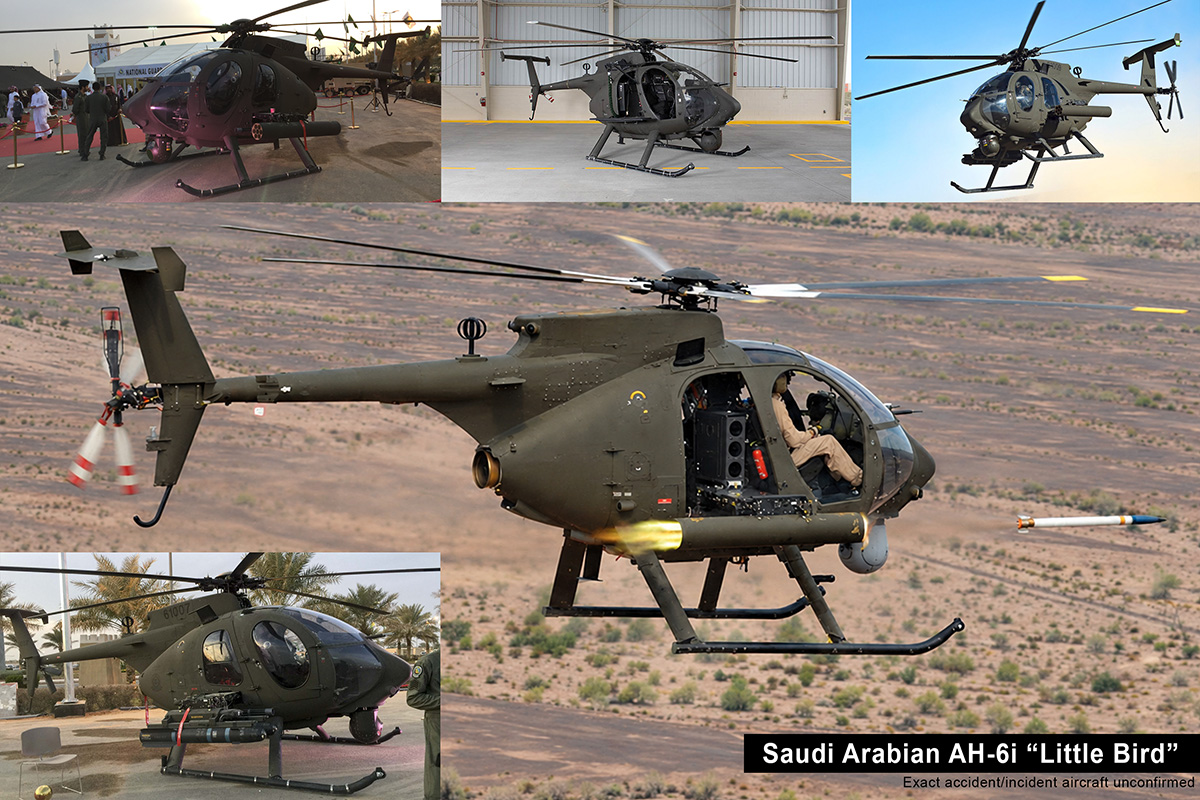
Two Saudi Arabian National Guard officers were killed when their Boeing AH-6i light reconnaissance and attack helicopter crashed in the Najran region of southwestern Saudi Arabia on October 18, 2026. Saudi coalition spokesman Major General Turki Al-Maliki attributed the accident to a technical malfunction, identifying the aircraft as belonging to the Ministry of National Guard. The statement did not disclose the aircraft’s military serial number, the identities of the deceased officers, the exact crash location, or the nature of the reported malfunction. Those omissions leave important questions unanswered about the loss of an aircraft type that has received comparatively little public attention despite its sophisticated military capabilities.
The accident occurred against a background of renewed military activity along the Saudi–Yemeni frontier. Houthi forces separately claimed to have shot down a Saudi Apache attack helicopter near Najran, but the coalition identified its lost aircraft as an AH-6i rather than an AH-64 Apache. These are fundamentally different aircraft. Associated Press also reported that Al-Maliki indicated the AH-6i had not entered the conflict. There is currently insufficient independently verified evidence to establish that the Houthi claim and the Saudi announcement concern the same incident. The reported technical malfunction remains an official explanation rather than a publicly demonstrated investigative finding.
From the Hughes OH-6 to the Boeing AH-6i
The AH-6i’s ancestry reaches back to the Hughes OH-6 Cayuse, the compact observation helicopter developed during the 1960s for the United States Army. The original aircraft became known for its small size, maneuverability, distinctive fuselage, and usefulness in reconnaissance operations. Its fundamental configuration eventually provided the foundation for the broader Hughes 500 and MD Helicopters family, as well as the highly specialized Little Bird aircraft operated by American special operations forces.
The Little Bird’s military evolution demonstrated that a helicopter did not need the size or payload capacity of a conventional attack aircraft to perform valuable tactical missions. Its compact dimensions made it suitable for operations where maneuverability, rapid response, and a relatively small operating footprint were important. Armed versions could support ground forces, while transport-oriented configurations could insert or extract small teams. These advantages were accompanied by limitations inherent in a lightweight, single-engine helicopter, including restricted payload, endurance, and protection compared with heavier combat rotorcraft.
Boeing’s AH-6i program represented an effort to turn that specialized military lineage into a modern, internationally marketable aircraft. Rather than merely offering an older Little Bird with updated instruments, Boeing developed an integrated light attack and reconnaissance system combining a purpose-built military configuration with modern avionics, communications, sensors, and weapons. The international program was formally launched in 2008, with the first AH-6i prototype flying on September 16, 2009, at Boeing’s Mesa, Arizona, facility.
The prototype’s first flight lasted approximately 36 minutes, and Boeing publicly announced the milestone on October 7, 2009. Particularly significant was the adoption of an open-systems avionics architecture associated with Boeing’s Apache development work. The company sought to bring elements of a much larger and more expensive attack helicopter’s mission-system sophistication into a substantially smaller platform. This combination of established rotorcraft architecture and modern electronic integration became central to the AH-6i’s identity.
The Apache Connection
The AH-6i and AH-64 Apache are not interchangeable aircraft, but their developmental relationship is technically important. Boeing incorporated digital cockpit and mission-computer technologies derived from its Apache programs into the smaller helicopter. The resulting aircraft offered an integrated environment for navigation, communications, reconnaissance, and weapons employment rather than relying on a collection of largely independent systems.
Boeing’s production-configuration AH-6i made its first flight in 2014. The company described it as a single-turbine aircraft descended from the OH-6A and developed from the AH-6M used by U.S. Army special operations forces. The production test involved low-speed maneuvers in forward, rearward, and lateral flight. It was an important transition from prototype demonstration toward manufacturing aircraft for international customers.
The modern AH-6 family is designed to support reconnaissance, close air support, armed escort, security operations, and other specialized missions. Depending on configuration and customer requirements, weapons integration can include machine guns, multibarrel guns, 70-millimeter rockets, and precision-guided missiles. Electro-optical and infrared sensors enable observation and targeting under varying lighting conditions. The aircraft’s small size offers operational flexibility, but its mission equipment, weapons, fuel, crew, and environmental conditions all affect the performance margins available during a particular sortie.
Boeing’s published performance figures for the current AH-6 family include a maximum cruise speed of 126 knots, maximum range of 179 nautical miles, maximum endurance of 2.1 hours, and service ceiling of 20,000 feet. These are manufacturer figures for the advertised configuration and should not be treated as the demonstrated performance of a fully armed Saudi AH-6SA operating under specific temperature, altitude, and mission conditions. For military helicopters working in Saudi Arabia’s hot environments, density altitude, available engine power, aircraft weight, and operational planning remain critical considerations.
Saudi Arabia Becomes the Launch Customer
Saudi Arabia’s interest in the AH-6i emerged from a broader effort to modernize the aviation capabilities of its National Guard. Unlike the Royal Saudi Air Force, the Saudi Arabian National Guard has distinct institutional responsibilities involving national security, protection of important facilities, and support of military and internal-security missions. Its aviation modernization required a combination of transport, reconnaissance, and attack capabilities rather than a single helicopter type.
An American foreign military sales proposal announced in 2010 contemplated a much larger aviation acquisition that included AH-6i helicopters, Apache attack helicopters, and Black Hawk utility helicopters. The proposed AH-6i quantity was 36 aircraft. This figure is frequently confused with the subsequent firm procurement, which involved 24 helicopters. Distinguishing proposed sales from contracted and delivered quantities is essential when reconstructing the program’s history.
In April 2014, Boeing received a contract valued at approximately $234.7 million for 24 AH-6i helicopters, along with initial spares and ground-support equipment, for the Saudi Arabian National Guard. The arrangement proceeded through the United States Foreign Military Sales system. Boeing supplied the helicopters to the U.S. government, which in turn sold them to Saudi Arabia. Saudi Arabia became the first international customer for the AH-6i program.
The Saudi-specific aircraft are also referred to as AH-6SA. The designation is significant because it identifies the national configuration rather than a wholly unrelated helicopter model. Published information concerning the AH-6SA and the broader AH-6i family should therefore be compared carefully, particularly where avionics, rotor systems, weapons integration, or later upgrades are concerned. An advertised capability for one configuration does not automatically prove that every aircraft in the Saudi fleet possessed it at a particular date.
A Complex International Production Program
The Saudi contract involved more than a straightforward assembly process at Boeing’s Arizona facility. MD Helicopters supplied airframes and associated kits, while Boeing integrated other components and mission systems to produce the completed helicopters. Contemporary reporting also identified manufacturing activity in Mexico as part of the airframe supply chain. This arrangement reflected the aircraft’s complicated industrial heritage: a design descended from the Hughes and MD Helicopters family being developed and marketed internationally by Boeing.
By June 2016, Boeing was preparing the first Saudi aircraft, serial 61001, for delivery. Contemporary reporting described seven of the 24 ordered helicopters moving through production and noted that the first aircraft was approaching flight testing. Saudi pilots were expected to receive training in the United States, with additional instructional capability supporting operations in Saudi Arabia. The aircraft’s entry into service therefore depended not only on manufacturing but also on acceptance testing, pilot qualification, maintenance training, and establishment of a sustainment system.
One of the most revealing episodes in the AH-6i program was a commercial dispute between Boeing and MD Helicopters. Litigation filed in Arizona in 2017 concerned payments, airframe deliveries, alleged deficiencies, and contractual responsibilities associated with the Saudi program. The public court record establishes that Boeing ultimately assembled 24 AH-6i helicopters using MD Helicopters airframes and kits, together with equipment supplied by Boeing and other companies.
The litigation is significant for aviation historians because it provides an unusually detailed public record of a military aircraft production arrangement. Court documents identify the $234.7 million transaction and discuss disagreements over deliveries and airframe completion. They do not, however, establish that any manufacturing dispute caused the 2026 Najran accident. Drawing such a connection without specific maintenance records, investigative findings, or evidence from the accident aircraft would be unwarranted.
The Saudi Fleet’s Operational Identity
Saudi AH-6SA helicopters have appeared publicly at defense exhibitions and in operational imagery, providing a limited but useful record of individual airframes. Photographic records identify aircraft including 61006, 61007, 61009, and 61024. Some examples have appeared with rocket pods, sensor equipment, and other military fittings. These images confirm the aircraft’s presence in Saudi service and illustrate the versatility of its armed reconnaissance configuration.
Aviation photographic records associate Saudi AH-6i operations with the National Guard’s 1st Aviation Brigade at Khashm Al An near Riyadh and the 2nd Aviation Brigade at Hofuf in eastern Saudi Arabia. Such published unit associations are useful background, but they do not establish the assignment, operating base, or mission of the helicopter lost in Najran. Its presence in the southwestern border region should not be used to infer a specific combat task without supporting evidence.
The Saudi aircraft’s mission capabilities include surveillance and reconnaissance, but the AH-6SA is not merely an unarmed observation helicopter. Its weapons provisions allow it to support ground forces and conduct light attack missions when appropriately equipped. This dual-purpose identity explains why some reports describe the type as a reconnaissance helicopter while others call it a gunship. Neither description, standing alone, establishes the mission or armament carried by the aircraft at the time of the crash.
An Earlier Saudi AH-6SA Loss
The October 2026 accident is not the first documented loss associated with Saudi Arabia’s AH-6SA fleet. In reporting on a later precision-weapons upgrade, Janes stated that 24 aircraft had been delivered and that one had previously been lost in an accident. The report referred to a remaining fleet of 23 aircraft at the time of the upgrade program.
That detail is particularly important because it contradicts any assumption that the Najran crash necessarily represents the Saudi fleet’s first fatal or nonfatal aircraft loss. The earlier incident’s date, location, serial number, circumstances, and consequences require separate verification before a detailed comparison can be made. Nevertheless, the existence of a previously reported loss belongs in any serious account of the aircraft’s Saudi service history.
The Precision-Guided Rocket Upgrade
A second significant chapter in the Saudi program involved precision-guided rockets. In November 2019, Boeing received a contract valued at approximately $10.7 million to integrate the Advanced Precision Kill Weapon System II, commonly known as APKWS II, onto Saudi National Guard AH-6SA helicopters. The system adds laser-guidance capability to compatible 70-millimeter rockets, offering an intermediate precision-attack option between conventional unguided rockets and larger guided missiles.
The integration effort demonstrated that Saudi Arabia’s investment extended beyond the original acquisition. The AH-6SA was being developed as a platform capable of incorporating additional weapons technology over its service life. Subsequent U.S. approval of an APKWS II sale to Saudi Arabia further illustrated the Kingdom’s interest in precision air-to-ground weapons, although the intended host platforms and actual distribution of individual munitions must be distinguished from their theoretical compatibility.
The upgrade also highlights a fundamental feature of modern military aviation: a helicopter’s operational capabilities can change substantially during its service life without any obvious change in its external appearance. Two aircraft of the same type may differ in software, sensors, communications equipment, or approved weapons configurations. That is another reason accident reporting should identify the specific airframe and configuration wherever possible.
A Second International Customer
For years, Saudi Arabia was the defining international customer for Boeing’s AH-6i. Thailand subsequently selected the aircraft to replace its aging Bell AH-1F Cobra helicopters. The U.S. government approved a proposed package for eight AH-6i helicopters in 2019, with associated weapons and support equipment. Boeing announced a $103.7 million production contract in February 2022.
The Thai acquisition broadened the aircraft’s international footprint and demonstrated continued interest in compact, digitally integrated attack helicopters. The proposed weapons package included Hellfire missiles, APKWS rockets, machine guns, and electro-optical/infrared equipment. Production and flight testing in Arizona provided further evidence that the AH-6i remained an active military aircraft program well beyond the original Saudi acquisition.
The Thai program also illustrates why the AH-6i occupies an unusual market position. It offers some of the mission-system and precision-attack features associated with larger helicopters while retaining a smaller airframe and operating footprint. That does not make it a direct replacement for a heavy attack helicopter in every mission, but it provides military operators with an alternative where reconnaissance, rapid response, and lighter attack capabilities are priorities.
What the Najran Accident Does—and Does Not—Tell Us
The October 18 announcement establishes the reported loss of a Saudi National Guard AH-6i and the deaths of its two officers. It also establishes that Saudi officials publicly attributed the crash to a technical malfunction. It does not establish which component or system allegedly malfunctioned, whether the aircraft was maneuvering or cruising, its altitude or airspeed, prevailing weather, crew communications, or the condition of the wreckage.
From an aviation safety perspective, the phrase “technical malfunction” is too broad to constitute a meaningful causal analysis. A helicopter accident investigation would ordinarily examine the powerplant, fuel system, rotor and transmission assemblies, flight controls, aircraft maintenance history, recorded operational information where available, environmental conditions, and evidence of any external damage. The available evidence does not justify selecting any of these possibilities as the cause.
The competing Houthi account presents a separate evidentiary problem. The group reportedly described shooting down an Apache, while the Saudi statement concerned an AH-6i. Without independently authenticated wreckage imagery, matching serial information, a reliable event timeline, or other corroborating evidence, the claims cannot responsibly be merged into a single narrative. Nor does the absence of such evidence prove either account false. The appropriate distinction is between what each party alleges and what independent evidence establishes.
Why the Aircraft’s Serial Number Matters
Military aircraft serial numbers provide a crucial link between historical photographs, production records, unit assignments, maintenance documentation, and accident reports. In the present case, publicly available photographs of Saudi AH-6SA helicopters include identifiable examples such as 61007 and 61009. Neither aircraft has been connected to the Najran accident by the information presently available.
The Boeing demonstrator N106HX, frequently used in illustrative photographs of the AH-6i, presents a different identification problem. It carried an American civil registration associated with Boeing’s development program. Although aircraft destined for foreign military customers may carry American registrations during development or testing, that practice does not establish that a particular demonstrator was subsequently delivered to Saudi Arabia. Published aircraft records identify N106HX as a Boeing-operated AH-6i rather than confirming it as the lost Saudi aircraft.
For aviation publications, the distinction is not cosmetic. Presenting a photograph of an unrelated aircraft as the machine involved in a fatal accident creates a false historical association that can persist in search engines, image databases, and subsequent reporting. Until the Najran helicopter’s serial number is independently established, photographs of other Saudi AH-6SA aircraft should be treated only as type illustrations, with their identities made explicit.
A Small Aircraft With a Significant History
The AH-6i occupies a distinctive position in modern rotorcraft development. It combines a design lineage reaching back to the Vietnam War era with digital mission systems derived in part from the Apache family. Its Saudi acquisition produced an important export program, a complex international manufacturing arrangement, and a later precision-weapons integration effort. Its subsequent selection by Thailand demonstrated that the concept retained international relevance.
The Najran crash now adds another tragic event to that history. Two officers have lost their lives, and the available public record remains insufficient to determine precisely what happened. The aircraft’s serial number, mission, operating conditions, wreckage evidence, and any eventual investigative findings will be essential to a reliable account.
The central lesson for aviation reporting is that aircraft identification, historical context, and causal evidence must remain separate until the facts justify connecting them. The AH-6i deserves technical scrutiny because of its unusual development and operational history. The officers killed in Najran deserve an account that does not substitute speculation for evidence.
ASX News will update this report as additional independently verifiable information becomes available.