


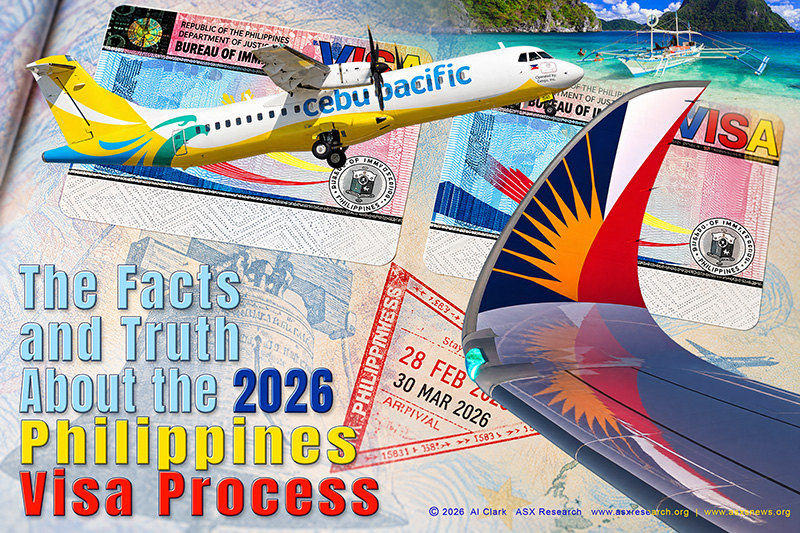
The Philippines welcomes millions of international visitors, retirees, foreign spouses, professionals, and investors. Yet navigating the country’s immigration system can be considerably more complicated than obtaining permission to enter. Visa-free privileges, tourist extensions, permanent residency, retirement programs, and departure requirements operate under different rules administered by several government agencies.
A newly published, 27-page research article by Albert N. Clark in the ASX Research Journal and Database examines the facts behind Philippine immigration procedures as of October 16, 2026. Drawing primarily on official Philippine government sources, the research distinguishes established requirements from outdated advice, commercial interpretations, and widespread misconceptions.
Visa-Free Entry Is Not Universal
Many foreign nationals, including United States citizens, qualify for an initial 30-day visa-free visit to the Philippines. However, eligibility depends on nationality, travel documentation, and applicable immigration restrictions. Some travelers receive different admission periods, while others must obtain a visa before departure.
The research also examines changes affecting qualifying Indian and Chinese nationals, emphasizing that nationality-specific privileges should never be confused with universal immigration policies.
Tourist Visa Extensions and Maximum Stay Limits
Qualifying visitors initially admitted for 30 days may obtain a 29-day visa waiver, extending their authorized stay to approximately 59 days. Additional extensions may be available through the Bureau of Immigration, including its electronic services system.
However, repeated extensions do not establish permanent residence. The Bureau of Immigration identifies ordinary cumulative tourist-stay limits of 36 months for qualifying visa-non-required nationals and 24 months for visa-required nationals, subject to applicable procedures and exceptions.
These limitations are particularly important for foreign nationals intending to pursue marriage-based immigration, retirement residency, employment, or other long-term arrangements.
Electronic Visas and Immigration Extensions Are Different
The Philippine Department of Foreign Affairs administers consular visas and its electronic visa system, while the Bureau of Immigration handles domestic immigration extensions, conversions, and related transactions.
The research identifies an important distinction: Philippine eVisas issued through the Department of Foreign Affairs electronic system are subject to published restrictions on extension and conversion. Travelers should not assume that an electronic visa application and an ordinary tourist extension are interchangeable procedures.
Marriage-Based Permanent Residency Under Section 13(a)
Foreign nationals legally married to Filipino citizens may qualify for immigration under Section 13(a). However, marriage does not automatically grant permanent residence.
The domestic application process ordinarily begins with probationary immigrant status valid for one year. A separate amendment procedure is required to obtain permanent immigrant status.
The article also examines documentary complications involving foreign divorces, previous marriages, apostilles, and immigration applications awaiting administrative approval.
Retirement Visas and the Real Financial Requirements
The Special Resident Retiree’s Visa (SRRV), administered by the Philippine Retirement Authority, provides a separate pathway to long-term residence for qualifying applicants beginning at age 40.
Under the published SRRV Classic framework examined in the research, qualifying pensioners aged 50 or older face a US$15,000 deposit requirement, compared with US$30,000 for nonpensioners. For qualifying applicants aged 40 through 49, the respective deposit amounts are US$25,000 and US$50,000.
Special Courtesy classifications may offer substantially lower deposit requirements to eligible applicants, including certain former Filipino citizens and qualifying retired military or diplomatic personnel. However, these privileges are not universally available.
The research also distinguishes required deposits from processing fees, annual membership charges, and additional documentary expenses.
ACR I-Cards, Annual Reporting, and Departure Clearances
An Alien Certificate of Registration Identity Card, commonly known as an ACR I-Card, does not independently establish permanent residency. Its significance depends on the holder’s underlying immigration classification.
Likewise, Annual Reporting obligations do not apply identically to every foreign national. The Bureau of Immigration’s published guidance distinguishes temporary visitors from categories subject to the annual reporting requirement.
Departure requirements can also surprise long-term visitors. Foreign nationals who have remained in the Philippines for six months or longer under temporary visitor status generally fall within the categories requiring an Emigration Clearance Certificate before departure, subject to the applicable classification and circumstances.
Overstaying, Apostilles, and Government Fees
The research examines the administrative consequences of overstaying, including fines, processing charges, and possible complications involving subsequent immigration applications or departure.
It also explains the difference between authenticating a foreign document and establishing its substantive legal validity. An apostille verifies specified aspects of a public document’s authenticity; it does not automatically establish that a foreign divorce or marriage satisfies every Philippine legal requirement.
Government fees are another source of confusion. Some publicly available immigration schedules contain historical amounts, making it important to distinguish published examples from current transaction-specific assessments.
Separating Immigration Facts From Misconceptions
The article concludes that Philippine immigration is neither universally permissive nor inherently inaccessible. Successful navigation depends on understanding the appropriate visa classification, preparing acceptable documentation, distinguishing the responsibilities of government agencies, and maintaining lawful immigration status.
Commercial visa guides and expatriate experiences may offer useful context, but neither substitutes for the requirements established by the responsible Philippine authorities.
Read the Complete Research Article
The full 27-page publication, “The Facts and Truth About the 2026 Philippines Visa Process,” by Albert N. Clark, was published October 16, 2026, in the ASX Research Journal and Database, ISSN 3068-3351.
The complete article includes detailed discussions of immigration classifications, retirement deposits, marriage-based residency, electronic services, documentary requirements, administrative costs, and a bibliography of government and supporting sources.
The research is available through the ASX Academic Repository and Zenodo as an open-access scholarly publication.
References
Bureau of Immigration. (2025). Bureau of Immigration Citizen’s Charter 2025 (1st ed.).
Bureau of Immigration. (n.d.). Visas; Frequently asked questions; eServices; Immigrant visa by marriage (13A); Permanent resident visa; Annual report; Temporary visitor visa waiver.
Department of Foreign Affairs. (n.d.). Philippine eVisa policy and visa classifications; Authentication Division guidance and documentary requirements.
Philippine Retirement Authority. (n.d.). Special Resident Retiree’s Visa.
Philippine Travel Information System. (n.d.). Frequently asked questions.
Visafoto. (n.d.). Philippines visa guide.